- Warehouse vending machines pay when 75 or more workers share a break room, shifts run 8 to 12 hours and the nearest restaurant is a drive away.
- Warehouses and factories are the second most searched venue type on VendBuddy: 31 operators ran 68 manufacturing searches across 39 ZIP codes since April 2026.
- BLS counted 1,838.5 thousand people employed in warehousing and storage in July 2026.
- Pitch the plant, HR or operations manager. Union sites and big employers may route you through a procurement process or a contract caterer.
- Stock big drinks, hot food from a microwave, protein, salty snacks and cold water. Offer a micro market when a site has 150 or more people on a shift.
Warehouse vending machines are one of the best bets in this business, and the reason is a captive crowd. A few hundred people clock in at the same time, work a 10 hour shift, and have a 30 minute lunch in a break room with no restaurant in walking distance. Whether it works comes down to two things: how many people share that break room, and whether a cafeteria, a caterer or a lunch truck already fills it.
Part of our complete guide: how to find vending machine locations.
Warehouses are the second most searched place on VendBuddy, right after offices. If you want the Georgia-specific version, with county counts and state tax rules, read warehouse vending in Atlanta. For plants that make things rather than store them, see vending machines for manufacturing plants. This guide is the general one.
Warehouses in VendBuddy's own data
Between April 10 and October 4, 2026, 31 operators ran 68 manufacturing searches across 39 ZIP codes in Lead Finder, and another 7 operators ran 11 searches filtered to warehouses. That makes this group the second most searched venue type after offices (VendBuddy’s own Lead Finder data, 2026-10-04). Lead Finder gives manufacturing a base score of 75 out of 100, the third highest of any venue family, because of the shift length and the lack of nearby food.
The workforce behind it is big. The Bureau of Labor Statistics counted 1,838.5 thousand people employed in warehousing and storage in July 2026, with about 23,800 private establishments in the first quarter (BLS, Warehousing and Storage). Factories and plants sit on top of that. Most of these buildings sit in industrial parks outside town, where a lunch run takes the whole break.
Factories add a second, bigger pool. BLS counted 12,652 thousand manufacturing jobs in September 2026, seasonally adjusted and still preliminary (BLS, Manufacturing: NAICS 31-33). Not every one of those jobs sits next to a break room you could serve, but most of them run on a shift clock, and that clock is what sells snacks.
Why warehouse vending machines work: the break-room math
Three things make a warehouse different from an office of the same size.
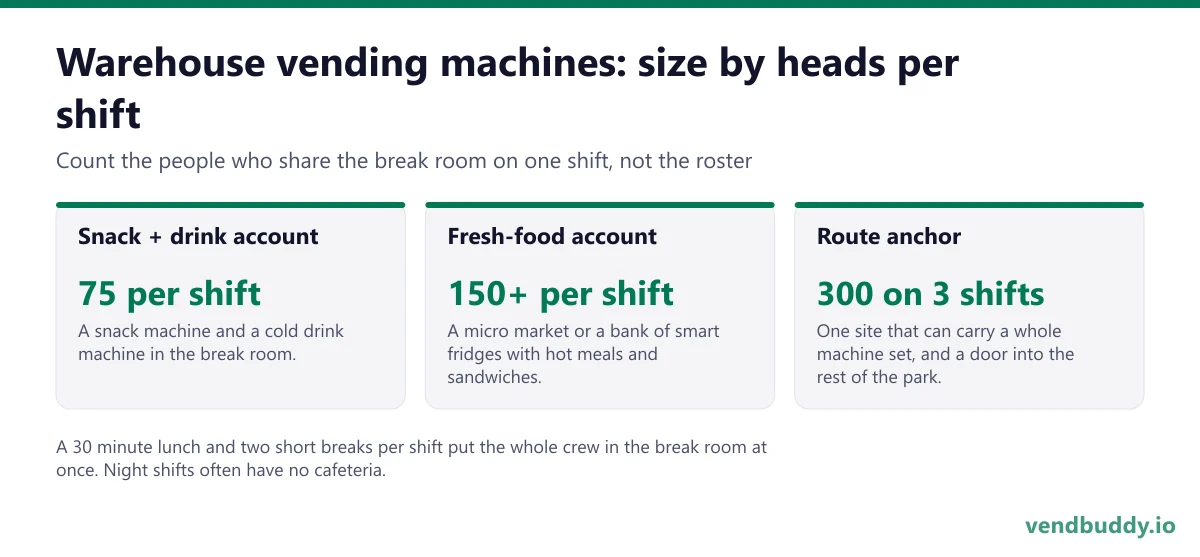
- The breaks are fixed. A 30 minute lunch and two short breaks per shift means the whole crew hits the break room inside the same few minutes. Nobody has time to drive to a drive-thru and back.
- The day is long. A 10 hour shift on your feet burns through a packed lunch. The second break is where the machine earns its keep.
- The building never fully empties. With two or three shifts, the same break room serves three different crowds a day, and the night crowd has no cafeteria at all.
So the number to collect is heads per shift, not heads on the roster. A site with 75 people on one shift is a snack-and-drink account. A site with 150 or more on a shift is a fresh-food account. A site with 300 across three shifts is a route anchor.
Picture the machines paying you while you sleep
That’s the real promise of vending — income that doesn’t cost you your time, and a life on your own terms. VendBuddy turns this guide into a step-by-step plan so you actually build it instead of just reading about it. Start free today.
Start building free →How a warehouse or factory runs
Shifts are the key word. A typical site runs two or three: 6 am to 2 pm, 2 to 10, and sometimes overnight. Each shift has a start break, a 30 minute lunch and a short afternoon break, and the break room fills at the same minute every day. Overnight and weekend shifts are often the best, since no cafeteria is open.
Break rooms often have microwaves, a refrigerator and sometimes a coffee service. People bring lunch, but they forget it, run out of water, or want a 10 am snack. Workers are on their feet, so they drink more than office staff and they want salt, sugar and protein.
Many sites are union shops or run on strict contracts. A union may negotiate the break room, and a machine can be a benefit the union wants to protect or a perk the employer offers. Ask whether the site has a joint committee or a break room committee, because employees' opinions matter.
Check who else is there. A large plant may have a contract caterer with an exclusive on food service. A lunch truck at the gate takes sales at noon. If another vendor is in the building, ask when the contract ends and how the machines look. Slow restocking is the opening.
If you would rather not draft the contract from scratch, we keep a plain-English walkthrough at get vending machine contracts. It covers term, commission, exclusivity and how either side gets out.
Which machine fits a warehouse, and what goes in it
Scale the machine to the shift. A site with 75 workers per shift can take a snack machine and a cold drink machine. At 150 or more on a shift, a micro market or a bank of smart fridges brings in hot meals, sandwiches and packaged lunches with fast checkout. The smart cooler guide covers costs. For the full store version, see how a micro market business works and what it costs. Dust and heat matter too, so ask for a clean, climate-controlled break room, not a dock.
What to stock, and why:
- Big bottled water and sports drinks. Workers sweat, and these sell all shift.
- Energy drinks and canned coffee. The first sold out on the early and night shifts.
- Jerky, protein bars and nut packs. Slow-burn energy for a physical job.
- Heat-and-eat meals and instant noodles. A hot lunch for workers who forgot theirs.
- Chips, crackers and cookies. Salty and sweet for the 3 pm dip.
- Sandwiches and burritos in a fridge. The lunch item with the best margin, if you can rotate them twice a week.
- Gum, pain relievers and earplugs. Small things people forget and will pay for.
Keep prices fair. Workers talk, and a high price on water becomes a break-room story. For snack ideas, see vending machine snacks.
What to look out for before you sign a warehouse
Most bad warehouse accounts were bad on paper before the machine arrived. Check these before you agree to anything:
- Shift coverage. Ask which shifts run, on which days, and whether the headcount drops in the slow season. Many distribution centers staff up hard for the fourth quarter with temp workers and shrink in January. Plan stock for the low month.
- Access hours. Find out when you are allowed in. Some sites only let vendors in on first shift, which means the night machine goes empty by Thursday. Ask for a badge or a set visit window that lets you restock before the busiest shift.
- Safety rules and PPE. Expect a safety orientation, a hi-vis vest, sometimes safety shoes and a walking route that keeps you out of forklift lanes. Never accept a spot on the dock or the floor; a break room keeps the machine clean and you out of traffic.
- Certificate of insurance. Plants and logistics companies almost always ask for a certificate of insurance before install, and many want to be named as additional insured. Get a quote from your insurer before the meeting so you can say yes on the spot.
- Contract terms. Read for the term length, a 30 day out clause on both sides, who approves prices, whether the site wants exclusivity, and whether commission is paid on gross or on net. Commission on gross with a monthly statement is the clean version.
- Permits and tax. You need your local business license and a sales tax permit in most states. Fresh food in a fridge can bring a county health permit; ask the county before you stock sandwiches.
- The incumbent. If a caterer or another operator is already there, find out when the contract ends and what the night shift thinks of it. Empty rows at 2 am are your pitch.
If several of these come back wrong at once, walk away and read our list of the worst vending machine locations. A warehouse with one shift, no night access and a caterer on contract can look big and still sell little.
The warehouse pitch: who decides and how it goes
At a warehouse or plant, the decision usually belongs to the plant manager, the HR manager or the operations manager. A larger employer may have a corporate procurement team and a list of approved vendors. We do not list a fixed set of job titles for this venue in Lead Finder, so ask at the front desk who handles the break room and vendors.
An opener that respects their time:
“I stock break rooms for plants and warehouses nearby. Your people are a long way from lunch, and I’d like to put in a free machine, stocked and fixed by me. Who handles break room vendors?”
The objection: “We have a contract with a food service company.” Ask what hours the caterer covers and whether it serves the night shift. If it does not, offer to cover those hours.
Another objection is safety: “We can’t have vendors on the floor.” Agree, and offer a break room only placement with a documented visit window, a certificate of insurance and a safety orientation.
On money, operators commonly report 5 to 15% of gross sales to the site, and large employers sometimes ask for the higher end or route proceeds to an employee fund. See vending machine commission rates and run the vending ROI calculator before you quote.
On the walk-in, count heads per shift, not the total on the roster. Ask how many shifts run, check the break room size and the power outlets, and ask about safety rules for outside vendors.
Objections you will hear at a plant, and what to say
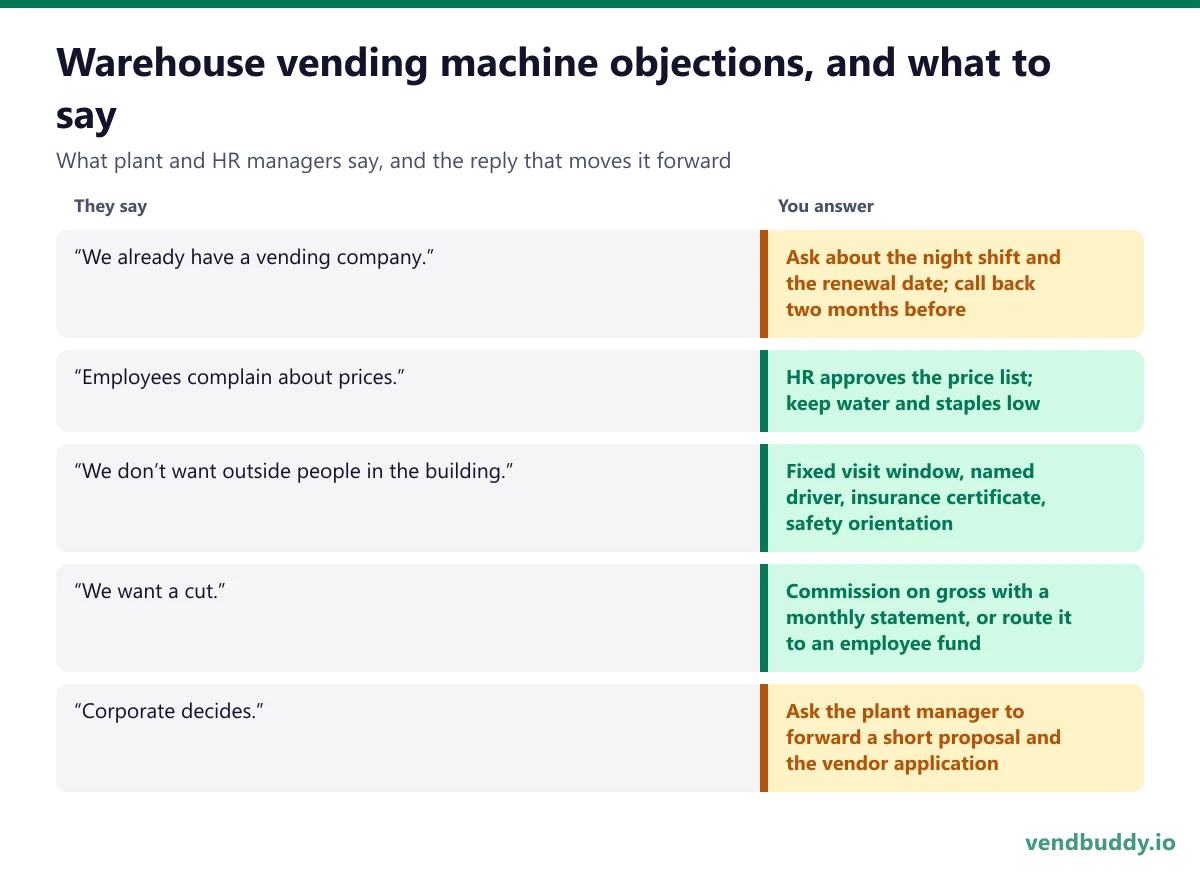
- “We already have a vending company.” Ask how the machines look on the night shift and when the agreement renews. Leave a one-page offer and a date to call back two months before renewal.
- “Employees complain about prices.” Offer to post the price list for HR to approve and keep water and one or two staples at a low price. Workers talk; a fair price list is part of the pitch.
- “We don’t want outside people in the building.” Offer a fixed visit window, a named driver, a certificate of insurance and a safety orientation. You go to the break room and nowhere else.
- “We want a cut.” Fine, on gross, with a monthly statement. If they want it routed to an employee fund or the safety picnic, even better; it makes the machine theirs.
- “Corporate decides.” Ask the plant manager to forward a short proposal to procurement, and ask what the approved-vendor application needs. A local champion moves paper faster than a cold email.
Illustrative example: one distribution center, three shifts
Illustrative example, not a real operator or client. Picture a distribution center with three shifts of about 100 people each, a break room with two microwaves, and no restaurant within ten minutes. The day shift is covered by a lunch truck at noon. The night shift has nothing.
An operator who counts heads per shift sees the opening: the truck already owns the day lunch, so the pitch is the night and the weekend. She proposes a snack machine and a cold drink machine with a card reader, priced with HR, restocked twice a week inside a visit window on first shift, and a 90 day review. Water, energy drinks and jerky carry the night; heat-and-eat meals fill the gap the truck leaves on weekends.
On card readers specifically, Nayax is the default for a dull reason: it is the one most machine suppliers pre-wire for. Price the monthly against your slowest machine, not your best one. Affiliate link, so we may earn a commission at no extra cost to you.
The point of the example is the method, not a sales number: find the shift nobody serves, sell to that shift, and let the numbers from the first 90 days decide whether a fridge or a micro market comes next. Run your own figures in the vending ROI calculator before you quote anything.
How to find warehouses and factories near you
The quickest route: Find warehouses and factories near you in Lead Finder. It lists warehouses, factories and plants around a ZIP with a score and contact where available.
Free alternatives:
- Google Maps. Search “distribution center near me”, “manufacturing plant” and “warehouse”, then switch on satellite view. Big lots with a hundred cars are the targets.
- A drive-by test. Visit an industrial park at shift change, around 2:00 or 2:30 pm, and count the cars leaving.
Lead Finder adds the contact, a score and a radius, which saves a lot of driving in spread-out industrial areas. For the general method, see how to find vending locations.
One plant can fill a route
A single site with 300 people on three shifts can carry a whole machine set, and once you are in, the neighbors in the same park will take your call. Find warehouses and factories near you in Lead Finder, pick the three biggest lots on the map, and call the plant managers on Tuesday morning.
Want to compare warehouses with other high-traffic spots first? Our ranked list of the best vending machine locations in 2026 puts them side by side with hospitals, apartments and offices.
Frequently Asked Questions
Are warehouses good vending machine locations?
Yes, when 75 or more workers share a break room, shifts run 8 to 12 hours and there is no restaurant nearby. The crowd is captive and the break times are predictable. A site with a full cafeteria or an exclusive caterer is harder, so ask before you invest time.
What sells best in a warehouse vending machine?
Water, sports drinks, energy drinks, jerky, protein bars, nuts, chips, crackers and heat-and-eat meals. Workers are on their feet and sweat, so hydration and salty or protein snacks lead. Sandwiches and burritos from a fridge do well if you can restock twice a week.
How much commission does a warehouse or factory expect?
Operators commonly report 5 to 15% of gross sales to the site. Large employers may ask for the higher end or direct proceeds to an employee fund. Some accept a lower percentage for a micro market that includes hot meals. Confirm any contract caterer exclusive first.
Do union rules affect warehouse vending?
They can. A union may negotiate break room conditions, and some sites have a break room committee that weighs in on vendors. Ask the HR or plant manager whether a committee or labor agreement covers the break room before you sign.
How many workers does a warehouse need for a vending machine?
Count heads per shift, not the total roster. Around 75 people on a shift can carry a snack machine and a cold drink machine. At 150 or more on a shift, a micro market or smart fridges with fresh food start to make sense. A site with 300 people across three shifts can anchor a route.
What insurance do I need for a warehouse vending placement?
Most plants and logistics companies ask for a certificate of insurance showing general liability before install, and many ask to be named as additional insured. Get the quote from your insurer before the meeting so you can answer on the spot.
Can I restock a warehouse vending machine at night?
Only if the site gives you access. Many warehouses limit vendors to first shift, so ask for a badge or a fixed visit window. If you can only come in by day, stock heavier before the weekend so the night shift does not find empty rows.
What is selling, which buildings say yes, and the numbers before you buy a machine. Free, confirm from your inbox, unsubscribe in one click. Refer one friend and get 25 VendBuddy credits.
Every operator we talk to wants fewer cold calls. The ones who get there have a Google Business Profile and a simple site a manager can check before replying. AI builders make that an evening job now. Wix is the mature site builder; Base44 also builds working tools like a quote form. Start with the AI website walkthrough or Wix vs Base44.
General information, not legal, tax or financial advice. Rules change, so check the official source. Revenue and income figures are examples, not promises. See our terms.