- The lowest maintenance vending machines are mechanical bulk candy units and non-refrigerated spiral snack machines, because they have no compressor and few parts that can fail.
- Refrigeration drives cost: a compressor repair runs roughly $450 to $1,050 installed, and EPA Section 608 requires certified technicians for refrigerant work.
- ENERGY STAR says certified refrigerated beverage machines are about 9% more efficient and save about 1,000 kWh a year, worth about $145 at the EIA's July 2026 commercial average of 14.53 cents per kWh.
- Royal Vendors warrants refrigeration and vend motors for 5 years and boards for 3; AMS's Sensit 3 manual gives 3 years on refrigeration and boards; Seaga gives 1 year. Labor is excluded or not covered.
- AI coolers remove spirals but add locks, cameras, modems and software; frozen machines carry the highest energy and repair exposure.
The lowest maintenance vending machines are non-refrigerated spiral snack machines, followed by mechanical bulk candy heads, which have almost nothing that can break. Once a compressor is involved, maintenance cost goes up, and it goes up again with glass fronts, cameras and freezers. Refrigeration is the biggest variable in both repairs and power: ENERGY STAR says certified refrigerated beverage machines use about 9% less energy and save roughly 1,000 kWh a year compared with standard models.
Part of our complete guide: how much does a vending machine cost.
This page ranks machine types by how much they cost to keep running and explains why. If a machine has already broken and you want a price for the fix, go to our vending machine repair cost guide. If you want the routine that prevents most of these failures, use the preventive maintenance checklist.
Which vending machines have the lowest maintenance costs?
Ranked from least to most maintenance, by the number and cost of the parts that can fail:
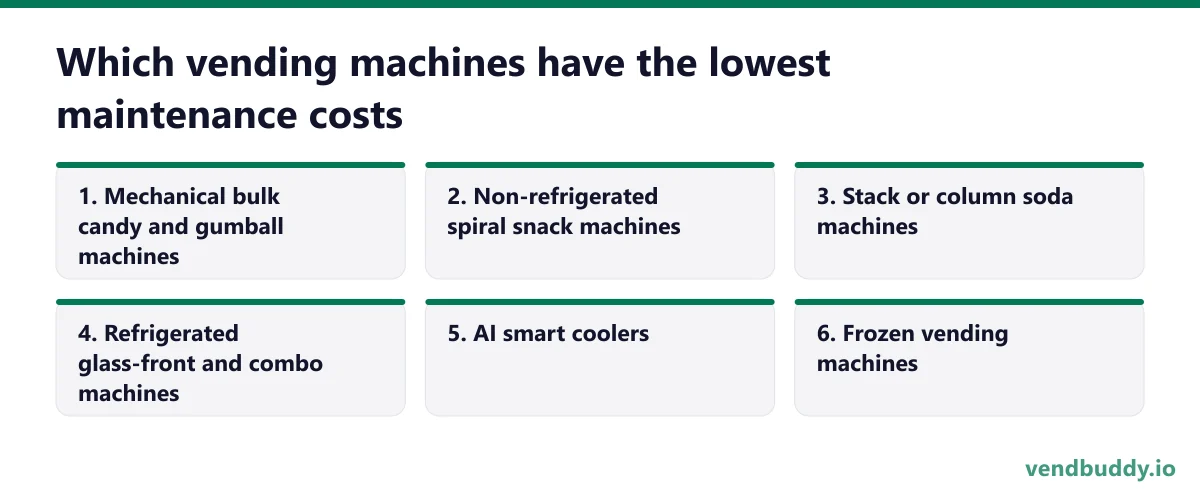
- Mechanical bulk candy and gumball machines. No power, no electronics, no refrigeration. The only moving parts are a coin mechanism and a dispensing wheel.
- Non-refrigerated spiral snack machines. Motors, spirals, a control board, lights, and a payment system. No compressor, and power use in the range of a lamp.
- Stack or column soda machines. Refrigerated, but the vend mechanism is simple: cans and bottles drop out of gravity-fed columns. Built for heavy, repetitive use.
- Refrigerated glass-front and combo machines. A compressor plus spirals or an elevator, a big glass door to seal, and more lighting.
- AI smart coolers. Few mechanical parts, but a compressor, a smart lock, cameras or weight sensors, a cellular modem, and software that has to stay supported.
- Frozen vending machines. A freezer-grade refrigeration system working against a larger temperature difference, often with a vend elevator, and frost to manage.
Two facts from manufacturers show how much refrigeration shapes cost. Royal Vendors, which makes refrigerated stack and glass-front machines, warrants its refrigeration system and vend motors for five years but excludes labor from warranty coverage. And federal rules under EPA Section 608 require technicians who service equipment that could release ozone-depleting refrigerants to be certified, which is why most compressor work is a paid service call, not a DIY fix.
Why non-refrigerated spiral snack machines need the least maintenance
A non-refrigerated snack machine is a steel cabinet with a row of small DC motors, one spiral per selection, a control board and a payment system. That is the whole list, and every part on it is cheap and easy to replace.
- Motors and spirals are modular. One failed motor takes out one selection, not the machine. Our repair guide prices a replacement motor at roughly $15 to $40 and a spiral at roughly $25 to $80, with most swaps done in under half an hour without special tools.
- No refrigerant, no certification. There is no sealed system to leak, no condenser to clog, and nothing that legally needs a certified technician.
- Tiny power draw. Lighting and a control board, which matters because heat and constant cycling are what wear out refrigerated parts.
- Long useful life. Our vending machine lifespan guide puts ambient snack machines at 15 to 20 or more years, because almost nothing on them wears out beyond coils and payment hardware.
The trade-off is revenue. A snack-only machine cannot sell cold drinks, which are often the best sellers at a location. Many operators pair a snack machine with a separate drink machine instead of buying one combo, so a compressor failure only takes out half the offer.
Picture the machines paying you while you sleep
That’s the real promise of vending — income that doesn’t cost you your time, and a life on your own terms. VendBuddy turns this guide into a step-by-step plan so you actually build it instead of just reading about it. Start free today.
Start building free →Refrigerated, AI and frozen vending machines: where the maintenance cost comes from
Every refrigerated vending machine adds the same set of parts: a compressor, a condenser and evaporator, fan motors, a thermostat or temperature controller, door seals, and refrigerant lines. Those parts fail more slowly than a spiral motor, but they cost much more when they do. What changes from one refrigerated machine type to another is what sits on top of that system.
Stack or column soda machines
Refrigeration plus a mechanical column vend. There are very few selections, the product falls by gravity, and the design has been refined over decades. Once you have the refrigeration system in good shape, stack machines tend to be among the easiest refrigerated machines to keep running.
Refrigerated glass-front machines
A large glass door lets in more heat than a solid front, so the compressor runs more often. Door gaskets, spirals or a vend elevator, and delivery sensors all add parts. More parts, more service calls.
AI smart coolers
No spirals, which removes the most common vending repair. In their place: an electronic lock, cameras or shelf weight sensors, a touchscreen or tablet, and a constant cellular connection. When those fail, the machine stops selling entirely, and fixes often depend on the vendor's support team and software updates. Our lifespan guide puts smart machines at about 7 to 10 years, because the electronics age faster than the cabinet.
Frozen vending machines
Keeping product at freezing temperatures makes the refrigeration system work harder than it does in a drink machine, and frost build-up has to be managed. Some frozen machines also use an elevator or robotic arm to deliver product, which adds moving parts. Expect frozen to have the highest energy and maintenance costs per machine.
The vending machine components that fail and cost money
Five parts account for most vending maintenance spending. The cost ranges below come from our repair cost guide and are estimates, not quotes. Card reader prices come from vendor stores.
- Compressor. The most expensive single repair: roughly $300 to $800 for the part plus $150 to $250 labor. Only refrigerated machines have one. Most compressors fail early because of a clogged condenser, not old age. Details are in our compressor replacement cost guide.
- Bill validator. Roughly $200 to $400 to replace. It is the part most likely to cause lost sales without anyone noticing, because a validator that rejects $20 bills still takes $1s.
- Coin mechanism. Roughly $150 to $300, and often fixable with cleaning.
- Spiral motors. Roughly $15 to $40 each. They are the most common failure but the cheapest.
- Card reader. A new Nayax VPOS Touch lists at $399 for one to four units on the Nayax US store, with a 12-month limited warranty. Readers also carry a monthly fee, so they are a running cost even when they work.
Control boards are the wildcard. Our repair guide puts them at roughly $400 to $1,200, and at the high end a board failure on an old machine is usually the point where you replace the machine instead.
Vending machine energy costs by type, using ENERGY STAR data
Power is a maintenance cost too, even when the location pays the bill, because a machine that uses less energy runs its compressor less and wears it out more slowly.
ENERGY STAR sets a maximum daily energy use for certified refrigerated beverage vending machines based on refrigerated volume. For a fully cooled (Class A) machine, the key product criteria formula is 0.0523 times the refrigerated volume in cubic feet, plus 2.432 kWh per day. Certified machines also need a low-power mode that can turn off lights and let the average beverage temperature rise to 40°F or higher during long quiet periods, then return to normal on their own.
To put that in dollars, the U.S. Energy Information Administration reports an average commercial electricity price of 14.53 cents per kWh for July 2026 (EIA Electric Power Monthly, Table 5.6.A). At that rate:
- The roughly 1,000 kWh a year ENERGY STAR says a certified machine saves is worth about $145 a year.
- An illustrative Class A machine with 20 cubic feet of refrigerated volume would have an ENERGY STAR cap of about 3.5 kWh a day, or around 1,270 kWh and $185 a year.
- A non-refrigerated snack machine drawing the 0.5 to 1 kWh a day in our electricity guide would cost roughly $27 to $53 a year.
Your local rate can be well above or below the national average, so use your own utility's number for a real budget.
Manufacturer warranty terms that change your maintenance cost
A long warranty on the expensive parts lowers your maintenance cost for the first years. Read what is covered, because the headline number rarely covers everything. Here is what three manufacturers publish.
| Manufacturer | Refrigeration | Boards and electronics | Everything else | Notable exclusions |
|---|---|---|---|---|
| Royal Vendors (vendors) | 5 years; vend motors also 5 years | Control boards and displays 3 years; LED lighting 3 years | 1 year | Labor excluded; fluorescent bulbs and finish excluded |
| AMS (Sensit 3 manual) | 3 years on the refrigeration unit | 3 years on the control board and the two sensor boards | 1 year from shipment | Labor excluded; bulbs, glass and paint excluded; must be maintained per the manual |
| Seaga | 1 year from shipment on Seaga-made products | Normal wear of moving parts and improper maintenance excluded; parts made by others fall under their makers' warranties; written notice within 30 days of failure | ||
Sources: Royal Vendors, AMS Sensit 3 operation manual, Seaga terms and warranty. Warranties go to the original purchaser, so a used machine usually has none, and the AMS terms come from a manual that may be older than current production.
Three things hold across all of them. Labor is your cost even when the part is free. Warranties require you to have followed the maintenance instructions, so a compressor that failed behind a clogged condenser may not be covered. And payment devices such as bill validators and card readers are often made by other companies, so their warranty comes from that maker.
On card readers specifically, Nayax is the default for a dull reason: it is the one most machine suppliers pre-wire for. Price the monthly against your slowest machine, not your best one. Affiliate link, so we may earn a commission at no extra cost to you.
Vending machine maintenance cost comparison by machine type
This table pulls the pieces together. Energy figures use the daily draw ranges in our electricity guide at the EIA's July 2026 commercial average of 14.53 cents per kWh. Repair budgets come from our repair cost guide where it gives them. All numbers are estimates for planning, not quotes.
| Machine type | Main failure points | Most expensive likely repair | Estimated energy per year | Estimated repair budget |
|---|---|---|---|---|
| Mechanical bulk candy | Coin mech, dispensing wheel | Coin mech | $0 | Minimal |
| Non-refrigerated spiral snack | Motors, spirals, validator, reader | Control board ($400–$1,200) | About $27–$53 | Lowest of the powered machines |
| Stack soda, newer | Refrigeration, validator, reader | Compressor ($450–$1,050 installed) | About $160–$265 | Low to moderate |
| Used snack and drink combo | Motors, spirals, coin mech, refrigeration | Compressor | About $160–$265 newer; $424–$636 older | $300–$800 a year |
| AI smart cooler | Lock, cameras or sensors, modem, software, refrigeration | Compressor or vision hardware | About $160–$265 | $150–$400 a year hardware, plus downtime |
| Frozen | Freezer system, frost, elevator | Compressor | Highest; varies widely by model | Highest; not well documented |
Where a cell says "lowest", "low to moderate" or "not well documented", we did not find a sourced dollar range and chose not to invent one. The ranking between rows is based on the parts each machine type contains.
How to choose a low-maintenance vending machine
You can cut maintenance costs at the buying stage, before any machine breaks.
- Buy refrigeration only where it earns its keep. If a site mostly wants snacks, a non-refrigerated machine avoids the most expensive failure on the list.
- Split snack and drink at strong sites. Two simpler machines instead of one combo means one failure never takes out the whole offer.
- Check the warranty, not just its length. Look for multi-year cover on the refrigeration system and boards, and budget labor yourself.
- Look for the ENERGY STAR label on refrigerated beverage machines, and a working low-power mode.
- Standardize. Running the same models across a route means one set of spare motors, one validator model and one repair routine.
- Put machines where they sell. A machine that turns over its stock every week gets looked at every week, and small problems get caught early.
The last point is the one people skip. Maintenance cost only matters compared with what a machine earns, and the same repair bill is a rounding error at a busy site and a loss at a quiet one. The VendBuddy location finder shows properties in any ZIP with the best contact on file, so you can place low-maintenance machines where the revenue justifies them.
Frequently Asked Questions
Which vending machines have the lowest maintenance costs?
Mechanical bulk candy machines and non-refrigerated spiral snack machines have the lowest maintenance costs. Neither has a compressor, which is the most expensive part to repair, and snack machine motors and spirals are cheap, modular parts you can swap yourself. Stack soda machines are usually the easiest refrigerated option. Glass-front, AI cooler and frozen machines add more parts that can fail.
How much does it cost to maintain a vending machine?
It depends mostly on whether the machine is refrigerated. Our repair cost guide estimates $300 to $800 a year for a used snack and drink combo and $150 to $400 a year in hardware for an AI smart cooler, while a non-refrigerated snack machine is lower. Energy adds roughly $27 to $53 a year for a snack machine and about $160 to $265 for a newer refrigerated one at the July 2026 US commercial average rate. Treat these as planning estimates, not quotes.
What vending machine part is the most expensive to repair?
The compressor, on refrigerated machines. Our compressor guide puts replacement at roughly $300 to $800 for the part plus $150 to $250 labor. Refrigerant work requires an EPA Section 608 certified technician, so it is rarely a DIY job. Control boards can also reach $400 to $1,200, which is often the point where replacing an old machine makes more sense.
Do vending machine warranties cover labor?
Usually not. Royal Vendors' published warranty specifically excludes labor to diagnose, repair, remove or reinstall parts, and the limited warranty in AMS's Sensit 3 manual excludes the labor of removing and reinstalling a defective part. Seaga covers its own products for one year and sends you to the original maker for components it did not make. Budget technician time even on a machine under warranty.
Are AI smart coolers lower maintenance than traditional vending machines?
They remove spiral motors, the most common vending repair, but add an electronic lock, cameras or weight sensors, a cellular modem and software that has to stay supported. They still have a compressor. When the electronics or connection fail, the machine usually stops selling completely. Our lifespan guide puts smart machines at about 7 to 10 years, shorter than a snack machine.
What is selling, which buildings say yes, and the numbers before you buy a machine. Free, confirm from your inbox, unsubscribe in one click. Refer one friend and get 25 VendBuddy credits.
General information, not legal, tax or financial advice. Rules change, so check the official source. Revenue and income figures are examples, not promises. See our terms.