- Dry snack machine: roughly 0.5–1 kWh a day, about $2–$5 a month. Lighting and a control board, essentially nothing.
- Refrigerated machine, newer: roughly 3–5 kWh a day. Older units run 8–12 kWh a day. Together that is about $15–$60 a month depending on age and local rate.
- The location almost always pays. The draw is too small to meter, which makes it a pitch asset rather than an operating cost.
- Refrigeration is the entire variable. Whether the machine has a compressor matters more than its size, its age or its brand.
- Cheapest fixes if a machine is drawing more than it should: LED conversion, a clean condenser coil, rear clearance, and keeping it out of direct sun.
This question comes from two directions. Operators want to know whether power is a real cost line. Property managers want to know what they are agreeing to before they let a machine into the building. Both deserve a number rather than a shrug, so here are the working figures, where they come from, and how to use them in a placement conversation.
Part of our complete guide: how much do vending machines make.
The working numbers
Refrigeration decides everything. A machine with a compressor is in a different category from one without, and nothing else — brand, cabinet size, age of the payment system — comes close to mattering as much.
| Machine type | Daily draw | Rough monthly cost |
|---|---|---|
| Dry snack machine (LED, no refrigeration) | ~0.5–1 kWh | ~$2–$5 |
| Refrigerated drink or glass-front cooler, newer | ~3–5 kWh | ~$15–$30 |
| Refrigerated machine, older or poorly sited | ~8–12 kWh | ~$35–$60 |
| Bulk candy head | None | $0 |
The arithmetic is simple if you want to run it for your own rate: daily kWh × 30 × your rate per kWh. At 15 cents, an old refrigerated machine at 10 kWh a day is 300 kWh a month and about $45. At 11 cents it is closer to $33. The spread between an efficient new cooler and a tired old one is larger than the spread between one state and another.
Who pays, and why it belongs in your pitch
At the overwhelming majority of placements, the location pays. The machine plugs into their building, the draw is too small to justify submetering, and no property manager wants to administer a monthly power invoice for one appliance.
That makes this a pitch asset rather than a cost line. The objection you actually get in a placement conversation is rarely stated as a number — it is a vague sense that a vending machine must be expensive to run, usually mixed up with a walk-in cooler. Having the real figure ready ends that in one sentence: a snack machine costs the building a few dollars a month, and a drink cooler is comparable to a second office refrigerator. Put it in the agreement so nobody re-opens it in month four; the contracts guide covers where that clause sits.
The exception is a site where you are the tenant of a metered space, or an outdoor installation where an electrician has to run a dedicated GFCI-protected circuit. That install cost is a real negotiation and usually lands on the property — see what an outdoor placement requires.
Picture the machines paying you while you sleep
That’s the real promise of vending — income that doesn’t cost you your time, and a life on your own terms. VendBuddy turns this guide into a step-by-step plan so you actually build it instead of just reading about it. Start free today.
Start building free →If a machine is drawing more than it should
Four causes account for nearly all of it, in order of how often they turn up:
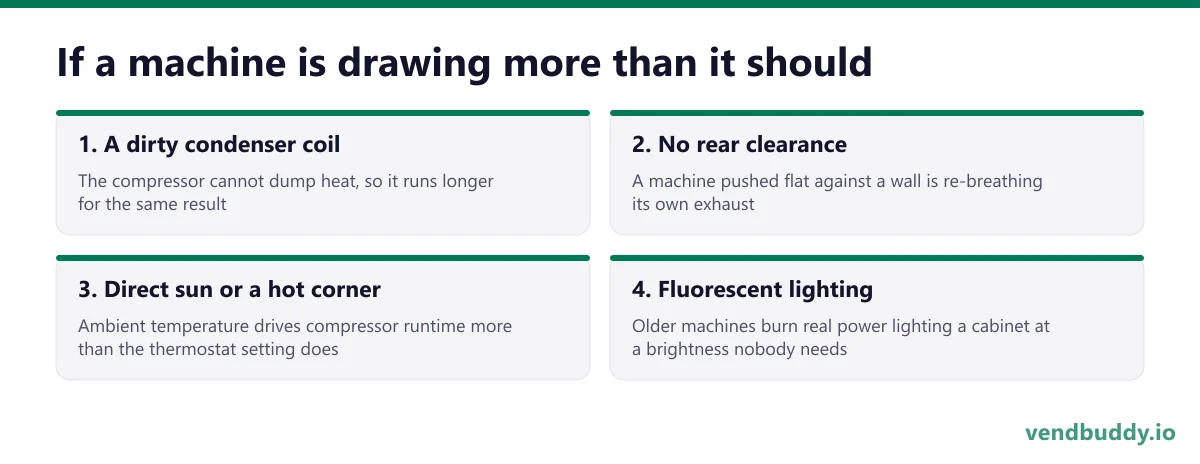
- A dirty condenser coil. The compressor cannot dump heat, so it runs longer for the same result. A brush and a vacuum on a restock visit is a five-minute job and the single highest-return maintenance habit in vending.
- No rear clearance. A machine pushed flat against a wall is re-breathing its own exhaust. Several inches of gap changes the duty cycle measurably.
- Direct sun or a hot corner. Ambient temperature drives compressor runtime more than the thermostat setting does.
- Fluorescent lighting. Older machines burn real power lighting a cabinet at a brightness nobody needs. LED conversion kits are cheap, and delamping the top bank costs nothing at all.
A machine drawing badly is usually also a machine about to have a refrigeration failure, which is the expensive one: compressor work runs $300–$800 in parts plus $150–$250 in labour per the repair cost breakdown. Treat a jump in runtime as an early warning rather than a billing question.
Where power sits in the real cost picture
Honestly: near the bottom. Even at the high end, an old refrigerated machine costs somebody about $60 a month to run, and that somebody is usually not you. Compare that to product cost, commission, fuel and your own time, all of which are laid out in the monthly operating cost breakdown and modelled properly in the full profit breakdown.
The reason to know the number is not budgeting. It is that a property manager asked, and an operator who can answer in specifics sounds like someone who has done this before.
Power is one line. The ROI calculator runs the whole set - product cost, commission, cashless fees, fuel and payback period - against your actual vend prices, so you can see what a placement is worth before you sign it.
Frequently Asked Questions
How much electricity does a vending machine use per month?
A dry snack machine draws roughly 0.5 to 1 kWh a day, which is about $2 to $5 a month at typical US rates. A refrigerated drink machine or glass-front cooler runs a compressor around the clock: roughly 3 to 5 kWh a day for a newer efficient unit and 8 to 12 kWh a day for an older one, which works out to about $15 to $60 a month. At most placements the location pays for that power, which is why it is a negotiation point rather than a line in your budget.
Who pays for the electricity on a vending machine?
In the overwhelming majority of placements, the location does. The machine plugs into their building and the draw is small enough that it is not worth metering. That is also why it belongs in your pitch: the power cost to the property is a few dollars a month for a dry machine and a modest amount for a refrigerated one, which is a much easier number for a property manager to accept than a vague sense that a vending machine is expensive to run.
How many amps does a vending machine draw?
Most single-phase US vending machines run on a standard 115 to 120 volt circuit and are commonly specified for a dedicated 15 or 20 amp outlet. Running draw is far lower than that, but compressor start-up is a brief spike, which is why sharing a circuit with other equipment is the usual cause of nuisance breaker trips. Confirm the plate rating for your specific model and give the machine its own outlet where you can.
Can you reduce a vending machine electricity bill?
Yes, and the two cheapest levers are LED conversion and delamping. Older fluorescent-lit machines spend real power on lighting that customers do not need at full brightness, and LED kits are an inexpensive swap. Beyond that: keep the condenser coil clean, give the machine several inches of rear clearance so it can exhaust heat, and keep it out of direct sun. A dirty coil in a hot corner is the single most common reason a machine draws more than its spec.
Does a vending machine need its own circuit?
It is strongly preferable, and outdoors it is non-negotiable. A shared circuit works until something else on it draws at the same moment the compressor starts, and then you have a machine that is dark until somebody at the property resets a breaker you cannot reach. If a site can only offer a shared outlet, that is worth raising before install day rather than discovering it during your first week of missing sales.
What is selling, which buildings say yes, and the numbers before you buy a machine. Free, confirm from your inbox, unsubscribe in one click. Refer one friend and get 25 VendBuddy credits.
Want the free 38-page Ultimate Vending Guide too? Get the guide
General information, not legal, tax or financial advice. Rules change, so check the official source. Revenue and income figures are examples, not promises. See our terms.