- Roughly $800–$900 a month at a decent location, against about $1,200 gross — leaving around $330 net. Product cost is most of it; everything else combined is $200–$300.
- Electricity is small and usually not yours. A dry snack machine costs $2–$5 a month to run; a refrigerated one $15–$60. At standard placements the location pays it, which is a negotiating point worth using.
- Gross margin after product is 40–55%. Net is 25–30% of gross. The twenty-point gap between those two numbers is this entire article.
- Some costs scale with machine count and some do not. Product and processing are purely variable; insurance, vehicle and software are largely fixed. That asymmetry is why density beats machine count.
- If you modelled your business on gross revenue, you are probably about 30% optimistic — see how vending margin actually works.
Almost every vending calculation you find online stops at gross. A machine does $1,200 a month, product costs half of that, so you make $600 — and then reality arrives with a card processor, a commission cheque, a fuel bill and a failed compressor. This page is the other half of that sum: every recurring cost of owning one machine, with real ranges, built into a monthly table that reconciles to what a solid machine actually nets.
Electricity, and why the answer is usually zero
Start here because it is the most-searched line item and the most misunderstood one.
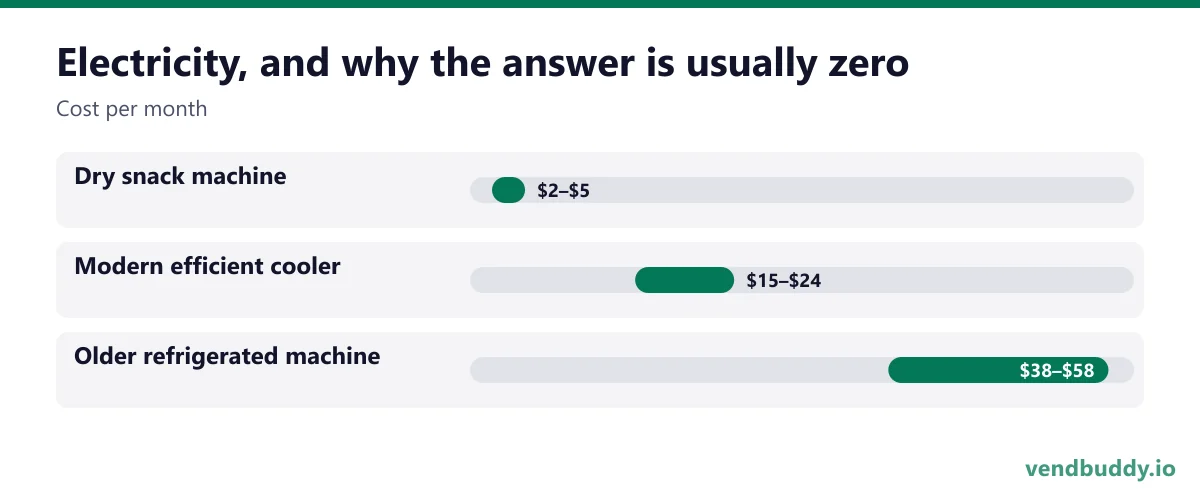
A dry snack machine costs almost nothing to run. There is no compressor. You are powering LED lighting, a control board, a bill validator and a card reader — call it 0.5 to 1 kWh a day. At a US average retail rate somewhere around $0.16 per kWh, that is $2–$5 a month. It is a rounding error and you should stop thinking about it.
A refrigerated machine is a different conversation. A glass-front drink machine or cooler runs a compressor continuously, cycling harder in a warm room or a busy doorway. A newer, well-sealed, efficiency-rated unit lands somewhere around 3–5 kWh a day. An older machine with tired door gaskets and an aging compressor can pull 8–12 kWh a day. Run those through the same rate:
| Machine | kWh per day | kWh per month | Cost per month |
|---|---|---|---|
| Dry snack machine | 0.5–1 | 15–30 | $2–$5 |
| Modern efficient cooler | 3–5 | 90–150 | $15–$24 |
| Older refrigerated machine | 8–12 | 240–360 | $38–$58 |
Now the part that matters commercially: at standard placements the location pays for the power. The machine plugs into their wall, there is no practical way to sub-meter it, and this is the industry norm rather than a concession you have to win. Treat it that way in conversation.
Where it becomes a live issue is with refrigerated equipment at a cost-sensitive site. Asking a small business to absorb $40 a month of electricity is asking for something real, and occasionally a location will notice and push back. If they do, you have two honest moves: put a newer, more efficient machine there, or fold the power cost into the commission conversation. A site charging you for electricity should not also be taking 15%. Commission rates covers how that negotiation normally goes — and this is a legitimate lever inside it.
Worth reading before you sign anything: the contract walkthrough covers which terms get pushed back on and which ones you can safely give away. Commission is rarely the clause that hurts you later.
Product cost, the line that dwarfs everything else
Cost of goods is not one line among many. It is roughly two-thirds of your total monthly spend, and every other item on this page is a rounding error by comparison.
The working number is that gross margin after product cost lands at 40–55%. Where you sit in that band is decided almost entirely by two things: where you buy, and how you price. Buying at a wholesale club is convenient and costs you five to ten points of margin versus a proper distributor once your volume justifies one. Pricing to the location rather than to a habit is worth several more points — a $1.75 item at a captive site that will pay $2.00 is margin you chose to give away.
The reason this line deserves attention out of proportion to its glamour is leverage. Five points of product margin on a $1,200 machine is $60 a month, which is more than your card fees, telemetry and permits combined. Most operators chasing an extra $40 a month go looking for another machine. It is usually cheaper to go looking at your invoice.
Picture the machines paying you while you sleep
That’s the real promise of vending — income that doesn’t cost you your time, and a life on your own terms. VendBuddy turns this guide into a step-by-step plan so you actually build it instead of just reading about it. Start free today.
Start building free →Card processing and cashless fees
Cashless is now most of the volume at most sites, which means processing is a genuine monthly line rather than a footnote. Vending is a hostile case for card fees because the ticket size is tiny — a percentage-plus-fixed-fee structure hurts badly when the transaction is $1.75. Effective rates in vending commonly land in the mid single digits once the fixed portion is spread across small purchases, and some readers add a monthly device or gateway fee on top.
On a $1,200 machine with roughly two-thirds of sales going through the reader, that is somewhere in the region of $40–$55 a month. It is not enormous, but it is permanent, and the details vary meaningfully between providers. What card reader fees actually cost breaks down the structures properly, including the ones where the headline rate is not the number that matters.
Connectivity and telemetry
If your reader reports sales, that connection costs something — typically a small per-machine monthly subscription covering the cellular data and the reporting platform. Budget roughly $8–$20 per machine per month depending on the provider and bundle.
This is the one recurring cost that is almost always worth paying. Telemetry is what turns restocking from guesswork into a plan: you stop driving to machines that do not need service, you stop running out of the two items that actually sell, and you get the data to argue for a price change instead of hoping. On a $1,200 machine, $12 a month is one percent of gross to know what is happening.
Location commission
Commission runs 0–15% of gross sales depending on the site. Plenty of small placements pay nothing at all — the location wants a machine and the amenity is the deal. Competitive sites, larger properties and anywhere a professional operator has already set the expectation will want a percentage, and schools and large employers can sit at the top of that range.
The number to hold in your head is that commission comes out of gross, not net, which makes it far more expensive than it sounds. On a $1,200 machine, 10% is $120 — against a $330 net, that single line is over a third of your profit. This is why an operator will happily take a slightly worse location at 0% over a slightly better one at 15%.
Fuel, vehicle, and the cost of driving
This is the cost most first-year operators leave out entirely, and it is the one that quietly decides whether the business is worth your time.
Service takes 1–2 hours per machine per month in handling terms, but on a loose route with driving included it is closer to two hours per machine per week of your actual life. The fuel and vehicle cost attached to that depends almost entirely on how far apart your machines are. A machine fifteen minutes from three others costs you almost nothing incremental to service. A machine forty minutes out on its own carries the whole trip.
Allocated per machine, budget $25–$60 a month for fuel plus a share of vehicle wear on a normally spread route, and understand that the number moves with geography rather than with sales. This is the mechanism behind route density versus machine count: two machines in one building are dramatically more profitable per hour than two machines twenty miles apart, even when they gross exactly the same.
Repairs and maintenance, reserved monthly
A compressor does not fail every month. It fails once, expensively, on a Friday, at your best location. The honest way to account for that is to reserve for it monthly rather than pretend the months it does not happen are pure profit.
A sensible reserve for a single machine is $35–$60 a month, covering the ordinary run of bill validator jams, coin mech cleaning, door gaskets, LED strips and the occasional real failure. Newer equipment reserves at the low end, an older used machine at the high end — and if you bought a cheap used machine to save money on the way in, this is the line where you pay some of it back. Vending machine repair costs has the part-by-part ranges if you want to build the reserve properly rather than guessing.
Prices move around more than any guide keeps up with. The machine finder is where we keep the current line-up, sorted by what a location that size can realistically support rather than by what looks impressive.
Insurance, permits and licences
These are annual costs that belong in a monthly model, amortised. General liability insurance for a small vending operation is not expensive, and many locations now require you to carry it and name them as additional insured before they will sign — see the vending insurance guide for what coverage actually needs to look like. Business licences, sales tax registration and any per-machine decal or permit sit alongside it.
Allocated to a single machine, expect roughly $20–$35 a month combined. Note that this is the first line on the page that gets cheaper per machine as you grow, because most of it does not increase when you add machines.
Shrink, spoilage and stale product
Every machine loses some product without generating revenue. Items expire on the shelf. A coil misfires and drops two. Something is out of date because a slow month meant it sat too long. Someone rocks the machine or forces the door. On a snack and drink machine, 2–3% of gross is a realistic allowance for all of it combined.
The number is small precisely because shelf-stable product is forgiving. If you are running anything perishable it stops being small very quickly, which is the entire argument in how to start a food vending business.
The worked monthly table for one machine
Here is a single machine at a decent location doing $1,200 a month in gross sales — a solid but entirely ordinary placement, not a trophy site.
| Line item | Monthly | Notes |
|---|---|---|
| Gross sales | $1,200 | Decent location, mixed snack and drink |
| Product cost (COGS) | $600 | 50% — mid-band of the 40–55% margin range |
| Location commission | $60 | 5% of gross; range is 0–15% |
| Card processing | $45 | On roughly two-thirds cashless volume |
| Telemetry / connectivity | $12 | Per-machine data and reporting |
| Electricity | $0 | Location pays; $15–$60 if you absorb it |
| Fuel and vehicle share | $48 | Moves with route density, not with sales |
| Repair reserve | $50 | Averaged, not a monthly bill |
| Insurance (amortised) | $15 | Largely fixed as you add machines |
| Permits and licences (amortised) | $10 | Annual costs spread monthly |
| Shrink, spoilage, stale product | $30 | 2.5% of gross on shelf-stable product |
| Total operating cost | $870 | |
| Net profit | $330 | 27.5% of gross — inside the 25–30% band |
That $330 is the number this site uses whenever it does machine math, and it is not a target — it is a normal outcome at a decent site. The realistic range per machine per month is $150–$400, and the difference between the ends of that range is mostly location quality and how hard you negotiated commission.
Notice what the table does to the intuitive version of the sum. Gross minus product cost is $600. Everything after that removes another $270, which is 45% of what most people call their profit. None of those lines is dramatic on its own. Together they are the difference between a business that works and one that disappoints you.
The free operator guide includes the same line-item model with your own gross, commission and route distance filled in — so you can see net per machine before you sign a location, not after.
Get the free guide →Which of these costs scale, and which do not
This is the section that changes how you think about growth, because the two halves behave completely differently.
Purely variable — scales one-for-one with sales. Product cost, card processing, commission and shrink. Double the machines and these double. There is no economy of scale here beyond better wholesale pricing at volume, which is real but modest.
Largely fixed — barely moves as you add machines. Insurance, your vehicle, route management software, your business licence and registration, and your own baseline admin time. Your general liability policy does not double because you went from three machines to six. This is where scale earns.
Semi-variable — depends on geography, not on count. Fuel and drive time. This is the interesting one, because it does not scale with machines at all — it scales with how spread out they are. Adding a second machine inside a building you already service costs you almost no additional fuel and almost no additional time. Adding one thirty miles away costs you a whole trip.
Put those three together and you get the real reason route density matters more than machine count. Ten machines across four buildings and twelve machines across eleven buildings can produce similar gross and wildly different net per hour of your life. If you are deciding where to put machine number four, this is the calculation to run — density versus count works through it, and the full cost and profit breakdown puts the startup and ongoing numbers side by side.
If you modelled on gross, you are about 30% optimistic
Here is the disqualifier, stated plainly.
The most common way people get vending wrong is not overestimating sales. It is counting product cost, calling the remainder profit, and skipping everything else on this page. That mistake is worth about 45% of the figure they thought was their profit — $600 becomes $330 in the table above — and it does its real damage to the payback period.
Every figure here is an average, and averages hide the building. The revenue calculator lets you plug in the property you are actually looking at and see the range for that type.
An all-in first placement costs $2,000–$4,000 for a used machine with a card reader, initial stock and a move. Call it $3,000. Now run payback both ways:
- The gross-minus-product model: $3,000 ÷ $600 a month = 5 months. This is the number that makes people buy three machines at once.
- The honest model: $3,000 ÷ $330 a month = 9 months. Which is a perfectly good outcome, sits squarely inside the normal 6–12 month payback band, and is nearly twice as long as the first number.
Nine months is a fine business. The problem is not the nine months. The problem is having planned around five, having bought a second machine on the strength of it, and then finding out in month seven that neither is paid off yet and there is a compressor to replace.
It gets worse at a weak site. A machine grossing $700 a month rather than $1,200 does not lose costs proportionally — fuel, insurance, telemetry and the repair reserve barely move. Product falls to $350 and processing to $26, but the fixed and semi-fixed items stay put. Net lands near $130, and payback on the same $3,000 stretches past two years. That is the same machine, the same operator and the same effort, ruined by a location. It is also the single best argument for being ruthless about placement rather than eager — if a site is already underperforming, why a machine is not making money covers the diagnosis before you conclude the business does not work.
So build the table before you buy. Put your own gross in the top row, your actual commission, your real drive distance. If the bottom line does not clear $150 a month, the location is not worth the placement — and knowing that costs you nothing, while finding out afterwards costs you $3,000 and nine months. For the revenue side of the same equation, what vending machines actually make sets the expectations this page is deducting from.
Frequently Asked Questions
How much does it cost to run a vending machine per month?
At a decent location, expect total monthly running costs of roughly $800–$900 against about $1,200 in gross sales, leaving around $330 net. Product cost is the dominant line at 45–55% of sales. Everything else — card processing, telemetry, commission, fuel, a repair reserve, insurance and permits — typically adds up to $200–$300 combined. Electricity is often $0 to you because the location pays it.
How much electricity does a vending machine use?
It depends entirely on whether it refrigerates. A dry snack machine draws almost nothing — LED lighting and a control board, roughly 0.5–1 kWh a day, which is $2–$5 a month at typical US rates. A refrigerated drink machine or glass-front cooler runs a compressor around the clock: roughly 3–5 kWh a day for a newer efficient unit and 8–12 kWh a day for an older one, which is $15–$60 a month. At most placements the location pays for that power.
Who pays for the electricity, the operator or the location?
In standard vending placements the location pays, because the machine plugs into their building and there is no practical way to sub-meter it. That is the norm, not a favour, and you should treat it as such in negotiation. It matters most with refrigerated equipment, where you are asking a location to absorb $15–$60 a month. If a site wants to charge you for power, that is a real cost to model and a reason to push back on commission.
What percentage of vending revenue is profit?
Gross margin after product cost runs 40–55%. Net profit, after every other operating cost, runs 25–30% of gross sales. That gap — roughly 20 points — is where card fees, commission, fuel, repairs, insurance and shrink live. A solid single machine at a decent location nets around $330 a month, within a normal range of $150–$400.
Which vending costs go up when I add more machines?
Product cost and card processing scale essentially one-for-one with sales — double the machines, double those lines. Commission scales too, since it is a percentage. Insurance, your vehicle, software subscriptions and your business licence are largely fixed and get cheaper per machine as you add them. That is why net per machine improves with scale even when net per sale does not.
Why is my vending machine making less than I expected?
The most common reason is that the forecast was built on gross revenue and the costs were never fully counted. If you modelled product cost but skipped processing fees, commission, fuel, a repair reserve, insurance and shrink, you are typically about 30% optimistic on net — which turns a projected six-month payback into nine or more. The second most common reason is that the location simply has less traffic than assumed.
Related: vending profit margin explained, how much vending machines make, the full cost and profit breakdown, card reader fees, commission rates, route density versus machine count, repair costs, and the insurance guide.
What is selling, which buildings say yes, and the numbers before you buy a machine. Free, confirm from your inbox, unsubscribe in one click. Refer one friend and get 25 VendBuddy credits.
General information, not legal, tax or financial advice. Rules change, so check the official source. Revenue and income figures are examples, not promises. See our terms.