- “Food vending” is three different businesses. Fresh food machines, micro markets, and mobile food vending — trucks and carts. Only the first two are route businesses, and only the first two are what this site can help with.
- The compliance surface is genuinely heavier than snack vending. Health department permit, food handler certification, NSF-rated equipment, temperature logging, and in many counties a licensed commissary as the food source.
- Shrink is what kills it. Snacks last 6–12 months; a sandwich lasts 3–5 days. Below about 80% sell-through the margin collapses, and at 50% sell-through you are only just covering product cost.
- The honest verdict: fresh food is the wrong first machine. It is a second or third stage move at a site where a snack machine has already proved the traffic.
- Rules vary enormously by county. Confirm everything with your county health department and state agency — start with what permits vending actually requires.
If you searched for how to start a food vending business, you are probably picturing one of three very different things, and the advice for each contradicts the advice for the other two. So before anything else, this page sorts out which business you actually mean. Then it covers the one this site can genuinely help you with, including the part most guides skip: what fresh food does to your margin when the machine has a slow week.
Three businesses share one phrase
The term covers all of these, and people use it to mean any of them:
- Fresh food vending machines. Refrigerated machines dispensing sandwiches, salads, wraps, yogurt, fruit cups and ready meals. A route business, serviced on a schedule, run alongside a job by most operators.
- Micro markets. An unattended store rather than a machine — open shelving, glass-door coolers, a self-checkout kiosk. Also a route business, larger capital commitment, and the format where fresh food genuinely performs best.
- Mobile food vending. Food trucks, trailers, carts, festival and event concessions. A different industry with a different cost structure, a different regulator relationship and a completely different life.
The first two are the same business you would recognise from starting a vending machine business, with a heavier compliance layer and a much less forgiving product. The third is not.
The honest paragraph about food trucks and carts
Mobile food vending is a legitimate and often excellent business, and plenty of people build real incomes with it. Its genuine advantages over machines are large: you control the product, you can charge restaurant prices rather than convenience prices, a good truck at a good spot can gross more in one lunch service than a snack machine grosses in a month, and you build a brand customers actually recognise and follow. Nothing here is a knock on it.
But it is not a route business, and that difference is the whole point. A food truck is a full-time operating job: you are there for prep, for service, for the breakdown and the clean, and the revenue stops the moment you do. The regulatory load is a different order of magnitude — mobile food unit permits, commissary agreements, fire suppression inspection, health inspections at the truck, event and municipal permits per location. The capital is different, the hours are different, and the skill being tested is cooking and crowd operations, not placement and logistics. If that is the business you want, be aware you are researching a hospitality business, and this site is the wrong resource for it. We are not going to pretend otherwise. Everything below is about machines and markets.
Picture the machines paying you while you sleep
That’s the real promise of vending — income that doesn’t cost you your time, and a life on your own terms. VendBuddy turns this guide into a step-by-step plan so you actually build it instead of just reading about it. Start free today.
Start building free →What actually changes versus snack vending
If you already understand snack and drink vending, fresh food is not a new business so much as the same business with four dials turned up: compliance, spoilage, equipment cost, and required traffic. Take them one at a time.
The compliance surface is genuinely heavier
Snack vending in most places is a business licence, a sales tax registration and occasionally a per-machine sticker or decal. Fresh food generally pulls you under food service regulation, and the list gets longer. What you should expect to encounter, in some combination:
- A health department permit attached to the machine, the location or the operator, often with a plan review before you place anything.
- Food handler or food protection manager certification. Usually a course and an exam, cheap and quick, but a real prerequisite.
- NSF-certified equipment. Health departments generally want the machine itself to carry NSF certification for refrigerated food vending, which is a specification to check before you buy a used unit, not after.
- Temperature control and record keeping. Refrigerated units are commonly required to hold product at or below a set temperature and to shut off sales automatically if the internal temperature stays out of range. Many jurisdictions also want logs you can produce on request.
- A commissary requirement. This is the one that surprises people. In many jurisdictions the food must originate from a licensed commissary or approved food establishment, and you must be able to name it.
- Date marking and labelling on every item — contents, allergens, and a use-by date.
Here is the part that matters more than the list: none of this is uniform. Food service rules are written and enforced at state and county level, and two counties an hour apart can genuinely have different answers on whether your machine needs its own permit, whether the location holds it, and what counts as an approved food source. Anyone who tells you the national requirement for food vending is making it up.
So the correct first phone call is to your county health department, and the second is to your state agency. Ask them specifically: does a refrigerated food vending machine require a permit here, who holds it, is a commissary required, and what certification does the person servicing it need. Twenty minutes on the phone beats a month of reading. Our state-by-state permit overview is a starting map for the conversation, not a substitute for it, and the same caution applies to the general licence and permit guide.
Shrink is the thing that actually kills fresh food
This is the section to read twice, because it is where the business is won or lost and it is almost never shown with numbers.
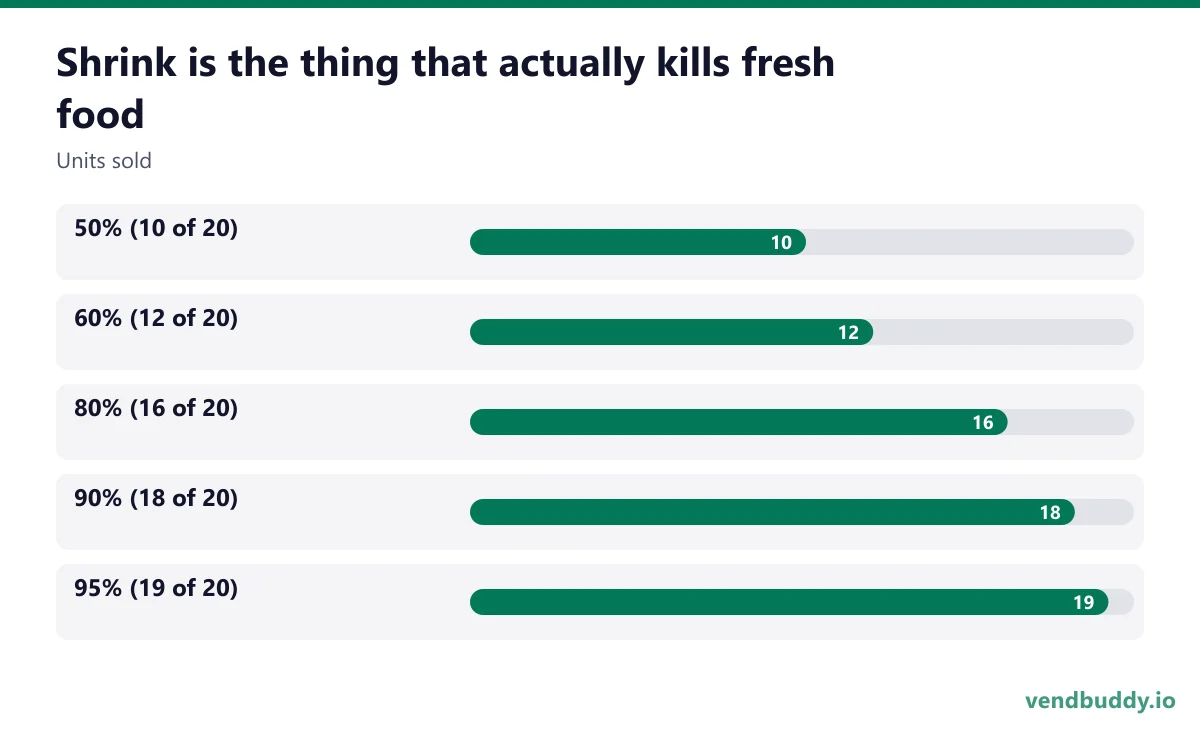
A bag of chips has a six to twelve month shelf life. If it does not sell this week, it sells next month, and the only cost of being wrong is capital sitting in a coil. A sandwich has three to five days. If it does not sell, it is a loss — you paid for it, you carried it, and now you are paying to bin it. Fresh food converts a slow week from a timing problem into a real, permanent cost.
Put numbers on it. Say a sandwich costs you $3.50 from a commissary and sells for $7.00. That reads as a 50% gross margin, comfortably inside the 40–55% band a normal machine earns after product cost. Now stock twenty of them on a four-day cycle and watch what sell-through does:
If the spend is going on plastic anyway, the card choice is worth ten minutes. Most operators we talk to land on the Bilt card, not for what it pays on pallets but because the rent payment earns too. Referral link, and the honest caveat is that a carried balance beats what any of these points are worth. Affiliate link, so we may earn a commission at no extra cost to you.
| Sell-through | Units sold | Revenue | Product cost | Gross profit | Effective margin |
|---|---|---|---|---|---|
| 50% (10 of 20) | 10 | $70.00 | $70.00 | $0.00 | 0% |
| 60% (12 of 20) | 12 | $84.00 | $70.00 | $14.00 | 17% |
| 80% (16 of 20) | 16 | $112.00 | $70.00 | $42.00 | 38% |
| 90% (18 of 20) | 18 | $126.00 | $70.00 | $56.00 | 44% |
| 95% (19 of 20) | 19 | $133.00 | $70.00 | $63.00 | 47% |
Three things fall out of that table.
Fifty percent sell-through is breakeven on product cost alone. Not breakeven on the business — breakeven on the food. Commission, power, fuel, card fees and your own time are all still unpaid at that line. Sell half your sandwiches and you worked the site for nothing.
You need roughly 80–85% sell-through to earn the margin a snack machine earns by default. A snack machine sitting at 40% sell-through in a slow month still books its normal margin on what it sold. Fresh food does not get that grace.
The curve is steep exactly where you have least control. Between 50% and 80% sell-through your effective margin swings from nothing to 38%. That range is decided by weather, holidays, a shift pattern change, a floor being closed for maintenance — things you find out about after the fact. Fresh food gives you a business whose profitability is highly sensitive to variables you do not control and often cannot see coming.
The practical consequence is that fresh food needs materially more traffic than a snack machine, not a little more. A snack machine can survive on modest foot traffic because unsold inventory just waits. Fresh food needs enough daily buyers to clear a perishable par level on a short cycle, which in practice means a captive population with a genuine lunch need — a manufacturing plant with shift changes, a hospital wing, a large office floor with no cafeteria within walking distance. If you are unsure what your site can support, how many people a vending machine needs sets the floor for snacks; assume fresh food wants several times that.
The machine costs more and fails more expensively
Refrigeration changes the equipment maths in three ways at once.
Purchase price. A used combo machine typically runs $1,500–$3,000 and an all-in first placement lands at $2,000–$4,000. A compliant refrigerated fresh food merchandiser sits above that class, and NSF certification plus a working health control system narrows the used market considerably. Budget accordingly and be sceptical of a suspiciously cheap unit — the reason it is cheap is usually the compressor or the controller.
Running cost. A dry snack machine draws almost nothing: LED lighting and a control board. A refrigerated machine runs a compressor around the clock. At most sites the location pays the power, which makes this a negotiating point rather than a line on your books, but it is a real cost you may be asked to absorb at a site that has done its homework.
Failure cost. This is the asymmetry that catches people. When a snack machine fails, you lose sales until you fix it, and the product is fine. When a refrigerated machine loses its compressor, you lose the sales and everything inside it, and depending on how long it sat you may be legally obliged to discard product that looks perfectly good. A compressor repair is not a monthly event, but it is a real number you should be reserving against every month — see what vending repairs actually cost for the ranges.
Where the food comes from, and what each option obliges you to do
There are three realistic sources, and your choice largely determines your licensing picture.
Whichever you pick, confirm it with the health department before you sign anything. An arrangement that is normal in one county is a violation in the next.
If you take the own-prep route and end up producing for several machines or markets, the kitchen side becomes a small manufacturing job: every recipe is a bill of materials, every ingredient is stock you have to reorder before a production day, and every batch needs a date. A spreadsheet holds that for a while. Past a few sites, small-manufacturer software such as MRPeasy plans production runs and tracks ingredient inventory against your recipes. VendBuddy may earn a commission if you sign up through that link.
The operator kits include the location scoring worksheet and the per-site profit model we use to decide whether a placement can carry fresh food at all — before the machine, the permit and the commissary contract are already paid for.
See the operator kits →Why micro markets are usually the better fresh food answer
If your reason for wanting fresh food is that a location asked for real meals, the honest recommendation is often a micro market rather than a fresh food machine. Customers can see and handle the product, which lifts sell-through on exactly the items that spoil. The assortment is wide enough to hedge — if the sandwiches move slowly this week, the drinks, snacks and shelf-stable items still earn. Average ticket is higher because people buy three things instead of one. And you get one refrigeration failure point across a much larger revenue base.
The trade-off is real and you should price it before you get excited: micro markets need a substantially larger captive population, they need floor space the location has to agree to give up, the kiosk and fixtures cost more than a machine, and theft is a live consideration in an open format. Micro markets versus vending machines covers the economics properly, and smart cooler versus micro market covers the middle option — a locked, camera-monitored cooler that handles fresh product with a much smaller footprint and headcount requirement.
The honest verdict: this is not your first machine
Here is the paragraph that will save some readers several thousand dollars.
If you have never placed a machine, fresh food is the wrong place to start, and it is not close. You would be taking on a heavier permit process, a machine that costs more and fails more expensively, a product that punishes every slow week permanently, and a traffic requirement you have no data on — all at once, at a site you have never operated. Every one of those is survivable alone. Together, on a first placement, they are how people conclude that vending does not work.
The disqualifier math is blunt. Fresh food needs roughly 80–85% sell-through on a three to five day cycle to earn a normal margin. To hit that reliably you need to know, not guess, how many people buy from that spot on a Tuesday in February. Nobody knows that about a location they have not operated. Which is why the sequence that works looks like this:
The operators who make fresh food work are almost never first-timers who chose it. They are operators who already had a snack machine at a plant or a hospital, watched it sell out of every substantial item by 11am for six months straight, and added fresh food because the demand was visibly there and measured. That is a very different decision from picking fresh food off a list of business ideas.
If your underlying motivation is that snacks feel unhealthy or unserious, that is a fair instinct and there is a cheaper way to act on it. A better-for-you machine using shelf-stable products — protein bars, nuts, jerky, low-sugar drinks — gets you most of the positioning benefit with none of the spoilage risk, and the product selection guide shows what actually sells in that category. Start there. Earn the traffic data. Then decide whether the cooler is worth it.
Frequently Asked Questions
How do you start a food vending business?
Decide which of the three businesses you actually mean first, because they share almost nothing. Fresh food vending machines and micro markets are route businesses you can run alongside a job; food trucks and carts are full-time operating businesses. If you mean machines, the sequence is: confirm health department requirements for your county, secure a compliant food source, place a snack or drink machine first to measure real traffic, and only add fresh food once the site has proven it.
Do you need a permit to sell food from a vending machine?
Yes, and more of them than for snacks. Refrigerated fresh food generally pulls you under food service regulation, which typically means a health department permit for the machine or the location, a food handler or food manager certification, NSF-certified equipment, temperature records, and in many jurisdictions a licensed commissary as the source of the food. Requirements vary enormously by county, so confirm with your county health department and state agency directly rather than trusting any blog post, including this one.
How profitable is a fresh food vending machine?
It can beat a snack machine on revenue per sale and lose badly on margin, because the whole game is sell-through. A sandwich costing you $3.50 and selling for $7.00 looks like a 50% margin, but a five-day shelf life means unsold units become losses rather than inventory. At 50% sell-through you are exactly at breakeven on product cost alone. You need roughly 80–85% sell-through before fresh food earns the same gross margin a snack machine gets without trying.
You can run break-even on your own numbers in the revenue calculator instead of borrowing ours. It asks for property type and headcount, which is where nearly all of the difference comes from.
Is fresh food vending a good first machine?
For most first-time operators, no. It carries a heavier permit burden, a machine that costs more and fails more expensively, a perishable product that punishes slow weeks, and a traffic requirement well above what a snack machine needs. It is a second or third stage move, best made at a site where a snack machine has already given you months of real sales data proving the traffic is there.
What is the difference between fresh food vending and a micro market?
A machine dispenses one item at a time behind glass; a micro market is an unattended store with open shelving, coolers and a self-checkout kiosk. Fresh food generally works better in the micro market format because customers can see and handle the product, the assortment is wider, and average ticket is higher. The trade-off is that micro markets need a much larger captive population and a location willing to give up floor space.
Can I make the food myself at home?
Almost certainly not for machine sale. Cottage food laws, which allow home production of some items, generally exclude time and temperature controlled foods — which is exactly what sandwiches, salads and refrigerated meals are. In practice you are looking at a licensed commercial or commissary kitchen, or buying finished product from a licensed supplier. Confirm the specifics with your state agency before you buy anything.
Related: micro markets versus vending machines, the healthy vending business, licence and permit requirements, permit requirements by state, smart cooler versus micro market, the best products to stock, how to start a vending machine business, and what repairs actually cost.
What is selling, which buildings say yes, and the numbers before you buy a machine. Free, confirm from your inbox, unsubscribe in one click. Refer one friend and get 25 VendBuddy credits.
Every operator we talk to wants fewer cold calls. The ones who get there have a Google Business Profile and a simple site a manager can check before replying. AI builders make that an evening job now. Wix is the mature site builder; Base44 also builds working tools like a quote form. Start with the AI website walkthrough or Wix vs Base44.
General information, not legal, tax or financial advice. Rules change, so check the official source. Revenue and income figures are examples, not promises. See our terms.