- Vending machines for manufacturing plants work best at the 26,027 U.S. plants with 100+ employees, which employ 8.39 million people, 68% of manufacturing jobs (2023 County Business Patterns).
- In BLS 2024-25 data, 15.3% of manufacturing workers usually worked non-daytime schedules and 5.9% worked nights, versus 3.4% nights for all workers.
- OSHA bars eating or storing food in areas exposed to toxic material, so plant machines go in break rooms, canteens and entrances, never on the floor.
- Industrial PPE vending (Fastenal FASTVend, Grainger KeepStock) is a separate distributor business: OSHA requires employers to pay for required PPE.
- A yes usually takes two owners: the plant or operations manager plus HR, EHS or facilities.
Vending machines for manufacturing plants work because plants concentrate a lot of people on fixed, short breaks, often around the clock and often far from food. The best targets are plants with 100 or more employees, and there are 26,027 of them in the U.S., employing about 8.4 million people. Put machines in break rooms and canteens, never on the production floor, and stock them for every shift, not just days.
Part of our complete guide: how to find vending machine locations.
The numbers come from the U.S. Census Bureau, County Business Patterns 2023. The 2023 County Business Patterns counted 284,452 manufacturing establishments with 12,335,234 employees. Only 26,027 of those establishments (9.1%) had 100 or more employees, but they employed 8,390,423 people, or 68% of all manufacturing jobs. That works out to an average of about 322 employees per large plant. Shift work adds to the appeal: in the Bureau of Labor Statistics’ 2024–25 work schedules data, 15.3% of manufacturing wage and salary workers usually worked a non-daytime schedule, and 5.9% worked nights, versus 3.4% of all workers. And federal sanitation rules decide where the machine goes: OSHA’s 29 CFR 1910.141(g)(2) bars employees from eating or drinking in any area exposed to a toxic material.
Why do manufacturing plants make good vending locations?
A manufacturing plant has the three things a vending route wants in one building: a big headcount, a schedule that keeps people on site, and few alternatives nearby.
- Concentrated headcount. The 26,027 manufacturing establishments with 100+ employees are about 13% of every establishment of that size in the country (200,344 across all industries in the 2023 County Business Patterns). Few other industries put this many workers behind one door.
- Short, fixed breaks. Line workers usually get set break and lunch windows. Leaving the site to buy food on a short break is often impractical, so the break room is where money gets spent.
- Nights and weekends. With manufacturing night work running well above the all-worker rate in BLS data, a plant can have buyers at hours when every nearby store or restaurant is closed.
- Industrial locations. Plants often sit in industrial parks or on the edge of town, where the nearest convenience store may be a drive away.
The catch is volatility. Plants add or cut shifts with orders, and a line shutdown can empty a break room for weeks. Build your route so no single plant is more than you can afford to lose, and put the shift count, not just total headcount, in the agreement conversation.
Where are large manufacturing plants concentrated?
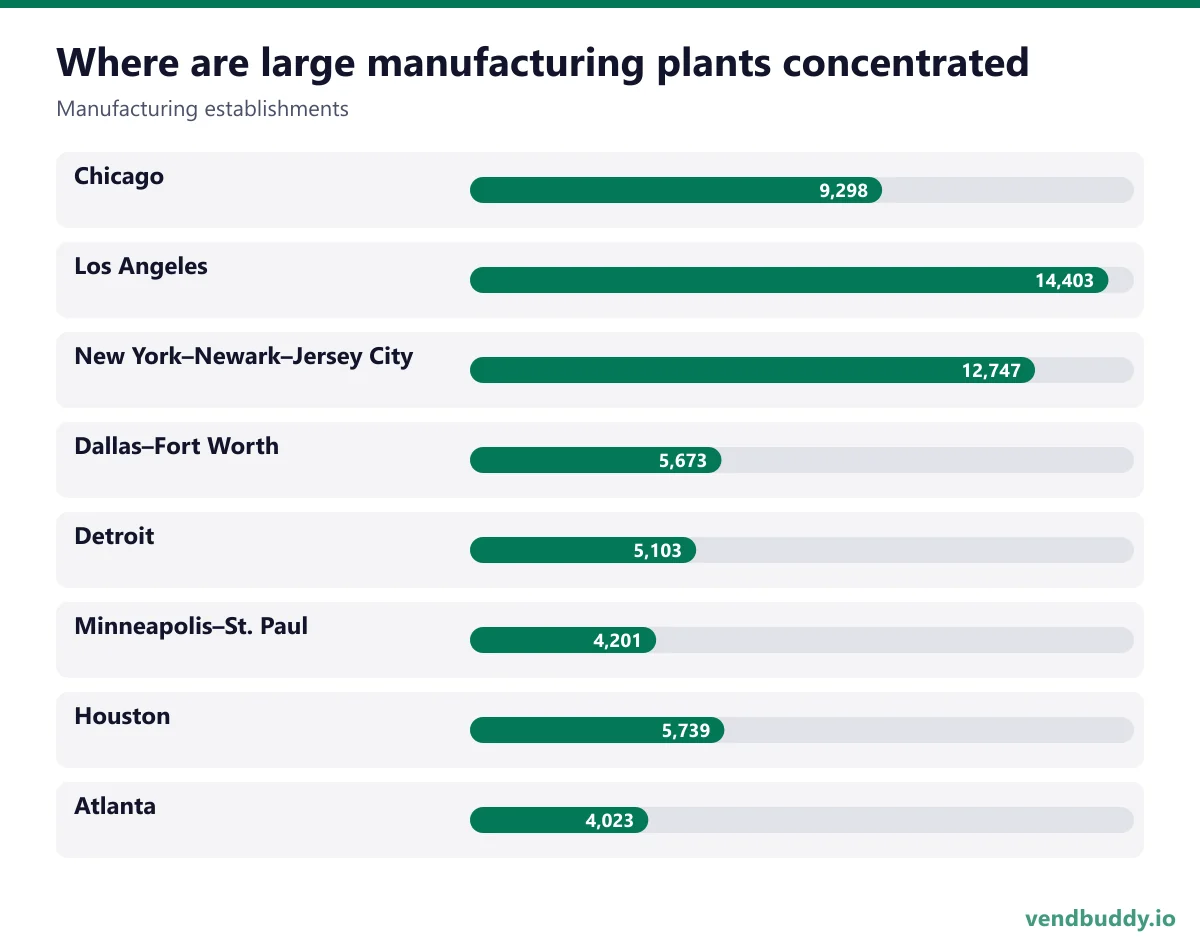
Large plants cluster in a handful of metros. Among the 56 large metro areas we pulled from the 2023 County Business Patterns, these had the most manufacturing establishments with 100 or more employees.
| Metro area (CBSA) | Manufacturing establishments | Manufacturing employees | Establishments with 50+ | Establishments with 100+ |
|---|---|---|---|---|
| Chicago | 9,298 | 370,871 | 1,663 | 854 |
| Los Angeles | 14,403 | 435,021 | 1,692 | 854 |
| New York–Newark–Jersey City | 12,747 | 297,801 | 1,284 | 626 |
| Dallas–Fort Worth | 5,673 | 281,809 | 1,080 | 563 |
| Detroit | 5,103 | 240,214 | 873 | 467 |
| Minneapolis–St. Paul | 4,201 | 201,259 | 807 | 452 |
| Houston | 5,739 | 207,412 | 875 | 446 |
| Atlanta | 4,023 | 163,443 | 699 | 398 |
Two readings matter for an operator. Los Angeles has far more plants than Chicago but the same number of large ones, so the average LA plant is smaller. Detroit and Minneapolis–St. Paul have fewer total plants than New York but a high share of big ones. Census can suppress some size-class cells to protect confidentiality, so treat these counts as a floor rather than a ceiling.
Picture the machines paying you while you sleep
That’s the real promise of vending — income that doesn’t cost you your time, and a life on your own terms. VendBuddy turns this guide into a step-by-step plan so you actually build it instead of just reading about it. Start free today.
Start building free →What should vending machines in a manufacturing plant stock?
Plant stocking starts with where the machine is allowed to be. Under OSHA 1910.141(g)(2) and (g)(4), food and drink may not be consumed or stored in toilet rooms or any area exposed to a toxic material. Food plants have a second rule: FDA’s current good manufacturing practice regulation at 21 CFR 117.10(b)(8) requires eating, drinking, chewing gum and tobacco use to be confined to areas away from exposed food and from where equipment is washed. So machines belong in break rooms, canteens, locker-room corridors and entrances, and the plant will tell you exactly which rooms qualify.
Break room and canteen machines
- Meals, not just snacks. A worker on a 12-hour shift with a 30-minute lunch wants calories: sandwiches, burritos, microwavable bowls, and cups of noodles next to a microwave the plant provides.
- Night-shift breakfast. Overnight crews buy breakfast items and coffee drinks at 4 a.m.; do not stock the night machine like a day machine.
- Hydration. Water, sports drinks and electrolyte drinks sell hard in hot plants and in summer.
- Energy and caffeine. Energy drinks and cold coffee are staples on rotating and night shifts.
Entrance and locker-room machines
Machines near time clocks catch the start and end of each shift: drinks for the drive home, snacks for the first break. Some plants also want a machine selling personal items like earplug refills or lip balm here, but anything the employer must provide for safety is a different matter, covered below.
Ask about glass. Many food and pharmaceutical plants restrict glass and brittle plastic anywhere near production, and some extend that to break rooms, so plan on cans, plastic bottles and cartons.
Vending machine or micro market for a manufacturing plant?
The answer depends on the people on site per shift, not the plant’s total headcount, and on how many break rooms there are. These are operator rules of thumb, not published thresholds.
- Under roughly 75 people per shift: a snack machine and a drink machine, or one combo unit, in the main break room.
- Roughly 75 to 200 per shift: a bank of machines including fresh food, or a compact micro market if the break room has space and the plant is comfortable with an open-shelf format.
- Larger plants: a full micro market in the main canteen, plus machines in satellite break rooms at the far end of the building so workers do not burn half a break walking.
A plant is a closed population with badge access, which tends to keep theft low in open-shelf formats. It also means every worker you serve comes back tomorrow, so bad product rotation or an empty machine on the night shift gets noticed quickly. Our comparison of micro markets vs vending machines has the equipment math.
Is industrial supply and PPE vending the same business as snack vending?
No. Industrial vending machines at plants dispense gloves, safety glasses, earplugs, cutting tools and other supplies, and they are run by industrial distributors as an inventory-control service, not as retail. Fastenal says in its 2025 annual report (Form 10-K) that it introduced industrial vending (FASTVend) in 2008 “to provide our customers with improved product monitoring and control,” and it ended 2025 with 136,638 weighted FASTBin and FASTVend devices installed, with its flagship FAST 5000 device targeted at $2,000 a month in throughput. Grainger runs a similar program under its KeepStock name.
Three differences matter if you are a snack operator:
- Who pays. Under OSHA 29 CFR 1910.132(h)(1), PPE used to comply with OSHA standards must be provided by the employer at no cost to employees. The customer is the plant’s purchasing department, not the worker with a card.
- What you sell. The money is in the supply contract, not the machine. Distributors win by managing thousands of SKUs and billing the plant.
- Who you talk to. Purchasing, maintenance and EHS own PPE vending; HR and facilities usually own the break room.
The overlap is useful, though. When you see a PPE dispenser on a plant tour, you know the plant is comfortable with automated retail and badge-based access.
What safety and access rules apply to vending route drivers at plants?
Expect a manufacturing plant to treat your route driver as a contractor. Rules vary by site and are set by the plant, so ask for them in writing before the first service visit. Common requirements include:
- Badging and sign-in. A contractor badge, a visitor log, or an escort requirement, sometimes with a background check.
- Site safety orientation. A short video or briefing before you can walk anywhere past the lobby.
- PPE for the route. If your path from the dock to the break room crosses production, expect to wear what the plant requires in that zone, such as safety glasses, hearing protection or safety shoes.
- Service windows. Many plants want restocking between breaks, not during them, and some limit dock use to set hours.
- Certificates of insurance. A COI naming the plant, and sometimes proof of workers’ compensation for anyone you send on site.
Plan the service schedule around shift changes. A machine restocked at 2 p.m. and empty by the night shift’s first break fails the people most likely to buy.
Who decides on vending at a manufacturing plant?
The break room has more than one owner in a plant, and a yes usually needs two of them.
- Plant manager or operations manager: final say at single-site companies; cares about break times and downtime.
- HR: sees vending as an employee-retention perk and hears the complaints when the machine is empty.
- EHS (environment, health and safety): signs off on placement, contractor access and anything near production.
- Facilities or maintenance: power, space, and where the machine physically goes.
- Corporate procurement: at multi-plant companies, a regional or national vending contract may already exist, so ask early.
Titles by building type are mapped in our vending decision-maker map, and the warehouse version of this pitch, which shares a lot with plants, is in the warehouse vending playbook.
How to find manufacturing plants in your ZIP
Manufacturing sits in NAICS sectors 31–33. Searching a map for industrial parks and watching the parking lots at shift change tells you which plants run nights. To skip the guesswork, VendBuddy lists businesses by type in any ZIP with the decision-maker contacts, so you can sort plants by size and start with the ones most likely to run multiple shifts.
The fastest way to test this in your own ZIP is the . Search once, see which businesses sit within a few miles, and reveal five contacts for nothing. It will not tell you who says yes, but it saves the afternoon you would spend building the list by hand.
Frequently Asked Questions
Are manufacturing plants good locations for vending machines?
Large plants often are. The 2023 County Business Patterns counts 26,027 manufacturing establishments with 100 or more employees, averaging about 322 employees each. Workers take short, fixed breaks, many plants run evening or night shifts, and plants are often far from food. The main risk is volatility, since shift cuts or line shutdowns can drop sales quickly.
Where can vending machines be placed in a factory?
In break rooms, canteens, locker-room corridors and entrances, never on the production floor. OSHA 29 CFR 1910.141(g) bars eating, drinking and storing food in toilet rooms or any area exposed to a toxic material. Food plants must also confine eating and drinking to areas away from exposed food under FDA rule 21 CFR 117.10(b)(8). The plant's EHS team will specify the approved rooms.
What sells best in vending machines at manufacturing plants?
Meal-sized items sell well because workers on long shifts eat on site: sandwiches, burritos, microwavable bowls and noodle cups. Water, sports and electrolyte drinks move in hot plants, and energy drinks and cold coffee are staples on night and rotating shifts. Stock night-shift machines with breakfast items. Check whether the plant restricts glass before choosing packaging.
Is PPE vending the same as snack vending at a plant?
No. PPE and industrial supply vending is run by distributors such as Fastenal and Grainger as an inventory-control service billed to the plant. OSHA 29 CFR 1910.132(h)(1) requires employers to provide required PPE at no cost to employees, so the buyer is purchasing, not the worker. Snack vending is a retail sale to employees negotiated with HR or facilities.
Who approves a vending machine at a manufacturing plant?
Usually the plant manager or operations manager, with input from HR, EHS and facilities. HR tends to care about the employee perk, EHS about placement and contractor access, and facilities about power and space. At multi-plant companies, check with corporate procurement first, since a regional vending contract may already cover the site.
What is selling, which buildings say yes, and the numbers before you buy a machine. Free, confirm from your inbox, unsubscribe in one click. Refer one friend and get 25 VendBuddy credits.
Walk-ins and cold emails find locations. A small site with your own machine photos and a request-a-machine form lets the next one find you. Around machine three to five, an AI builder drafts it in an evening. Wix is the mature site builder; Base44 also builds working tools like a quote form. Start with the AI website walkthrough or Wix vs Base44.
General information, not legal, tax or financial advice. Rules change, so check the official source. Revenue and income figures are examples, not promises. See our terms.