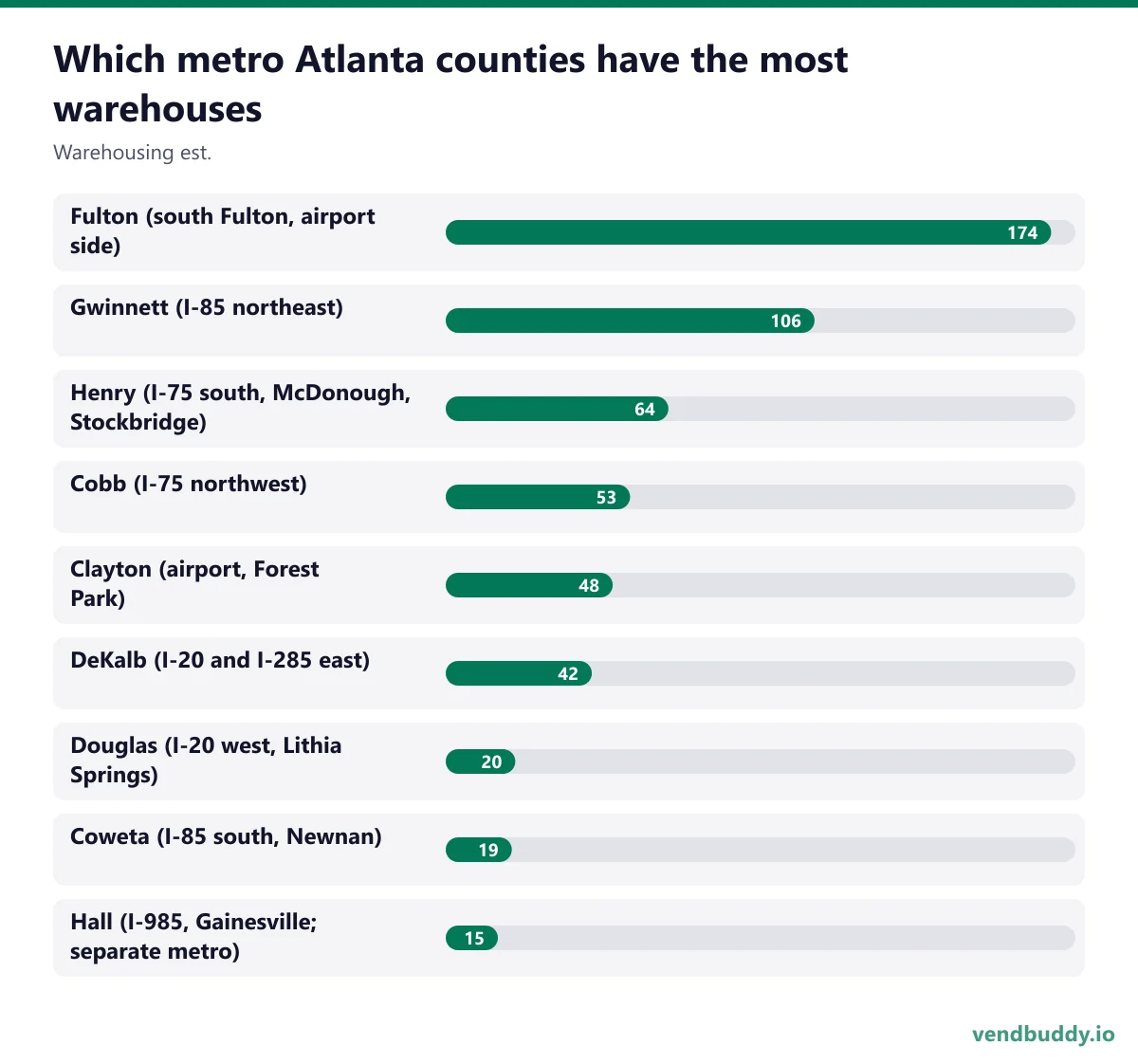
- Warehouse vending in Atlanta starts in Fulton, Gwinnett and Henry: 2023 County Business Patterns counts 602 metro warehouses, 174 with 50+ employees.
- Henry County has the highest share of large buildings: 27 of its 64 warehouses have 50+ employees, averaging about 110 jobs each.
- Georgia exempts prepackaged vending food and packaged beverages from the 4% state sales tax but not local tax; heated vending items such as coffee are fully taxable.
- The Georgia Department of Agriculture says it currently does not license or inspect unattended markets inside controlled-access facilities such as badge-entry warehouses.
- Size the format by headcount per shift, not total staff, and sell to the site manager, HR and EHS together.
Warehouse vending in Atlanta is concentrated in a handful of counties. The U.S. Census Bureau, County Business Patterns 2023 counts 602 warehousing and storage establishments in the metro, 174 of them with 50 or more employees, and Fulton, Gwinnett and Henry hold most of them. Two Georgia rules shape the offer you make to those buildings. Prepackaged food sold from a vending machine is exempt from the 4% state sales tax but not from local tax, under Georgia Department of Revenue Rule 560-12-2-.104. And the Georgia Department of Agriculture says it currently does not license or inspect unattended markets inside controlled-access facilities. This guide works through the county data, shift patterns, who says yes at a distribution center, and the Georgia rules, in that order.
Part of our complete guide: how to find vending machine locations.
Which metro Atlanta counties have the most warehouses?
Metro Atlanta's warehouse base looks huge in total and narrow up close. In 2023 County Business Patterns, the metro's 602 warehousing establishments employed about 67,800 people, and 109 of them had 100 or more workers. Most of that sits in a few counties along I-75, I-85 and I-20 and around the airport. For comparison, the metro also has 4,023 manufacturing establishments, 699 of them with 50+ employees, so plants are a second target list in the same counties.
| County (corridor) | Warehousing est. | With 50+ emp. | With 100+ emp. | Warehousing jobs (approx.) | Manufacturing, 50+ |
|---|---|---|---|---|---|
| Fulton (south Fulton, airport side) | 174 | 57 | 34 | 30,478 | 114 |
| Gwinnett (I-85 northeast) | 106 | 20 | 12 | 6,627 | 119 |
| Henry (I-75 south, McDonough, Stockbridge) | 64 | 27 | 18 | 7,026 | 19 |
| Cobb (I-75 northwest) | 53 | 9 | 4 | ~6,500* | 63 |
| Clayton (airport, Forest Park) | 48 | 9 | 5 | 4,661 | 21 |
| DeKalb (I-20 and I-285 east) | 42 | 7 | 3 | 3,292 | 59 |
| Douglas (I-20 west, Lithia Springs) | 20 | 7 | 4 | 1,264 | 14 |
| Coweta (I-85 south, Newnan) | 19 | 3 | 3 | 2,450 | 14 |
| Hall (I-985, Gainesville; separate metro) | 15 | 6 | 3 | 851 | 69 |
Source: 2023 County Business Patterns (warehousing and storage, NAICS 493). *Census flags Cobb's warehousing employment as high-noise, so treat it as a rough figure. Forsyth, Cherokee and other outer counties have warehouse counts too small for Census to publish size classes. Hall County belongs to the Gainesville metro, not Atlanta's, but it sits within reach of a Gwinnett route and has 69 plants with 50+ employees.
Why do Henry and Clayton counties matter so much for Atlanta warehouse vending?
Raw counts put Fulton first, but for a vending operator the share of large buildings matters more. In Henry County, 27 of 64 warehouses (about 42%) have 50 or more employees, the highest share of any county in the table. Henry's warehouses average roughly 110 employees each, against about 63 in Gwinnett. That makes Henry, along I-75 through Stockbridge and McDonough, the densest place in the metro to fill a route with large warehouse stops.
Clayton is a different case. It has only 48 warehouses, but its broader transportation and warehousing sector counts 463 establishments and about 20,600 jobs in 2023 County Business Patterns, which makes it the most transport-heavy county for its size in the table. Fulton's transportation and warehousing sector is bigger still, at about 114,000 jobs, but that Census sector also covers air transportation, couriers and transit, so it is not a count of dock workers. For a vending route, the useful targets in both counties are the freight forwarders, cargo handlers and trucking terminals with break rooms, not the terminals themselves.
Gwinnett offers breadth instead. Its 106 warehouses sit alongside 119 manufacturing sites and 160 wholesale establishments with 50+ employees, so a route around Lawrenceville, Norcross and Suwanee can mix warehouse, plant and distributor stops within a short drive.
Picture the machines paying you while you sleep
That’s the real promise of vending — income that doesn’t cost you your time, and a life on your own terms. VendBuddy turns this guide into a step-by-step plan so you actually build it instead of just reading about it. Start free today.
Start building free →Should an Atlanta warehouse get vending machines or a micro market?
An Atlanta distribution center that runs two or three shifts needs food at 2 a.m. as well as noon, so the question is what format holds up around the clock. Headcount per shift decides it more than total headcount does.
- Under about 50 people per shift: a snack machine and a cold drink machine, both with card readers. Stock is protected behind glass, and the site needs nothing more than two outlets.
- Roughly 50 to 150 per shift: add a fresh-food machine or a smart cooler. Sandwiches and meals sell to overnight crews who cannot leave the site on a 30-minute break.
- 150 or more per shift: a micro market starts to make sense, provided the break room is behind badge access. Our comparison of micro markets and vending machines covers the revenue side.
These bands are working rules of thumb, not published standards, so confirm them with the site's own shift numbers. Shift changes also dictate the service window: restock right after a shift change, when the break room is emptiest, and fill the machines heaviest before the overnight shift and the weekend, when nobody can call you about an empty coil. Dock and yard crews in an Atlanta summer drink far more than office staff, so size the cold drink capacity for July, not for the first site visit in spring. The overnight stocking and product mix side of 24/7 sites is covered in our 24/7 warehouse vending guide.
Who approves vending at an Atlanta distribution center?
At an Atlanta distribution center, the person who signs a vending agreement is rarely the person you meet first. Map three roles before you pitch:
- Site or general manager. Owns the break room and the building and usually signs. Their pain point is labor: turnover, overtime and people leaving the site at lunch.
- HR or people operations. Often the one who champions food on site, because it shows up in retention and in employee surveys. At large third-party logistics sites, HR may sit at a regional office rather than on the floor.
- EHS or facilities. Approves where a machine can go (egress, fire lanes, electrical load, forklift traffic) and may ask for your certificate of insurance.
Two structural questions save wasted visits. First, is the building run by the brand whose name is on the trucks, or by a 3PL on contract? A 3PL site may need approval from its own corporate office. Second, in a multi-tenant park, does the landlord control the common break areas? Our decision-maker map goes through titles by property type. To build a list quickly, pull warehouses in a target ZIP such as 30281 (Stockbridge) or 30253 (McDonough) with VendBuddy, which returns the businesses and their decision-maker contacts, then call the site manager rather than a corporate switchboard.
How does Georgia tax vending machine sales at a warehouse?
Georgia's vending tax rules come from two Department of Revenue rules, and they affect how you price a warehouse machine.
- Who owes the tax. Under Rule 560-12-2-.06, the person who owns the goods in the machine is the retail seller and owes tax on total gross receipts, with no deduction for the commission paid to the property. If the host site cannot get into the machine or its cash, the operator who stocks and services it is the seller.
- Food is state-exempt, local-taxable. Rule 560-12-2-.104, applying O.C.G.A. § 48-8-3(57), lists prepackaged food sold from vending machines and packaged beverages of all kinds among items exempt from the 4% state sales tax when sold to individuals. Local sales taxes still apply, and they vary by county, so check the Department of Revenue's quarterly rate charts for each county on your route.
- Hot items are fully taxable. The same rule lists heated food sold by a vending machine, such as coffee, as subject to both state and local tax. A coffee machine in the break room gets taxed differently from the snack machine next to it.
- Registration. Register as a dealer through the Georgia Tax Center; the Department of Revenue registration FAQ says online registrants typically receive a tax account number by email within 15 minutes, and the certificate of registration must be displayed at the place it covers.
Under Rule 560-12-2-.21, a retailer that folds tax into the price normally has to tell each customer in writing, but that notice requirement does not apply to vending machine sales, so tax-included pricing on the machine face is workable. Keep separate sales records for heated items and for packaged goods so the local-only and full-rate sales can be reported correctly.
Does Georgia require a food license for vending machines in a warehouse?
Georgia's food rules for vending run through the Department of Agriculture, not county health departments. The GDA's retail food requirements page defines food sales establishments to include vending machines and the operations connected with them. Where a license applies, it cannot be transferred to another person or establishment. Under Rule 40-7-1, license fees run by risk tier, from $100 for Tier 1 to $300 for Tier 5.
For warehouses, the key passage is on the GDA's retailers page. It describes unattended food sales establishments (micro markets, self-service food markets and self-service convenience stores) as covered by the Georgia Food Act, then says that because they are typically inside controlled-access facilities, sell the kinds of products they do and use lockout measures, "at this time GDA has decided not to license and inspect these types of facilities." The department also reserves the right to enter and inspect them.
A badge-access distribution center is exactly that kind of controlled-access facility. Two cautions follow. First, "at this time" is a policy that can change. Second, a machine in a public lobby or a truck-driver lounge open to outside visitors is not behind controlled access. If your warehouse placement includes fresh food, or you are unsure which side of the line a site falls on, email the GDA Food Safety Division and keep its answer in writing. You can also ask the department whether it will confirm in writing that no license is required for that site.
How do you build a first warehouse vending route in metro Atlanta?
A first Atlanta warehouse route works best when it sits on one corridor, because crossing I-285 twice a day wipes out the margin from a good account. Pick one spoke from the county table and fill it before adding a second:
- I-75 south (Henry, Clayton): the most large warehouses per establishment, plus airport-area freight operators.
- I-85 northeast (Gwinnett, with Hall beyond): the widest mix of warehouses, plants and wholesale distributors.
- I-20 west (Douglas, south Fulton): fewer buildings, but 7 of Douglas's 20 warehouses have 50+ employees.
Visit five sites in one ZIP cluster in a single morning, go in at a shift change, and ask the guard or receptionist who handles the break room. Before you place equipment, run the numbers on each account with the vending ROI calculator. For how warehouse revenue scales once you have a few accounts, see our warehouse vending playbook.
Frequently Asked Questions
Which Atlanta counties are best for warehouse vending machines?
By 2023 County Business Patterns, Fulton has the most warehouses with 50 or more employees (57), followed by Henry (27) and Gwinnett (20). Henry has the highest share of large buildings, with about 42% of its warehouses at 50+ employees. Clayton adds a large transportation sector around the airport, and Douglas has 7 large warehouses on I-20 west. Gwinnett mixes warehouses with manufacturing and wholesale sites.
Do I need a license to put a vending machine in a Georgia warehouse?
You need a Georgia sales and use tax registration through the Georgia Tax Center in any case. For food, the Georgia Department of Agriculture's definition of food sales establishments includes vending machines, but the department says it currently does not license or inspect unattended markets housed in controlled-access facilities. A badge-entry warehouse break room usually fits that description. Confirm with the GDA in writing if the site is open to the public or you sell fresh food.
Is vending machine food taxed in Georgia?
Prepackaged food sold from vending machines and packaged beverages are exempt from Georgia's 4% state sales tax when sold to individuals, under Rule 560-12-2-.104. Local sales taxes still apply at each county's rate. Heated food sold from a vending machine, such as coffee, is subject to both state and local tax. The machine's owner owes the tax on total gross receipts with no deduction for commissions.
Should a 24/7 Atlanta warehouse get a micro market or vending machines?
It depends on headcount per shift and access control. As a rule of thumb, sites under about 50 people per shift do well with a snack and drink machine pair, 50 to 150 per shift justify adding fresh food or a smart cooler, and larger badge-access sites can support a micro market. Check the site's actual shift numbers before you commit equipment.
Who decides on vending at a distribution center in Atlanta?
The site or general manager usually signs, because they control the building and break room. HR often champions the idea because food on site helps retention, and EHS or facilities approves placement, electrical load and insurance. At third-party logistics sites the approval may also need the 3PL's corporate office, and in multi-tenant parks the landlord may control shared break areas.
What is selling, which buildings say yes, and the numbers before you buy a machine. Free, confirm from your inbox, unsubscribe in one click. Refer one friend and get 25 VendBuddy credits.
Every operator we talk to wants fewer cold calls. The ones who get there have a Google Business Profile and a simple site a manager can check before replying. AI builders make that an evening job now. Wix is the mature site builder; Base44 also builds working tools like a quote form. Start with the AI website walkthrough or Wix vs Base44.
General information, not legal, tax or financial advice. Rules change, so check the official source. Revenue and income figures are examples, not promises. See our terms.