- A micro market business runs self-checkout stores inside workplaces; most markets cost about $15,000 to $50,000 to build.
- Micro market revenue grew from $2.4 billion in 2019 to an estimated $5.4 billion in 2023, about 20% of the convenience services industry (NAMA Foundation census).
- In our example a $6,500-a-month market nets about $1,495 and pays back a $20,000 build in about 13 months; at $3,000 it takes about 35.
- Look for closed sites with at least 50 to 100 regular users, long shifts and few food options nearby; below that, start with a smart cooler.
A micro market business runs small self-checkout stores inside workplaces: open shelves, a few coolers and a kiosk where employees scan and pay. Most new markets cost roughly $15,000 to $50,000 to build, and they work best at a closed site with 100 or more regular users, because one market has to sell several thousand dollars a month before it pays back the build.
Part of our complete guide: how to start a vending machine business.
It is the fastest-growing part of the vending industry. It is also a bigger bet than a vending machine, with more product, more spoilage and more labor. Here is what it costs, what a market can earn and how to tell if your first site can carry one.
What is a micro market business and how is it different from vending?
A vending machine locks the product behind glass. A micro market puts it on open shelves and trusts people to pay at a kiosk, which means it can sell fresh meals, salads, coffee and bigger items a spiral can't hold. Customers pick up the item, scan it and pay by card, phone or badge. The operator stocks the shelves and manages prices and restock lists in the market software.
The trade has grown fast. According to the NAMA Foundation's 2022-2023 industry census, micro market revenue grew from $2.4 billion in 2019 to an estimated $5.4 billion in 2023, rising from 9% to 20% of the convenience services industry, and micro markets were forecast to grow about 19% a year from 2023 through 2028. For a side-by-side of when each format wins, see micro markets vs vending machines.
How much does it cost to start a micro market business?
Expect roughly $15,000 to $50,000 per market, with $20,000 a realistic middle for a first, modest build. The Vending Club's 2026 micro market guide gives the $15,000 to $50,000 installation range and kiosk prices of about $3,500 to $7,500. Its sample build adds up like this:
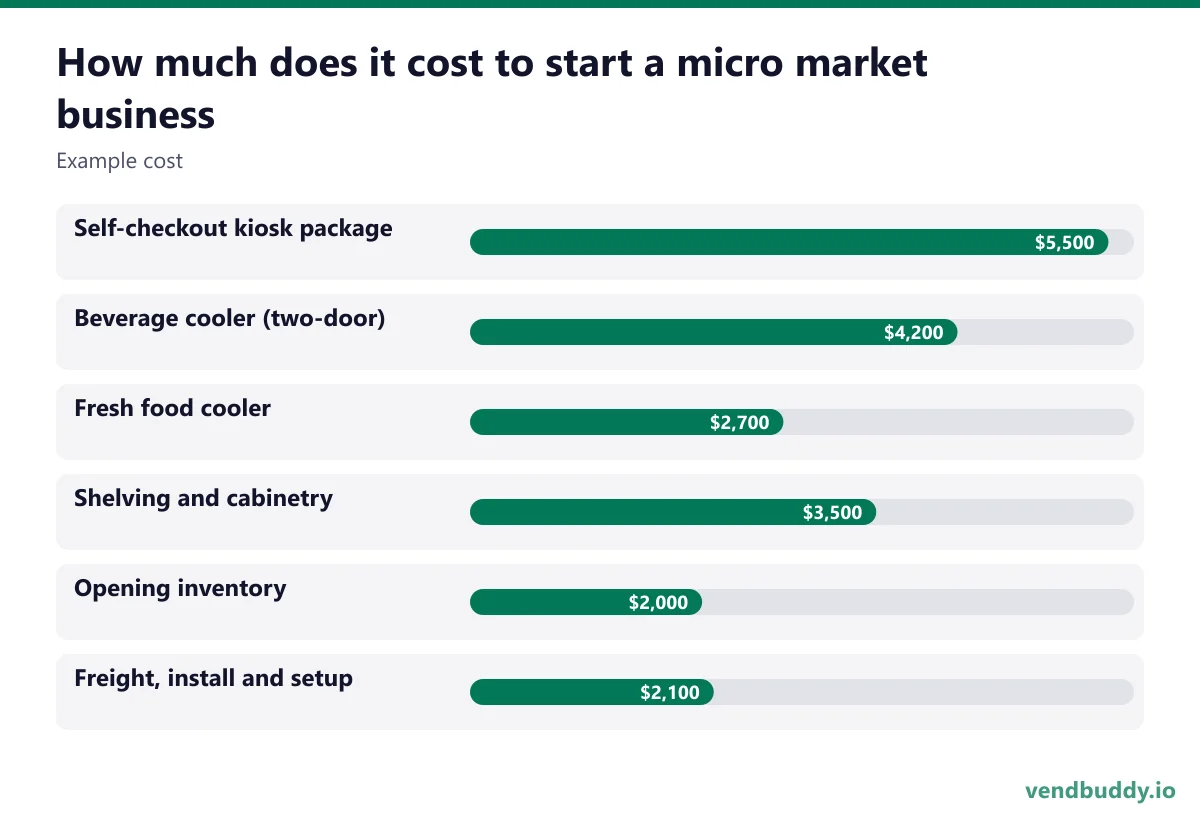
| Line item | Example cost |
|---|---|
| Self-checkout kiosk package | $5,500 |
| Beverage cooler (two-door) | $4,200 |
| Fresh food cooler | $2,700 |
| Shelving and cabinetry | $3,500 |
| Opening inventory | $2,000 |
| Freight, install and setup | $2,100 |
| Total | $20,000 |
On top of that come the monthly costs: market software, card processing, a security camera, and your own time. Add a freezer, a coffee setup or custom panels and you're quickly past $30,000. Many operators finance or lease the equipment, so price the payment into the plan before you sign the location.
Picture the machines paying you while you sleep
That’s the real promise of vending — income that doesn’t cost you your time, and a life on your own terms. VendBuddy turns this guide into a step-by-step plan so you actually build it instead of just reading about it. Start free today.
Start building free →How much money does a micro market make per month?
It depends on sales per market, and the guides disagree on what "good" looks like. The Vending Club suggests many operators want $6,500 to $9,000 a month before a standard market feels strong. To show where the money goes, we ran three example markets. Inputs, all assumptions you should replace with your own: product cost 55% of sales, shrink 3% (the same guide puts typical shrink at 2% to 5%), a 5% commission to the location (it cites 0% to 15%), card and software fees at 6%, and restock labor at $20 an hour for 2 hours a visit.
| Monthly line | Slow market | Solid market | Strong market |
|---|---|---|---|
| Sales | $3,000 | $6,500 | $9,000 |
| Product cost (55%) | -$1,650 | -$3,575 | -$4,950 |
| Shrink (3%) | -$90 | -$195 | -$270 |
| Commission (5%) | -$150 | -$325 | -$450 |
| Card and software fees (6%) | -$180 | -$390 | -$540 |
| Restock labor | -$360 (9 visits) | -$520 (13 visits) | -$520 (13 visits) |
| Net before vehicle and overhead | $570 | $1,495 | $2,270 |
| Months to pay back a $20,000 build | about 35 | about 13 | about 9 |
Check the middle column: $6,500 minus $3,575, $195, $325, $390 and $520 leaves $1,495, and $20,000 / $1,495 is about 13.4 months. The slow market is the warning. At $3,000 a month the build takes almost three years to earn back, and one bad quarter of spoilage wipes out a season of profit. Our rule: if you can't see a clear path to about $5,000 a month in sales, start the site with a smart cooler and upgrade later.
This is general information, not legal, tax or financial advice; figures are examples.
How many employees does a location need for a micro market?
There's no single number. The Vending Club guide says many operators look for at least 50 to 100 regular users with strong on-site activity, and our comparison with vending puts a compact market at about 100 to 250 employees and a full one at 250 or more. Headcount alone misleads, though. What matters is how many people are on site at once, for how long, and whether there's a cafeteria or a grocery store across the street.
Good fits share a few traits: a closed building where the public can't walk in, long shifts or 24-hour operations, few food options nearby and a break room with power and space for coolers. Warehouses, manufacturing plants, hospitals, call centers and large offices are the usual targets.
What are the biggest risks in a micro market business?
Shrink
Open shelves mean some product walks. Most markets plan for a few percent, but a bad site can run much higher. Cameras near the kiosk, a closed building and weekly inventory counts keep it down. If shrink stays high after you've tightened things up, pull the market and put in locked equipment.
Spoilage
Fresh food sells at higher prices and spoils fast. Order small at first, rotate by date on every visit, and drop items that don't turn within their shelf life. The software tells you what sells; trust it over your own taste.
Labor
A market is a small store. Restocking a full market takes longer than filling a vending machine, and busy sites need visits several times a week. If you're working a day job, your hours are the real limit on how many markets you can run.
What equipment and software does a micro market need?
At minimum: a self-checkout kiosk with a card reader, at least one beverage cooler and one food cooler, shelving, and a camera. The kiosk runs market management software that handles pricing, sales reports, restock lists and shrink tracking. Most operators use the software sold with their kiosk. Smaller operators testing the idea at a pop-up or a staffed site sometimes start with a tablet point-of-sale; our guide to Shopify POS for micro markets and pop-ups covers where that works and where it doesn't.
If your first site is closer to 50 people than 150, a smart cooler gives you the same grab-and-go feel in one locked unit, with far less product and labor. Smart cooler vs micro market compares the two on cost and fit.
Buy the SandStar direct from VendBuddy — $4,995 to $6,995
We are a direct SandStar dealer, so this is the one smart cooler on this page we sell ourselves instead of linking to. Five configurations, $4,995 to $6,995 for the cabinet, plus $65 per machine per month for the software licence. It isn’t the cheapest vision cooler on the internet, and we’d rather say that here than after you have paid.
- We inspect the cooler before it ships and own the freight claim if a carrier dents it.
- Remote training and planogram support cost nothing. An onsite technician is optional at $500 a day, two-day minimum.
- The $65 monthly licence covers the SIM and cellular data, telemetry, device management and remote support, so there’s no second connectivity bill.
- Warranty runs 3 years on the SRK series and 5 years on the VRK series.
Not ready to sign anything? Get pricing and availability first →
How do you find the first location for a micro market?
Start with places that already struggle to feed their people: a warehouse with three shifts, a plant on the edge of town, a hospital wing far from the cafeteria. Call the facility manager or HR lead, not the front desk. Lead with the employee benefit, not the commission: hot coffee and real food at 2 a.m. without leaving the building. Bring a simple layout of the break room with the coolers drawn in, and offer a 90-day trial with sales reports.
On the site visit, get answers to five things before you quote: how many people are on site per shift, whether the break room has dedicated outlets for coolers, who can enter the building after hours, what food is within a five-minute walk, and whether an existing vending contract runs out soon. Then ask for a written agreement that covers the term, the commission (if any), who pays for power and what happens to the equipment if either side ends it. A market is too much money to place on a handshake.
Many operators get into markets by adding one to an account where they already have vending machines and a good relationship. If you run machines now, look at your best-selling site first. Our smart markets guide for operators covers the upgrade path from machines to markets.
To build your list of sites, use the vending location finder. VendBuddy shows you which warehouses, plants and offices near you are worth the walk-in, with business and property listings and contact details where available; credit packs on the pricing page need no subscription.
Frequently Asked Questions
Is a micro market business profitable?
It can be at the right site. In our example, a market selling $6,500 a month nets about $1,495 before vehicle and overhead, while one selling $3,000 nets about $570. Product cost, shrink and restock labor decide most of the difference, so run the numbers for your own site.
Worth noting on product spend: the route spend is the smaller half of this. The bigger line is the rent or mortgage payment, which normally earns nothing. Per its card page the Bilt card earns up to 1.25X on that payment with no transaction fee, and the no-fee Blue tier earns 1X on everything else. Referral link, and it only works if you clear the balance every month. Affiliate link, so we may earn a commission at no extra cost to you.
Can you start a micro market with no vending experience?
Yes, but it is a steeper start than a single vending machine because you are managing a small store with fresh food. Many new operators begin with a smart cooler or a few machines, learn product mix and restocking, then add a market at their best account.
Do micro market locations charge a commission?
Some do and many do not. One 2026 operator guide puts micro market commissions at 0% to 15%, lower than typical vending, because the location sees the market as an employee benefit. Agree the rate and how it is calculated before you install.
How do you stop theft in a micro market?
Pick closed sites the public cannot enter, mount a camera that covers the kiosk and shelves, count inventory weekly and watch shrink in the market software. If losses stay high after that, replace the open market with a smart cooler or locked machines.
What is selling, which buildings say yes, and the numbers before you buy a machine. Free, confirm from your inbox, unsubscribe in one click. Refer one friend and get 25 VendBuddy credits.
Walk-ins and cold emails find locations. A small site with your own machine photos and a request-a-machine form lets the next one find you. Around machine three to five, an AI builder drafts it in an evening. Wix is the mature site builder; Base44 also builds working tools like a quote form. Start with the AI website walkthrough or Wix vs Base44.
General information, not legal, tax or financial advice. Rules change, so check the official source. Revenue and income figures are examples, not promises. See our terms.