- The worst vending machine locations fail for one of eight reasons: too few people, no dwell time, free food nearby, a high commission, locked doors, no supervision, seasonality or an unstable building.
- Walk away from sites under 50 daily visitors; a 300-person hospital unit beats a 3,000-person mall with a food court next door.
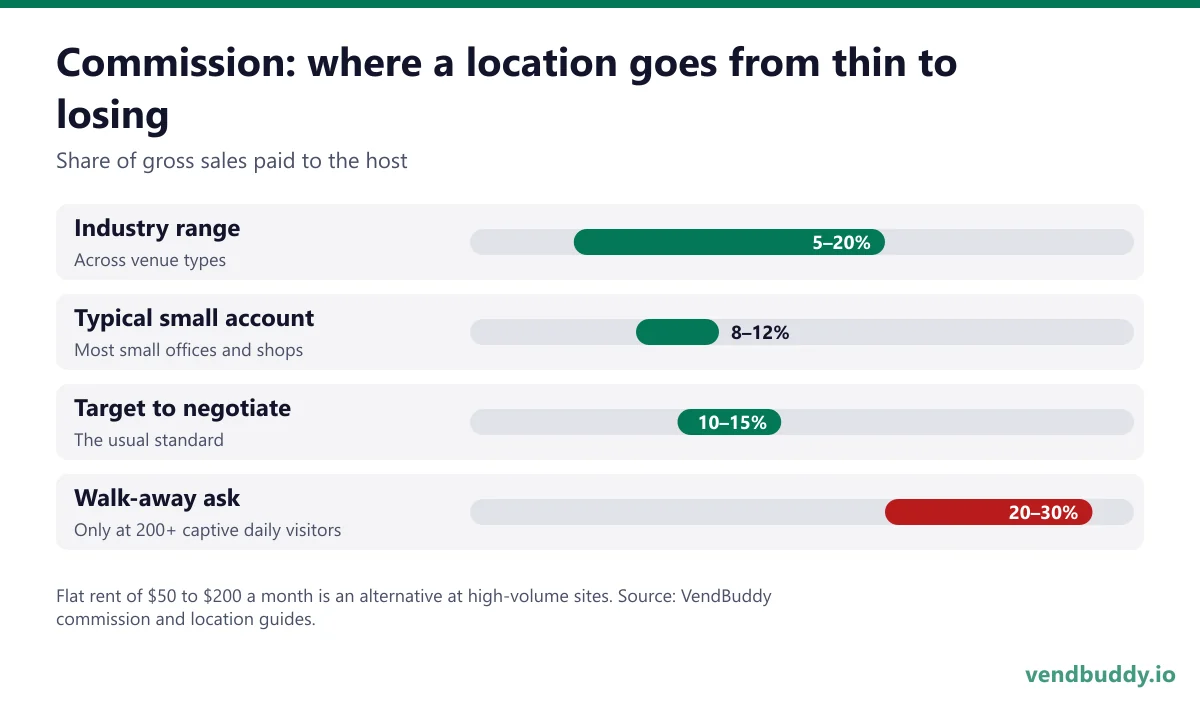
- Commission norms run 5-20% of gross with 10-15% the target; a 20-30% ask only works at 200+ captive daily visitors.
- Outdoor and unsupervised spots lose 3-8% of revenue to theft before any damage, so move inside near staff.
- Seasonal sites make a fine second machine and a poor first one; average the whole year, not the best weekend.
The worst vending machine locations are not the empty ones. They are the places that look busy from the parking lot and still leave your machine half full at the end of the month. Every operator signs one sooner or later. The trick is to spot the warning signs before the machine is on a dolly, because moving a 600-pound cabinet back out costs you a day, a favor and some pride.
Part of our complete guide: how to find vending machine locations.
This page is the other side of our best vending machine locations for 2026. That guide tells you where to aim. This one tells you what to walk away from, how to check each problem on a single visit, and where to put the machine instead.
Why bad vending locations fail
A machine makes money when people are near it, stay long enough to get hungry or thirsty, and have nowhere better to go. Take away any one of those three and sales drop fast. Our location-finding playbook puts the floor plainly: a site with under 50 daily visitors is a walk-away. The 2026 locations guide adds the second test, which it calls the captive audience score: what share of visitors stay longer than 15 minutes with no realistic nearby option? It uses a blunt example. A 300-person hospital unit beats a 3,000-person mall, because the mall has a food court next door.
So the worst locations fail for a short list of reasons. Too few people. People who do not stay. Free or cheaper food a few steps away. A host who wants too much of the sales. Doors you cannot get through when you need to restock. Machines nobody watches. And sites that are only busy for part of the year. Each one is below, with the sign to look for and the fix.
The worst vending locations in 2026, one by one
1. Low foot traffic, even when the building is big
The warning sign: a large building with a small headcount. Think of a self-storage office, a quiet showroom, or a professional office with eight people. Square footage does not buy snacks. People do.
How to check it: ask the manager how many people are on site on a normal day and when the peak hours are. Count cars at noon. If the honest answer is under 50 people a day, you have your answer.
What to do instead: use the same drive to pitch a building with a crowd. Warehouses, plants and apartment buildings with 200 or more units sit at the top of our tier list; see the warehouse and factory guide for how those are run.
2. No dwell time
The warning sign: people pass through but never stop. A lobby people cross on the way to the elevator, a pharmacy pickup counter, a quick-service bank branch. Lots of bodies, two minutes each.
How to check it: stand where the machine would go for 20 minutes. Count how many people sit down, wait, or linger. If almost nobody stays 15 minutes, the captive audience score is near zero.
What to do instead: follow the waiting. Car dealership service bays, where our 2026 guide notes customers wait 60 to 120 minutes, are the classic example; the car dealership guide covers the pitch. Laundromats share the same long wait, and our laundromat guide explains why the owner often already has a machine.
3. Free food or a cheaper option next door
The warning sign: a free coffee bar, catered Friday lunches, a stocked snack basket, an on-site cafe, or a food court around the corner. Our office building guide lists these exactly, and the coworking guide notes that many spaces include free coffee, tea and sometimes fruit in the membership.
How to check it: walk the break room and ask what the company already provides. Look at the street on a map. If there is a convenience store within a two-minute walk, your machine is competing on price and losing.
What to do instead: do not give up on every perk building. Free coffee and a snack basket do not cover a 1 pm lunch or an 8 pm dinner, which is why a fresh-food fridge can still work there. If the company buys lunch every day, though, move on.
4. A host who wants 20 to 30 percent
The warning sign: the first number out of the manager’s mouth is a big commission. Our guides put the industry range at 5 to 20 percent of gross sales, with 8 to 12 percent typical for small accounts, and a target of 10 to 15 percent. A demand for 20 to 30 percent eats the margin before you pay for product, gas and card fees.
How to check it: run the numbers before you answer. If the site will not clear real volume (we use 200 or more daily visitors with a captive audience as the bar), a high commission turns a thin location into a losing one.
What to do instead: offer a lower percentage tied to better equipment and service, or a flat rent. Our playbook notes flat rent of $50 to $200 a month as an option at high-volume sites. The scripts are in vending machine commission rates and how to negotiate vending machine locations.
5. Doors you cannot open when you need to
The warning sign: restocking only between 10 and 11 am on weekdays, a security escort for every visit, a badge that takes weeks, or a building that locks at 5 pm. You cannot fix an empty machine you cannot reach.
How to check it: ask who lets you in, when, and how fast. Then put access hours for restocking in the written agreement, along with commission, termination and who carries vandalism and theft liability. Those are the clauses our playbook says every placement contract needs.
Most first agreements are two pages, not twenty. The contracts walkthrough lays out the clauses that actually matter for the contract, including the termination language operators forget about until they need it.
What to do instead: favor buildings that never close. Truck stops, 24-hour warehouses and hospitals sell around the clock, and access is rarely the problem there (though hospital contracts have their own hurdles).
6. Unsupervised and outdoor spots
The warning sign: an outside wall, a back hallway nobody uses, a park with no staff after dark. Our playbook puts the cost of theft at 3 to 8 percent of revenue at outdoor or unsupervised spots, and that is before a smashed glass front.
How to check it: look for cameras, staff sight lines and lighting. Ask whether anything near the spot has been damaged before. The park guide is honest that vandalism is a cost of doing business outdoors.
What to do instead: move the machine inside, near a front desk or a staffed counter. If the host only offers an outside wall, price in the loss or pass. Smart coolers belong indoors only; our review of the HAHA open-front machine says to skip outdoor spots.
7. Seasonal venues treated like year-round ones
The warning sign: a place that is packed in July and dark in January. Golf courses in the north shut for months. Campgrounds and marinas live on summer weekends. Student housing, per our 2026 guide, is strong August through April and drops hard in summer.
How to check it: ask how many months the gates are actually open and what a slow month looks like. Then average the year, not the best weekend.
What to do instead: treat a seasonal site as a second machine, not your first. Put your first machine somewhere steady, and add the seasonal spot once the route pays its own bills.
8. The building that is about to change
The warning sign: unclear management, high turnover, a tenant on the way out, or a property for sale. Our playbook flags restrictive access and unclear management as red flags that signal future headaches.
How to check it: ask who signs, how long they have been there, and whether anything is changing in the next year. A 30-day termination clause plus a manager who is leaving is a coin flip.
What to do instead: ask for a longer term in writing, or put the effort into a building with a stable decision maker.
Picture the machines paying you while you sleep
That’s the real promise of vending — income that doesn’t cost you your time, and a life on your own terms. VendBuddy turns this guide into a step-by-step plan so you actually build it instead of just reading about it. Start free today.
Start building free →Warning sign vs what to do instead
Keep this table on your phone for walk-ins. Every line comes from the sections above.
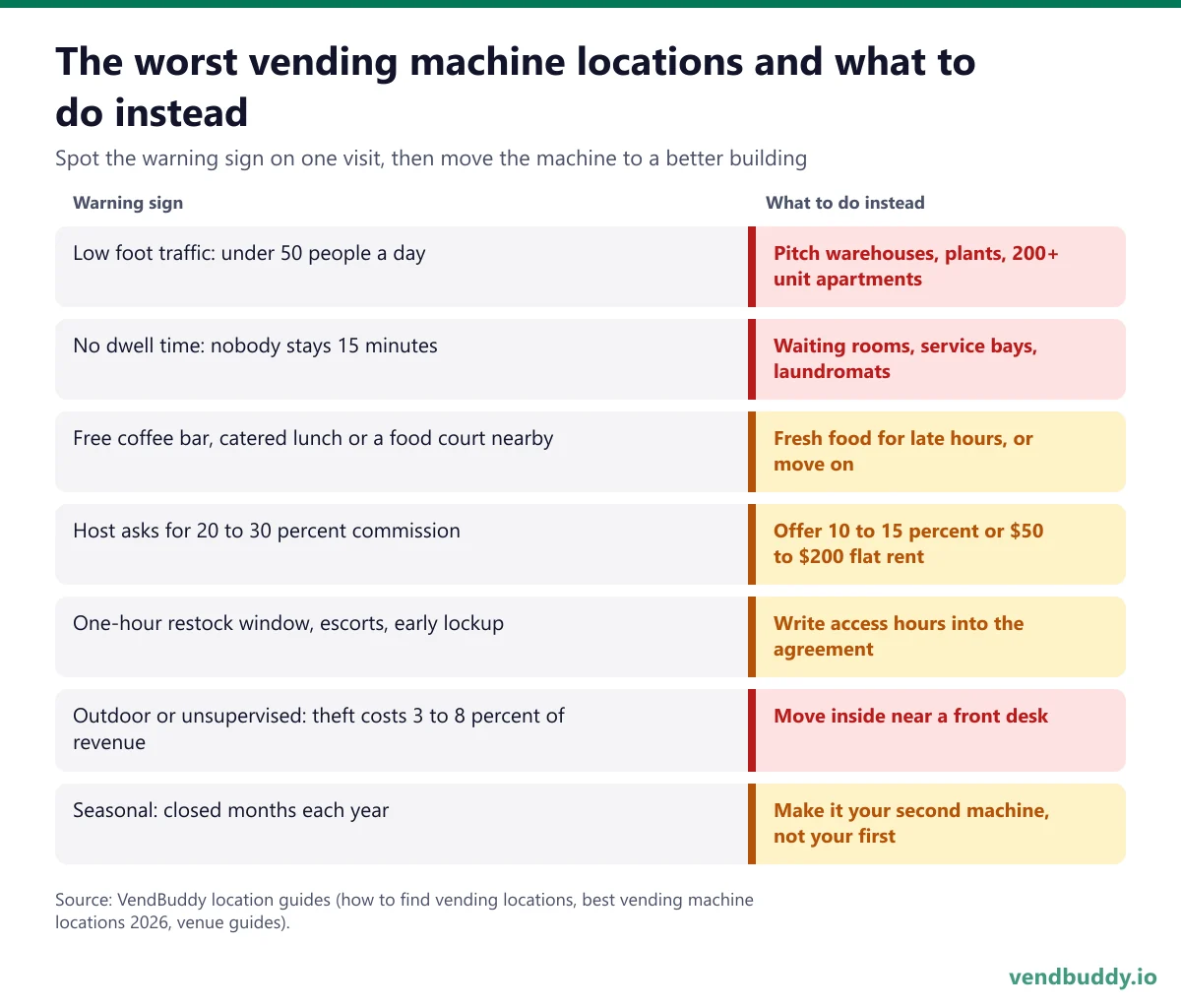
| Bad location type | Warning sign | Check before you sign | What to do instead |
|---|---|---|---|
| Low foot traffic | Under 50 people a day | Ask headcount, count cars at noon | Pitch warehouses, plants, 200+ unit apartments |
| No dwell time | Nobody stays 15 minutes | Watch the spot for 20 minutes | Waiting rooms, service bays, laundromats |
| Free food nearby | Free coffee bar, catered lunch, food court | Walk the break room, check the map | Fresh food for late hours, or move on |
| High commission | 20 to 30 percent ask | Model sales before you answer | Offer 10 to 15 percent or $50 to $200 flat rent |
| Restricted access | One-hour restock window, escorts | Write access hours into the agreement | 24-hour sites: truck stops, warehouses |
| Unsupervised | No staff, cameras or light | Ask about past damage | Move inside near a front desk |
| Seasonal | Closed months each year | Average the whole year | Make it your second machine, not your first |
| Unstable building | Manager leaving, property for sale | Ask what changes next year | Longer term in writing, or a stable site |
Already signed a bad location? How to get out cleanly
It happens. You will sign a site that looked fine and sells a few dollars a day. Give it a fair test first: a full month with the right products, a working card reader and a clean, full machine. Then look at the sales by day and hour. A cashless reader timestamps every sale, which turns a vague feeling into numbers you can show the manager.
If the numbers say move, say so politely and early. Offer to leave on a set date, thank the host, and ask whether they know another building that could use a machine. Hosts talk to each other, and leaving well keeps doors open. Our 90-day location test lays out how long to wait and what to measure before you pull a machine.
How to find the better building faster
Bad locations usually come from a short list. When you only have five places to pitch, the sixth-best one starts to look fine. Most operators pitch 15 to 20 locations for every one they land, so a long list is what protects you from settling. Build 20 targets before your first pop-in.
VendBuddy’s Lead Finder pulls businesses near any ZIP and scores them for vending, so you can skip the empty showroom and spend the afternoon on buildings with a crowd. For the full list of venue types and how each one runs, start at vending machine locations by business type. If you are weighing a smart cooler, read the best locations for AI vending machines before you buy; a weak site hurts a $5,000 cooler more than a used combo.
You do not need a perfect route on day one. You need one good location, and the discipline to say no to the bad ones on the way there.
Frequently Asked Questions
What is the worst place to put a vending machine?
A spot with few people, no reason to stay and food nearby, such as a quiet showroom or a lobby next to a food court. VendBuddy guides use under 50 daily visitors as a walk-away line.
Is a high-traffic location always good for vending?
No. Traffic only helps if people stay and have nowhere better to buy. A 300-person hospital unit beats a 3,000-person mall with a food court next door.
What commission is too high for a vending location?
Our guides put the norm at 5 to 20 percent of gross, with 10 to 15 percent the usual target. A 20 to 30 percent ask only makes sense at sites with 200 or more captive daily visitors.
Should I put a vending machine outside?
Only with a plan for theft and weather. Outdoor and unsupervised spots lose 3 to 8 percent of revenue to theft, and smart coolers should stay indoors.
How do I get out of a bad vending location?
Test it for a full month with the right products and a working card reader, review the sales data, then give the host a polite, early exit date and ask for a referral.
What is selling, which buildings say yes, and the numbers before you buy a machine. Free, confirm from your inbox, unsubscribe in one click. Refer one friend and get 25 VendBuddy credits.
Walk-ins and cold emails find locations. A small site with your own machine photos and a request-a-machine form lets the next one find you. Around machine three to five, an AI builder drafts it in an evening. Wix is the mature site builder; Base44 also builds working tools like a quote form. Start with the AI website walkthrough or Wix vs Base44.
General information, not legal, tax or financial advice. Rules change, so check the official source. Revenue and income figures are examples, not promises. See our terms.