- Bottom line of this HAHA open-front vending machine review: a sound $2,999 first machine for a signed indoor site with 100-200 card-paying daily visitors.
- "Open-front" means the tap-to-unlock glass door format, not an open-air shelf; listings describe the same 360 cabinet as the $3,299 Smart Combo.
- Year-one cash is roughly $3,800-$4,250 once the $40/month HAHA fee, first fill and sales tax are counted.
- At 22-32% net it pays back in about 3-4.5 months at $3,000/month gross and 8-11 months at $1,200.
- Skip it for unsigned sites, cash crowds, outdoor spots, or sites past ~40 sales a day that will empty it twice a week.
Our HAHA open-front vending machine review in one line: at $2,999 it is the cheapest way to put a real camera-checkout cabinet into a building, and it is worth buying for an indoor site with 100 to 200 card-paying daily visitors. It is not a cheaper way to test whether a building has traffic. Nothing at this price is.
Part of our complete guide: how much does a vending machine cost.
This is the machine we point budget buyers to in our AI vending machines ranked for 2026. That page gives it a paragraph. This one answers the questions buyers actually ask about it: what “open-front” means, why it costs $300 less than the Smart Combo, what the cash really looks like in year one, and who should spend the extra money on something else.
What “open-front” means, and what it does not
The name makes some buyers picture an open-air shelf like a grocery grab-and-go case. That is not what this is. The listings describe the same tap-to-unlock glass door as the rest of HAHA’s range: the customer taps a card or phone, the electromagnetic lock releases, they take what they want, and when the door shuts the cameras work out what left and bill the card. “Open-front” is marketing language for that open-the-door format, as opposed to a coil machine where you pick a slot and wait for a spiral.
That matters for theft. The door stays locked until a valid card is presented, and whatever leaves is charged to that card. The risk is not someone walking off with a shelf. It is the ordinary smart-cooler risks: look-alike packages billing as each other, a card that declines after the door opens, and a cabinet in an unsupervised spot getting knocked around. Indoor, access-controlled buildings suit it best.
Specs, with the disagreements left in
| Spec | What the listings say |
|---|---|
| Price | $2,999 on Amazon (sold by HAHA’s dealer storefront) and for the Mini 360 on HAHA’s own store |
| Cabinet | HAHA’s 360 cabinet, the same family as the $3,299 US-360 Smart Combo |
| Footprint | About 22.8 in wide and 76-76.4 in high; depth listed at 26 in on dealer pages, 30 in on one review |
| Weight | About 190 lb on dealer listings; one third-party review says 298 lb, so plan for the heavier figure when you book a dolly |
| Capacity | The Amazon listing says 245; HAHA’s store says 216; other 360 listings run to 252 |
| Temperature | 32-50°F, whole cabinet |
| Payment | Built-in contactless reader: cards and mobile wallets. No cash |
| Connectivity | 4G and Wi-Fi per the listing; app for inventory, sales and restock alerts |
| Warranty | 1 year; HAHA’s store lists extended coverage at $200 a year |
Two practical notes. The 22.8-inch width is the headline feature: it rolls through a standard 36-inch door without removing anything and fits alcoves a 39-inch combo machine never will. And the capacity spread is wide enough that you should count your own shelf facings after delivery rather than trusting any single number.
Picture the machines paying you while you sleep
That’s the real promise of vending — income that doesn’t cost you your time, and a life on your own terms. VendBuddy turns this guide into a step-by-step plan so you actually build it instead of just reading about it. Start free today.
Start building free →$2,999 vs $3,299: what is the $300 for?
This is the obvious question, and the honest answer is that the listings do not make it clear. The $3,299 Smart Combo US-360 and the $2,999 open-front listing both describe HAHA’s 360 cabinet: similar footprint, a 245-bottle figure on Amazon, the same checkout, the same $40 monthly fee and the same one-year warranty. HAHA’s own store lists its Mini 360 at $2,999 too.
We could not find a documented hardware difference that justifies the gap. What can differ between listings is the seller, colour and trim options, shipping speed, and return terms. So the rule we would use:
- Open both listings and compare the spec tables line by line: capacity, shelves, dimensions, included accessories.
- Compare who ships it, the delivery estimate, and the return terms on a freight item.
- If the specs match and the return terms are comparable, buy the cheaper one. $300 is about a third of a first fill of inventory.
If the specs do differ, the HAHA US-360 review has the full breakdown of the Smart Combo version, and you can decide whether the difference is worth $300 to you.
What year one actually costs
The sticker is the smallest surprise. HAHA’s merchant FAQ lists a $40 per machine per month service fee ($10 POS, $15 SIM, $15 software), pro-rated by the days the machine is live. Card processing is on top, and HAHA does not publish that rate in the same place; dealer listings for HAHA cabinets state 5.95% of sales, sometimes plus $0.05 per transaction. Get the number in writing and price your products with it in mind.
| Year-one line item | Amount |
|---|---|
| Machine | $2,999 |
| HAHA service fee, 12 months ($40 x 12) | $480 |
| First fill at wholesale | roughly $300-$500 |
| Sales tax on the machine (varies by state) | $0-$270 |
| Cash out before the first dollar comes back | roughly $3,800-$4,250 |
That $3,800-$4,250 figure is the one to hold against your savings, not $2,999. If it leaves you with nothing for a second fill, a broken hinge or a slow first month, wait until it does.
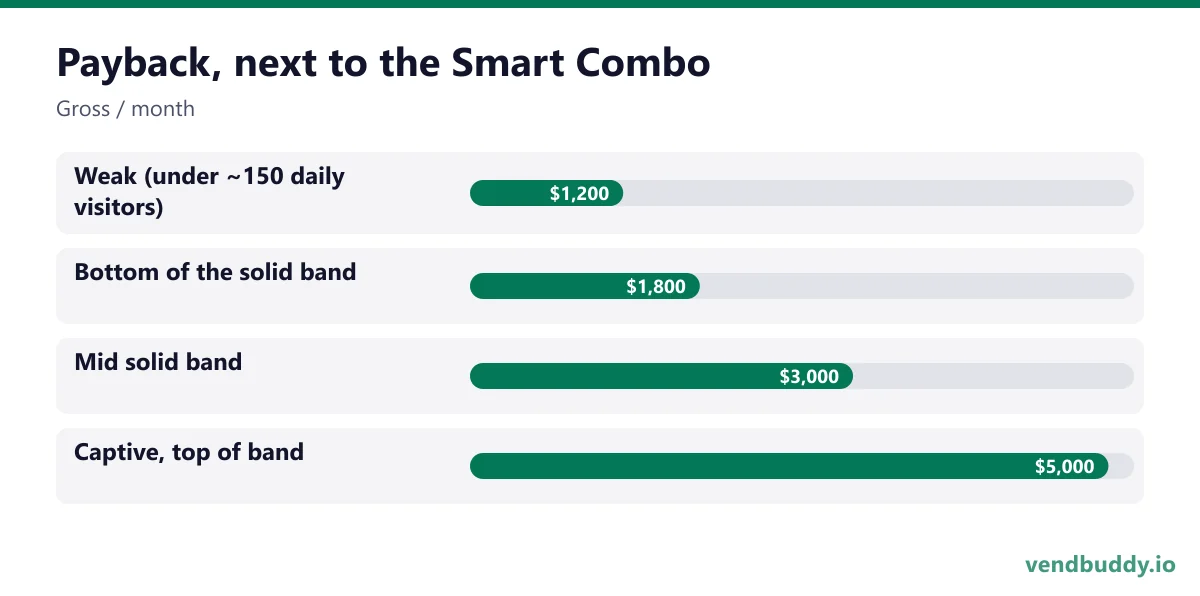
Payback, next to the Smart Combo
We use the same 22-32% net margin published in our AI vending machine revenue figures for every smart and AI machine. The last column shows the same building with the $3,299 version, so you can see what the $300 does to the clock.
| Site | Gross / month | Net at 22-32% | Months to recover $2,999 | Same site on a $3,299 US-360 |
|---|---|---|---|---|
| Weak (under ~150 daily visitors) | $1,200 | $265-$385 | 8-11 | 9-12 |
| Bottom of the solid band | $1,800 | $400-$575 | 5-7.5 | 6-8 |
| Mid solid band | $3,000 | $660-$960 | 3-4.5 | 3.5-5 |
| Captive, top of band | $5,000 | $1,100-$1,600 | 2-3 | 2-3 |
The savings matter most at weak and middling sites, where they take roughly a month off payback. At a strong site both machines are paid off in a season and the difference disappears. That is the real case for the cheaper listing: it is the machine that forgives a slightly disappointing building a little faster.
It still does not rescue a bad one. At $1,200 a month the $40 fee is equal to more than a tenth of what you net, every month, whether the building grows or not.
An illustrative first machine
Renee (illustrative, not a real customer) has $5,000 set aside and a day job. She spends a month pitching before she buys anything and lands a 180-unit apartment building with a mailroom lounge and no convenience store within a ten-minute walk. She orders the $2,999 open-front listing, keeps about $1,500 for stock and a cushion, and confirms activation in the app before stocking.
Month one sells about $1,100 while residents work out that the door opens. Month three is near $2,200, mostly drinks, protein bars and a few sandwiches. At a 27% net that is roughly $590 a month, and the machine is paid off around month six or seven. Her savings are not all gone, which is the point: when the property manager mentions a sister building across town, she can say yes to a second machine without borrowing.
The version of this that goes wrong is the same Renee placing the same machine in a 40-person office because it said yes first. Then she is looking at $600-$800 a month and a payback closer to a year and a half, with the $40 fee eating a bigger share of every month. The machine did not change. The building did. Our smart cooler as a first machine guide has a five-question test for exactly this decision.
Who should not buy the open-front
- Anyone without a signed site. A cheaper cabinet lowers the cost of a mistake. It does not remove it.
- Sites under about 150 daily visitors. Published results put low-traffic AI placements under $1,200 a month, often below break-even once fees are counted.
- Cash-heavy crowds. It cannot take a bill. A used coil combo with a card reader risks less money there.
- Outdoor or unsheltered placements. It is an indoor glass cabinet.
- Busy sites that will empty it twice a week. Past roughly 40 sales a day, the HAHA AI Plus and its extra shelf space are the better buy.
- Buyers who want someone else to fix things. HAHA support is app-based and self-serve, and the warranty is one year.
Alternatives worth comparing
The same cabinet family covers the obvious alternatives. The Smart Combo is the version most operators compare against; the AI Plus adds shelf space for a busier site.
Machines people on this page actually buy
Amazon is worth using for these because of Prime shipping and a return window you can actually use if the freight arrives dented. Every link below is an affiliate link, so we earn a commission when you buy through one.
HAHA AI Open-Front US-360 — $2,999View on Amazon →The cheapest way into AI vending, for indoor placements where an open front is not a theft problem.
HAHA Smart Combo US-360 — $3,299View on Amazon →Drinks and snacks in one cabinet. The default first AI machine for a 50–100 person site.
HAHA AI Plus (Plus 440) — $3,799View on Amazon →More shelf shapes and stacked goods. Worth the step up once a placement passes roughly 40 sales a day.
Affiliate links — VendBuddy earns a small commission from qualifying purchases at no extra cost to you. The full Amazon disclosure sits with the gear list elsewhere on this page.
If the thing that worries you is the one-year warranty and handling a freight claim yourself, the SandStar costs more up front and every month, but comes with 3-5 years of warranty and a dealer who inspects the cabinet before it ships. We sell it, so weigh our opinion accordingly; the full trade is in HAHA vs SandStar.
Buy the SandStar direct from VendBuddy — $4,995 to $6,995
We are a direct SandStar dealer, so this is the one smart cooler on this page we sell ourselves instead of linking to. Five configurations, $4,995 to $6,995 for the cabinet, plus $65 per machine per month for the software licence. It isn’t the cheapest vision cooler on the internet, and we’d rather say that here than after you have paid.
- We inspect the cooler before it ships and own the freight claim if a carrier dents it.
- Remote training and planogram support cost nothing. An onsite technician is optional at $500 a day, two-day minimum.
- The $65 monthly licence covers the SIM and cellular data, telemetry, device management and remote support, so there’s no second connectivity bill.
- Warranty runs 3 years on the SRK series and 5 years on the VRK series.
Verdict
The HAHA open-front is the right machine for a careful first-time operator with a signed indoor site and a tight budget. It is the same camera-checkout format as the $3,299 listing, the $300 saved pays for real inventory, and its slim footprint gets you into places bigger cabinets cannot go. Compare the two listings before you pay, confirm activation before you stock, and treat the one-year warranty as a reason to keep a repair cushion.
The step that decides whether it pays back is finding the building. VendBuddy pulls the apartment complexes, offices and gyms in any ZIP code along with the person who approves a machine, so the $2,999 goes into a lobby you have already counted. Start with your ZIP code.
Frequently Asked Questions
Is the HAHA open-front vending machine actually open with no door?
No. Despite the name, the listings describe the same tap-to-unlock glass door as the rest of HAHA’s range. The customer taps a card, the lock releases, they take items, and the cameras bill for what left when the door closes. Open-front refers to the open-the-door, grab-and-go format rather than a coil machine.
What is the difference between the $2,999 and $3,299 HAHA US-360 listings?
Both describe HAHA’s 360 cabinet with the same checkout, $40 monthly fee and one-year warranty, and HAHA’s own store also lists the Mini 360 at $2,999. We could not find a documented hardware difference that explains the $300. Compare the two listings’ spec tables, seller and return terms, and if they match, buy the cheaper one.
How much does it really cost to start with a HAHA open-front AI vending machine?
Plan on roughly $3,800-$4,250 in year one: $2,999 for the machine, $480 in HAHA service fees, $300-$500 for a first fill of inventory, and sales tax where your state charges it. Card processing comes out of sales on top, and dealer listings for HAHA cabinets state 5.95%.
How long does the HAHA open-front take to pay for itself?
At a 22-32% net margin, roughly 3-4.5 months at a site grossing $3,000 a month, 5-7.5 months at $1,800, and 8-11 months at $1,200. The first two months usually run below steady state while people learn the door opens, so add a little to any of those figures.
Where should I not put a HAHA open-front vending machine?
Avoid outdoor or unsheltered spots, cash-heavy crowds, and any site under about 150 daily visitors, where AI machines often gross under $1,200 a month. Also avoid very busy sites that would empty its roughly 216-252 item capacity twice a week; a larger cabinet saves restock trips there.
What is selling, which buildings say yes, and the numbers before you buy a machine. Free, confirm from your inbox, unsubscribe in one click. Refer one friend and get 25 VendBuddy credits.
General information, not legal, tax or financial advice. Rules change, so check the official source. Revenue and income figures are examples, not promises. See our terms.