- The honest per-month band is $1,800 to $5,000 gross for a smart or AI machine at a solid 100–200 daily-visitor site — and $2,500 to $8,000 gross, $700 to $2,500 net, at genuinely captive Class A placements.
- Below about 150 daily visitors it inverts. Published results put a low-traffic AI placement under $1,200 a month, often below break-even once the software licence is counted.
- The gross multiple is not the net multiple. 2.3× in premium multifamily and 1.8× in Class A office on gross; roughly 40–70% more take-home than a traditional combo once the licence comes out.
- Where the money comes from is basket size. A keypad sells one $1.25–$1.50 item. An open door sells a $4–$8 basket.
- Ramp is real. Months 1–2 run well under steady state on any machine, and a vision cooler also loses part of week one to 3–5 hours of AI product training.
The direct answer: a well-placed AI vending machine grosses roughly $1,800 to $5,000 per month at a normal good site, and $2,500 to $8,000 gross with $700 to $2,500 net at a genuinely captive Class A office or premium apartment placement. The caveats matter more than the number. Below about 150 daily visitors the same machine often clears under $1,200 and can fail to cover its own monthly software licence, net is 22–32% of gross rather than the 25–35% a coil machine runs, and nothing on that list happens in month one.
VendBuddy is a lead-finding tool that shows vending operators which businesses in a ZIP are worth pitching. One dated figure to anchor the rest: in our AI vending decision guide (updated 2026-04-15), the guide's premium multifamily comparison is about $3,200 a month for grab-and-go AI against $1,400 for a traditional machine. This is general information, not legal, tax or financial advice; figures are examples.
AI Vending Machine Revenue Per Month: Actual Operator Results
Every per-month figure published on this site, collapsed into one table — the direct answer to how much an AI vending machine actually makes per month. Gross is what the machine collects. Net is what reaches you after cost of goods, location commission, card processing, the monthly software licence and running costs.
| Machine type and placement | Gross / month | Net / month |
|---|---|---|
| Smart or AI machine, solid site (100–200 daily visitors) | $1,800–$5,000 | $400–$1,600 |
| AI cooler, Class A office or lobby (genuinely captive) | $3,000–$8,000 | $900–$2,500 |
| AI cooler, premium Class A multifamily | $2,800–$4,500 | $800–$1,400 |
| AI cooler, standard gym | $1,700–$2,500 | $450–$800 |
| AI cooler, under ~150 daily visitors | Under $1,200 | Often below break-even |
| Traditional snack-and-drink combo, same solid site | $1,200–$3,000 | $300–$1,050 |
The net columns are the gross bands multiplied by the published margin for each class: 22–32% for smart and AI machines, 25–35% for traditional coil and combo machines. The Class A office, multifamily and gym rows are operator-reported gross and net taken directly from our AI vending decision guide rather than calculated.
Smart vending machine net profit per machine per month: what operators actually clear
Most smart machines clear $400 to $1,600 net a month at a solid site, and the genuinely captive Class A placements clear $900 to $2,500. A weak site, meaning under about 150 daily visitors, lands nearer $265 to $385 and can finish the month below break-even once the $65 software licence is out. Read the row that matches the building you actually have, not the one you hope to sign.
You can run break-even on your own numbers in the revenue calculator instead of borrowing ours. It asks for property type and headcount, which is where nearly all of the difference comes from.
| Placement | Gross / machine / month | Net / machine / month |
|---|---|---|
| Slow — under ~150 daily visitors | Under $1,200 | $265–$385, often below break-even after the licence |
| Typical — solid site, 100–200 daily visitors | $1,800–$5,000 | $400–$1,600 |
| Strong — captive Class A office or lobby | $3,000–$8,000 | $900–$2,500 |
Net profit per machine per month is the number that actually pays you, and on a smart or AI machine it lands at 22–32% of gross — a few points under the 25–35% a traditional machine runs, because the monthly software licence and slightly higher perishable COGS come out first. Same margin band, applied across the gross tiers above, so you can read your own site off one row:
| Gross / machine / month | Net at 22% | Net at 32% | What that actually is |
|---|---|---|---|
| $1,200 (weak site) | $265 | $385 | Before you pay yourself for the restock drive, and still carrying the $65 monthly licence. Marginal. |
| $1,800 (bottom of the solid band) | $400 | $575 | A real but small monthly cheque. Works as machine one, does not fund a route. |
| $3,000 (mid solid band) | $660 | $960 | The realistic target for a good 100–200 daily-visitor placement. |
| $5,000 (top of the solid band) | $1,100 | $1,600 | Captive traffic doing the work. This is a building result, not a hardware result. |
| $8,000 (captive Class A ceiling) | $1,760 | $2,560 | Matches the $900–$2,500 operator-reported net for Class A office placements. |
The important part is what the table does at the bottom rather than the top: fixed costs do not shrink when the building underperforms, so a weak site does not just earn less, it changes sign.
Picture the machines paying you while you sleep
That’s the real promise of vending — income that doesn’t cost you your time, and a life on your own terms. VendBuddy turns this guide into a step-by-step plan so you actually build it instead of just reading about it. Start free today.
Start building free →Sandstar vending machine operator monthly sales results
Operator-reported Sandstar sales sit in the smart-cooler band: $1,800 to $5,000 gross a month at a 100 to 200 daily-visitor site and $2,500 to $8,000 at a captive Class A placement, per the operator results in our AI vending decision guide (updated 2026-04-15). There is no verified operator figure for a single Sandstar model, so use that range and read the row that matches your building.
AI vending machine actual revenue per month: operator results
Operator results in the same guide (updated 2026-04-15) put a Class A office at $3,000 to $8,000 gross a month and premium multifamily at $2,800 to $4,500. A standard gym grosses $1,700 to $2,500, and a site under about 150 daily visitors often clears under $1,200.
Smart vending machine net profit per machine per month
Net is 22 to 32 percent of gross, which works out to $400 to $1,600 a month at a solid site and $900 to $2,500 at a captive Class A office (operator results, decision guide, updated 2026-04-15). Under about 150 daily visitors the same machine nets $265 to $385 at best and can finish the month below break-even once the $65 licence is counted.
Smart vending machine monthly revenue per machine
A smart or AI machine grosses $1,800 to $5,000 a month at a solid 100 to 200 daily-visitor site (the per-month table above, updated 2026-10-09), and the operator results in our AI vending decision guide (updated 2026-04-15) put a well-placed machine at $2,500 to $8,000. Below about 150 daily visitors the published figure falls under $1,200.
A machine has no revenue of its own. The building has revenue — the machine is just how you collect it. Averaging machines across buildings describes none of them.
Why an AI machine changes the revenue math at all
The entire economic argument for a computer-vision cooler is one behaviour: the door opens.
On a traditional keypad machine, the transaction is a single selection. The customer decides what they want, presses one button, pays for exactly that thing and walks away. Average ticket lands in the $1.25 to $1.50 range, and it does not move much, because the interface physically only sells one item per interaction. Wanting a second thing means starting the whole process again in front of a queue.
On a grab-and-go cooler, the customer taps to unlock, opens a fridge door, and takes what they came for plus whatever caught their eye on the way past. Cameras and shelf sensors work out what left, and the whole basket bills on close. Average ticket on that flow runs $4 to $8. That is not a technology premium anybody is charging for — it is the same person buying three things instead of one because the friction of the second and third item dropped to zero.
Three second-order effects stack on top of that, and each one is worth real money:
- The product mix can shift upward. Coil machines handle drinks and fresh food badly, which caps you at shelf-stable snacks. A cooler sells $3.00–$4.50 energy drinks, $3.50 protein bars and $4.00 meal items — the exact SKUs that make up 50–70% of revenue at the highest-earning placements versus 20–30% at average ones. The product stocking playbook covers what actually moves.
- Nothing jams, so nothing gets refunded. The single most common vending complaint — the machine ate my money — largely disappears when no product has to be pushed off a coil. Every avoided refund is a full-price sale you keep.
- Property managers say yes more often. A lit glass cooler reads as an amenity in a Class A lobby; a steel combo machine reads as a vending machine. This does not show up as revenue on one machine — it shows up as access to the buildings where the revenue is.
All three only pay out where there was demand to unlock. That is the part the category’s marketing consistently skips, and it is why the same hardware produces a $6,000 month in one building and a $900 month in another.
What the published operator results actually show
By location tier, from operator-reported results in our AI vending decision guide:
| Placement type | Gross / month | Net / month | Uplift vs traditional |
|---|---|---|---|
| Class A office / lobby | $3,000–$8,000 | $900–$2,500 | ~1.8× |
| Premium multifamily (Class A) | $2,800–$4,500 | $800–$1,400 | ~2.3× |
| Standard gym | $1,700–$2,500 | $450–$800 | 1.2–1.4× |
| Low traffic (under ~150 daily visitors) | Under $1,200 | Often below break-even | Can invert |
Note the bottom row, because it is the one that costs people money. The uplift is not a property of the machine. In premium multifamily the published comparison is about $3,200 a month for the AI cooler against $1,400 for a traditional machine in the same building. In a standard gym the same swap buys you 1.2–1.4×, which frequently does not justify the capex at all. Below 150 daily visitors it can go negative, because the licence is fixed and the revenue is not.
By machine type at a solid site, from how much vending machines actually make, which puts a smart or AI machine at $1,800 to $5,000 per month gross at a 100–200 daily-visitor placement, against $1,200–$3,000 for a snack-and-drink combo in the same tier. That same guide breaks the smart/AI row across location quality:
| Location quality | Smart / AI machine, gross | Smart / AI machine, net |
|---|---|---|
| Poor | $240–$835 | $55–$265 |
| Average | $600–$2,500 | $130–$800 |
| Great | $3,600–$10,800 | $790–$3,450 |
The $4,000 machine, and why it is not your planning number
The most-cited single-machine figure in vending is the $4,000-a-month placement — one operator-reported machine in one building doing over $4,000 gross. It is also, in that post’s own words, roughly the top 1–2% of single-machine sites by revenue, and it was a traditional machine, not an AI cooler.
At a $2.75 average vend, $4,000 gross is about 1,455 transactions a month, or 48 a day. Sustaining that needs 400–750 people within range of the machine daily with no competing food source. At 35% margin that site generates $1,400 of gross profit, and after commission, restock labour and depreciation the operator’s net lands nearer $900 to $1,100. A $4,000 headline is a $1,000 business.
That building is exactly the profile where a vision cooler’s $4–$8 basket would beat a $2.75 keypad vend, which is the argument for putting one there. But it is an outlier building, and the reason it produces outlier numbers is the traffic, the captivity and the multi-shift occupancy — not the cabinet. If you plan your first machine around a top-1% building you have not found yet, you have planned around nothing.
SandStar specifically: what monthly sales look like on this hardware
We do not publish per-unit monthly sales figures for SandStar coolers, and you should distrust anyone who does. A SandStar SRK in a 500-person distribution centre and the identical SRK in a 40-person office are two completely different businesses, and averaging them produces a number that describes neither.
What we can say with the figures already on this site: a SandStar cooler is a computer-vision grab-and-go unit, so it belongs in the smart/AI band above rather than the traditional band. That means roughly $1,800 to $5,000 per month gross at a 100–200 daily-visitor site, with the higher $2,500–$8,000 Class A numbers available only where the traffic is genuinely captive, and the under-$1,200 floor firmly in play if it is not.
The specific, non-negotiable costs that come with this hardware are published on our smart vending machines for sale page: cabinets from $4,995 (SRK Cooler) to $6,995 (SRK2 and VRK Freezer), with 3-year warranty on the SRK series and 5-year on the VRK series, plus a $65 per machine per month software licence that includes the cellular SIM and data. That licence is not an upsell you can decline — the cameras, the vision model, the connection and the dashboard run as a service on every machine in this class, and vendors who do not quote it are deferring the conversation rather than saving you the money.
Two operational facts affect your first month’s number directly, both from our own critical review of this equipment. AI product training takes 3 to 5 hours, not the half hour the marketing implies, and visually similar items need deliberate fine-tuning or they bill as each other. And freight damage on a several-hundred-pound glass-door appliance is a genuine risk, which is the entire reason we became a distributor rather than telling people to import: someone else inspecting the pallet and owning the freight claim is the difference between a machine earning in week two and a machine sitting dark for a month.
What SandStar operators report in monthly sales results
Operator-reported monthly sales on a SandStar cooler cluster in the smart-cooler band already published above, not in a band of their own: roughly $1,800 to $5,000 per month gross at a solid 100–200 daily-visitor site, $2,500 to $8,000 where the placement is genuinely captive — a Class A office with no cafeteria, a multi-shift warehouse, a hospital staff area — and under $1,200 where the traffic is not there. Net lands at 22–32% of gross once product cost, commission, card processing and the $65 monthly software licence come out. Those are reported results, not projections, and nothing on this page is a guarantee of what any particular building will do.
When you want the number for your site rather than someone else’s, run the building through the free Machine Finder and compare the smart-cooler estimate against the traditional and used options before you commit capital.
Buy the SandStar direct from VendBuddy — $4,995 to $6,995
We are a direct SandStar dealer, so this is the one smart cooler on this page we sell ourselves instead of linking to. Five configurations, $4,995 to $6,995 for the cabinet, plus $65 per machine per month for the software licence. It isn’t the cheapest vision cooler on the internet, and we’d rather say that here than after you have paid.
- We inspect the cooler before it ships and own the freight claim if a carrier dents it.
- Remote training and planogram support cost nothing. An onsite technician is optional at $500 a day, two-day minimum.
- The $65 monthly licence covers the SIM and cellular data, telemetry, device management and remote support, so there’s no second connectivity bill.
- Warranty runs 3 years on the SRK series and 5 years on the VRK series.
Not ready to sign? Get pricing first
Leave your ZIP and how many machines you are thinking about, and we will email current pricing, lead times and financing options. No agreement, no commitment.
A realistic month-by-month ramp
Steady-state numbers are what everybody quotes and nobody earns in month one. This site publishes a general first-machine ramp — $400 to $900 gross in months 1–2, $800 to $1,500 in months 3–4, and steady state by months 5–6 — and it publishes the smart-machine uplift at 1.8× to 2.3× on gross.
The table below is those two published figures multiplied together and rounded. It is arithmetic on our own numbers, not a new dataset, and it assumes a site that actually justifies the cabinet in the first place.
| Month | Traditional machine (published ramp) | AI cooler, same site (1.8–2.3× applied) | What is actually going on |
|---|---|---|---|
| Month 1 | $400–$900 | $700–$2,100 | You lose part of week one to 3–5 hours of vision training. Nobody in the building knows the machine is there yet. Mistrained SKUs bill wrong until you catch them. |
| Month 2 | $400–$900 | $700–$2,100 | First real read on what sells. Your opening planogram is a guess; the telemetry is not. Cut the dead SKUs now, not at month six. |
| Months 3–4 | $800–$1,500 | $1,400–$3,500 | Buying habits form. Repeat customers appear. This is where the basket-size advantage starts showing up in the deposit rather than the theory. |
| Months 5–6 | Steady state | $1,800–$5,000 | Steady state at a 100–200 daily-visitor site. This is the number to judge the placement on. |
| Months 7–12 | Flat, seasonal | Flat, seasonal | Growth from here comes from price, mix and a second machine — not from the same machine getting better at its job. |
The published diagnostic threshold is worth memorising: if you are still below $800 a month gross at six months in a location with 50-plus daily visitors, the problem is the product mix or the exact spot in the building, not necessarily the location itself. On a machine carrying a $65 monthly licence, that diagnosis is more urgent, not less. Why a vending machine is not making money works through the fix list in order.
The cost side, so the net is honest
Gross revenue is the number people post. Net is the number that pays you. Here is everything that comes out between the two, using the percentages published across this site.
- Cost of goods: 40–50% of revenue. The single largest line, and the one where premium SKUs help twice — higher ticket and better absolute margin per vend.
- Location commission: 5–15%. Zero at many sites and non-negotiable at others. What is normal by venue type is worth knowing before the conversation, not during it.
- Card processing: 5–6%. On a cashless-only machine this applies to 100% of revenue rather than the cashless share, which is a real difference against a traditional machine that still takes bills. The full card-reader fee breakdown shows what that costs per machine per month, and if you are retrofitting a traditional machine rather than buying a cooler, Nayax card readers are the usual route.
- Software licence: $65 per machine per month on the SandStar line, and $30–$120 across the wider category. Fixed. It does not scale down when the site underperforms, which is exactly why it is the line that kills marginal placements.
- Everything else: fuel, insurance, repairs, your own restock time.
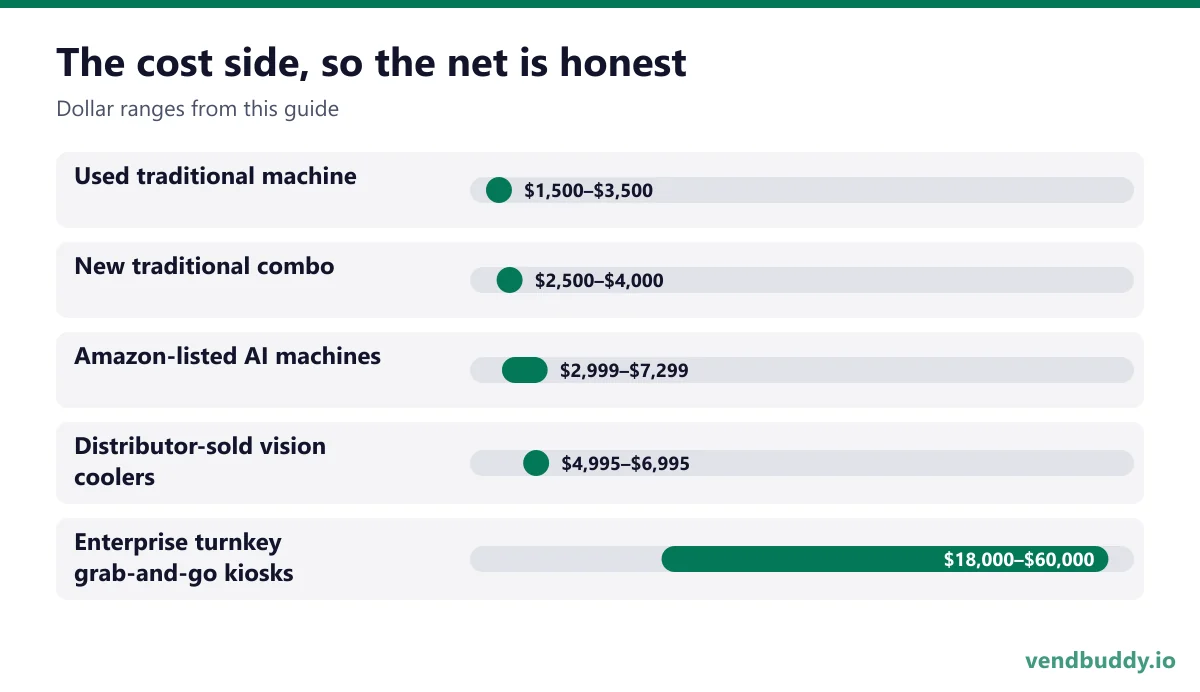
On the capital side, be clear which product you are actually buying, because the price range in this category spans an order of magnitude and the pages that quote it rarely say which tier they mean:
- Used traditional machine: $1,500–$3,500. Still the right answer for a lot of sites.
- New traditional combo: $2,500–$4,000.
- Amazon-listed AI machines: $2,999–$7,299 depending on configuration, with 30-day returns and Prime freight. Ranked in best AI vending machines on Amazon, which also documents the day-one trap that costs operators their first sales: these ship in demo mode and dispense free product until you complete the activation call.
- Distributor-sold vision coolers: $4,995–$6,995 plus the $65 monthly licence, with freight and warranty claims handled by the distributor.
- Enterprise turnkey grab-and-go kiosks: $18,000–$60,000. A genuinely different product class aimed at operators running fleets, and the tier where a bad placement becomes an expensive mistake rather than a cheap lesson.
Payback follows directly from which of those you bought. The Amazon-tier $3,299 machine at a 100-daily-traffic location is quoted at roughly a four-month payback. A $4,995 cooler netting the middle of the average-site band lands closer to the 6 to 12 months this site uses as the general vending planning range. Work yours properly in the payback-period guide before you commit capital, not after.
To model payback on your own machine price, sales and restock time, month by month with a slow start built in, the Vending Profit Spreadsheet treats a smart cooler like any other machine.
Who should not buy one
- Anyone without a signed location. Buying the cabinet first is the most common and most expensive sequencing error in vending. The machine cannot pick a good building for you.
- Sites under about 150 daily visitors. Published results put AI placements at that traffic level under $1,200 a month and frequently below break-even once the licence is counted. A used traditional machine earns nearly as much there for a quarter of the money.
- Standard gyms, unless the numbers are unusual. The published uplift is 1.2–1.4×, which often does not carry the capex. Worth checking against the specific site rather than assuming, since gym placements do have a genuinely favourable product mix.
- Price-sensitive, cash-heavy locations. Grab-and-go depends on people cheerfully taking a second and third item at $4–$8 a basket. Where they will not, the whole advantage disappears and you are left with the higher cabinet cost and the monthly fee.
- Placements contracted under 18 months. The payback maths does not survive losing the site before the machine has paid for itself.
- Anyone who has not run the payback numbers yet. It takes minutes and it is the difference between an asset and a $5,000 fridge.
Where an AI cooler genuinely does win: captive traffic, a drinks-and-fresh-food mix rather than shelf-stable snacks only, a property manager who cares how the space looks, and a building you expect to hold for years. Offices, apartment amenity rooms, medical buildings, hospitals and universities are where the published numbers come from. Office placements and apartment placements each have their own economics, and if the building has 75-plus employees it is worth checking whether a micro market beats a cooler outright before you order either.
The bottom line
An AI vending machine makes $1,800 to $5,000 a month gross at a good site, $2,500 to $8,000 at a captive Class A one, and under $1,200 at a site that never justified it. Net is 22–32% of whichever of those you land on.
Score the building, model the payback, and only then pick a cabinet — and if you are still choosing between categories rather than shopping within one, smart versus traditional and whether AI vending is worth it in 2026 are the two pages to read before this one becomes relevant.
VendBuddy scores real buildings near you by traffic, headcount and category, with the best contact on file attached — so you land the placement first and buy the machine second. Free to start, no card.
Related reading: how much vending machines actually make, our critical SandStar review, smart vending machines for sale with real prices, the anatomy of a $4K single-machine placement, profit by location type, and monthly operating costs.
Frequently Asked Questions
How much does an AI vending machine make per month?
The honest published band is wide because placement decides almost all of it. At a solid site of 100 to 200 daily visitors this site puts a smart or AI machine at $1,800 to $5,000 per month gross. At a genuinely captive Class A office or premium multifamily placement, operator-reported results run $2,500 to $8,000 gross and $700 to $2,500 net. Below roughly 150 daily visitors the same machine often fails to clear $1,200 and can struggle to cover its own software licence. Net is 22 to 32 percent of gross once product cost, commission, card processing and the monthly licence come out — slightly leaner than the 25 to 35 percent a traditional machine runs, because the licence is a cost a coil machine does not have.
If the spend is going on plastic anyway, the card choice is worth ten minutes. Most operators we talk to land on the Bilt card, not for what it pays on pallets but because the rent payment earns too. Referral link, and the honest caveat is that a carried balance beats what any of these points are worth. Affiliate link, so we may earn a commission at no extra cost to you.
AI vending machine actual revenue per month: what do operator results show?
The operator results published on this site break down by placement rather than by machine. A smart or AI machine at a solid 100 to 200 daily-visitor site grosses $1,800 to $5,000 a month. A genuinely captive Class A office or lobby placement grosses $3,000 to $8,000 and nets $900 to $2,500. Premium Class A multifamily grosses $2,800 to $4,500 and nets $800 to $1,400. A standard gym grosses $1,700 to $2,500 and nets $450 to $800. Below about 150 daily visitors the same machine clears under $1,200 and frequently sits below break-even once the monthly software licence is counted. The spread between the top and bottom rows is the building, not the hardware.
How much profit does a smart vending machine make per machine?
Net profit per machine per month runs 22 to 32 percent of gross on a smart or AI machine, against 25 to 35 percent on a traditional coil or combo machine. The gap is the monthly software licence, which is $65 per machine on the SandStar line and $30 to $120 across the wider category, plus slightly higher perishable COGS. Worked through: a machine grossing $3,000 nets roughly $660 to $960 a month. One grossing $1,800 nets about $400 to $575. One grossing $1,200 nets roughly $265 to $385 before you pay yourself for the restock drive. Because the licence is fixed and the revenue is not, a weak placement does not simply earn less — it can net nothing at all.
What are SandStar vending machine monthly sales?
VendBuddy sells the SandStar line and we do not publish per-unit sales figures for it, because a machine has no revenue of its own — the building does. What we can say honestly is that a SandStar cooler is a computer-vision grab-and-go unit, so it earns in the smart/AI band above rather than the traditional band: roughly $1,800 to $5,000 per month gross at a 100 to 200 daily-visitor site, with the higher operator-reported Class A numbers only where the traffic is genuinely captive. Against that you carry the cabinet at $4,995 to $6,995 and a $65 per month per-machine licence. Anyone quoting you a monthly sales figure for a specific model without asking about your building is quoting you a marketing number.
What do Sandstar operators report in monthly sales?
Operator-reported monthly sales on SandStar coolers fall inside the smart-cooler band rather than a band of their own: roughly $1,800 to $5,000 per month gross at a solid 100 to 200 daily-visitor site, $2,500 to $8,000 where the placement is genuinely captive such as a Class A office with no cafeteria or a multi-shift warehouse, and under $1,200 where the traffic is not there. Net runs 22 to 32 percent of gross after product cost, commission, card processing and the $65 monthly software licence. The useful signal in those reported results is the spread, not the midpoint — the same cabinet and the same operator produce a four-to-one difference in monthly sales based only on the building, so treat any single per-model figure as marketing. None of these are guarantees for a specific site.
Is an AI vending machine actually more profitable than a traditional one?
On gross, clearly. The published uplift is about 2.3 times in premium multifamily, 1.8 times in Class A office, and only 1.2 to 1.4 times in a standard gym. On net it is narrower: once the monthly software licence is netted out, the real take-home lift over a traditional combo in the same spot is closer to 40 to 70 percent. That is still a clear win at 100-plus daily visitors. It is not the full multiple the gross line advertises, and in a low-traffic site the multiple can invert entirely because the licence is a fixed cost and the revenue is not.
How long does an AI vending machine take to pay for itself?
It depends almost entirely on which end of the price range you buy at. A $3,299 Amazon-listed AI combo at a 100-daily-traffic location is quoted at roughly a four-month payback. A $4,995 SandStar cooler netting the middle of the average-site band takes meaningfully longer, and the honest planning number for a first machine is closer to the 6 to 12 months this site uses for vending equipment generally. A $20,000-plus enterprise grab-and-go kiosk in a site doing under $1,500 a month may never pay back at all, which is the single most expensive mistake in this category.
Why does an AI machine earn more per transaction?
Because the door opens. On a keypad machine the customer presses one button, pays for one item, and leaves — a $1.25 to $1.50 ticket. On a computer-vision cooler they open a fridge, take a drink and a protein bar and something that caught their eye, and the camera bills the whole basket on close. That is why average ticket on grab-and-go runs $4 to $8. The revenue difference is a behaviour difference, not a technology premium, which is also why it evaporates in a site where nobody was going to buy three things anyway.
What does an AI vending machine earn in its first month?
Less than its steady state, and that is normal rather than a warning sign. This site puts a new machine at $400 to $900 gross in months one and two while the location learns the machine exists. On a vision cooler you also lose part of week one to product training — budget 3 to 5 hours teaching the camera your SKUs, not the 30 minutes the marketing implies — and mistrained similar-looking items bill wrong until you fix them. Judge the placement at month five or six, not month one.
Can an AI vending machine lose money?
Yes, and the mechanism is boring. The cabinet is a fixed cost, the monthly licence is a fixed cost, and the revenue is entirely a function of the building. Published results put a low-traffic AI placement — under about 150 daily visitors — below $1,200 a month gross and frequently below break-even once the licence is included. The same site would have been fine with a $1,500 to $3,500 used traditional machine. Buying the expensive cabinet before you have the signed location is how operators end up with a working machine and a failing placement.
Do I need a captive location for an AI machine to work?
Effectively yes. Every high number in the published data comes from a building where people cannot conveniently buy the same thing somewhere else: multi-shift warehouses, hospital staff areas, Class A offices with no cafeteria, apartment buildings with no corner store in walking distance. Proximity alone is not enough — if there is a convenience store across the parking lot, your grab-and-go cooler is competing with a wider shelf at a lower price, and the basket-size advantage that justified the cabinet never shows up.
What is selling, which buildings say yes, and the numbers before you buy a machine. Free, confirm from your inbox, unsubscribe in one click. Refer one friend and get 25 VendBuddy credits.
General information, not legal, tax or financial advice. Rules change, so check the official source. Revenue and income figures are examples, not promises. See our terms.