Part of our complete guide: how much do vending machines make.
Most vending machines gross $300–$600 per month. A route operator recently documented a single machine in a single building producing over $4,000 per month in gross sales — more than ten times the average. That number is real, it is operator-reported, and understanding why it happened is more useful than dismissing it as an outlier.
This post breaks down the math behind $4K/month from one machine, the location anatomy that makes it possible, why product mix at these sites skews premium, what the honest caveats are, and how to search for comparable buildings systematically rather than door-knocking randomly.
The math at $4,000 per month
Work backwards from $4,000 gross. If average vend price is $2.75, that is roughly 1,455 transactions per month — about 48 per day. At $3.25 average, you need around 1,230 transactions, or 41 per day. Neither number is implausible at a genuinely high-traffic site. The benchmark most operators use is one transaction per 10–15 people who walk past the machine on a given day.
To sustain 40–50 transactions per day, the building needs to put at least 400–750 people within range of the machine on a daily basis — with no competing food or beverage source nearby. That is the first filter. Most buildings do not pass it. Office parks with 60 employees, apartment complexes where residents can walk to a corner store, clinics with a Subway next door — none of these reach the threshold. See vending machine profit by location type for how the numbers shake out across different building categories.
The implied gross margin at a $4K site also changes the economics of the whole route. At 35% margin after COGS, a single site like this generates $1,400/month in gross profit — more than three average machines combined. One good placement is worth finding.
What an outlier location actually looks like
Operator-reported $4K+ sites share a consistent profile. None of these factors alone is sufficient; the outliers have most of them simultaneously:
- Captive audience with no exit. Workers who cannot leave during a shift, patients in a long-wait setting, or residents without nearby retail. The key word is captive — proximity is not enough if alternatives exist.
- Multi-shift or 24/7 occupancy. A building with 300 people during day shift and another 200 on nights doubles the effective daily traffic without adding floor space. Distribution centers, hospitals, manufacturing plants, and data centers all fit this model.
- No cafeteria, food truck, or store within practical walking distance. "Practical" means five minutes or less each way during a break. If it is raining, or cold, or the break is only 10 minutes, even a store two blocks away becomes effectively inaccessible.
- Demographic that buys energy drinks and meal items, not candy. Blue-collar shift workers, healthcare staff, and long-haul drivers all purchase at higher frequency and higher average ticket than office workers who brought lunch from home.
- Consistent year-round occupancy. Seasonality kills otherwise strong sites. Warehouses, hospitals, and correctional facilities run 365 days. School buildings, stadiums, and convention centers do not.
Distribution centers and large manufacturing facilities come up most often in operator-reported high-performer lists. A 500-person warehouse with two shifts, no on-site cafeteria, and no food within a quarter mile is exactly the profile. So are large correctional facilities, regional hospitals (staff-side, not patient-side), and data centers with rotating on-site crews.
Picture the machines paying you while you sleep
That’s the real promise of vending — income that doesn’t cost you your time, and a life on your own terms. VendBuddy turns this guide into a step-by-step plan so you actually build it instead of just reading about it. Start free today.
Start building free →Why product mix at outlier sites skews premium
At an average location — a small office, an apartment lobby — you stock a mix of $1.25 chips, $1.75 candy bars, and $2.00 sodas because that is what the traffic will support. At a captive, high-frequency site, that mix leaves money on the table.
Shift workers buying their third energy drink of the week do not comparison-shop. They buy what is in front of them. Operators who have documented the highest per-machine revenue consistently report that premium SKUs ($3.00–$4.50 energy drinks, $3.50 protein bars, $4.00 meal-replacement items) make up 50–70% of revenue at their best sites — versus 20–30% at average locations.
The product mix calculus at a $4K site:
- Energy drinks (Celsius, Monster, Reign, Ghost): $3.00–$4.00, typically 30–40% of total units sold
- Protein bars and meal items: $3.50–$4.50, 15–25% of units
- Water and electrolyte drinks: $2.00–$3.00, 10–20% of units
- Traditional snacks and candy: $1.50–$2.50, remainder
Stocking an outlier site with a standard snack mix — heavy on chips and candy, light on premium beverage — may cost you 20–30% of achievable revenue. The machine earns what the planogram lets it earn.
The honest caveats
A $4K/month placement is real. It is also not the norm, and hunting for one while ignoring good $800–$1,200/month sites is a mistake most new operators make.
A few things to understand before recalibrating your expectations:
These sites are rare and usually locked up. Any building that meets the criteria above has almost certainly been approached by a vending company already. The ones currently without a machine either had a bad experience with a prior vendor, are in a category operators overlook (the right niche), or require a relationship you have not built yet.
They are usually won through persistence or referral, not cold-call luck. The operator who documented $4K/month on one machine almost certainly did not walk in cold and get a yes in one visit. These placements tend to come through facility managers who already know the operator, through a referral from another placement, or through following up after an existing vendor failed.
A $4K site justifies a second machine or micro-market before a competitor pitches it. If you land a site doing this kind of volume, the correct next move is not to celebrate and move on. A micro-market (open cooler, cashless checkout) in the same building can 2–3x revenue. A second machine in a different wing captures demand you are currently missing. Locking in that footprint before another operator notices the location is standard practice. For a look at how multi-machine math works, see the real math behind a 10-machine route.
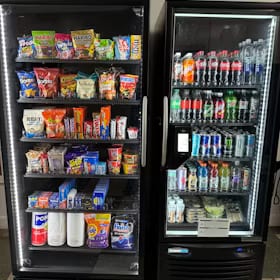
Gross revenue is not profit. $4K gross at 35% margin is $1,400 gross profit. After commission (if applicable), restock labor, and machine depreciation, net profit might be $900–$1,100/month. Exceptional, but the number to track is margin, not gross.
VendBuddy surfaces ranked nearby prospects — warehouses, healthcare facilities, manufacturing plants — with decision-maker contact info so you can pitch the right buildings first.
Try VendBuddy free →How to search for comparable buildings systematically
Door-knocking randomly is the least efficient way to find an outlier site. The operators who land them are usually searching by building type and employee count, not by geography alone.
The categories most likely to produce $2K+ single-machine sites, ranked by frequency in operator reports:
- Distribution centers and fulfillment warehouses — 200+ workers, multi-shift, no on-site food. Amazon, UPS, FedEx, and their third-party logistics partners are the obvious targets, but regional wholesale distributors are often overlooked and easier to land.
- Regional hospitals and large medical centers — staff-side placement near break rooms, not patient vending. A 300-bed hospital may have 800–1,200 staff on a typical day across all shifts.
- Large correctional facilities — staff-only machines (not inmate commissary). These require a security clearance or background check but once placed are essentially permanent.
- Manufacturing plants with 150+ workers — automotive suppliers, food processing, aerospace subcontractors. Multi-shift operations are common; cafeteria coverage is often partial.
- Data centers with on-site operations staff — smaller headcount but 24/7 and geographically isolated from retail.
The systematic approach: identify every building of these types within a 20-mile radius of your base, sort by estimated employee count (available from business databases and Google Maps), and work the list top-down. For each building, find the facilities manager or operations manager by name before you call. A named pitch converts at a meaningfully higher rate than "can I speak to whoever handles vending."
The fastest way to test this in your own ZIP is the free location finder. Search once, see which businesses sit within a few miles, and reveal five contacts for nothing. It will not tell you who says yes, but it saves the afternoon you would spend building the list by hand.
This is where location-finding tools pay for themselves. Rather than manually cross-referencing maps, employee count estimates, and contact lookups, a tool that surfaces buildings by type and employee count with decision-maker contacts already attached compresses weeks of prospecting into hours. See how to find vending machine locations for the full prospecting framework, including how to qualify a building before making first contact.
How much does a vending machine make a month?
Since this page exists because of one exceptional number, it is worth stating the ordinary one plainly. A vending machine makes $300 to $600 a month in gross sales at an average location. A drink-only machine at a genuinely high-traffic site reaches $800 to $1,200. The $4,000 machine documented above is roughly the top 1–2% of single-machine sites by revenue, and it is the exception that this entire post exists to explain.
| Machine and site | Gross per month | Gross profit at 35% margin | Roughly what it takes |
|---|---|---|---|
| Snack or combo, average location | $300–$600 | $105–$210 | 110–220 vends a month, or 4–7 a day |
| Drink machine, high-traffic site | $800–$1,200 | $280–$420 | 10–15 vends a day at a $2.75 average |
| The outlier in this case study | $4,000+ | ~$1,400 | 41–48 vends a day, 400–750 captive people on site |
Two things about the monthly number matter more than the number itself. Gross is not what you keep. At a 35% margin, the $4,000 machine produces about $1,400 of gross profit, and after commission, restock labour and machine depreciation the honest net lands somewhere around $900 to $1,100 a month — still exceptional, and still less than half the headline. Apply the same haircut to the average machine and $300 to $600 gross becomes roughly $70 to $150 of genuine monthly profit.
And the monthly figure is decided before the machine arrives. The same equipment, the same product cost and the same restock hour produce $300 in one building and $4,000 in another. That is the entire argument of this page: what a vending machine makes a month is a property of the location, not of the machine.
FAQ
How much does a vending machine make a month?
$300 to $600 a month in gross sales at an average location, $800 to $1,200 for a drink machine at a high-traffic site, and roughly $70 to $150 of actual monthly profit on the average machine once product cost, commission and labour come out. The $4,000-a-month machine broken down on this page nets about $900 to $1,100 after those same deductions and sits in the top 1–2% of single-machine sites. The monthly number is set by the building, not the equipment: 400+ captive people on site, multiple shifts, and no food within a five-minute walk is what separates a $4,000 machine from a $400 one.
How much does an average vending machine make?
The most commonly cited range among US operators is $300–$600 per month in gross sales for a standard snack or combo machine at an average location. Drink-only machines at high-traffic sites can reach $800–$1,200/month. The $4K/month figure is operator-reported from an exceptional placement and represents roughly the top 1–2% of single-machine sites by revenue. The how much do vending machines make post covers the full distribution across location types.
What kind of building can support $4K/month from one machine?
The profile is consistent across operator reports: 400+ people on-site daily across multiple shifts, no cafeteria or food retail within a five-minute walk, 24/7 or near-24/7 operation, and a workforce demographic that buys energy drinks and meal items rather than just snacks. Distribution centers, large manufacturing plants, regional hospitals, and correctional facilities come up most often. A standard office building with 80 employees and a Panera two blocks away is not this building.
Should I put a second machine in a high-performing location?
Yes, and quickly. A site doing $2K+ per month has demand that one machine likely cannot fully capture — especially if there are multiple break rooms, floors, or wings. A second machine in the same building adds revenue at near-zero marginal prospecting cost and makes it harder for a competing operator to pitch a partial foothold. If volume is strong enough, evaluate a micro-market conversion instead: open coolers with cashless checkout can 2–3x revenue at the same location without adding a second machine vend cycle.
Related: how much do vending machines make, vending machine profit by location type, real math behind a 10-machine route, how to find vending machine locations.