- Golf courses can be good locations at the turn house, the driving range and the cart barn, but access depends on who runs the food and beverage.
- The National Golf Foundation counts about 16,000 courses at nearly 14,000 US facilities, and roughly three-quarters are open to the public.
- Private clubs usually run their own food service. Municipal and daily-fee courses are the easier entry.
- Lead Finder places hospitality venues, which includes golf, at a base score of 78, the highest family score in the tool.
- Sell cold water, sports drinks, salty snacks and small golf items like tees, balls and sunscreen.
Golf course vending machines can work at the right spots: the turn house between nines, the driving range and the cart barn. The one thing that decides it is who controls food and beverage. A private club with a restaurant will say no. A municipal course with a bare snack window will often say yes, and it may thank you.
Part of our complete guide: how to find vending machine locations.
If you left a job to get your afternoons back, golf is a venue where your customers are doing the same thing, on a weekday. They are out for hours, thirsty and without a store in sight.
Are golf courses good vending machine locations?
Yes at the right type of course. The National Golf Foundation reports approximately 16,000 courses at nearly 14,000 facilities in the United States, making it the world's largest golf market (NGF, 2025 industry summary). The NGF also reports that around three-quarters of courses and facilities are open to the public. Those public courses are where you should start.
Traffic is seasonal and weather-driven. A busy public course sees a few hundred rounds on a good Saturday, and each round lasts four hours or more. A driving range adds walk-up traffic that never reaches the clubhouse. Winter shuts many northern courses for months, so plan for a long off-season.
VendBuddy does not have golf-specific search counts to quote as of 2026-10-04. In Lead Finder, golf courses fall under the hospitality family, which starts at a base score of 78. That is the highest starting score of any venue family in the tool, ahead of transit at 76 and manufacturing at 75. It reflects long dwell times and spending ability, and you still have to win the owner.
How a golf course runs
Tee times start at dawn and run until dusk. The busiest windows are weekend mornings and weekday afternoons for leagues. Most 18-hole courses have a turn house or snack shack between the ninth green and the tenth tee, where golfers stop for 5 minutes. The cart barn, the pro shop and the driving range are other gathering points.
Golfers buy water, sports drinks and beer if the course sells it. Many bring their own cooler. They snack on chips, bars and jerky. At the range, people hit balls for 30 minutes and then want a drink. A guy on his lunch break buys a bottle and goes back to work.
The competition is the pro shop, the grill and the beverage cart. A private club or a resort course often has a full restaurant and a contract that blocks outside machines. A municipal course or a nine-hole executive course may only have a counter that closes early.
Worth reading before you sign anything: the contract walkthrough covers which terms get pushed back on and which ones you can safely give away. Commission is rarely the clause that hurts you later.
The key rules are practical. Alcohol is the course's own business, and you should not touch it. Vending is for drinks and snacks. Outdoor placement needs an outdoor-rated machine or a covered spot, and the city or county may require a license.
Think about what a golfer does at the turn. A foursome has 10 minutes between holes. They want something cold, quick and easy to carry on a cart. A machine that takes a card tap and gives back a bottle in seconds fits that. A machine that jams, or one that only takes cash, loses the sale and annoys the pro.
The driving range works the other way. People stay longer, hit a bucket of balls and look for something to drink while they cool down. A cooler by the range office, in view of the counter, usually sells more than one on the course.
Picture the machines paying you while you sleep
That’s the real promise of vending — income that doesn’t cost you your time, and a life on your own terms. VendBuddy turns this guide into a step-by-step plan so you actually build it instead of just reading about it. Start free today.
Start building free →Which machine fits a golf course, and what goes in it
Pick a weather-rated glass-front cooler for the turn house and a combo unit for the cart barn or range. Stock for heat, sun and long walks:
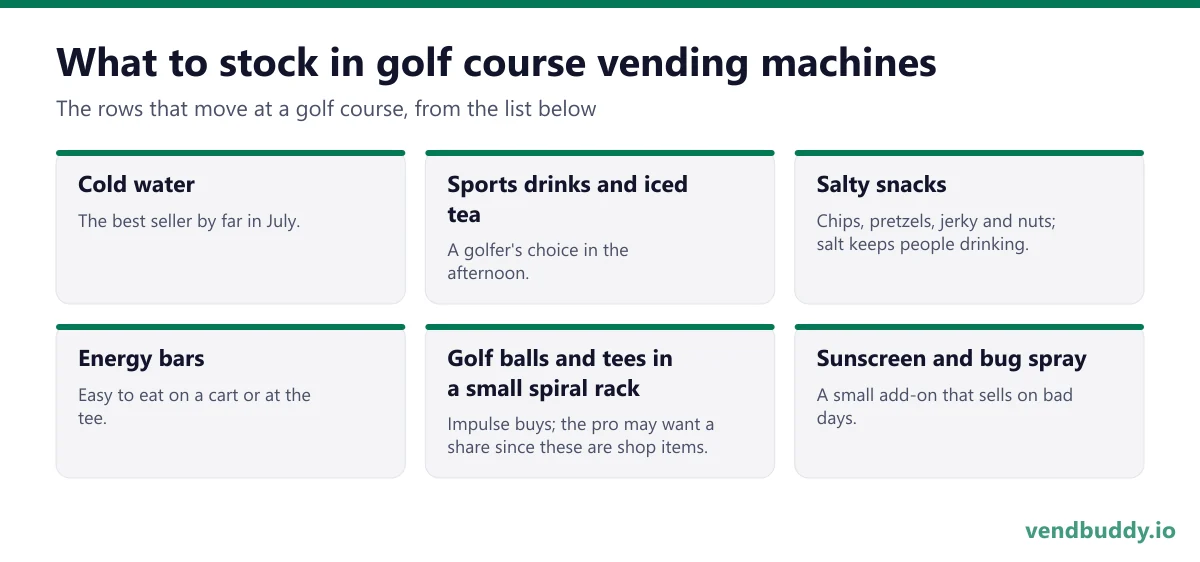
- Cold water. The best seller by far in July.
- Sports drinks and iced tea. A golfer's choice in the afternoon.
- Salty snacks. Chips, pretzels, jerky and nuts; salt keeps people drinking.
- Energy bars. Easy to eat on a cart or at the tee.
- Golf balls and tees in a small spiral rack. Impulse buys; the pro may want a share since these are shop items.
- Sunscreen and bug spray. A small add-on that sells on bad days.
- Gum and mints. Cheap, small and steady.
Avoid chocolate in summer outdoor machines. It melts and ruins the rest of the row.
Remember that golf is a relationship business. Course managers talk to each other, and a good report from one municipal course opens doors at the next. Show up on a quiet weekday, dress like you work there and bring a one-page plan with a photo of the machine.
The golf course pitch: who decides and how it goes
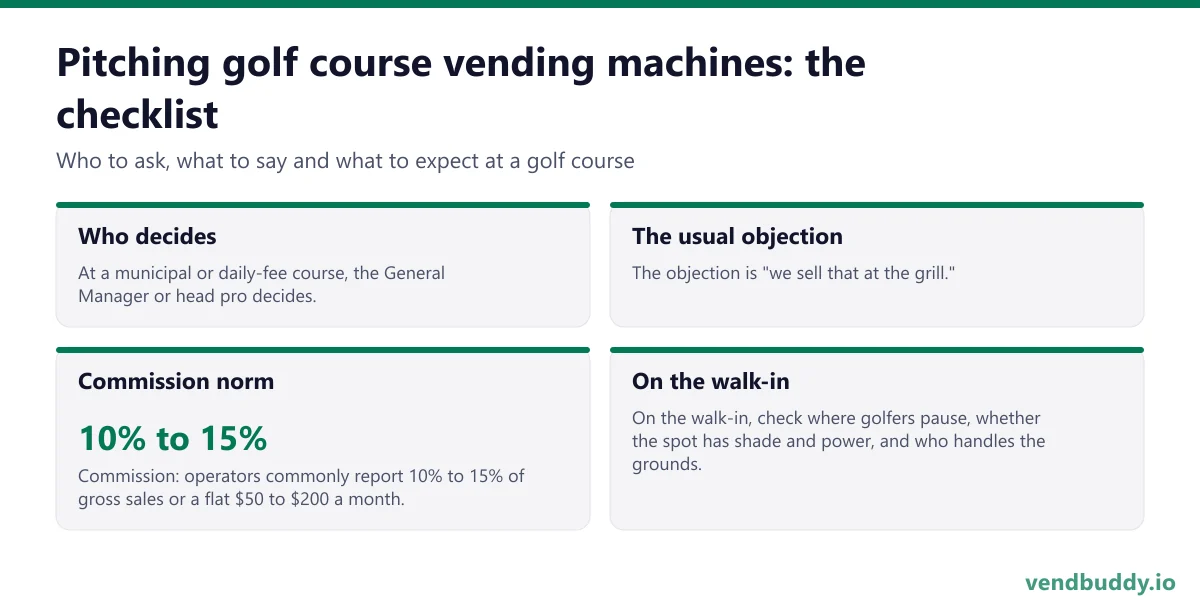
At a municipal or daily-fee course, the General Manager or head pro decides. At a private club, the General Manager reports to a board, and the food and beverage director has a say. Lead Finder shows an owner contact where one is listed, but for golf you should expect to ask who runs concessions.
Opener: "I place vending machines at places where people are outside for hours. I would put a cold drink unit at your turn house and one at the range, stock it daily in season, and share sales with you. Is your snack window open on weekdays?"
The objection is "we sell that at the grill." The answer is to cover the gaps: dawn tee times before the grill opens, the range, the far end of the course and slow weekdays when the counter is closed.
Commission: operators commonly report 10% to 15% of gross sales or a flat $50 to $200 a month. The vending machine commission rates post has the full picture. Check your numbers in the vending ROI calculator, and be honest about the off-season.
On the walk-in, check where golfers pause, whether the spot has shade and power, and who handles the grounds. A power run across a cart path is a cost you should know about up front.
If a course says no for this year, ask when contracts renew. Many food and beverage agreements run one to three years, and the manager can tell you when to call back. Put the date in your calendar.
How to find golf courses near you
Use Lead Finder: Find golf courses near you in Lead Finder. Choose Golf Course / Country Club, enter a ZIP and set the radius up to 50 miles. Results show a score and, where listed, a contact.
The free route starts on Google Maps. Search "golf course near me," "driving range" and "municipal golf course." City websites list their courses and the department that runs them. The drive-by test is a Saturday at 9 am from April through September. A full lot means full tee sheets. The longer playbook is in how to find vending locations.
Lead Finder adds a location score, the contact and a radius search so you can compare every course in your area.
A few good municipal courses can make a fine summer route. Find golf courses near you in Lead Finder and begin with the public ones.
Frequently Asked Questions
Are golf courses good vending machine locations?
Yes at public and municipal courses, especially at the turn house and the driving range. Golfers are outside for hours with no store nearby. Private clubs usually run their own food service, so they are harder to enter. Expect a seasonal business in colder states.
What sells best in a golf course vending machine?
Cold water, sports drinks and iced tea lead. Salty snacks, jerky, nuts and energy bars follow. Small items like tees, balls, sunscreen and bug spray sell as impulse buys. Skip chocolate in outdoor machines during summer.
How much commission does a golf course expect?
Operators commonly report 10% to 15% of gross sales or a flat $50 to $200 a month. Courses with a grill may ask for more or limit your products. The commission rates post shows how to compare the two.
Do private country clubs allow vending machines?
Rarely in the clubhouse, because they run restaurants and bars. Cart barns, range stations, fitness rooms and staff areas are more open. Ask the general manager what the board permits before you spend time on a pitch.
What is selling, which buildings say yes, and the numbers before you buy a machine. Free, confirm from your inbox, unsubscribe in one click. Refer one friend and get 25 VendBuddy credits.
Every operator we talk to wants fewer cold calls. The ones who get there have a Google Business Profile and a simple site a manager can check before replying. AI builders make that an evening job now. Wix is the mature site builder; Base44 also builds working tools like a quote form. Start with the AI website walkthrough or Wix vs Base44.
General information, not legal, tax or financial advice. Rules change, so check the official source. Revenue and income figures are examples, not promises. See our terms.