- A glass front vending machine shows every product behind glass and usually offers 40 to 60 selections, against 8 to 10 on a stack vendor.
- Drink models use an elevator or delivery arm, so they can sell bottles, cans and odd-shaped drinks without shims and without shaking carbonated drinks.
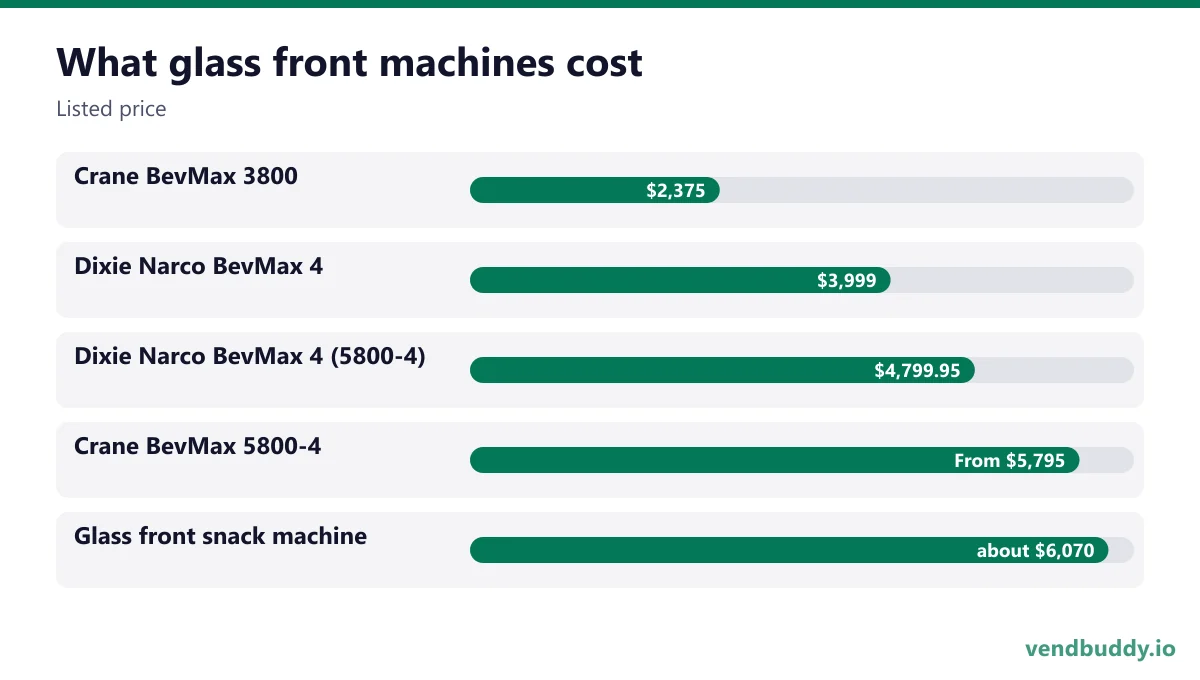
- Real listings: a used Crane BevMax 3800 at $2,375, refurbished BevMax 4 units at $3,999 to $4,800, a refurbished BevMax 5800-4 from $5,795. New glass front snack machines start around $6,000.
- They're wider and pricier than stack vendors, often 39 to 47 inches wide, so they make sense where people want variety: gyms, offices, hospitals, apartment amenities.
- In a warehouse where everyone wants the same five sodas, a cheaper stack vendor usually earns more per dollar.
A glass front vending machine is the one where you can see everything before you pay: rows of drinks or snacks behind a big window, and an elevator or arm that brings your choice to the bin. It costs more than a basic stack vendor, and it's wider. What you get for the money is variety, and in the right building variety is what sells.
Part of our complete guide: how to find vending machine locations.
This guide covers how glass fronts differ from stack vendors, real prices for common models new, refurbished and used, their sizes, and how to tell if a location will pay back the extra cost.
Glass front vs stack vendor
A stack vendor drops cans from columns behind a solid panel. It usually offers 8 to 10 selections, holds a lot, and rarely breaks. A glass front drink machine shows the products on shelves and usually offers 40 to 60 selections (Vending Group).
| Stack vendor | Glass front | |
|---|---|---|
| Selections | 8 to 10 | 40 to 60 |
| Products | Cans and standard bottles (shims for size changes) | Cans, bottles, energy drinks, odd shapes |
| Delivery | Gravity drop | Elevator or arm |
| Typical width | 29 to 39.5 inches | 39 to 47 inches |
| Refurbished price | About $1,500 to $1,800 (Dixie Narco 501E) | About $2,400 to $5,800 (BevMax family) |
The elevator matters more than it sounds. A carbonated drink that falls a few feet gets shaken; one carried down on an elevator doesn't. And because the shelves are adjustable, you can switch from 12-ounce cans to 20-ounce bottles to tall energy cans without shimming columns. One seller of a BevMax 4 notes it vends all bottle sizes with no shims needed (Seattle Vending Machines).
What glass front machines cost
| Machine | Condition | Listed price | Notes |
|---|---|---|---|
| Crane BevMax 3800 | Used | $2,375 | Glass front elevator drink vendor (Vendo Fleet) |
| Dixie Narco BevMax 4 | Used/refurbished | $3,999 | 45 selections, 360 bottles of 16 to 20 oz (Seattle Vending Machines) |
| Dixie Narco BevMax 4 (5800-4) | Refurbished | $4,799.95 | Plus $399 delivery (Westway Vending) |
| Crane BevMax 5800-4 | Refurbished | From $5,795 | 45 selections, about 450 cans or 360 bottles (Vending Concepts) |
| Glass front snack machine | New | From about $6,070 MSRP | High-volume snack model (Vital Vending) |
Prices move with condition, graphics, the card reader that's included and delivery distance, so use these as anchors, not quotes. If you're buying used, test the elevator through a full cycle on every shelf before money changes hands. Our used vending machine checklist covers the rest.
Picture the machines paying you while you sleep
That’s the real promise of vending — income that doesn’t cost you your time, and a life on your own terms. VendBuddy turns this guide into a step-by-step plan so you actually build it instead of just reading about it. Start free today.
Start building free →Sizes and weights
Glass fronts are full height, 72 inches, and wider than most stack vendors. Common examples: Dixie Narco BevMax narrow at 39 inches wide and 32 deep, BevMax 4 at 47 by 32, Royal Vision Vendor 500 Plus at 39 by 35.5 and 760 pounds, and Vendo GF9 at 47 by 34 and 715 pounds (Vending Group). Measure the spot and the doorway before you commit; the full table is in our vending machine dimensions guide.
Where a glass front pays off
The extra cost buys variety, so put it where variety sells:
- Gyms: water, sports drinks, protein shakes and energy drinks in many sizes.
- Offices and hospitals: people buy every day and get bored of the same five choices.
- Apartment amenity spaces and hotels: residents and guests expect a store-like selection.
- Schools and colleges: where allowed products vary and change often.
In a warehouse or a laundromat, where most buyers want a cold soda and nothing else, a stack vendor at a third of the price usually earns more per dollar you put in. Our soda vending machine guide covers that side.
A quick payback check
Here's a simple way to decide, with illustrative numbers rather than a promise. Say a refurbished glass front costs $3,500 more than a stack vendor. If the variety lifts sales by 40 drinks a month at $1.25 profit each after product, commission and card fees, that's $50 a month, and the extra cost takes about six years to earn back. If it lifts sales by 200 drinks, payback is about 14 months. The answer depends entirely on how many more people buy because they can see more choice, and you can test that cheaply by asking the location what people complain the current machine doesn't carry.
Every figure here is an average, and averages hide the building. The revenue calculator lets you plug in the property you are actually looking at and see the range for that type.
Energy drinks change this math because they sell at higher prices and come in sizes that jam stack columns. If a location is asking for them, read energy drink vending machines first.
Glass front snack and combo machines
Almost every modern snack machine is a glass front, with spiral coils behind the window. Combo machines put snacks and refrigerated drinks behind one glass front in a single cabinet, which is the default for smaller break rooms. See the combo vending machine price guide for what those cost.
Buying a used glass front: what to check
Glass fronts have more moving parts than stack vendors, so a used one needs a closer look. On the spot, before any money moves:
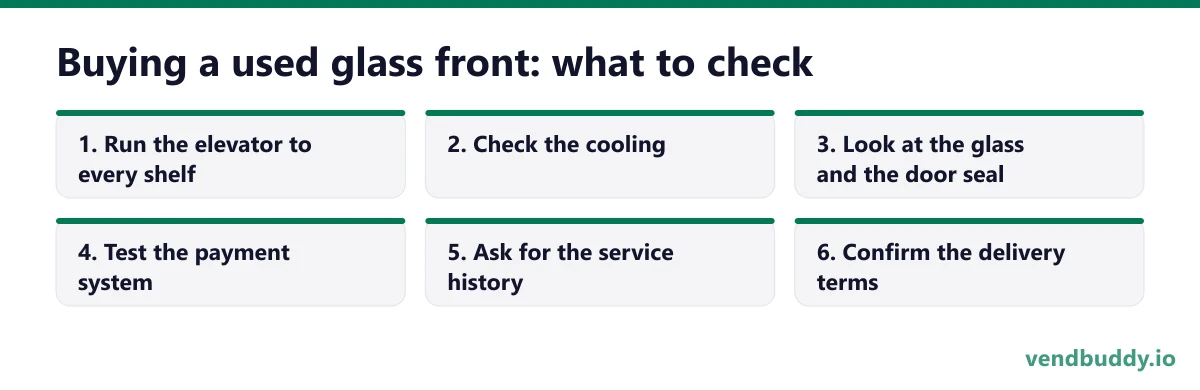
- Run the elevator to every shelf. Watch for hesitation, grinding or a delivery that misses the bin.
- Check the cooling. Put a thermometer in a bottle on the top shelf and one on the bottom after the machine has run for an hour. A big difference points to a fan or airflow problem.
- Look at the glass and the door seal. Cracked glass is expensive to ship and replace, and a worn seal makes the compressor work harder.
- Test the payment system. Bills, coins and the card reader, if one is included. Ask whether the reader's service contract transfers.
- Ask for the service history. Elevator motors and boards are the usual repairs; knowing they were replaced recently is worth money.
- Confirm the delivery terms. Machines this heavy usually come to the door, not into the building. Plan how it gets to the spot.
Stocking a glass front so it sells
The point of the glass is that people see the choice, so lay it out like a small store. Put the best sellers at eye level, keep each row full to the front so it never looks half empty, and group drinks by type: water together, sodas together, energy drinks together. Leave a row or two for rotating products and watch what moves. A glass front that shows ten rows of the same cola has thrown away the reason it cost more.
Check the shelf spacing whenever you change products. A row set for 12-ounce cans won't vend a tall energy can, and a jam on a glass front is a jam everyone can see.
Before you buy
Pick the location first, then the machine. A glass front in the wrong building is an expensive way to sell the same sodas a stack vendor would have sold. If you're still looking for the building, VendBuddy shows you which businesses near you are worth the walk-in.
Frequently Asked Questions
How much does a glass front vending machine cost?
Used glass front drink machines list from about $2,375 (Crane BevMax 3800). Refurbished BevMax 4 units list around $3,999 to $4,800, a refurbished BevMax 5800-4 from $5,795, and new glass front snack machines from about $6,000.
Is a glass front vending machine better than a stack vendor?
It's better where people want variety, because it offers 40 to 60 selections and handles any bottle size. A stack vendor is cheaper, tougher and usually earns more per dollar in high-volume spots where buyers want the same few drinks.
How many drinks does a glass front machine hold?
A BevMax 5800-4 holds about 450 12-ounce cans or 360 bottles across 45 selections, according to dealer listings. Capacity changes with how you set the shelves.
How wide is a glass front vending machine?
Most are 39 to 47 inches wide, 32 to 35.5 inches deep and 72 inches tall, and weigh roughly 700 to 760 pounds empty.
Why do glass front machines use an elevator?
So drinks are carried down instead of dropped. That prevents shaken sodas, protects glass bottles and lets the machine vend odd shapes and sizes without shims.
What is selling, which buildings say yes, and the numbers before you buy a machine. Free, confirm from your inbox, unsubscribe in one click. Refer one friend and get 25 VendBuddy credits.
General information, not legal, tax or financial advice. Rules change, so check the official source. Revenue and income figures are examples, not promises. See our terms.