- Used combo: $1,500–$3,000. New combo: $3,000–$6,000 — and $4,500–$6,500 if you want a name-brand cabinet rather than an entry-level import.
- All-in is the number that matters: about $2,000–$4,000 used and $4,000–$7,000 new, once the card reader, the first load of product, the move and the insurance are in.
- The cashless module is $300–$500 and it is not optional. Cash-only leaves 25–35% of sales uncollected, so it repays itself inside the first two months at almost any location.
- A combo is cheaper than a pair because it is smaller, not because it is a bargain. One cabinet, split between snacks and drinks, holding less of each.
- Three buyers should skip it: locations above ~150 daily buyers, drink-dominant venues, and anyone who has not measured the doorway.
A combo machine is the default first purchase in vending, and the price question behind it is narrower than it looks. You are not comparing fifteen machine types — you are asking what one cabinet that does snacks and drinks costs, what the card reader adds, and whether the money saved against buying two machines is real or is just capacity you gave away without noticing.
Part of our complete guide: how much does a vending machine cost.
This page answers that one question. If you want the full sheet across snack, drink, coffee, smart coolers and micro-markets, that lives in vending machine prices by type. Everything below is combo only.
What a combo actually costs in 2026
| What you are buying | Machine price | Realistic all-in |
|---|---|---|
| Private-party used combo (marketplace listing, as-is) | Under $1,000–$1,500 | $1,500–$2,500 |
| Dealer-refurbished used combo | $1,500–$3,000 | $2,000–$4,000 |
| New combo, entry-level import | $3,000–$4,000 | $4,000–$5,000 |
| New combo, name-brand with cashless | $4,500–$6,500 | $5,500–$7,000 |
The all-in column is the one to budget against, and almost no listing shows it. It carries the card reader, the opening load of product, moving a 600-plus-pound cabinet through a door, and the liability coverage most property managers ask to see before they sign. That is roughly $700–$1,000 on top of whatever the machine costs, and it does not shrink because the machine was cheap.
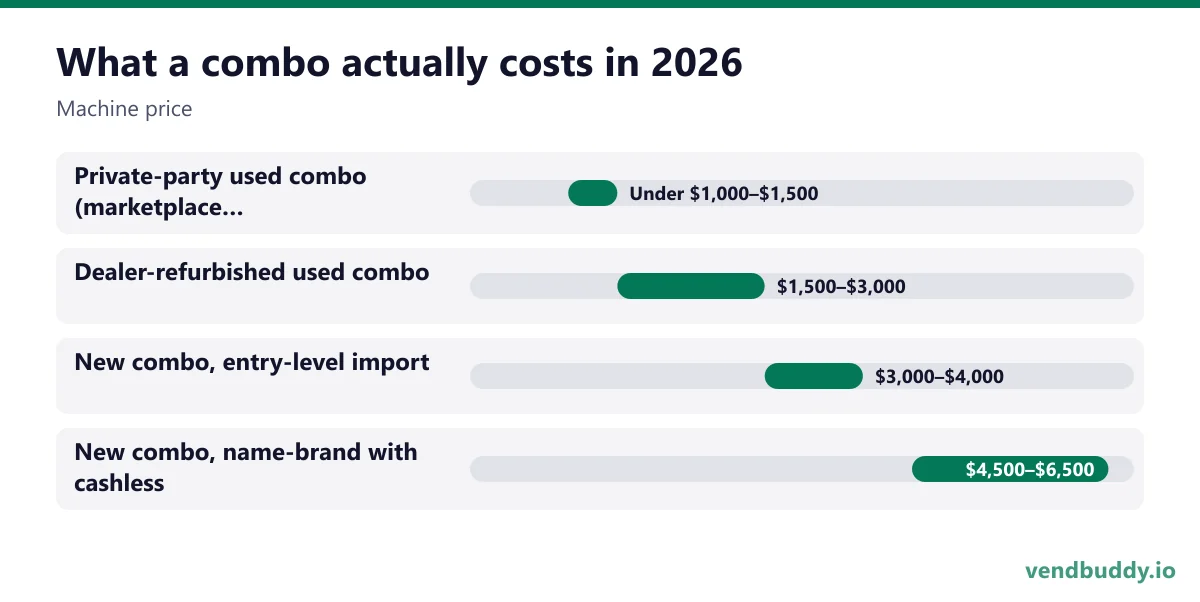
Notice what the bands do not say. There is no premium for a bigger combo at a location that will not sell the extra capacity, and there is no meaningful earnings difference between a $1,500 refurbished cabinet and a $6,000 new one standing in the same break room. Both vend the same bag of chips to the same person for the same $1.75. The price you pay changes your payback period; it does not change your revenue.
Every figure here is an average, and averages hide the building. The revenue calculator lets you plug in the property you are actually looking at and see the range for that type.
The $300–$500 line that is not optional
A cashless module — the card and tap reader on the front — adds about $300–$500 to a machine, whether it ships fitted from the factory or you retrofit it to a used cabinet afterwards. There is also a processing cost afterwards, typically a small percentage plus a per-transaction fee, and on some platforms a monthly connectivity charge per machine.
Fit it anyway, and treat the question as closed. A cash-only machine leaves roughly 25–35% of sales uncollected, because a meaningful share of the people walking past a machine in 2026 are not carrying a dollar bill at all. On a machine grossing $800 a month, the low end of that range is $200 a month you are declining to accept. The reader pays for itself somewhere in month two and then keeps paying.
The one place to spend thought rather than money is which reader, because the hardware, the fee structure and the telemetry that comes with it differ more than the price does. The card reader comparison covers what each platform charges and what it reports back.
A cash-only vending machine leaves 25 to 35 percent of sales on the table. The card reader costs $300 to $500 once. That is not a decision, it is arithmetic.
Picture the machines paying you while you sleep
That’s the real promise of vending — income that doesn’t cost you your time, and a life on your own terms. VendBuddy turns this guide into a step-by-step plan so you actually build it instead of just reading about it. Start free today.
Start building free →One combo, or a snack machine plus a drink machine?
This is the real trade behind the price, and it is a capacity question wearing a cost question’s clothes.
| One combo machine | A snack machine plus a drink machine | |
|---|---|---|
| New equipment cost | $3,000–$6,000 | $6,000–$12,000 |
| Used equipment cost | $1,500–$3,000 | $3,000–$6,000 |
| Card readers needed | One ($300–$500) | Two ($600–$1,000) |
| Delivery and placement | One move | Two moves |
| Floor space and power | One footprint, one outlet | Two footprints, often two outlets |
| Capacity per product line | Split — each side holds materially less | Full depth on both |
| Restock frequency at a busy site | Higher — the fast movers empty first | Lower |
| What the host sees | One tidy cabinet | A bank of machines, which some hosts refuse |
The traffic thresholds above are the same ones used in how to choose the right vending machine, and if you already have a specific building in mind, what machine to buy for your location works the problem from the room outward instead of from the catalogue.
Machines people on this page actually buy
If the combo you want is a new one, these are the listings operators actually buy. Both are cashless-only AI machines, so the card-reader line above is already inside the price. Affiliate links, and we earn a commission when you buy through one.
HAHA Smart Combo US-360View on Amazon →Drinks and snacks in one cabinet. The default first AI machine for a 50–100 person site.
HAHA AI Plus (Plus 440)View on Amazon →More shelf shapes and stacked goods. Worth the step up once a placement passes roughly 40 sales a day.
Three buyers who should not buy a combo
New or used, for a combo specifically
For a first combo, dealer-refurbished at $1,500–$3,000 is the right purchase in most cases. It earns exactly what a $6,000 new unit earns in the same room, and the $3,000 you did not spend is the difference between one machine and two. The risk is entirely in buying blind — a private-party cabinet at $700 that needs a compressor is a $1,100 machine with two weeks of downtime attached. Test the bill validator, the coin mech, every motor and the refrigeration under load before money moves; how to buy a used vending machine is the full inspection sequence.
Buy new when the machine is going into a location that will not tolerate a scuffed cabinet — a Class A office lobby, a medical building — or when a manufacturer warranty is what lets you sleep. Those are real reasons. "Used feels risky" is not one, and it is the reason most first-timers overspend by $3,000 on their opening purchase.
A $12-a-day location and a $40-a-day location cost identical money to enter - which means the building decides your return far more than the model number does. VendBuddy scores real venues near you by traffic, headcount and category, hands you the best contact on file for each, and models what a machine would net there. Five free credits, no card required.
Related reading: the full price sheet by machine type, how to buy a used machine without getting burned, how to choose the right machine, which card reader to fit, and how long a machine takes to pay for itself.
Frequently Asked Questions
How much does a combo vending machine cost?
A dealer-refurbished used combo runs $1,500 to $3,000 and a new one runs $3,000 to $6,000, with name-brand new units at $4,500 to $6,500 and the $3,000 end of the band being entry-level imports. Those are machine prices only. Add roughly $700 to $1,000 for the card reader, the opening load of product, moving it through a door and insurance, which puts a realistic used combo at $2,000 to $4,000 all-in and a new one at $4,000 to $7,000.
Most operators end up on Nayax for card readers because it is what the distributors already support. Their reader handles tap, chip and the telemetry feed in one box, and the monthly fee is the part to check against your per-machine volume before you commit the route to it. Affiliate link, so we may earn a commission at no extra cost to you.
Is a combo vending machine cheaper than buying two machines?
Yes, and by more than most first-time buyers expect. One new combo at $3,000 to $6,000 replaces a snack machine plus a drink machine that would run $6,000 to $12,000 new, and it needs one card reader instead of two, one delivery instead of two and one footprint instead of two. What you give up is capacity: a combo splits a single cabinet between snacks and drinks, so each side holds materially less than a dedicated machine would. Under about 50 buyers a day that trade is free. Above roughly 150 it starts costing you sales.
Does a combo vending machine come with a card reader?
New combos from the main distributors usually ship with a cashless module fitted or offered as a factory option, and it adds about $300 to $500 to the price. Used machines frequently do not have one, and retrofitting is the same $300 to $500 plus a monthly processing fee. Fit it either way. Cash-only machines leave roughly 25 to 35 percent of sales on the table, which is a bigger number than the reader costs in its first two months.
How much does a used combo vending machine cost?
A dealer-refurbished combo is $1,500 to $3,000 and a private-party machine off a marketplace listing can be under $1,000. The gap between those two numbers is the testing, the parts already replaced and somebody to call when it stops vending. For a first machine the dealer-refurbished end is usually the right purchase, because a $700 machine that needs a $400 compressor and two weeks of downtime was never actually $700.
Who should not buy a combo vending machine?
Three buyers. Anyone placing into a location with more than about 150 daily buyers, where the split cabinet will run out of the fast movers between visits and a dedicated pair earns more. Anyone whose location is overwhelmingly drink-driven, such as a gym or a warehouse in summer, because half a cabinet of snacks is half a cabinet of dead inventory. And anyone who has not confirmed the doorway, because a combo is a single wide cabinet that has to fit through one door rather than two narrower machines that fit through most.
What is selling, which buildings say yes, and the numbers before you buy a machine. Free, confirm from your inbox, unsubscribe in one click. Refer one friend and get 25 VendBuddy credits.
Want the free 38-page Ultimate Vending Guide too? Get the guide
General information, not legal, tax or financial advice. Rules change, so check the official source. Revenue and income figures are examples, not promises. See our terms.