- Energy has lower percentage margin than soda but higher gross profit per vend — about $1.45 on a $3.00 can versus $1.05 on a $1.50 soda. Same slot, more dollars.
- Price at $2.75–$3.50 for a 16oz can, $3.50–$4.00 in gyms and 24-hour sites. Price against the nearest convenience store, not against your own soda row.
- The venues that move volume are gyms, 24/7 warehouses, colleges and trade schools, and auto shops — anywhere with a night shift or a workout.
- Check your machine before your pallet. Older stack-style can machines are built for 12oz and jam on 16oz cans. Glass-front merchandisers take anything.
- Chasing specific brands? The Celsius and Alani Nu sourcing map is the deep dive under this page.
Energy is the one category that has genuinely changed vending economics in the last five years. A machine that used to average a $1.50 vend now averages closer to $2.40 in the right building, and almost all of that came from a handful of cans. Here is what the category actually earns, where to buy it, and which locations justify giving it real space.
One honest caveat before the numbers: energy drinks are not a magic row. They are a higher-ticket, lower-percentage, more perishable-by-date-code category that rewards the right venue and punishes the wrong one. Put four facings of energy in a 30-person daytime office and you will be pulling expired cans in five months.
Margins: energy versus soda, honestly
The percentage looks worse. The dollars look better. Both are true and the dollars are what pay you.
| Item | Typical wholesale | Typical vend price | Gross profit per vend | Gross margin |
|---|---|---|---|---|
| 12oz soda can | $0.42 | $1.50 | $1.08 | 72% |
| 20oz soda bottle | $1.10 | $2.25 | $1.15 | 51% |
| 16oz mainstream energy | $1.55 | $3.00 | $1.45 | 48% |
| 12oz fitness energy (Celsius, Alani Nu style) | $1.50 | $3.25 | $1.75 | 54% |
| 8.4oz premium energy | $1.45 | $2.75 | $1.30 | 47% |
Wholesale costs move with brand, pack size and lane, so treat those as the middle of a range rather than a quote. The shape is what matters: energy earns 35–60% more gross profit per vend than a soda can from the same slot. On a machine turning 400 vends a month, shifting 100 of those from soda to energy is roughly $40–$65 more gross profit a month for zero extra drive time.
Two costs sit against that. Energy ties up more cash per case, which matters when you are stocking three machines out of one paycheck. And it dates faster in practice, not because the shelf life is short but because slow rows in the wrong building sit long enough to reach it.
Where energy actually sells
Category performance in vending is a venue question far more than a product question. These are the buildings where energy earns its facings:
| Venue | Energy share of drink sales | What to stock |
|---|---|---|
| Gyms and fitness studios | 40–60% | Fitness energy and zero-sugar leads; add protein and electrolyte. See the gym vending guide. |
| 24/7 warehouses and distribution centers | 35–50% | Large-format mainstream energy for night shift, plus coffee-style energy at shift change. |
| Colleges and trade schools | 30–45% | Wide brand variety, price-sensitive; the newest brand outsells the best brand. |
| Auto, collision and machine shops | 30–40% | Mainstream 16oz, cold and cheap-feeling. Loyalty to one brand is unusually strong here. |
| Standard daytime offices | 15–25% | Two facings, zero-sugar weighted. Coffee competes directly and usually wins. |
| Apartment common areas | 10–20% | One or two facings. Convenience items and snacks carry these machines. |
The pattern is that energy sells where people are either about to exert themselves or fighting to stay awake, and it underperforms wherever a free coffee pot exists. That is worth knowing before you promise a property manager a machine full of it.
Picture the machines paying you while you sleep
That’s the real promise of vending — income that doesn’t cost you your time, and a life on your own terms. VendBuddy turns this guide into a step-by-step plan so you actually build it instead of just reading about it. Start free today.
Start building free →The four sourcing lanes
Which brands live in which lane keeps changing as beverage companies acquire distribution rights, so verify current availability before you build a planogram around a single brand. The lanes themselves are stable:
- Club stores. The right answer at one to five machines. No minimums, no account setup, and the per-unit cost is usually within 10–15% of a distributor. You pay in trips and in a hard ceiling on how much you can carry.
- Broadline vending distributors. Worth opening an account once you are ordering pallets rather than carts. Better pricing, delivery, and one invoice, but minimum orders and a catalog that does not always carry the fitness-energy brands your gyms want.
- Direct store delivery from the beverage companies. Once your volume justifies it, the big beverage companies will deliver, and sometimes supply or subsidize equipment. Read anything they ask you to sign carefully — exclusivity on a machine is a real constraint on your product mix.
- Regional and specialty distributors. Where you find the brands the big lanes have dropped or never carried. Costs more per unit, and is frequently the only way to keep a gym happy.
For the brand-by-brand version of this — who owns what, which lane carries it now, and what to do when your usual source drops a SKU — the Celsius and Alani Nu sourcing map is the detailed sibling to this page. For the broader wholesale comparison, Vistar versus the club stores runs the numbers on all four lanes across every category.
Finding the regional distributor who carries the brand your gym wants is the unglamorous half of this job. The Vending Business Starter Kit includes a distributor list covering all 50 states, so you start from names and phone numbers instead of a search box. $27 once, nothing renews.
See the 50-state distributor list →The equipment problem nobody warns you about
This is the most common expensive surprise in the category. Older stack-style can machines were engineered around the 12oz can. The 16oz format that most mainstream energy ships in is taller and often wider, and in those machines it either jams the stack, drops two at a time, or will not load at all. Operators discover this after buying a pallet.
What works, in order of flexibility:
- Glass-front merchandisers with adjustable shelves. Take any package in any format, let you merchandise the label toward the customer, and are the reason most drink-heavy operators standardize on them. Energy sells partly on branding, and a can nobody can see does not sell.
- Modern combo machines with drink shelves. Handle mixed formats, and let you run the snack-and-cold hybrid that fits smaller sites.
- Stack-style can machines. Check the manufacturer specification for your exact model before ordering. Some handle 16oz on specific columns only. Assume nothing.
Refrigeration matters more here too. Energy is a cold-only purchase — a lukewarm can does not sell at any price — so a compressor that struggles in a hot warehouse costs you the whole category, not just a few sales. If yours is marginal, that is a repair to make before you expand the row, and the repair cost guide covers what that should run.
Pricing without guessing
The reference price in the customer’s head is the gas station down the road, not your soda row. That is why a $3.25 energy drink sells fine next to a $1.50 soda and a $2.25 soda feels expensive next to the same can.
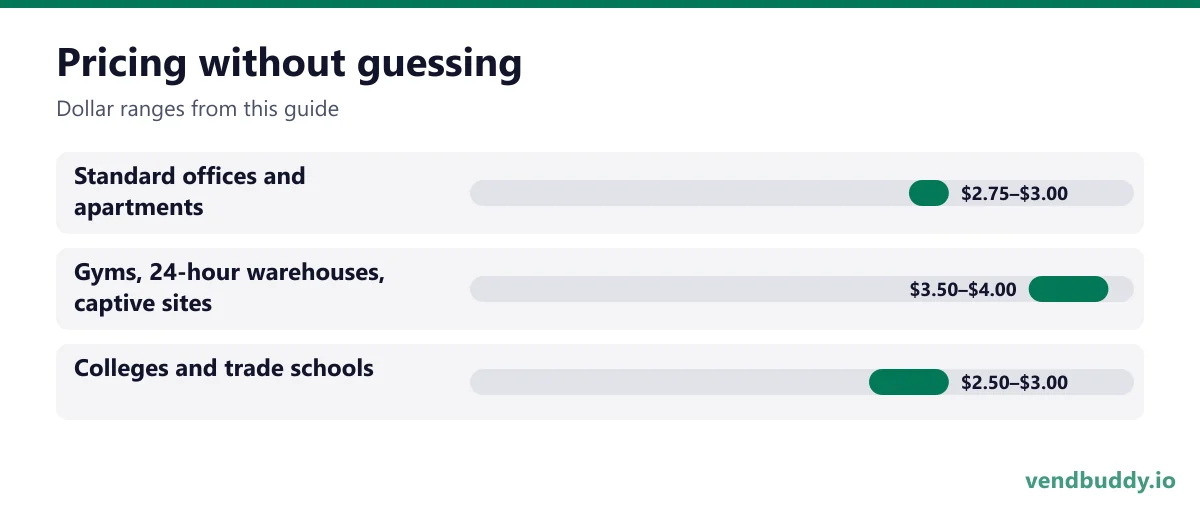
- Standard offices and apartments: $2.75–$3.00 for 16oz mainstream, $3.00–$3.25 for fitness energy.
- Gyms, 24-hour warehouses, captive sites: $3.50–$4.00. Convenience is the product and the nearest alternative is a drive.
- Colleges and trade schools: $2.50–$3.00. Price sensitivity is real and volume makes up the difference.
Raise in 25¢ steps and watch unit volume for two restock cycles before deciding. The category tolerates price better than any other in the machine, which is exactly why repricing on a schedule is worth more here than anywhere else.
Four mistakes that cost real money
- Over-facing in the wrong building. Four facings in a 30-person office is a slow expiry. Start with two, read the sales data, expand only where it earns.
- Ignoring date codes on the slow rows. Rotate on every visit, oldest to the front. A dated can is a total loss on a $1.55 cost, which wipes out the profit on the next three sales.
- Signing an exclusivity you did not read. Subsidised equipment from a beverage company can be a good trade. It can also lock the highest-margin brand in the category out of your best machine.
- Assuming energy is allowed. Many schools restrict caffeine sales, and some sites restrict products carrying a Supplement Facts panel rather than a Nutrition Facts panel. Ask before you plan the row — school vending contracts covers the rules that apply there.
The next step
If you have a gym, a 24-hour warehouse or a trade school in your pipeline, energy is the row to build the machine around and the reason that placement is worth pitching hard. If you are still deciding what a machine should hold generally, the product stocking guide covers the whole planogram, and the profitability ranking puts energy in context against every other category.
Frequently Asked Questions
Are energy drinks profitable in vending machines?
Yes, but for a different reason than people assume. Percentage margin on energy is lower than soda, roughly 45 to 55 percent against 65 to 72 percent. Gross profit per vend is higher: about 1.45 dollars on a 3.00 dollar energy drink against about 1.05 dollars on a 1.50 dollar soda. The same shelf space earns more dollars, which is what actually matters.
What should I charge for energy drinks in a vending machine?
Between 2.75 and 3.50 dollars for a 16 ounce can in most locations, and 3.50 to 4.00 dollars in gyms, 24 hour warehouses and captive sites where the nearest alternative is a drive. Price against the closest convenience store rather than against your soda row, because that is the comparison the buyer is actually making.
Where do vending operators buy energy drinks wholesale?
Four lanes: club stores for one to five machines, a broadline vending distributor once you are ordering pallets, direct store delivery from the beverage companies once your volume justifies it, and regional distributors for the brands the big lanes have dropped. Which brands sit in which lane changes, so verify before you build a planogram around one.
Which locations sell the most energy drinks?
Gyms, 24 hour warehouses and distribution centers, colleges and trade schools, auto and collision shops, and any site with a night shift. The common factor is not demographics, it is a captive audience that needs to stay awake or is about to work out. Standard daytime offices sell energy but at roughly half the rate.
Will 16 ounce energy cans fit my drink machine?
Often not. Older stack-style can machines are built around 12 ounce cans and either jam or refuse the taller 16 ounce format. Glass front merchandisers with adjustable shelves take any package. Check the manufacturer spec for your model before you order a pallet, because discovering this on restock day is expensive.
Related: where to source Celsius and Alani Nu, gym vending machines, the best products to stock, the most profitable vending products, cans versus bottles, and Vistar versus Costco, Sams and Walmart.
What is selling, which buildings say yes, and the numbers before you buy a machine. Free, confirm from your inbox, unsubscribe in one click. Refer one friend and get 25 VendBuddy credits.
General information, not legal, tax or financial advice. Rules change, so check the official source. Revenue and income figures are examples, not promises. See our terms.