- Hospital vending machines sell 24/7 to staff, patients and families, but most hospitals run vending through a contract, a food service partner or a procurement process.
- The American Hospital Association counts 5,121 US community hospitals in its 2026 Fast Facts.
- Lead Finder has scored 274 hospitals; they carry a median of 444 Google reviews and a 3.68 average rating (our data, 2026-10-04).
- Healthcare is a mid-sized search on VendBuddy: 19 operators ran 29 searches across 24 ZIP codes since April 2026.
- Pitch nutrition services, facilities or the food service director, offer healthy rows, and look at satellite buildings, outpatient clinics and smaller hospitals first.
Hospital vending machines look like the dream location: the lights are on 24 hours, the building is full of tired people, and nobody can pop out for a bite. The catch is that a hospital is the hardest building on this list to get into, and the reason is not the traffic. It is the contract. Whether you have a shot depends on a single question: who holds the food service and vending agreement, and when does it end?
Part of our complete guide: how to find vending machine locations.
Many operators will start with medical offices and urgent care clinics and come to hospitals later. If you do want a hospital, here is how it works.
What VendBuddy's Lead Finder shows for hospitals
The American Hospital Association counts 5,121 community hospitals in the United States in its 2026 Fast Facts, with 775,297 staffed beds (AHA, Fast Facts on U.S. Hospitals, 2026). Community hospitals are the nonfederal, short-term general and specialty hospitals. About 1,224 are investor-owned, 913 are state and local government, and 2,984 are nonprofit.
VendBuddy’s Lead Finder has scored 274 hospitals across 234 regions. They carry a median of 444 Google reviews, and the average rating is 3.68 stars, the lowest of any venue type we track with this much data (VendBuddy’s own Lead Finder data, 2026-10-04). That is a useful signal: people leave reviews when they are stressed. Do not use the rating to judge your odds. Use the review count to see how busy the place is.
On the search side, healthcare as a whole is mid-sized: 19 operators ran 29 healthcare searches across 24 ZIP codes since April 10, 2026. Lead Finder uses the default base score of 55 out of 100 for the healthcare family until it adjusts for the individual location.
Why hospital vending machines work: the night shift and the waiting room
A hospital is one of the few buildings with demand every hour of every day. The 775,297 staffed beds in U.S. community hospitals need nurses, technicians, doctors, cleaners and security on the floor around the clock, usually on 12 hour shifts. Each of those beds also brings visitors who sit for hours and do not want to leave the floor.
Three crowds, three patterns:
- Staff on nights and weekends. The cafeteria closes; the machine does not. This is the steadiest buyer you will find.
- Families in waiting rooms. Long, stressful waits in surgery, the emergency department and labor and delivery. Water, coffee and something salty.
- Outpatients. Short waits between check-in and a test, with a spike in the morning.
That is why the best machine in a hospital is rarely in the main lobby. It is the one by the staff lounge on a unit floor or in a 24 hour waiting room.
Picture the machines paying you while you sleep
That’s the real promise of vending — income that doesn’t cost you your time, and a life on your own terms. VendBuddy turns this guide into a step-by-step plan so you actually build it instead of just reading about it. Start free today.
Start building free →How a hospital runs
There are four groups of buyers. Staff, who work 12 hour shifts and make up the biggest group. Visitors, who spend hours in a waiting room or a patient room. Outpatients, who wait for tests and procedures. And patients themselves, though many are on restricted diets.
The night shift is the secret. A cafeteria that closes at 7 pm leaves hundreds of nurses and technicians with a vending machine as their only option. The best machines in a hospital are not the lobby ones; they are the ones near the nursing units, the staff lounges and the 24 hour waiting rooms.
Hospitals also run on rules. Many have adopted healthy vending policies that set limits on calories, sugar and sodium, or require a share of items to meet a nutrition standard. Some use traffic-light labeling. Expect a nutrition services department to review your product list.
Contracts, procurement and who is already there
Most hospitals do not let a vendor walk in. They run vending through one of three paths. A contract food service company that runs the cafeteria and also holds the vending rights. A group purchasing arrangement or an approved vendor list. Or a local hospital that gives the job to a single operator on a multi-year deal.
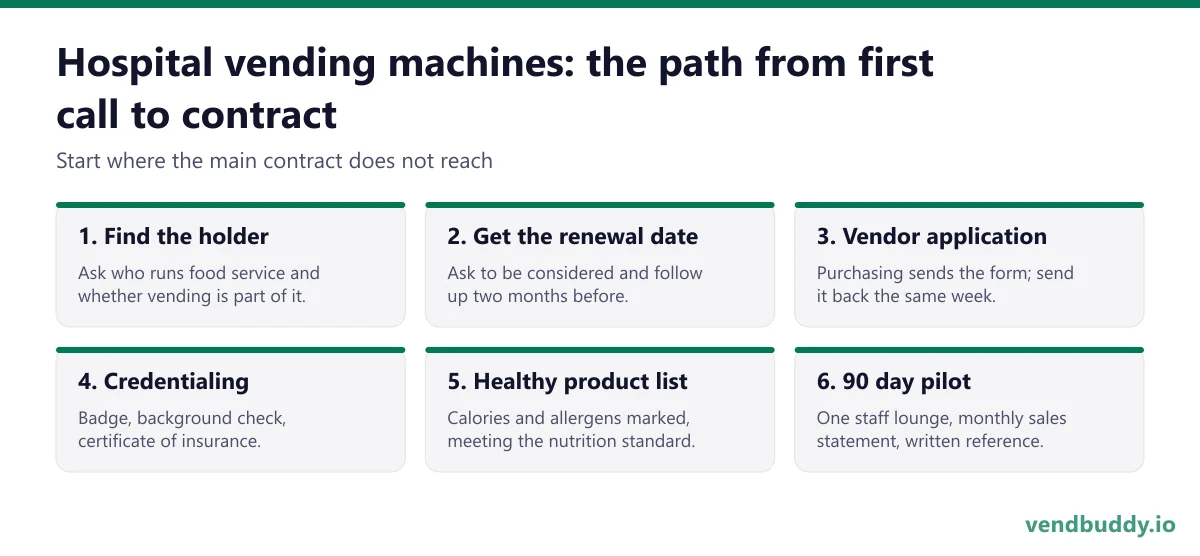
Ask three questions: Who runs your food service? Is vending part of that agreement? When does it renew? If a large contract caterer holds it, you will not get in this year, but you can ask to be on the list for the renewal. If the hospital manages its own vending, you may get a placement in a staff lounge or a clinic building.
Look at the edges. Satellite clinics, outpatient surgery centers, medical office buildings on the campus and smaller rural hospitals often manage their own vending and have fewer layers. Government and county hospitals follow public purchasing rules, so check the rules in can you put a vending machine anywhere.
What to look out for in a hospital vending agreement
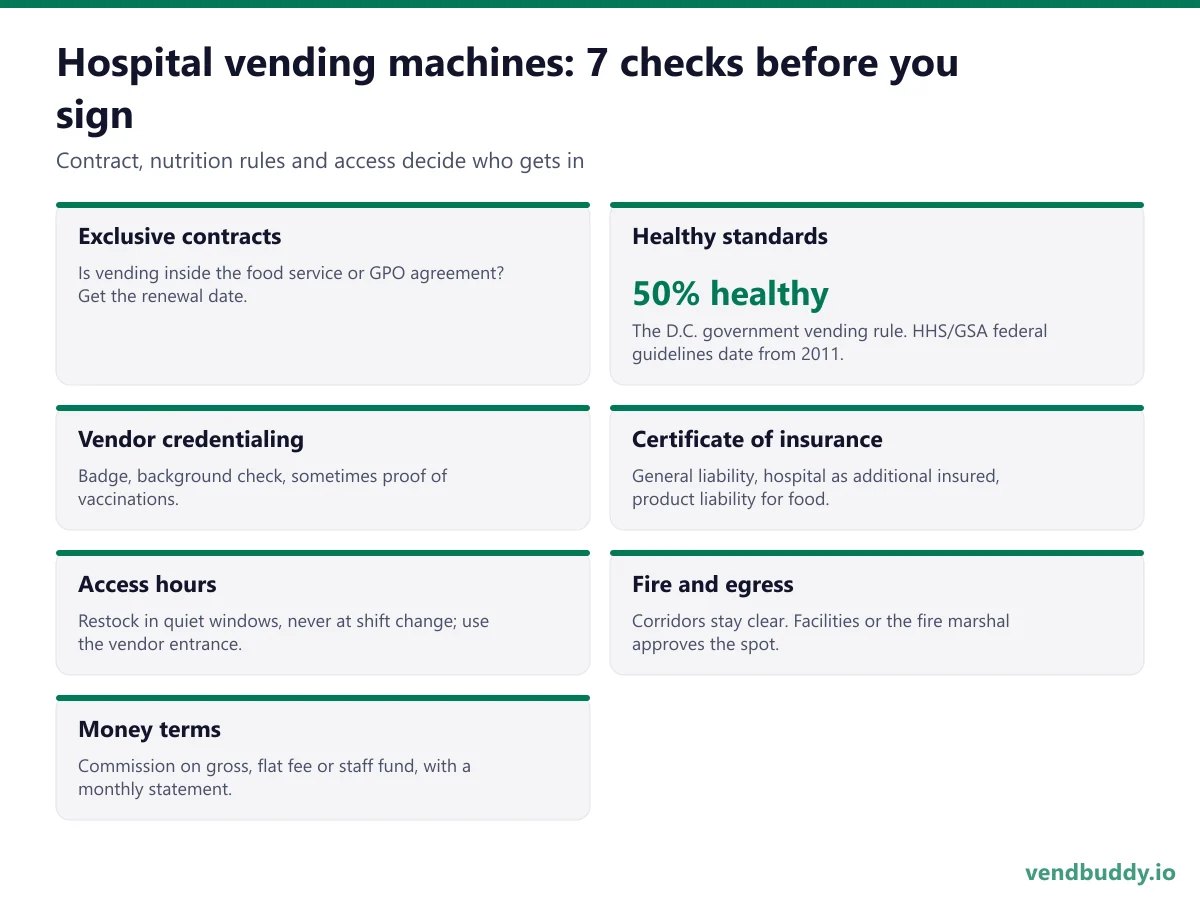
- Exclusive food service contracts. If a contract caterer or a group purchasing agreement already includes vending, the hospital may not be able to sign you even if it wants to. Ask for the renewal date and get on the list.
- Healthy vending standards. Many hospitals follow written nutrition rules. Federal buildings use the Health and Sustainability Guidelines for Federal Concessions and Vending Operations that HHS and GSA released jointly in 2011 (GAO, implementation of the HHS/GSA guidelines; CDC Stacks), and public rules elsewhere copy them. Washington, D.C., for example, requires that no less than 50% of the foods and beverages in District government vending be healthy (D.C. Code 1-541.02). Build your planogram so you can hand nutrition services a list that already meets a standard.
- Vendor credentialing. Many hospitals register vendors through a credentialing system before they can enter: a badge, a background check and sometimes proof of vaccinations. Ask on the first call so it does not hold up the install.
- Certificate of insurance. Expect to send a certificate with general liability and the hospital named as additional insured, and sometimes product liability for food.
- Access hours. Restock in quiet windows, not at shift change or during visiting peaks, and keep carts out of clinical hallways. Ask where to park and which entrance vendors use.
- Fire and egress rules. Corridors must stay clear. Facilities or the fire marshal may decide where a machine is allowed, so ask before you promise a spot.
- Money terms. A commission on gross, a flat fee, or a share routed to a staff fund. Get it in writing with a monthly statement and a clear removal clause.
A hospital that says no for contract reasons is not a bad location; it is a later location. A clinic building with no night traffic and a cafeteria next door can be. Our list of the worst vending locations covers those warning signs.
What to stock in a hospital machine
Hospitals want sturdy, easy-to-clean machines with card readers and clear labels. Smart fridges are a good fit for staff lounges, and the smart cooler guide covers the cost.
What to stock, and why:
- Bottled water and electrolyte drinks. The top sellers in every healthcare setting.
- Coffee drinks and unsweetened tea. What a night nurse needs at 3 am.
- Nuts, protein bars and jerky. Fit a nutrition standard and fill an empty stomach.
- Fruit cups, yogurt and cheese sticks. A fridge row that wins nutrition approval.
- Sandwiches and wraps. The real meal on a night shift. Rotate often.
- Crackers and pretzels. Gentle options for families waiting through a long day.
- Comfort items like gum, mints and small candy. A few, kept low in the machine.
See vending machine snacks for more ideas, and label allergens clearly.
Who signs at a hospital, and what to say
The person to find is the food service director, nutrition services manager, facilities manager or a purchasing contact. We do not list a fixed set of job titles for this venue in Lead Finder, so call the main number and ask who manages vending and vendor contracts. Expect to fill out a vendor application, show a certificate of insurance and provide your product list.
Worth reading before you sign anything: the contract walkthrough covers which terms get pushed back on and which ones you can safely give away. Commission is rarely the clause that hurts you later.
An opener:
“I run a small vending service that stocks healthy options. I’d like to learn how the hospital handles vending, and whether you have a vendor application or an upcoming renewal.”
The objection: “We already have a contract.” Answer: “Understood. When does it renew, and who would I contact to be considered?” Then follow up two months before.
On money, operators commonly report 5 to 15% of gross sales to the property, though hospitals under a contract may set their own terms or a flat fee. See vending machine commission rates and check your numbers in the vending ROI calculator.
On the walk-in, find the staff lounges and the 24 hour waiting rooms, see whether a machine is there and how it looks, and note which units run the night shift.
Hospital objections and how to answer them
- “Everything goes through our food service partner.” Ask whether satellite buildings, clinics or the parking garage are covered by the same agreement. Often they are not.
- “We need healthy options.” Bring a product list that already meets a nutrition standard, with calories and allergens marked. That turns the objection into your advantage.
- “You’re too small.” Offer a single staff lounge as a 90 day pilot with a monthly sales statement. Small operators answer service calls faster than national ones, and staff notice.
- “Send it to purchasing.” Do, and ask purchasing for the vendor application and the renewal date in the same email.
Illustrative example: a staff lounge pilot at a small hospital
Illustrative example, not a real operator or hospital. A small rural hospital runs its own cafeteria, which closes in the early evening. The night nurses walk to a lobby machine that is often empty.
An operator calls the main number, asks who manages vending and reaches the nutrition services manager. The manager will not change the lobby machine but agrees to a 90 day pilot in the second-floor staff lounge: a smart fridge with sandwiches, yogurt and fruit, plus a snack machine where more than half the items meet the hospital’s nutrition list. The operator completes vendor credentialing, sends a certificate of insurance and restocks twice a week in a set window.
The lesson is the path, not a dollar figure: start with one lounge the contract does not cover, earn a written reference, and be on the list when the main agreement renews.
How to find hospitals and medical centers near you
The quickest route: Find hospitals and medical centers near you in Lead Finder. It lists hospitals and medical centers around a ZIP with a score.
Free alternatives:
- Google Maps. Search “hospital near me”, “medical center” and “outpatient surgery center”. The smaller names are often easier.
- A drive-by test. Visit the main entrance and the staff entrance at 7 pm. Note who is walking in with a bag lunch.
Lead Finder adds contact, score and radius. For the general method, see how to find vending locations.
Start at the edges
You may not land the main campus first, and that is fine. A signed outpatient clinic or a rural hospital gives you references, and procurement offices respond to references. Find hospitals and medical centers near you in Lead Finder, list the smaller sites in your area, and ask each one how it handles vending.
To see how hospitals rank against warehouses, apartments and offices, read the best vending machine locations in 2026.
Frequently Asked Questions
Are hospitals good vending machine locations?
The traffic is excellent, with 24/7 staff, visitors and outpatients. The difficulty is access, because most hospitals run vending through a food service contract or procurement process. Smaller hospitals, outpatient centers and satellite clinics are often easier first targets.
What sells best in a hospital vending machine?
Water, electrolyte drinks, coffee, unsweetened tea, nuts, protein bars, fruit cups, yogurt and sandwiches. Night shifts buy meals and caffeine; visitors buy water and light snacks. Many hospitals require healthy options, so plan your mix around a nutrition standard.
How much commission does a hospital expect?
Operators commonly report 5 to 15% of gross sales to the property. Hospitals under a food service contract may set their own terms, a flat fee or revenue that goes to an employee fund. Ask the nutrition or facilities department what applies.
How do I get a vending contract with a hospital?
Ask who holds the food service and vending agreement and when it renews, then apply to the vendor list or bid. Provide insurance, a product list that meets their nutrition policy and references. Smaller sites on a campus are often easier first.
Do hospitals require healthy vending machines?
Many do. Federal buildings follow the HHS and GSA Health and Sustainability Guidelines for Federal Concessions and Vending Operations, released in 2011, and many hospitals and public bodies set their own nutrition rules. Washington, D.C. requires that no less than 50% of the foods and beverages in District government vending be healthy.
What is vendor credentialing at a hospital?
It is the registration a hospital requires before an outside vendor can enter. It often includes a badge, a background check and sometimes proof of vaccinations. Ask about it on the first call so it does not delay your install.
Where should a vending machine go in a hospital?
Near the staff lounges on unit floors and in 24 hour waiting rooms, not just the main lobby. Night staff and families waiting through surgery are the steadiest buyers. Facilities decides final placement because corridors must stay clear for fire safety.
What is selling, which buildings say yes, and the numbers before you buy a machine. Free, confirm from your inbox, unsubscribe in one click. Refer one friend and get 25 VendBuddy credits.
Every operator we talk to wants fewer cold calls. The ones who get there have a Google Business Profile and a simple site a manager can check before replying. AI builders make that an evening job now. Wix is the mature site builder; Base44 also builds working tools like a quote form. Start with the AI website walkthrough or Wix vs Base44.
General information, not legal, tax or financial advice. Rules change, so check the official source. Revenue and income figures are examples, not promises. See our terms.