- Urgent care vending machines work in busy clinics where patients and families wait 30 minutes or more and no cafe is nearby.
- The Urgent Care Association counted 15,032 urgent care centers in the US as of January 2025, and the number has grown since.
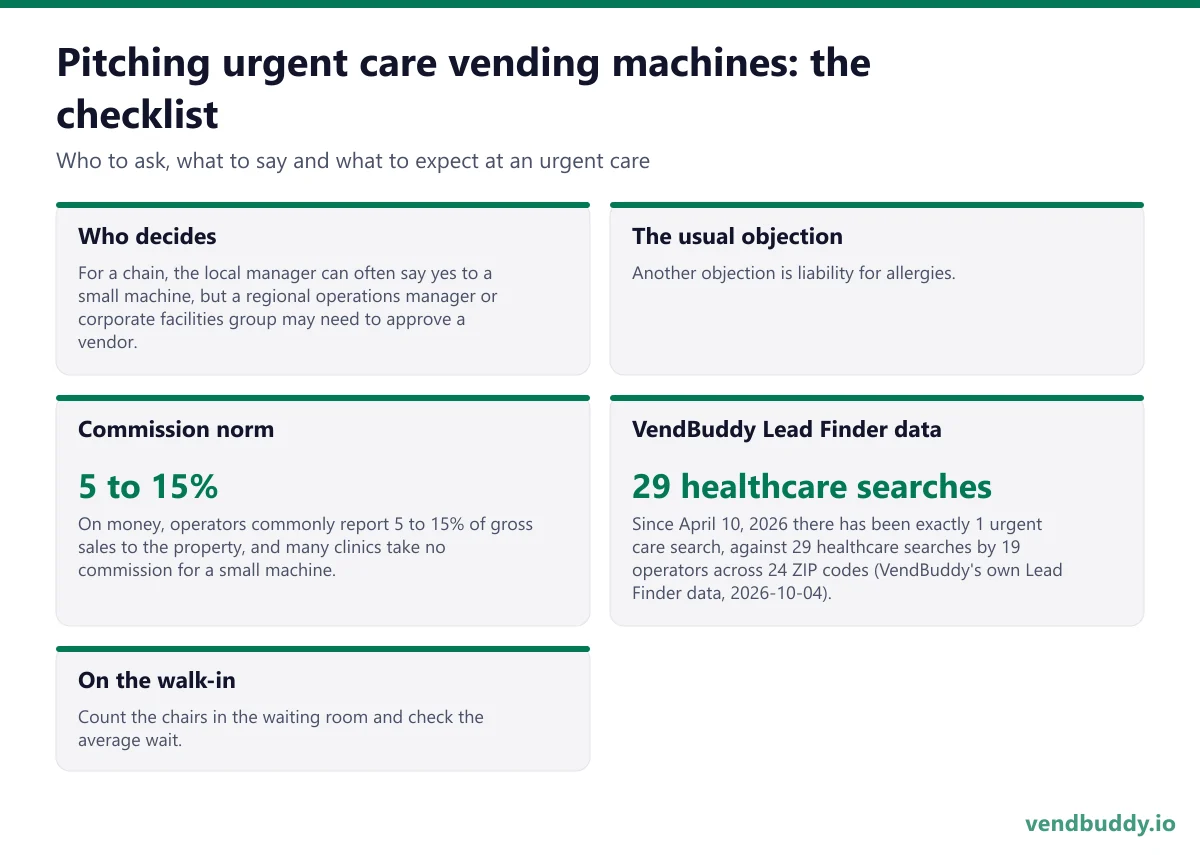
- Few operators search for them: VendBuddy logged 1 urgent care search since April 2026, against 29 healthcare searches by 19 operators overall (our data, 2026-10-04).
- Stock water, electrolyte drinks, juice, crackers and quiet snacks, and keep everything sealed and clearly labeled.
- Pitch the clinic manager or the regional operations contact, and expect a corporate approval step in chains.
Urgent care vending machines are a smart niche for an operator who likes steady, simple sites, because an urgent care waiting room is full of people with time and no plan. A parent with a sick kid, a worker with a sprained wrist, a college student with a fever: each one sits for half an hour or more, and each one gets thirsty. The condition that decides it is volume. A clinic that sees 60 patients a day is a placement. One that sees 12 is not.
Part of our complete guide: how to find vending machine locations.
It is also close to untouched. Few operators look for them, and most clinics have never been offered a machine by someone who knows how to pitch.
Urgent care clinics in VendBuddy's own data
The Urgent Care Association counted 15,032 open urgent care centers in the United States in January 2025 (State of Urgent Care 2025), and the count has grown every year the association has tracked it.
On VendBuddy, demand from operators is almost nonexistent. Since April 10, 2026 there has been exactly 1 urgent care search, against 29 healthcare searches by 19 operators across 24 ZIP codes (VendBuddy’s own Lead Finder data, 2026-10-04). For you, that is a reason to look: if no one else is knocking on these doors, you might be the first operator the clinic hears from. Lead Finder uses a default base score of 55 out of 100 for healthcare until the location is adjusted, so use your own walk-in numbers.
How an urgent care clinic runs
Most clinics open early and close late, often 8 am to 8 pm, seven days a week. Evenings and weekends are the busiest, because that is when primary care offices are closed. Winter brings the flu season peak, and a Monday morning can be packed.
Patients wait 20 to 60 minutes, and many bring a family member. Kids and parents are a big share of the crowd. They want a drink, a plain snack and something to keep a child busy. Most are not on a diet, but some are fasting or avoiding food, so a clear label and a water option matter.
Staff are a smaller group but a steady one. A clinic has maybe 8 to 15 staff on a shift, and they spend 10 to 12 hours there. A break room machine is a perk that clinics like.
Many clinics sit in strip centers or medical plazas, where the landlord has a say. A plaza with a pharmacy, a grocery store or a cafe next door cuts into your sales, since a patient can walk out for a drink. Look for clinics in standalone buildings or in places with little else around.
Picture the machines paying you while you sleep
That’s the real promise of vending — income that doesn’t cost you your time, and a life on your own terms. VendBuddy turns this guide into a step-by-step plan so you actually build it instead of just reading about it. Start free today.
Start building free →The rows that sell at a urgent care clinic
A small combo machine in the waiting room usually does the job. If the lobby is tight, put a countertop fridge near the check-in area or a slim machine in the staff area. Keep it quiet; clinics will not tolerate a noisy machine or a flashing display. A smart fridge also works, and our smart cooler guide covers costs.
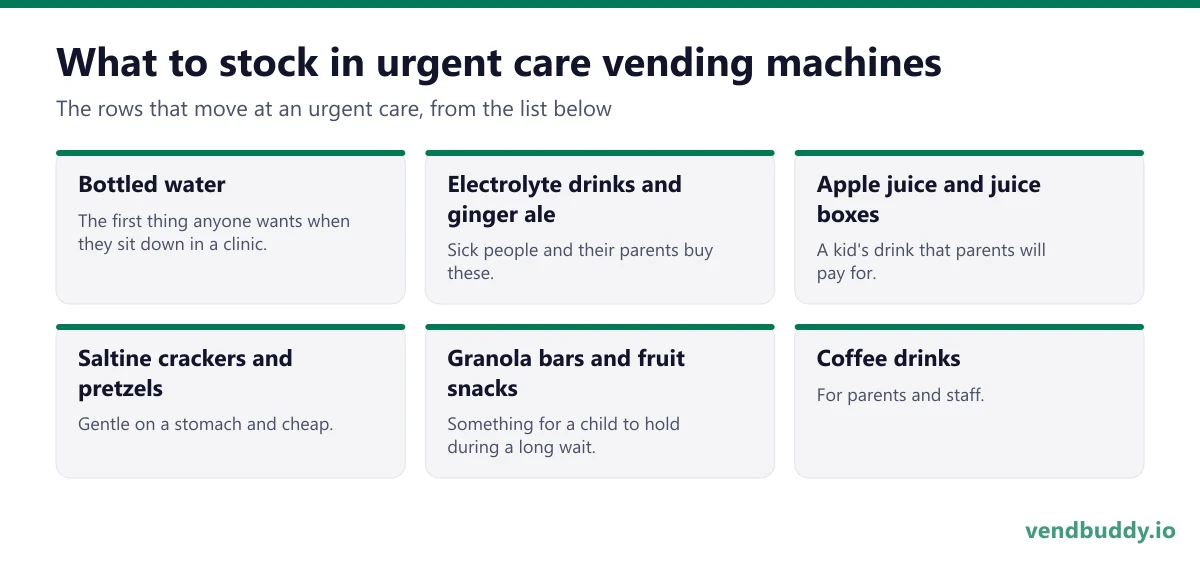
What to stock, and why:
- Bottled water. The first thing anyone wants when they sit down in a clinic.
- Electrolyte drinks and ginger ale. Sick people and their parents buy these.
- Apple juice and juice boxes. A kid’s drink that parents will pay for.
- Saltine crackers and pretzels. Gentle on a stomach and cheap.
- Granola bars and fruit snacks. Something for a child to hold during a long wait.
- Coffee drinks. For parents and staff.
- Tissues and hand sanitizer. Small items that sell in a clinic.
Skip anything messy, anything with nuts that you cannot label, and anything that smells strong. See vending machine snacks for more ideas.
Pitching the urgent care clinic: the opener and the objection
For an independent clinic, ask for the clinic manager or the practice owner. For a chain, the local manager can often say yes to a small machine, but a regional operations manager or corporate facilities group may need to approve a vendor. We do not list a fixed set of job titles for this venue in Lead Finder, so ask at the front desk who handles supplies and vendors.
An opener:
“I put small vending machines in clinics, stocked with water, juice and plain snacks, at no cost to you. A lot of your patients are waiting a while, and I’d like to see if a machine would help. Who should I talk to?”
The objection: “We don’t want food in the lobby.” Offer a drinks-only machine, or a staff-area placement, and show the clean, sealed stock. Another objection is liability for allergies. A sealed, labeled product list and your certificate of insurance help here.
On money, operators commonly report 5 to 15% of gross sales to the property, and many clinics take no commission for a small machine. See vending machine commission rates, and run the vending ROI calculator to check a low-volume site.
On the walk-in, ask how many patients are seen on a typical day and a busy day. Count the chairs in the waiting room and check the average wait. Look around for a pharmacy or a store within walking distance.
Running it well
An urgent care clinic can go from empty to packed in an hour, so keep the machine stocked for the busy part of the week. Fill it on Sunday night or Monday morning before the post-weekend rush, and again on Thursday. Winter sells more juice and electrolyte drinks, so adjust the rows when flu season starts.
Keep cleanliness front and center. Patients are sick, parents are worried, and nobody wants a sticky coin return. Wipe the front each visit, and offer to run a sanitizer wipe on the touch points. Clinic staff notice, and it separates you from the vendor who never shows up.
Finally, ask for a yearly check-in. Clinics change hours, add providers and remodel waiting rooms. A short call each spring keeps you in the loop and keeps the agreement alive, and it is a good moment to ask for a second machine or a staff-room fridge.
How to find urgent care clinics near you
The quickest route: Find urgent care clinics near you in Lead Finder. It lists urgent care and walk-in clinics around a ZIP.
Free alternatives:
- Google Maps. Search “urgent care near me” and “walk-in clinic”. Look for clinics with hundreds of reviews, since volume shows up there.
- A drive-by test. Drive past at 6 pm on a weekday. A full parking lot at that hour is a busy clinic.
Lead Finder adds the contact, a score and a radius. For the general method, see how to find vending locations. If you are working healthcare more broadly, see medical office vending machines and hospital vending machines.
Be the first to ask
Not many operators are asking these clinics. Make a list of the five busiest in your area, visit on a weekday evening, and talk to the manager. Find urgent care clinics near you in Lead Finder to build the list in a few minutes.
Frequently Asked Questions
Are urgent care clinics good vending machine locations?
Busy ones can be. Patients and families wait 20 to 60 minutes with nothing to do, and clinics stay open late and on weekends. A clinic seeing 50 or more patients a day is a good target; a quiet one is not. Check what is nearby, since a pharmacy next door cuts sales.
What sells best in an urgent care vending machine?
Bottled water, electrolyte drinks, ginger ale, apple juice, saltine crackers, pretzels, granola bars and fruit snacks. Sick patients and parents want plain, gentle items and drinks. Keep everything sealed and labeled, and skip messy or strong-smelling products.
How much commission does an urgent care expect?
Operators commonly report 5 to 15% of gross sales to the property. Many clinics take little or nothing for a small machine that helps patients. A chain may set terms at the regional level, so ask the local manager who handles vendors.
Who approves a vending machine at an urgent care?
At an independent clinic, the clinic manager or owner. At a chain, the local manager may agree, but a regional operations or corporate facilities contact often approves vendors. Have a certificate of insurance and a product list ready.
What is selling, which buildings say yes, and the numbers before you buy a machine. Free, confirm from your inbox, unsubscribe in one click. Refer one friend and get 25 VendBuddy credits.
Walk-ins and cold emails find locations. A small site with your own machine photos and a request-a-machine form lets the next one find you. Around machine three to five, an AI builder drafts it in an evening. Wix is the mature site builder; Base44 also builds working tools like a quote form. Start with the AI website walkthrough or Wix vs Base44.
General information, not legal, tax or financial advice. Rules change, so check the official source. Revenue and income figures are examples, not promises. See our terms.