- Medical office vending machines work in large practices with 20 or more staff, multi-doctor clinics and waiting rooms where patients sit for 20 minutes or more.
- Lead Finder has scored 637 doctor offices and 94 physiotherapy clinics; doctor offices carry a median of 141 Google reviews and a 4.35 average rating (our data, 2026-10-04).
- On VendBuddy, 19 operators ran 29 healthcare searches across 24 ZIP codes since April 2026.
- CDC survey data counted about 1.04 billion office-based physician visits in 2019, so the visitor base is large.
- Stock water, low-sugar drinks, nuts and protein for staff, and keep patient-facing items healthy. Pitch the practice or office manager.
Medical office vending machines are a quiet, steady placement, and they work because a doctor’s office has two audiences under one roof. The staff are there from 7 to 5 with a break room and no time to leave. The patients sit in a waiting room, often longer than they planned. Whether it works for you comes down to size: a four-person practice cannot carry a machine, but a clinic with 20 staff and a waiting room that stays full can.
Part of our complete guide: how to find vending machine locations.
This guide is for clinics and practices, the kind with a front desk and exam rooms. For hospitals, see hospital vending machines; for walk-in clinics, urgent care vending machines.
The numbers behind medical offices
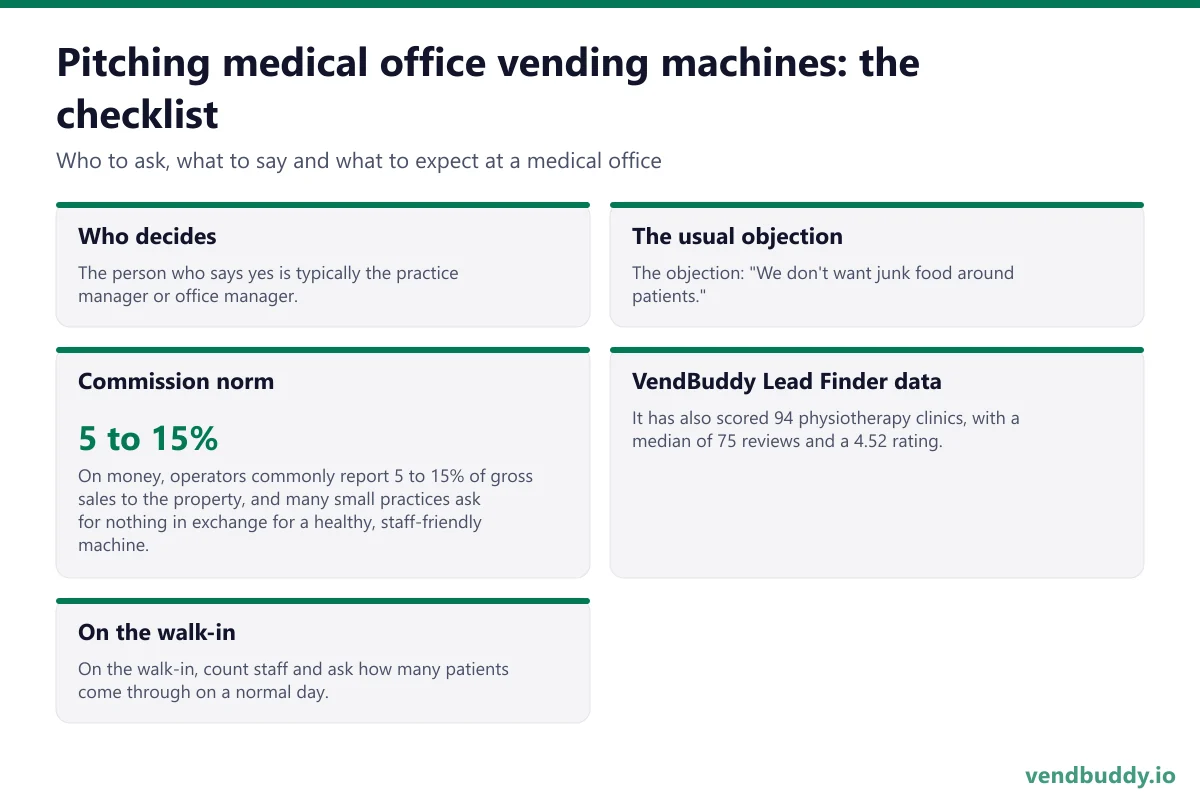
Healthcare is a mid-sized search on VendBuddy. Since April 10, 2026, 19 operators ran 29 healthcare searches across 24 ZIP codes (VendBuddy’s own Lead Finder data, 2026-10-04). Lead lists in this space are deep: the Lead Finder has scored 637 doctor offices across 363 regions, with a median of 141 Google reviews and a 4.35 average rating. It has also scored 94 physiotherapy clinics, with a median of 75 reviews and a 4.52 rating. Healthcare uses the default base score of 55 out of 100 until a practice is adjusted for review volume, demographics and distance, so the number you see for a clinic matters more than the family score.
The visitor base is large. The CDC’s National Ambulatory Medical Care Survey estimated about 1.04 billion visits to office-based physicians in the United States in 2019 (CDC, NAMCS 2019 summary tables). Most of those visits happen in practices too small for a machine, which is why the big ones are worth finding.
How a medical office runs
Hours are regular, usually 8 to 5, with a lull at lunch when the office closes for an hour. Patients arrive in clusters in the morning and mid-afternoon. A waiting room with 12 chairs and a 25 minute average wait is a place where someone buys a drink. A pediatric office has parents and children who are bored. A physical therapy clinic has people who have just done an hour of exercise and want water.
Staff are the steadier customer. Doctors, nurses and medical assistants work long days with little time away, and many eat at their desks. A break room with ten people who see the machine every day is worth more than a lobby full of strangers.
Know the rules. Many practices have wellness goals and do not want sugary drinks or candy in front of patients. Some sit in medical office buildings where the landlord controls common areas, and the building may have an exclusive vendor. Fasting patients and children with allergies are a reason to label everything clearly.
Picture the machines paying you while you sleep
That’s the real promise of vending — income that doesn’t cost you your time, and a life on your own terms. VendBuddy turns this guide into a step-by-step plan so you actually build it instead of just reading about it. Start free today.
Start building free →Stocking for a medical office: the rows that move
Small practices use a slim combo or a countertop fridge in the break room. Large clinics with a lobby and a staff room can use two machines: one for staff and one for patients. A smart fridge with fresh food and a card reader works well for staff; our smart cooler guide covers the costs.
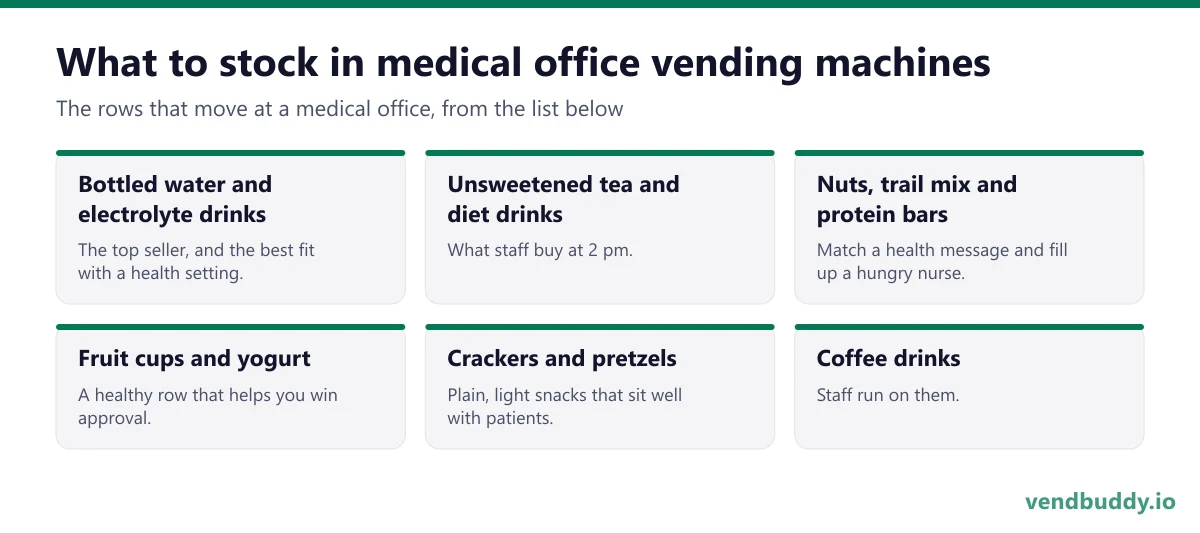
What to stock, and why:
- Bottled water and electrolyte drinks. The top seller, and the best fit with a health setting.
- Unsweetened tea and diet drinks. What staff buy at 2 pm.
- Nuts, trail mix and protein bars. Match a health message and fill up a hungry nurse.
- Fruit cups and yogurt. A healthy row that helps you win approval.
- Crackers and pretzels. Plain, light snacks that sit well with patients.
- Coffee drinks. Staff run on them.
- Sugar-free gum and mints. Cheap, small, easy to sell at checkout time.
Keep items nut-labeled and sealed. See vending machine snacks for more ideas.
Getting the yes from a medical office
The person who says yes is typically the practice manager or office manager. In a physician-owned practice, the lead doctor may sign off; in a hospital-owned or private-equity-backed group, the decision may go to a regional manager. We do not list a fixed title set for this venue in Lead Finder, so ask at the front desk who handles vendors and supplies.
An opener:
“I run a small vending service that stocks healthy snacks and water. Your staff and patients have no place to buy anything nearby, and I’d like to put a machine in your break room at no cost. Who handles that for the practice?”
The objection: “We don’t want junk food around patients.” Agree, then show your healthy planogram: water, nuts, protein, fruit and plain crackers, and offer to remove any item they dislike.
On money, operators commonly report 5 to 15% of gross sales to the property, and many small practices ask for nothing in exchange for a healthy, staff-friendly machine. See vending machine commission rates and use the vending ROI calculator.
On the walk-in, count staff and ask how many patients come through on a normal day. Look at the waiting room for seats and the average wait. Check whether the building has an exclusive vending vendor in the lease.
Running it well
Clean and full is the whole job in a medical setting. A practice manager looks at the machine every day on the way to the break room, and a dusty or empty one reflects on the office. Visit weekly, wipe it down, pull anything near its date and keep the glass clear.
Watch the product mix as well. If staff keep asking for a certain coffee drink or protein bar, add it. If patients rarely touch the candy row, replace it with water or crackers. A small practice will tell you what it wants if you ask once a month.
Plan for privacy and quiet. Do not place a machine near exam rooms or where a conversation could be overheard, and pick a model that hums softly. Ask the manager to choose the spot, and stay out of clinical areas. A vendor who respects those lines gets a long agreement and often a referral to another practice in the same building.
How to find medical offices near you
The quickest route: Find medical offices and clinics near you in Lead Finder. It lists doctor offices, clinics and therapy practices around a ZIP, with a score.
Free alternatives:
- Google Maps. Search “medical group near me”, “family practice” and “physical therapy”. Practices with many reviews and several providers are the larger ones.
- A drive-by test. Visit a medical office building at 10 am. A full lot and a crowded lobby mean volume.
Lead Finder adds the contact, a score and a radius. For the general method, see how to find vending locations.
Pick the big practices first
You will talk to a lot of small offices that cannot carry a machine. Skip them. Look for the multi-doctor groups, the specialty centers and the clinics that share a building. Find medical offices and clinics near you in Lead Finder, sort by review count and call the practice managers at the top.
Frequently Asked Questions
Are medical offices good vending machine locations?
Larger ones can be. Practices with 20 or more staff, several providers and a busy waiting room give you a break room crowd and patients who wait. A small practice with a handful of employees usually cannot carry a machine.
What sells best in a medical office vending machine?
Bottled water, electrolyte drinks, unsweetened tea, nuts, protein bars, fruit cups, yogurt, plain crackers and sugar-free gum. Staff buy coffee and protein; patients buy water and light snacks. A healthy mix helps you win approval.
How much commission does a medical office expect?
Operators commonly report 5 to 15% of gross sales, and many small practices ask for nothing in return for a healthy, staff-friendly machine. Larger groups or building landlords may ask for a percentage or have a preferred vendor.
Can I put a vending machine in a doctor office waiting room?
Often yes, with the practice manager's approval. Many practices prefer a healthier mix and a break room placement for staff. Check the building lease for exclusive vendors, label allergens clearly and keep the machine clean and full.
What is selling, which buildings say yes, and the numbers before you buy a machine. Free, confirm from your inbox, unsubscribe in one click. Refer one friend and get 25 VendBuddy credits.
Every operator we talk to wants fewer cold calls. The ones who get there have a Google Business Profile and a simple site a manager can check before replying. AI builders make that an evening job now. Wix is the mature site builder; Base44 also builds working tools like a quote form. Start with the AI website walkthrough or Wix vs Base44.
General information, not legal, tax or financial advice. Rules change, so check the official source. Revenue and income figures are examples, not promises. See our terms.