- As of October 1, 2026, the main US marketplace listed 263 vending machine businesses for sale; 234 were established operations once start-up packages and non-US listings were removed.
- Median asking price: $120,000. The middle half asked $48,000 to $168,000.
- Where sellers showed cash flow (129 listings), the median asking price was 2.3x annual cash flow, with the middle half between 1.4x and 3.4x.
- A low multiple is not a bargain on its own: cash flow on a listing is usually before paying yourself, and many listings show no numbers at all.
- Verify machine-level sales, location agreements and transferability before any money moves.
Vending routes for sale are easy to find and hard to price. A listing tells you a city, an asking price and, if you’re lucky, a cash-flow number. It doesn’t tell you whether that price is normal. So we counted: every public vending machine business listing on the largest US business-for-sale marketplace, as of October 1, 2026, reduced to the numbers a buyer actually needs.
Part of our complete guide: scale a vending machine business.
Buying a route is one of the fastest ways to get time back from a job: the locations are already signed and the machines are already selling. It is also the easiest place in vending to overpay. Here is what the market looks like, how to read a listing, and what to check before you hand anyone a deposit.
The market in one table
Data as of October 1, 2026. Source: the public BizBuySell vending machine businesses category. These are our counts of public listing pages; asking prices are what sellers want, not what routes sold for.
| Measure | Value |
|---|---|
| Listings in the category | 263 |
| Established businesses (start-up packages and Canada removed) | 234 |
| Median asking price | $120,000 |
| Middle half of asking prices | $48,000 to $168,000 |
| Listings showing cash flow | 130 |
| Median asking price / annual cash flow | 2.3x (middle half 1.4x to 3.4x) |
| Median asking price per machine (listings that state a count) | $5,700 (28 listings) |
| Smart coolers, micro markets or kiosks mentioned | 12% of established listings |
Asking prices by band
| Asking price | Established listings |
|---|---|
| Under $50,000 | 60 |
| $50,000 to $150,000 | 101 |
| $150,000 to $500,000 | 60 |
| Over $500,000 | 13 |
Specialty routes show up too. The most common in this snapshot: coffee (6), claw (4), pokemon (3), bulk (3), atm (3), ice (2).
How vending routes are priced
Small businesses usually sell for a multiple of what they earn, and routes are no different. In this snapshot the median asking price was 2.3x the annual cash flow the seller reported. For context, the Coin Laundry Association says laundromats usually sell for three to five times net cash flow (CLA), so vending asks sit lower, which fits a business where locations can leave on short notice.
Two cautions. First, “cash flow” on most listings is seller’s discretionary earnings, which is before the owner pays themselves for restocking and driving. If the route needs 20 hours a week of your time, subtract a fair wage before you judge the multiple. Second, 5 listings reported EBITDA instead, which we left out of the multiple because it isn’t the same measure.
Here’s how to use the multiple: take the cash flow you can verify, subtract your own labor, and multiply by the market range. If the asking price lands well above that, the seller is pricing in growth you’d be paying to deliver. Our route negotiation guide shows how to bring that back to the table.
Picture the machines paying you while you sleep
That’s the real promise of vending — income that doesn’t cost you your time, and a life on your own terms. VendBuddy turns this guide into a step-by-step plan so you actually build it instead of just reading about it. Start free today.
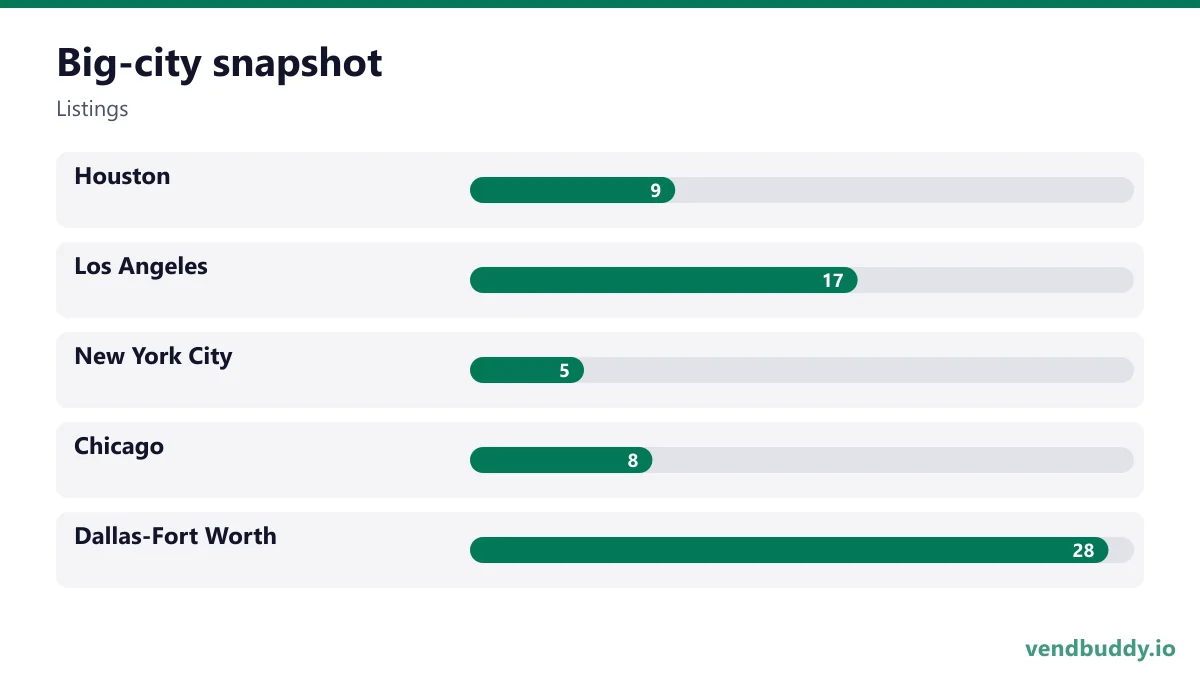
Start building free →Big-city snapshot
| Metro | Listings | Established | Median ask |
|---|---|---|---|
| Houston | 9 | 9 | $142,900 |
| Los Angeles | 17 | 17 | $69,000 |
| New York City | 5 | 5 | $135,000 |
| Chicago | 8 | 8 | $124,875 |
| Dallas-Fort Worth | 28 | 25 | $130,000 |
Dallas-Fort Worth combines Dallas, Tarrant, Collin and Denton counties. Big metros have fewer listings than you’d expect, because good urban routes often sell privately before they reach a marketplace.
States with the most routes for sale
| State | Established listings | Median ask | Median ask / cash flow |
|---|---|---|---|
| Florida | 27 | $125,000 | 3.1x |
| California | 26 | $73,975 | 3.2x |
| Texas | 25 | $130,000 | 1.4x |
| Indiana | 12 | $102,250 | 2.5x |
| Ohio | 12 | $130,600 | 1.9x |
| New York | 11 | $83,500 | 2.5x |
| Pennsylvania | 11 | $120,000 | 1.5x |
| Illinois | 10 | $114,875 | 2.4x |
| Tennessee | 10 | $130,000 | 2.3x |
| Colorado | 9 | $120,000 | 2.0x |
| North Carolina | 9 | $95,000 | 2.0x |
| Michigan | 8 | $122,500 | 2.0x |
Each state link goes to that state’s rules, taxes and researched city guides.
What to check before you buy a vending route
- Machine-level sales, not a route total. Ask for 12 months of sales per machine from the card-reader or telemetry dashboard, not a spreadsheet. A route total hides the two machines carrying the other ten.
- The cash-flow definition. Listings say “cash flow” (seller’s discretionary earnings, before the owner’s own pay) or EBITDA. Rebuild it yourself: sales minus product cost, commissions, card fees, fuel and repairs, then pay yourself for the hours.
- Location agreements. Get every placement agreement and read the term, the commission and the termination clause. A location on a handshake can leave the week after you buy. Our contracts guide covers the clauses that matter.
- Machine age and condition. List every machine by model and year, test the coolers, bill validators and card readers, and price what you would replace in the first year.
- Hours. Ride the route for a full week. A route that needs 30 hours a week is a job, and the price should reflect that.
- Concentration. If one building is more than a third of sales, the route is really that building. Ask how long it has been there and when its agreement renews.
- Transfer. Ask whether each location has agreed to the sale. Some agreements are not assignable without consent.
The full version, with a document request list, is in our vending route due diligence checklist.
Red flags in vending route listings
- No financials at all. In this snapshot 100 of 237 established listings showed no cash-flow figure on the listing card. That doesn’t make them bad, but it means every number is still a claim.
- “Turnkey” packages that are really machine sales. 14 listings in the national category were start-up packages: new machines plus placement promises, not a running business. Price those against machine prices, not against route multiples.
- A price far above the machines. When the asking price is many times what the equipment would cost and the cash flow is thin, you are paying for locations, so the location agreements have to be strong.
- Cash-only routes with no records. If sales can’t be traced to card data or deposits, assume the reported number is optimistic.
- Pressure to close fast. A seller who won’t let you ride the route or call the locations is telling you something.
Where else routes change hands
Marketplaces are only part of it. Retiring operators often sell to someone they know, through a distributor or a local vending association, or through owner groups online. Our guide to retiring-operator deals covers how to find them, and seller financing explains how buyers pay over time. VendBuddy members can also post and browse routes on the VendBuddy marketplace, and the routes for sale by state page shows what is listed in yours.
Buy a route or build one?
Buying gets you cash flow on day one and costs a multiple of it. Building costs a machine and your time, and the first good location can take weeks of walk-ins. If you only want one machine that is already earning, read how to check a vending machine for sale with a location before you pay a premium for the placement. Plenty of operators do both: they buy a small route to learn the work, then grow it with their own placements. If you are leaning toward buying, Walker Deibel’s Buy Then Build is the standard book on acquiring a small business instead of starting one. If you’d rather build, VendBuddy shows you which businesses near you are worth the walk-in.
How we built these numbers
We read the public category pages for the US, each state and five metros, de-duplicated listings by their ID, removed start-up packages, franchise ads and Canadian listings, and computed medians and middle-half ranges from the asking prices and cash-flow figures shown on the listing cards. We do not copy listing descriptions or verify sellers’ claims. The data refreshes periodically; this page shows the date of the last run.
Frequently Asked Questions
How much does a vending route cost?
As of October 1, 2026, the median asking price for an established US vending business on the main marketplace was $120,000, and the middle half asked $48,000 to $168,000. Size, machine age and location agreements drive the spread.
What multiple do vending routes sell for?
Where sellers showed cash flow, the median asking price was 2.3x annual cash flow, with the middle half between 1.4x and 3.4x. Asking prices are not sale prices, and listed cash flow is usually before paying the owner.
Is buying a vending route a good idea?
It can be, if the sales are verifiable machine by machine, the location agreements are in writing and transferable, and the price still works after you pay yourself for the hours. Many listings show no financials at all.
Where can I find vending routes for sale near me?
Business-for-sale marketplaces, vending distributors and associations, operator groups online, and the VendBuddy marketplace. Retiring operators often sell privately, so asking around locally finds routes that never get listed.
What is selling, which buildings say yes, and the numbers before you buy a machine. Free, confirm from your inbox, unsubscribe in one click. Refer one friend and get 25 VendBuddy credits.
Walk-ins and cold emails find locations. A small site with your own machine photos and a request-a-machine form lets the next one find you. Around machine three to five, an AI builder drafts it in an evening. Wix is the mature site builder; Base44 also builds working tools like a quote form. Start with the AI website walkthrough or Wix vs Base44.
General information, not legal, tax or financial advice. Rules change, so check the official source. Revenue and income figures are examples, not promises. See our terms.