- As of October 1, 2026, public listing pages showed 9 vending businesses for sale in the Houston market, 9 of them established operations.
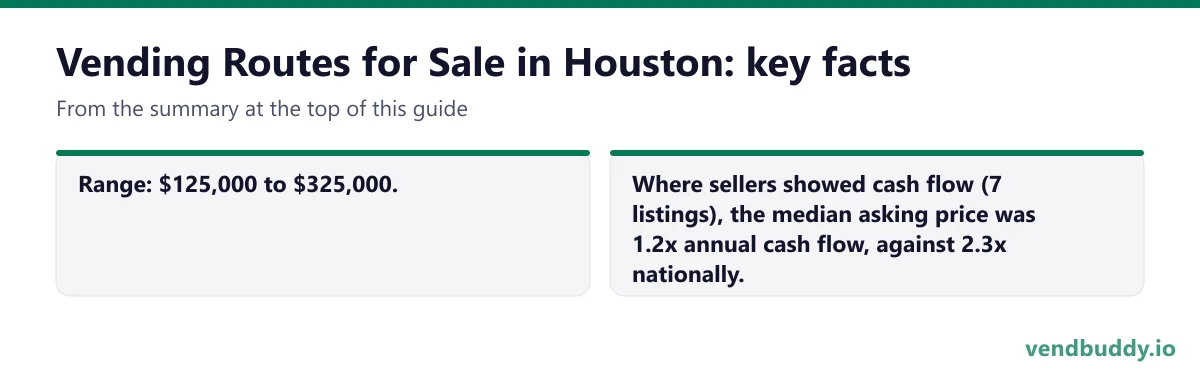
- Median asking price: $142,900, above the national median of $120,000. Range: $125,000 to $325,000.
- Where sellers showed cash flow (7 listings), the median asking price was 1.2x annual cash flow, against 2.3x nationally. A multiple that low usually means some listed cash-flow figures are projections or include the owner’s pay, so ask for the bank deposits behind them.
- Check machine-level sales, written and transferable location agreements, and the hours the route really takes.
Vending routes for sale in Houston come up less often than you’d think for a market this size, and when they do, the asking prices are all over the place. As of October 1, 2026, we counted 9 established Houston-area vending businesses on the largest public marketplace. Here is what they ask, how that compares with the rest of the country, and what to check before you buy one.
Part of our complete guide: scale a vending machine business.
Houston route listings at a glance
| Measure | Houston | National |
|---|---|---|
| Established listings | 9 | 234 |
| Median asking price | $142,900 | $120,000 |
| Asking price range | $125,000 to $325,000 | $1,500 to $2,000,000 |
| Median ask / annual cash flow | 1.2x | 2.3x |
| Listings mentioning smart coolers, micro markets or kiosks | 22% | 12% |
Source: public BizBuySell category page for the Houston market, data as of October 1, 2026. These are our counts and medians; asking prices are not sale prices.
Asking prices by band
| Asking price | Listings |
|---|---|
| Under $50,000 | 0 |
| $50,000 to $150,000 | 5 |
| $150,000 to $500,000 | 4 |
| Over $500,000 | 0 |
How to read a Houston listing
Where sellers showed cash flow (7 listings), the median asking price was 1.2x annual cash flow, against 2.3x nationally. A multiple that low usually means some listed cash-flow figures are projections or include the owner’s pay, so ask for the bank deposits behind them. A listing’s cash flow is usually before you pay yourself, so take out a fair wage for the hours before you compare it with the price. A route at a low multiple that needs 30 hours a week of driving in Houston traffic is not cheap.
In a big metro, drive time is a cost. Map every location on the route and time a full restock loop at the hours you’d actually run it. Two routes with the same sales can have very different profit once you add an hour of traffic between stops.
Local rules matter too. Check sales tax and permit requirements in the Texas vending rules before you take over another operator’s machines, and make sure the seller’s permits are current, because some don’t transfer with the business.
Picture the machines paying you while you sleep
That’s the real promise of vending — income that doesn’t cost you your time, and a life on your own terms. VendBuddy turns this guide into a step-by-step plan so you actually build it instead of just reading about it. Start free today.
Start building free →What Houston locations expect in commission
A route is only worth what its location agreements are worth, so check every commission rate against the local norm. In our Houston research the typical range is 5–10% of gross. Houston has the widest commission spread of any Texas market because the site types are so different from one another. Class A office towers downtown, in Uptown and along the Energy Corridor ask 8–10% and expect a premium mix — cold brew, better protein, imported waters. Class B multi-tenant buildings in Westchase and the older Southwest Freeway stock settle at 6–8%. Medical office buildings around the Texas Medical Center commonly take 5–7%, or a monthly product credit for the staff lounge instead of cash. Industrial and petrochemical sites along the Ship Channel usually pay nothing: what they are buying is uptime, a service call answered the same day, and enough capacity that the night shift is not looking at empty coils. Turnaround contractor placements are typically short-term flat arrangements rather than percentage deals.
A route paying well above those rates is carrying thin machines; one paying well below may face a renegotiation when the agreement renews. Either way, price it in.
Which Houston locations hold their value
When you read a route’s location list, these are the areas our Houston research rates highest, and why:
- Downtown and the tunnel system. About 150,000 people work in a downtown holding tens of millions of square feet of office space, tied together by roughly six miles of underground pedestrian tunnel lined with food courts and services. That tunnel retail is leased and competitive; the value for an operator is in the building floors above it, especially the older Class B towers on the eastern side.
- Texas Medical Center. The largest medical complex in the world, with more than 100,000 employees, a 24-hour rhythm and a research campus at Helix Park layered on top. Hospital food service is contracted; everything around it is not.
- Energy Corridor. A West Houston office district along I-10 between Beltway 8 and Barker Cypress, roughly 26 million square feet across hundreds of companies, with campus-style security and internal cafeterias at the largest tenants. Traffic-dependent and heavily commuter-based, so demand collapses after 6 p.m.
- Westchase and Uptown. Two of Houston's biggest non-downtown business centers: Westchase covers about 16.3 million square feet across 118 buildings with 1,500-plus businesses, and Uptown around the Galleria adds roughly 23.6 million square feet and some 2,000 companies. Deep tenant rosters, constant churn, and property managers handling several buildings each.
Who you’d be competing with
Canteen and the other national full-line houses hold the towers — downtown, Uptown, the Energy Corridor campuses — plus the hospital systems and the largest industrial accounts, all won at corporate level rather than in a building lobby. Regional Houston operators with decades-old routes cover much of the Class B office and the closer-in industrial belt. What goes uncovered is the far industrial ring and the contractor economy: plant-services firms in Pasadena and Channelview, trucking and tank-wash yards, north side fabrication shops, and the seasonal turnaround workforce. Independents also do well in the Medical Center's private practice buildings, where an office manager decides rather than a procurement department. Route density, not lead generation, is the real constraint in a metro this size.
For a buyer, that tells you which accounts are at risk of being bid away and which are hard for a national operator to serve profitably, which is where a small route keeps its locations.
What to check before you buy a vending route
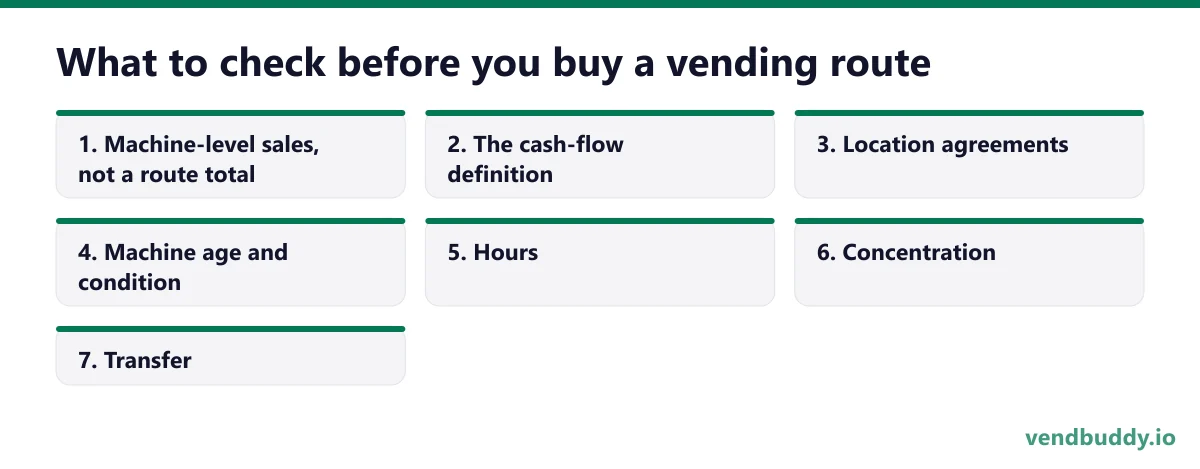
- Machine-level sales, not a route total. Ask for 12 months of sales per machine from the card-reader or telemetry dashboard, not a spreadsheet. A route total hides the two machines carrying the other ten.
- The cash-flow definition. Listings say “cash flow” (seller’s discretionary earnings, before the owner’s own pay) or EBITDA. Rebuild it yourself: sales minus product cost, commissions, card fees, fuel and repairs, then pay yourself for the hours.
- Location agreements. Get every placement agreement and read the term, the commission and the termination clause. A location on a handshake can leave the week after you buy. Our contracts guide covers the clauses that matter.
- Machine age and condition. List every machine by model and year, test the coolers, bill validators and card readers, and price what you would replace in the first year.
- Hours. Ride the route for a full week. A route that needs 30 hours a week is a job, and the price should reflect that.
- Concentration. If one building is more than a third of sales, the route is really that building. Ask how long it has been there and when its agreement renews.
- Transfer. Ask whether each location has agreed to the sale. Some agreements are not assignable without consent.
The full version, with a document request list, is in our vending route due diligence checklist.
Buy in Houston or build your own?
A route gets you cash flow on day one. Building costs a machine and your time, and a dense metro is one of the best places to do it, because there are more buildings with real foot traffic within a short drive. Many operators buy a small route, learn the work, then add their own placements nearby. Our Houston location guide covers the districts and employers worth a walk-in, and VendBuddy shows you which Houston businesses are worth the visit.
For the national picture, including how prices compare state by state and the red flags we see most often, read vending routes for sale: prices, multiples and red flags.
About these numbers
We read the public category pages for the Houston market, removed duplicates, start-up packages and franchise ads, and computed the medians from the asking prices and cash-flow figures on the listing cards. We don’t copy listing text or verify sellers’ claims. The data refreshes periodically, and this page shows the date of the last run.
Frequently Asked Questions
How much is a vending route in Houston?
As of October 1, 2026, established Houston-area listings had a median asking price of $142,900, ranging from $125,000 to $325,000.
Where do I find vending routes for sale in Houston?
Business-for-sale marketplaces, local vending distributors and operator groups, and the VendBuddy marketplace. Many good routes sell privately, so ask operators and distributors directly.
What should I check before buying a Houston vending route?
Machine-level sales from card or telemetry data, written and transferable location agreements, machine age, the real hours including drive time, and whether permits transfer to you.
What is selling, which buildings say yes, and the numbers before you buy a machine. Free, confirm from your inbox, unsubscribe in one click. Refer one friend and get 25 VendBuddy credits.
Every operator we talk to wants fewer cold calls. The ones who get there have a Google Business Profile and a simple site a manager can check before replying. AI builders make that an evening job now. Wix is the mature site builder; Base44 also builds working tools like a quote form. Start with the AI website walkthrough or Wix vs Base44.
General information, not legal, tax or financial advice. Rules change, so check the official source. Revenue and income figures are examples, not promises. See our terms.