- Vending machine routes for sale in Nashville mostly move through BizBuySell-type marketplaces, Middle Tennessee brokers, the Tennessee Automatic Merchandisers Association and retiring operators; search all four by hand.
- 2023 County Business Patterns counts 50,910 establishments in the Nashville metro, only 3,511 with 50+ employees, and Davidson County holds 1,845 of those.
- Rutherford and Wilson are the industrial counties: 18 and 20 warehouses with 50+ employees, versus 8 in Davidson.
- Tennessee taxes vending at the 7% state rate (4% on qualifying food) plus a flat 2.25% local rate, regardless of county.
- Withhold part of the price until the seller shows a Tennessee tax clearance: under Tenn. Code Ann. 67-6-513 the buyer can owe the seller's unpaid sales tax.
Vending machine routes for sale in Nashville rarely sit on a public listing for long, and many never get one: they move through business brokers, trade-association contacts and operators who are ready to retire. Before you chase any of them, know what a good Middle Tennessee route should look like on paper. The U.S. Census Bureau, County Business Patterns 2023 counts 50,910 establishments in the Nashville metro, and only 3,511 of them have 50 or more employees. Know how Tennessee taxes what the machines sell, too: vending sales carry a flat 2.25% local rate, not the county rate, according to the Tennessee Department of Revenue Sales and Use Tax Manual. This guide covers where to look, what the county data says a route should hold, the Tennessee and Davidson County paperwork that changes hands with it, and how to check a route spread across three interstates.
Part of our complete guide: scale a vending machine business.
What does Census data say a Nashville vending route should contain?
A Nashville-area route is only as good as the buildings its machines sit in, and the 2023 County Business Patterns data shows those buildings are not spread evenly. The metro's 3,511 establishments with 50 or more people on the payroll, the kind of site that can usually carry a full-size snack and drink pair, cluster in Davidson County, then fall off fast as you move out toward the rural edge of the metro.
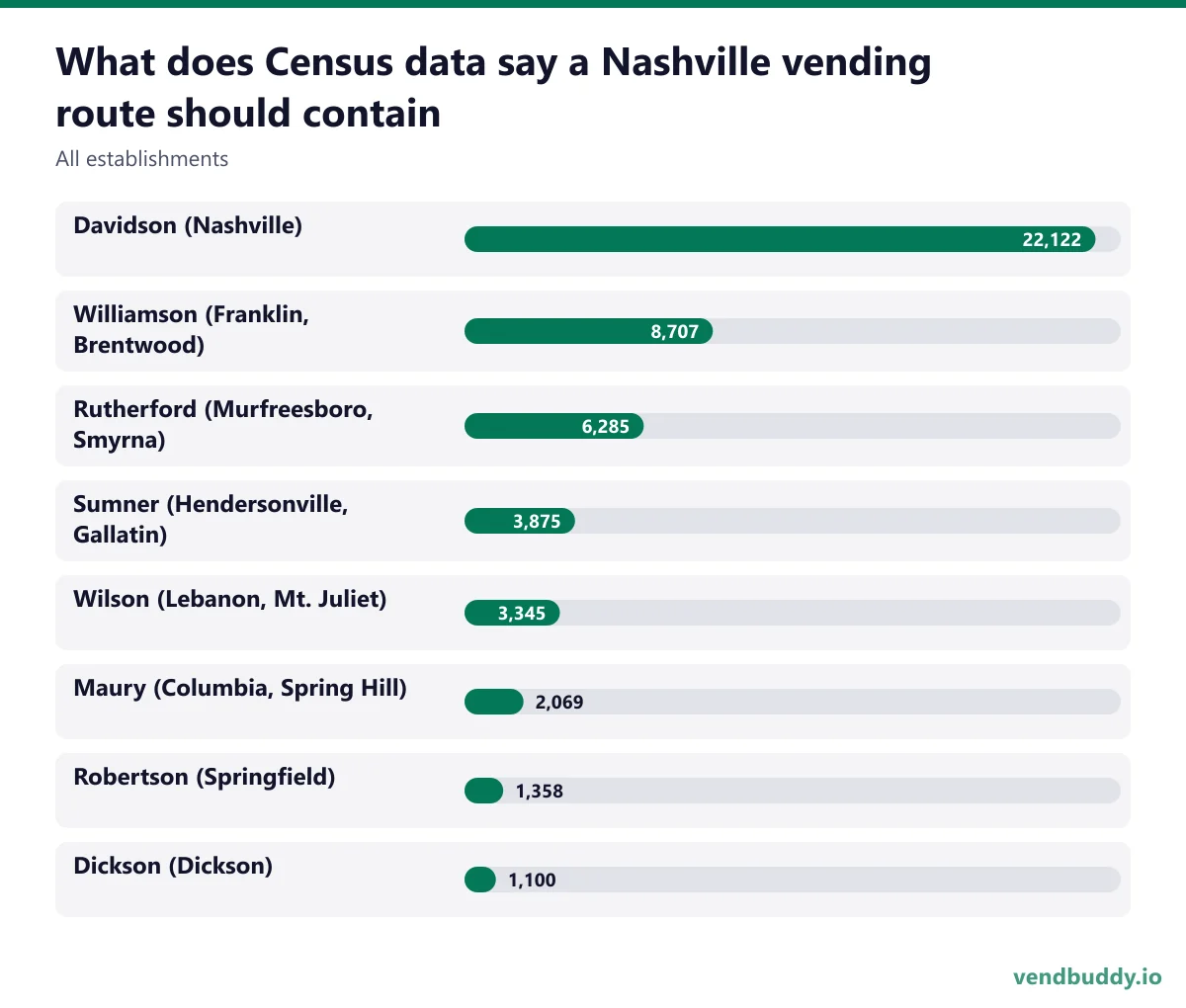
Across the whole metro, 2023 County Business Patterns lists 1,552 manufacturing establishments (305 with 50+ employees and 174 with 100+), 208 warehousing and storage establishments employing about 21,700 people (66 with 50+), 42 hospital establishments (35 with 50+) and 423 hotels (47 with 50+). Those are the categories that tend to anchor a route with steady, shift-driven volume. Sort any seller stop list against the table below: a route of small outer-county retail stops is a different asset from one parked in Rutherford plants and Davidson hospitals.
| County (main towns) | All establishments | With 50+ employees | Manufacturing, 50+ | Warehousing est. (50+) | Health care, 50+ |
|---|---|---|---|---|---|
| Davidson (Nashville) | 22,122 | 1,845 | 93 | 62 (8) | 247 |
| Williamson (Franklin, Brentwood) | 8,707 | 548 | 9 | 16 (n/a) | 87 |
| Rutherford (Murfreesboro, Smyrna) | 6,285 | 449 | 53 | 49 (18) | 39 |
| Sumner (Hendersonville, Gallatin) | 3,875 | 186 | 31 | 13 (n/a) | 18 |
| Wilson (Lebanon, Mt. Juliet) | 3,345 | 172 | 22 | 50 (20) | 4 |
| Maury (Columbia, Spring Hill) | 2,069 | 103 | 20 | 6 (n/a) | 12 |
| Robertson (Springfield) | 1,358 | 64 | 18 | 9 (n/a) | 3 |
| Dickson (Dickson) | 1,100 | 59 | 16 | n/a | 9 |
Source: 2023 County Business Patterns. "n/a" means Census did not publish the size-class count, usually to protect individual employers, so read it as unknown rather than zero. Health care here is the broad health care category, which includes clinics and residential care as well as hospitals.
Three patterns worth pricing in
- Davidson is dense but crowded. It holds more than half of the metro's 50+ employee sites. Expect the biggest hospital and office accounts there to be under contract with national operators already, so a route with independent Davidson stops has usually earned them one building at a time.
- Rutherford and Wilson are the industrial counties. Rutherford has 53 manufacturing sites with 50+ employees and 18 warehouses of that size; Wilson has 20 warehouses with 50+ employees and about 7,500 warehousing jobs, more than Davidson's roughly 4,400.
- Williamson is offices and health care, not plants. Only 9 of its manufacturing sites reach 50 employees, while 87 health care establishments do. A Williamson-heavy route should show mostly weekday office and clinic stops.
Where are vending routes for sale in the Nashville area actually listed?
Buyers looking for a Nashville vending route usually work four channels at once, because no single one carries most of the deals.
- Business-for-sale marketplaces. BizBuySell and BizQuest carry vending listings, but they block automated scraping, so you search by hand. Filter to Tennessee, then run the keywords "vending," "route," "micro market" and "snack" separately; sellers label the same thing four ways. Widen past Nashville to Murfreesboro, Franklin, Lebanon, Clarksville and Columbia, since many listings name the seller's home town rather than the metro. Turn on saved-search alerts.
- Business brokers. Many route sales here are handled by general Main Street brokers who list a vending deal once every year or two. Call the ones working Middle Tennessee, ask whether they have handled vending before, and ask to be told about pocket listings before they go public.
- The operator network. The Tennessee Automatic Merchandisers Association is the state council affiliated with NAMA. Operators who are consolidating or shrinking often sell to someone they have met at a meeting before they pay a broker, which makes it one of the most direct ways to hear about a sale early.
- Retiring owners who have not listed. Snack distributors, machine technicians and wholesale club regulars know which local operators are slowing down. Our guide to buying from a retiring operator covers how to open that conversation.
We do not publish counts or asking prices for current Nashville listings, because the marketplaces change daily and we cannot verify them. Treat any figure you see in a listing as the seller's claim until the due diligence below confirms it.
Picture the machines paying you while you sleep
That’s the real promise of vending — income that doesn’t cost you your time, and a life on your own terms. VendBuddy turns this guide into a step-by-step plan so you actually build it instead of just reading about it. Start free today.
Start building free →How does Tennessee tax vending machine sales on a route you buy?
Tennessee treats vending differently from ordinary retail, and a buyer who misses it will misread the seller's books. Per the Department of Revenue's manual, vending sales are taxed at the 7% state rate on general merchandise or the reduced 4% state rate on qualifying food and food ingredients, plus a flat 2.25% local rate on every vending sale, food or not, under Tenn. Code Ann. § 67-6-702(g). So a drink sold from a machine in Franklin and one sold in downtown Nashville carry the same local rate. A route whose books show tax at the full county rate has probably overpaid, and one showing no tax at all may leave a liability behind.
- Tax-included pricing is allowed if the machine displays a sign saying the prices include any applicable sales tax (Tenn. Comp. R. & Regs. 1320-05-01-.90). Check that the signs are actually on the machines.
- Vending sales go on the operator's regular monthly return. A separate vending-only account is no longer required; the vending amount is backed out on Schedule B and reported with its 2.25% local tax on Schedule C.
- Micro markets have their own definition. An unattended market with self-checkout and controlled entry must collect tax on the sales price, and an operator with several may register once per local jurisdiction rather than once per location.
- The penny-candy exception is narrow. Only machines run for a charitable nonprofit, selling items worth 25 cents or less at a fixed price, can pay gross receipts tax instead of sales tax, and each needs a decal.
Successor liability: hold back part of the price
Tennessee lets the state collect a seller's unpaid sales tax from the buyer. Under Tenn. Code Ann. § 67-6-513, a buyer must withhold enough of the purchase money to cover the seller's unpaid tax, interest and penalties until the seller produces a receipt or a no-tax-due certificate from the Commissioner of Revenue. If the buyer skips that step, they become personally liable, up to the amount they paid. The business tax has a parallel rule, described in the Tennessee Business Tax Manual. Put an escrow holdback in the purchase agreement and do not release it until the clearance arrives. The seller must also file a final sales tax return within 15 days of the sale.
Which Tennessee and Davidson County licenses does a Nashville route buyer need?
A route buyer in Tennessee needs licenses and registrations in their own name. None of the seller's paperwork transfers.
- Sales and use tax registration. Register your entity through the Department of Revenue's TNTAP portal before the closing date, so the first month's vends land on your return, not the seller's.
- Business tax and a business license. The Business Tax Manual says anyone selling through coin-operated vending machines must register with their city and county and pay business tax, and only the principal place of business owes the minimum tax. Licensing depends on gross sales in each jurisdiction: a standard license at $100,000 or more, a minimal activity license between $3,000 and $100,000, and no license required at $3,000 or less. The manual also says a business license generally cannot be transferred to a different taxpayer, so the buyer applies fresh.
- Davidson County. The Davidson County Clerk issues both license types. The fee is $30 if the business is inside the Urban Services District (Nashville city limits) and $15 if it is elsewhere in the county. If you base the business in Rutherford, Williamson or Wilson instead, that county's clerk (and your city, if it levies the tax) handles the license.
Ask the seller for copies of their Tennessee registration, license history and the last 12 monthly sales tax returns. Returns that match the telemetry reports are the quickest check on claimed revenue.
How do location agreements transfer when a Nashville route is sold?
The machines are the part of a route you can see. The contracts are the part you are really paying for, and in Tennessee they are private agreements between the operator and each property, so no agency approves the transfer. Read every agreement for four things:
- Assignment language. Does the agreement allow assignment to a buyer, need the property's written consent, or say nothing? If the seller is an entity, check whether a change of ownership counts as an assignment.
- Termination notice. Many placement agreements can be ended on 30 to 90 days' notice. A route full of short-notice handshake deals is worth less than one with signed terms; our termination clause guide explains why.
- Commission terms. Confirm the percentage each site is actually paid against the seller's bank records, not the summary sheet.
- The named contact. The manager who signed years ago may be gone. Plan to meet each site contact with the seller before closing and get a short written consent or a new agreement in your name.
If a key account refuses, you want an adjustment clause that cuts the price for that stop. Price and structure are covered in our negotiation guide; here, the point is simply to confirm each consent before you pay.
How do you check drive time on a route that spans several Middle Tennessee counties?
Nashville's metro stretches across more than a dozen counties, and a route that looks tight on a stop list can burn hours on the road. The three interstates set the shape: I-24 runs southeast to Smyrna and Murfreesboro, I-40 runs east to Mt. Juliet and Lebanon and west toward Dickson, and I-65 runs south through Brentwood and Franklin toward Spring Hill and north toward Goodlettsville. A route with stops on all three spokes forces the driver through the downtown interchanges every service day.
Measure it rather than trusting the seller's estimate:
- Plot every stop and group them by county and interstate spoke. Count how many service days each spoke needs.
- Run the actual sequence in a mapping app with departure times set to when the driver really leaves. Price out 7 a.m. and 4 p.m. separately, because the I-24 and I-65 commutes differ sharply from midday.
- Ride along for at least one full week, or ask for a week of dated service logs, and compare the time on the road with time spent at stops.
- Flag orphan stops: a single machine 40 minutes out on a spoke with nothing else on it. Decide before you close whether you would keep it, trade it or pull it.
If the stops are scattered, you can fill the gaps on each spoke after closing. VendBuddy lists businesses and decision-maker contacts by ZIP, which helps you find new accounts near the stops you already have.
How should you value a Nashville vending route before making an offer?
Valuing a Nashville route works the same way as anywhere else: verified net cash flow times a multiple, adjusted for how dependable each account is. Run the seller's numbers through the route valuation tool and use our due diligence checklist for the full document list. Then make four local adjustments:
- Tax restatement. Rebuild the net using the 7% or 4% state rate plus the flat 2.25% local rate. If the seller has been charging the county combined rate, the true margin may be better than the books suggest. If they have not been paying at all, it is worse, and the holdback matters more.
- Account mix by county. Weight stops at large manufacturing, warehouse and hospital sites in the table above more heavily than small retail, and check whether any single employer makes up an outsized share of revenue.
- Consent risk. Discount stops where the contact has changed or the agreement has no assignment language.
- Drive time. Add an hourly cost for every hour on the road that the ride-along turns up.
Frequently Asked Questions
Where can I find vending machine routes for sale in Nashville TN?
Search business-for-sale marketplaces such as BizBuySell and BizQuest by hand with Tennessee filters and several keywords, since sellers describe routes differently. Call Middle Tennessee business brokers and ask to hear about pocket listings. Join the Tennessee Automatic Merchandisers Association, where consolidating operators often sell to people they know. Ask snack distributors and technicians which local operators are retiring.
What is the sales tax on vending machine sales in Nashville?
Tennessee taxes vending machine sales at the 7% state rate on general merchandise or the reduced 4% state rate on qualifying food and food ingredients. On top of that, every vending sale carries a flat 2.25% local rate, not the county's regular local rate. That applies in Davidson County and the surrounding counties alike. Prices may include tax if the machine displays a sign saying so.
Do I need a business license to run vending machines in Davidson County?
Usually, yes. Tennessee requires anyone selling through coin-operated vending machines to register with their city and county for business tax. A minimal activity license applies between $3,000 and $100,000 in gross sales, and a standard license at $100,000 or more. The Davidson County Clerk charges $30 inside the Urban Services District and $15 elsewhere in the county. A license cannot be transferred from the seller.
Can I be liable for a seller's unpaid taxes when I buy a vending route in Tennessee?
Yes. Under Tenn. Code Ann. 67-6-513, a buyer who does not withhold enough of the purchase money to cover the seller's unpaid sales tax can become personally liable for it, up to the amount paid. The fix is an escrow holdback that is released only after the seller produces a receipt or no-tax-due certificate from the Commissioner of Revenue. The business tax has a similar successor rule.
Which Nashville-area counties have the most large employers for vending?
In 2023 County Business Patterns, Davidson County has 1,845 establishments with 50 or more employees, Williamson has 548, Rutherford 449, Sumner 186 and Wilson 172. For industrial accounts, Rutherford has 53 manufacturing sites and 18 warehouses of that size, and Wilson has 20 warehouses of that size. Williamson leans toward offices and health care rather than plants.
What is selling, which buildings say yes, and the numbers before you buy a machine. Free, confirm from your inbox, unsubscribe in one click. Refer one friend and get 25 VendBuddy credits.
Every operator we talk to wants fewer cold calls. The ones who get there have a Google Business Profile and a simple site a manager can check before replying. AI builders make that an evening job now. Wix is the mature site builder; Base44 also builds working tools like a quote form. Start with the AI website walkthrough or Wix vs Base44.
General information, not legal, tax or financial advice. Rules change, so check the official source. Revenue and income figures are examples, not promises. See our terms.