- Under Comptroller Rule 3.293, Texas vending operators pay sales tax on 100% of soft drink and candy receipts, 50% of food-product receipts, and nothing on plain bottled water.
- Vending sales are sourced to the machine's location (Rule 3.334), at 6.25% state plus up to 2% local, capped at 8.25%.
- The Comptroller sales and use tax permit is free; Texas has no general vending machine decal, but claw and other amusement machines need a coin-op license and a $60 annual decal each.
- Machines with only prepackaged, non-potentially-hazardous food are exempt from the DSHS retail food permit; TCS food and micro markets are not.
- Tobacco and e-cigarette vending is limited to 21-and-over facilities under Health and Safety Code 161.086, and the 2026 minimum wage is the federal $7.25.
Texas vending machine laws are light on licensing and specific on tax: food snacks are taxed on only half of what the machine takes in, candy and soft drinks on every dollar, plain bottled water on nothing, and the only state filing most snack-and-soda routes need is a free Comptroller sales tax permit. This reference walks through the exact rule text, a worked tax example for a $1,000-a-month machine, when a health permit or a coin-op license kicks in, the tobacco ban, and what you owe a route driver in 2026.
Part of our complete guide: how to start a vending machine business.
How does Texas sales tax apply to vending machine sales?
Texas writes a vending-specific formula into its food rule. Subsection (d) of Comptroller Rule 3.293 (34 TAC §3.293) says food, candy and soft drinks sold through vending machines are taxable, then splits the base three ways:
- Soft drinks and candy: the operator remits tax on 100% of gross receipts, with no deduction for spoilage, waste or other losses.
- Food products: the operator remits tax on 50% of gross receipts, again with no spoilage deduction. The rule lists snack items, milk, tea, coffee and juice that is more than 50% fruit or vegetable juice by volume as examples.
- Water: plain bottled, spring, sparkling or mineral water is exempt. Flavored water, carbonated or not, counts as a soft drink and is taxed on full receipts.
Two more lines in the same rule matter on the route. Every machine must carry a sign stating that the vended price includes sales tax, and if your price does include tax you may back the tax out before you report taxable sales. Separately, subsection (e) exempts food, gum, candy and toys sold for $0.50 or less from a bulk vending machine (the unsorted, random-dispense kind); if you run both bulk and regular machines, you must keep records showing which items went through the bulk units.
The rate itself comes from the Texas Comptroller: 6.25% state, up to 2% local, 8.25% combined maximum. Which local taxes apply is set by where the machine stands. Rule 3.334 treats a vending machine as an itinerant-vendor sale rather than a place of business, and states that sales from a vending machine are consummated at the location of the machine. A route with machines in three cities can owe three different local rates, so each placement address belongs in your records.
What does Texas sales tax cost on a $1,000-a-month vending machine?
Take one combo machine at an 8.25% address that grosses $1,000 in a month. The product mix below is illustrative, not an average; your planogram will differ, which is exactly why the split matters.
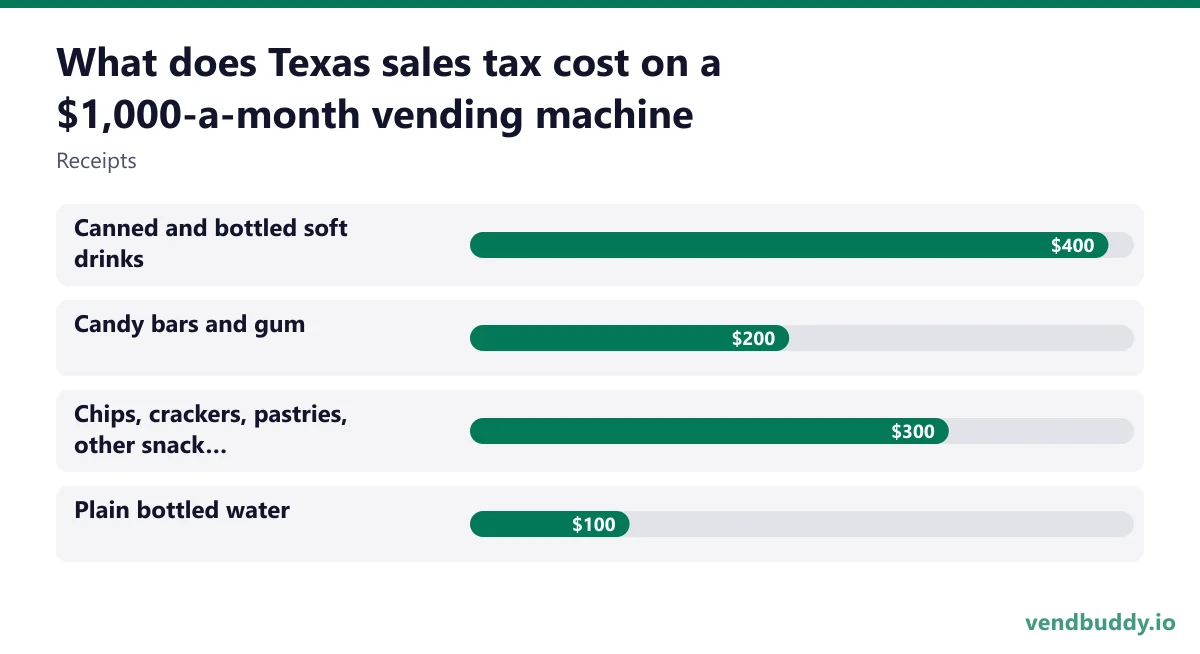
| Category (illustrative mix) | Receipts | Taxable share under Rule 3.293 | Taxable base | Tax at 8.25% |
|---|---|---|---|---|
| Canned and bottled soft drinks | $400 | 100% | $400 | $33.00 |
| Candy bars and gum | $200 | 100% | $200 | $16.50 |
| Chips, crackers, pastries, other snack food | $300 | 50% | $150 | $12.38 |
| Plain bottled water | $100 | 0% | $0 | $0.00 |
| Total | $1,000 | $750 | $61.88 |
That $61.88 assumes the $1,000 is receipts before tax. Most machines post round, tax-included prices, and the rule lets you back the tax out: the tax portion of $750 in tax-included sales at 8.25% is $750 × 0.0825 ÷ 1.0825, or about $57.16. Either way the comparison that matters is against the lazy method. Charge 8.25% on the whole $1,000 and you would remit $82.50, roughly $20 to $25 a month more than the rule requires on this one machine. Across ten machines, that is real money over a year.
The split only works if your sales records can separate categories. A telemetry or card-reader report that groups sales by coil makes this a five-minute job; cash-only machines need a coil map and a count at each service.
Picture the machines paying you while you sleep
That’s the real promise of vending — income that doesn’t cost you your time, and a life on your own terms. VendBuddy turns this guide into a step-by-step plan so you actually build it instead of just reading about it. Start free today.
Start building free →What permits and registrations does a Texas vending business need?
Sales and use tax permit. This is the base state filing. The Comptroller's permit FAQ says there is no fee for the permit, though the agency may require a security bond if it has reason to believe tax will go unpaid. The application page tells you to allow 2 to 3 weeks to receive it. Returns are filed monthly, quarterly or yearly, due the 20th after the period, and timely filers keep a 0.5% discount on the tax they report.
No general vending decal. We found no Texas statute or Comptroller program that registers ordinary snack and drink machines one by one. The machine-level registrations that do exist are narrower. Cigarette and tobacco retailers list each vending machine by inventory number on their tobacco permit, and amusement machines fall under a separate law.
Claw and crane games are a different license. The Comptroller's coin-operated amusement machine guide covers music and skill-or-pleasure machines. The owner needs a general business license ($200 a year for 50 or fewer machines, $400 for 51 to 200, $500 for 201 or more) plus a $60 annual occupation tax permit decal on each machine. The Occupations Code excludes amusement machines designed exclusively for children, so confirm how your specific cabinet is classified before you order decals. If you are weighing cranes for a route, our claw machine profit guide covers the economics.
Franchise tax. An LLC or corporation owes the Texas franchise tax report every May 15. The no-tax-due threshold is $2.65 million in annualized revenue for 2026 reports, so a small route files a Public Information Report or Ownership Information Report rather than paying tax. Skipping that report is the usual way new Texas LLCs fall out of good standing.
For the national picture of what counts as a license versus a permit, see vending machine license and permit requirements. The city-by-city market notes live on the Texas vending hub.
When does a Texas vending machine need a health permit?
A machine stocked only with sealed shelf-stable snacks and bottled drinks usually needs no food permit in Texas. The Department of State Health Services lists “establishments that offer only pre-packaged foods that are not potentially hazardous” among the operations exempt from its retail food permit.
The exemption ends when you add food that needs refrigeration for safety: sandwiches, salads, dairy, cut fruit, anything a regulator calls time/temperature control for safety (TCS) food. Two points decide who you talk to:
- Jurisdiction. DSHS permits retail food establishments only in areas it regulates. Where a city, county or public health district runs its own food program, that local department issues the permit and sets the fee. Call the health department for the placement address before buying a refrigerated unit.
- DSHS fees, where DSHS is the regulator. The state's published fee is $258 for an operation with under $50,000 in gross annual food sales, $515 from $50,000 to $149,999.99, and $773 at $150,000 and above.
Micro markets are treated as their own category. DSHS's self-service food market FAQ says every self-service food market is a retail food establishment, and that coolers holding TCS food need an automatic shut-off control, or a plan approved by the regulator, that stops sales if the food cannot hold temperature. The agency compares it directly to the shut-off requirement for vending machines that hold TCS food, so budget for that feature on any fresh-food machine.
Can you sell tobacco, vapes or nicotine from a vending machine in Texas?
Almost never in a normal placement. Texas Health and Safety Code §161.086 bars any retailer from installing or maintaining a vending machine containing cigarettes, e-cigarettes or tobacco products, with three exceptions: a facility or business not open to anyone under 21 at any time, a humidor or cigar storage area restricted to adults 21 and older, and a package store holding an Alcoholic Beverage Code permit that keeps under-21s out. A violation is a Class C misdemeanor, and the Comptroller or a peace officer may seize, seal or disable the machine with or without a warrant.
The Comptroller's tobacco FAQ closes the obvious workaround: a lockout device or remote control on the machine does not make it “inaccessible to customers.” The machine has to sit where only employees can reach it, with staff checking age and retrieving the product. Federal law lands in the same place. 21 CFR 1140.16(c) limits cigarette and smokeless vending to facilities where no one under 21 is present or permitted at any time, and 21 CFR 1140.14(b)(3) applies the same limit to e-cigarettes and other covered products. Our nicotine and vape vending guide goes deeper on age-verification hardware.
What must a Texas vending operator pay a route driver in 2026?
The floor is $7.25 an hour. The Texas Workforce Commission explains that the Texas Minimum Wage Act adopts the federal rate, and Texas Labor Code §62.0515 makes the state minimum supersede city and county wage ordinances for private employers (public contracts aside). Austin, Dallas and Houston cannot set a higher floor for your driver.
Most first agreements are two pages, not twenty. The contracts walkthrough lays out the clauses that actually matter for the contract, including the termination language operators forget about until they need it.
Three state and federal rules shape the actual paycheck:
- Overtime. The federal Fair Labor Standards Act requires time and a half above 40 hours in a workweek for non-exempt workers, and a route driver paid hourly almost always is non-exempt.
- Pay frequency. Texas Labor Code §61.011 requires paying non-exempt employees at least twice a month; if you never designate paydays, they default to the 1st and 15th.
- Market reality. $7.25 is the legal minimum, not the hiring rate. In most Texas metros you will compete with delivery and warehouse jobs, so price the role against those.
The trigger math for when a hire pays for itself is in when to hire your first route driver.
First 30 days in Texas: a state-specific checklist
- Days 1–3: form the entity if you want one, get an EIN, and apply for the Comptroller sales and use tax permit. Allow 2 to 3 weeks for it to arrive.
- Days 1–7: classify every SKU you plan to stock as soft drink, candy, food product or water under Rule 3.293. Flavored water goes in the soft drink column.
- Days 7–14: order a “price includes sales tax” sign for each machine and set up per-coil or per-category sales reporting.
- Days 7–14: for each prospective placement, look up the local rate by street address and note which city, county or health district covers it. Our location finder pulls properties and decision-maker contacts for any Texas ZIP, which makes it faster to build that address list.
- Before any fresh food: call the local health department (or DSHS if none) and confirm TCS shut-off requirements.
- Before any claw machine: get the Comptroller general business license and a $60 decal per machine.
- Never: place tobacco, vapes or e-cigarettes in an all-ages location.
- Day 30: calendar the first sales tax return (the 20th after your first period) and next May 15 for the franchise tax information report.
Texas rules change through Comptroller rule amendments more often than through new statutes. Before relying on any figure here for a filing, check the linked agency page, and ask the Comptroller directly if a product does not fit neatly into one category.
Frequently Asked Questions
Do you need a license to put a vending machine in Texas?
For ordinary snack and drink machines, the only state registration is the Texas sales and use tax permit from the Comptroller, which has no fee. Texas does not issue a general vending machine decal. Claw, crane and other amusement machines are different: they need a Comptroller coin-operated machine general business license and a $60 annual occupation tax decal per machine. Fresh-food machines may need a local or DSHS food permit.
How is sales tax calculated on vending machine sales in Texas?
Comptroller Rule 3.293 sets three bases. Soft drinks and candy are taxed on 100% of gross receipts, food products such as chips, crackers, milk and qualifying juice are taxed on 50% of gross receipts, and plain bottled water is exempt. There is no deduction for spoilage or waste. The rate is the state 6.25% plus the local rate at the machine's address, up to 8.25% combined.
Does a vending machine in Texas have to say that tax is included?
Yes. Rule 3.293 requires the operator to place a sign on each vending machine stating that the vended price includes sales tax. When the price includes tax, the operator may back the tax out of receipts before reporting taxable sales on the return. A simple printed decal on the front of the machine satisfies the practical need.
Are bulk candy and gumball machines taxed in Texas?
Food, gum, candy and toys sold for $0.50 or less from a bulk vending machine are exempt under Rule 3.293(e). A bulk vending machine is one that dispenses unsorted items randomly without the customer choosing a specific product. Operators with only exempt bulk sales may still get a permit so they can buy stock tax-free with a resale certificate, and operators with both bulk and regular machines must keep records separating them.
Can I put a vape or cigarette vending machine in a Texas bar or gas station?
Only if the location keeps out everyone under 21 at all times, or it qualifies as an age-restricted humidor or package store under Health and Safety Code 161.086. An all-ages gas station does not qualify, and the Comptroller says a lockout device or remote control does not make the machine inaccessible. Federal rules at 21 CFR 1140.16(c) and 1140.14(b)(3) impose the same adult-only limit.
What is selling, which buildings say yes, and the numbers before you buy a machine. Free, confirm from your inbox, unsubscribe in one click. Refer one friend and get 25 VendBuddy credits.
General information, not legal, tax or financial advice. Rules change, so check the official source. Revenue and income figures are examples, not promises. See our terms.