- As of October 1, 2026, public listing pages showed 17 vending businesses for sale in the Los Angeles market, 17 of them established operations.
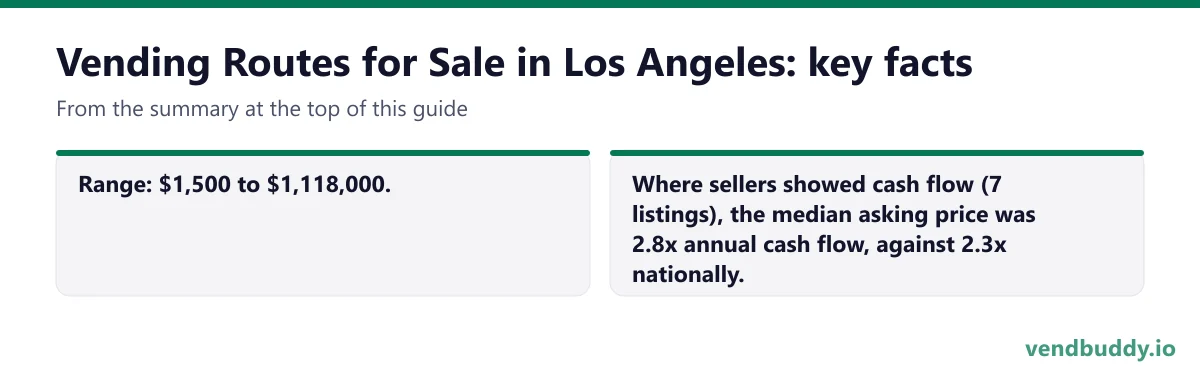
- Median asking price: $69,000, below the national median of $120,000. Range: $1,500 to $1,118,000.
- Where sellers showed cash flow (7 listings), the median asking price was 2.8x annual cash flow, against 2.3x nationally.
- Check machine-level sales, written and transferable location agreements, and the hours the route really takes.
Vending routes for sale in Los Angeles come up less often than you’d think for a market this size, and when they do, the asking prices are all over the place. As of October 1, 2026, we counted 17 established Los Angeles-area vending businesses on the largest public marketplace. Here is what they ask, how that compares with the rest of the country, and what to check before you buy one.
Part of our complete guide: scale a vending machine business.
Los Angeles route listings at a glance
| Measure | Los Angeles | National |
|---|---|---|
| Established listings | 17 | 234 |
| Median asking price | $69,000 | $120,000 |
| Asking price range | $1,500 to $1,118,000 | $1,500 to $2,000,000 |
| Median ask / annual cash flow | 2.8x | 2.3x |
| Listings mentioning smart coolers, micro markets or kiosks | 0% | 12% |
Source: public BizBuySell category page for the Los Angeles market, data as of October 1, 2026. These are our counts and medians; asking prices are not sale prices.
Asking prices by band
| Asking price | Listings |
|---|---|
| Under $50,000 | 7 |
| $50,000 to $150,000 | 7 |
| $150,000 to $500,000 | 1 |
| Over $500,000 | 2 |
How to read a Los Angeles listing
Where sellers showed cash flow (7 listings), the median asking price was 2.8x annual cash flow, against 2.3x nationally. A listing’s cash flow is usually before you pay yourself, so take out a fair wage for the hours before you compare it with the price. A route at a low multiple that needs 30 hours a week of driving in Los Angeles traffic is not cheap.
In a big metro, drive time is a cost. Map every location on the route and time a full restock loop at the hours you’d actually run it. Two routes with the same sales can have very different profit once you add an hour of traffic between stops.
Local rules matter too. Check sales tax and permit requirements in the California vending rules before you take over another operator’s machines, and make sure the seller’s permits are current, because some don’t transfer with the business.
Picture the machines paying you while you sleep
That’s the real promise of vending — income that doesn’t cost you your time, and a life on your own terms. VendBuddy turns this guide into a step-by-step plan so you actually build it instead of just reading about it. Start free today.
Start building free →What Los Angeles locations expect in commission
A route is only worth what its location agreements are worth, so check every commission rate against the local norm. In our Los Angeles research the typical range is 0-12% of gross. Century City and Westwood Class A landlords open at 10-12% and expect a signed vending agreement with insurance certificates attached. El Segundo aerospace suppliers land nearer 5-8%. The Vernon and Commerce industrial belt frequently takes nothing at all, because the plant manager's actual problem is a workforce that cannot leave the property during a shift — solving that is worth more to them than a check. Arts District creative tenants tend to negotiate for a curated product mix rather than cash, and hospital-adjacent medical offices often prefer a monthly product credit for the break room.
A route paying well above those rates is carrying thin machines; one paying well below may face a renegotiation when the agreement renews. Either way, price it in.
Which Los Angeles locations hold their value
When you read a route’s location list, these are the areas our Los Angeles research rates highest, and why:
- El Segundo and the South Bay aerospace corridor. Low-rise Class A and converted aerospace plants along Douglas Street, Rosecrans Avenue and Aviation Boulevard. This was the strongest-absorbing office submarket in the county through 2026, pulling defense, hypersonics and media tenants out of West LA.
- Vernon, Commerce and Santa Fe Springs. The county's manufacturing and cold-storage core — meat and produce processors, bakeries, apparel finishing, and cross-dock warehouses. Almost no street-level retail food, heavy second and third shift, and a workforce that is majority Spanish-speaking.
- Arts District, Fashion District and the Downtown fringe. Brick warehouse conversions holding creative agencies, apparel wholesalers, coffee roasters and small production companies. Rents are far below Bunker Hill, tenants are 10-to-80 people, and building ownership is fragmented across dozens of small landlords.
- Century City, Westwood and the Wilshire corridor. The county's premium office spine — law firms, talent agencies, wealth management and the new Century City Center development. High rents, concierge-grade expectations, and property managers who control vending across whole portfolios rather than building by building.
Who you’d be competing with
Canteen under Compass Group and Aramark Refreshments hold the institutional ground — hospital systems, university campuses, the largest corporate headquarters and most studio commissaries. Sodexo appears in healthcare and higher education. Below that tier, Los Angeles has one of the deepest benches of family-run independent operators in the country, many of them Latino- and Korean-owned, and they dominate the industrial belt through relationships built over decades. A newcomer does not win Vernon on price. Where the gaps actually sit are the El Segundo supplier ring, the Arts District conversions where buildings changed hands during the office downturn, and the Valley's Chatsworth and Van Nuys light-industrial parks that basin-based routes skip.
For a buyer, that tells you which accounts are at risk of being bid away and which are hard for a national operator to serve profitably, which is where a small route keeps its locations.
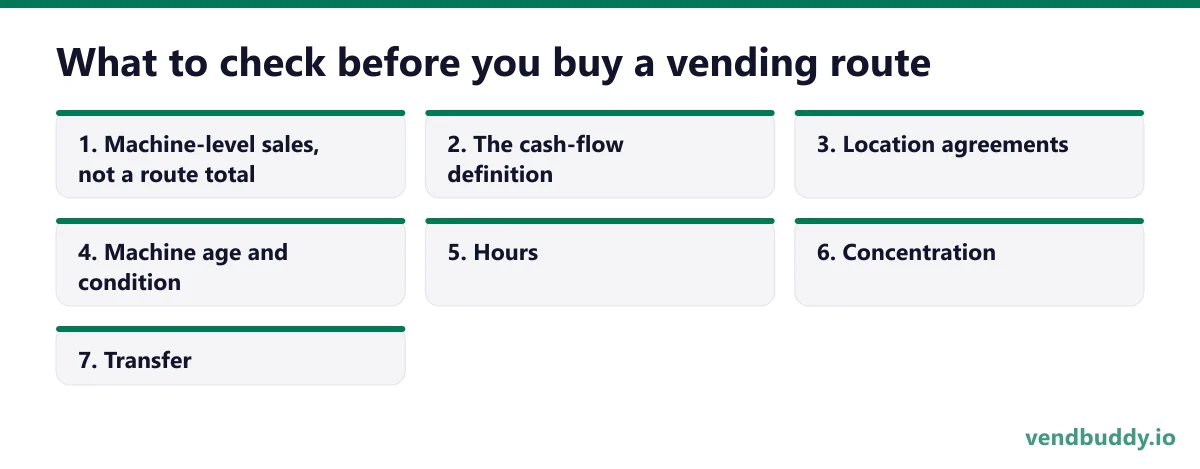
What to check before you buy a vending route
- Machine-level sales, not a route total. Ask for 12 months of sales per machine from the card-reader or telemetry dashboard, not a spreadsheet. A route total hides the two machines carrying the other ten.
- The cash-flow definition. Listings say “cash flow” (seller’s discretionary earnings, before the owner’s own pay) or EBITDA. Rebuild it yourself: sales minus product cost, commissions, card fees, fuel and repairs, then pay yourself for the hours.
- Location agreements. Get every placement agreement and read the term, the commission and the termination clause. A location on a handshake can leave the week after you buy. Our contracts guide covers the clauses that matter.
- Machine age and condition. List every machine by model and year, test the coolers, bill validators and card readers, and price what you would replace in the first year.
- Hours. Ride the route for a full week. A route that needs 30 hours a week is a job, and the price should reflect that.
- Concentration. If one building is more than a third of sales, the route is really that building. Ask how long it has been there and when its agreement renews.
- Transfer. Ask whether each location has agreed to the sale. Some agreements are not assignable without consent.
The full version, with a document request list, is in our vending route due diligence checklist.
Buy in Los Angeles or build your own?
A route gets you cash flow on day one. Building costs a machine and your time, and a dense metro is one of the best places to do it, because there are more buildings with real foot traffic within a short drive. Many operators buy a small route, learn the work, then add their own placements nearby. Our Los Angeles location guide covers the districts and employers worth a walk-in, and VendBuddy shows you which Los Angeles businesses are worth the visit.
For the national picture, including how prices compare state by state and the red flags we see most often, read vending routes for sale: prices, multiples and red flags.
About these numbers
We read the public category pages for the Los Angeles market, removed duplicates, start-up packages and franchise ads, and computed the medians from the asking prices and cash-flow figures on the listing cards. We don’t copy listing text or verify sellers’ claims. The data refreshes periodically, and this page shows the date of the last run.
Frequently Asked Questions
How much is a vending route in Los Angeles?
As of October 1, 2026, established Los Angeles-area listings had a median asking price of $69,000, ranging from $1,500 to $1,118,000.
Where do I find vending routes for sale in Los Angeles?
Business-for-sale marketplaces, local vending distributors and operator groups, and the VendBuddy marketplace. Many good routes sell privately, so ask operators and distributors directly.
What should I check before buying a Los Angeles vending route?
Machine-level sales from card or telemetry data, written and transferable location agreements, machine age, the real hours including drive time, and whether permits transfer to you.
What is selling, which buildings say yes, and the numbers before you buy a machine. Free, confirm from your inbox, unsubscribe in one click. Refer one friend and get 25 VendBuddy credits.
Every operator we talk to wants fewer cold calls. The ones who get there have a Google Business Profile and a simple site a manager can check before replying. AI builders make that an evening job now. Wix is the mature site builder; Base44 also builds working tools like a quote form. Start with the AI website walkthrough or Wix vs Base44.
General information, not legal, tax or financial advice. Rules change, so check the official source. Revenue and income figures are examples, not promises. See our terms.