- Transit station vending machines sell to commuters with a few minutes to wait, but the transit authority or the station owner decides who may place one.
- The condition that decides it is control of the space. Agency-run stations use procurement; a private bus depot or a station inside a building may need only a manager's yes.
- Expect vandalism, cash theft and long procurement. Plan for cashless-only machines, a hardened cabinet and a bid that can take months.
- Stock water, quick snacks, coffee, commuter items and phone chargers. People buy in the 10 minutes before a train or bus.
- Start with small bus depots, intercity stops, park-and-ride lots and stations inside larger buildings, then move to the agency bid.
Transit station vending machines look like an easy yes. Thousands of people pass the same spot every morning, and every one of them has a few minutes to wait. The problem is not demand. The problem is that someone owns that platform, and it is almost never the person standing behind the ticket window. If you want this placement, learn who owns the space before you spend a minute on product.
Part of our complete guide: how to find vending machine locations.
Are train and bus stations good vending machine locations?
For traffic, yes. For access and risk, it depends. A commuter platform has the same people at the same hours, which makes forecasting easy. A bus station has longer waits, because travelers show up early for a coach and sit.
The condition that decides it is who controls the space. A public transit authority will route any vending request through procurement and often through a concessions or advertising office. A privately owned bus depot, a station inside a mall or a hotel, or a park-and-ride lot may be a one-conversation deal.
The other big factor is the risk of break-ins. Stations are public, often open at night and not watched all day. Machines get shaken, kicked and sometimes broken into. Go in with that in mind and a hardened cabinet.
Trains in VendBuddy's own data
This is VendBuddy's own Lead Finder data as of October 4, 2026. Operators ran two train station searches and two bus station searches since April 2026, each from a single operator in a single ZIP code. That is very thin. Lead Finder has scored two train stations and two bus stations, so there is little to build a pattern on, and we will not pretend there is. Review counts swing wildly, from a median of 2,941 at the train stations to 19 at the bus stations, which shows how different the two are.
What we can say: transit sits in a family that starts at a base location score of 76, the second highest of the families we track. The contacts Lead Finder looks for are an Operations Manager, a Facilities Manager and a General Manager. For an agency station, the practical contact is often in concessions, real estate or procurement, so ask who handles tenant requests.
Picture the machines paying you while you sleep
That’s the real promise of vending — income that doesn’t cost you your time, and a life on your own terms. VendBuddy turns this guide into a step-by-step plan so you actually build it instead of just reading about it. Start free today.
Start building free →How a station runs
- Hours. Commuter stations peak from 6 to 9 a.m. and 4 to 7 p.m. Intercity bus depots and rail stations stay busy through the day, and some run overnight.
- Who is inside. Commuters who pass in two minutes, travelers waiting for a delayed bus, and station and security staff. Platforms have short dwell time; stations with a waiting room have a longer one.
- What they already buy. Coffee and a pastry on the way in, water for the ride, a snack when the train is late.
- What competes. A kiosk or cafe in the station, a convenience store across the street, and other vending in the concourse.
- The rule to ask about. The authority's procurement or concessions process. Many require a competitive bid, proof of insurance, and a lease or license agreement. Some require accessibility compliance for how the machine sits in a path of travel.
Two details change the numbers. First, direction: a machine on the inbound side of a commuter station sells coffee and breakfast, and a machine on the outbound side sells water and a snack for the ride home. Walk both platforms in the morning and the evening before you choose. Second, delays: a canceled train or a storm turns a quiet platform into a crowd with nothing to do. Those days can pay for a slow week, but you cannot count on them, so do not build your forecast around them.
Stocking for a train: the rows that move
Choose a cashless machine with a solid cabinet and a bright display. A cash box in a station is a target. A card reader with a mobile wallet option handles commuters, who rarely carry coins; see our guide to the best vending machine card readers and what card reader fees cost.
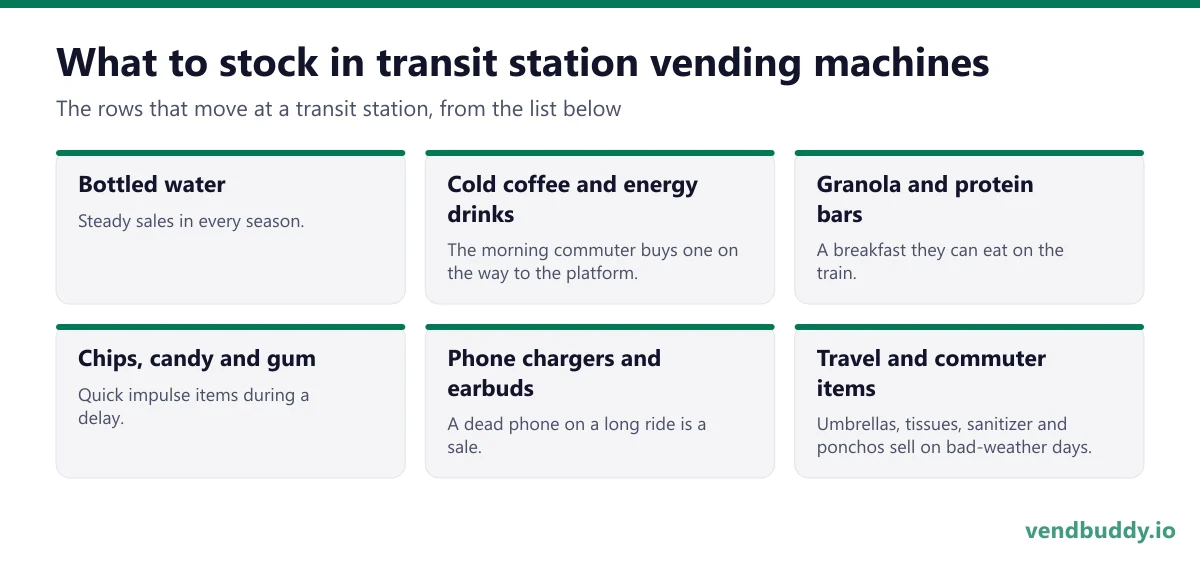
- Bottled water. Steady sales in every season.
- Cold coffee and energy drinks. The morning commuter buys one on the way to the platform.
- Granola and protein bars. A breakfast they can eat on the train.
- Chips, candy and gum. Quick impulse items during a delay.
- Phone chargers and earbuds. A dead phone on a long ride is a sale.
- Travel and commuter items. Umbrellas, tissues, sanitizer and ponchos sell on bad-weather days.
- Soft drinks. Still the staple of any station machine.
Getting the yes from a train
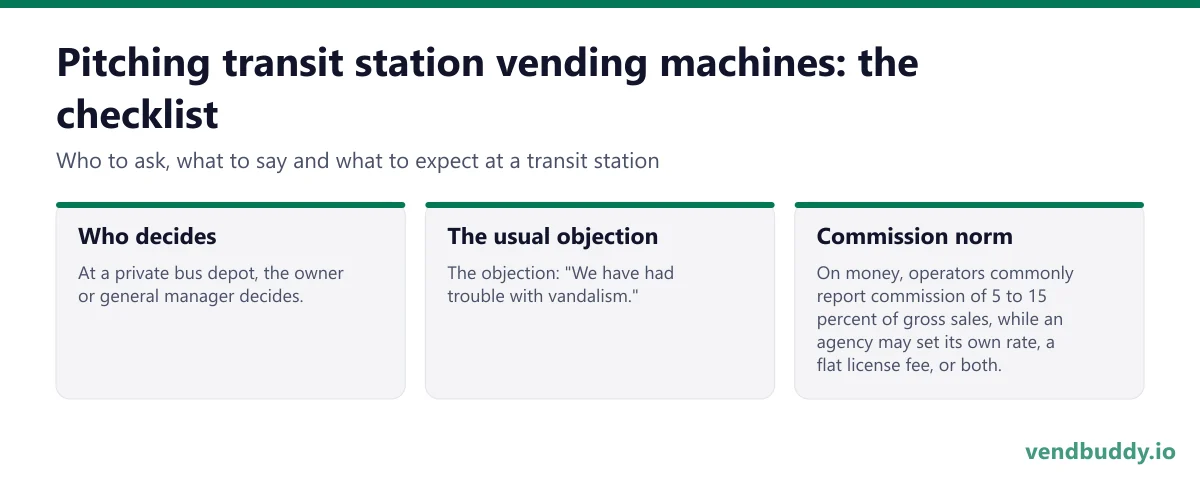
At an agency station, start with the concessions, property or procurement office, and ask for any open solicitation. A station manager can tell you who it is. At a private bus depot, the owner or general manager decides. Lead Finder looks for an Operations Manager, a Facilities Manager and a General Manager in this family.
Opener: “I run a vending service that is cashless and I take care of stocking and repairs. I am looking for a spot where riders wait, and I can pay a share of sales. Who handles tenant requests for the station?”
The objection: “We have had trouble with vandalism.” The answer is a hardened, bolted machine with no cash inside, a service number on the front and a plan for fast repairs. Offer to carry the damage risk.
On money, operators commonly report commission of 5 to 15 percent of gross sales, while an agency may set its own rate, a flat license fee, or both. See vending machine commission rates, and use the vending ROI calculator to see which fee you can carry.
On the walk-in, check where the foot traffic goes (the machine will be ignored if it sits off the main path), the power and network supply, and how fast the agency reviews and approves a placement. Write down the term; vending machine contracts 101 covers what a license should say.
Transit agencies are public bodies, so vending usually runs through a concession program or a formal bid. Vending machines in government buildings covers the portals, bonding and insurance that come with public contracts.
How to find train and bus stations near you
Use Lead Finder with the type pre-selected: Find train and bus stations near you in Lead Finder. It lists stations in your radius with a score and a contact when it has one.
The two free methods are simple. In Google Maps, search “bus station near me” and “train station near me”, then add “park and ride” for commuter lots. Then do a drive-by test: stand on the platform during the morning peak and count how many people wait more than five minutes, and whether a machine is there.
What Lead Finder adds is the contact, a score and a radius, so you can list every station within 50 miles in one pass. For the full method, see how to find vending locations.
Pick the easy ones first: a private bus depot, an intercity stop with a waiting room, or a station inside a larger building. A signed placement there is the reference that makes the agency bid easier. Find train and bus stations near you in Lead Finder and mark the stations that have a waiting room and no machine.
Frequently Asked Questions
Are train and bus stations good vending machine locations?
They can be. Traffic is high and predictable, but the transit authority or station owner controls the space and often uses a bid process. Vandalism is a risk, so use cashless, hardened machines. Private bus depots and stations inside buildings are the easiest entry points.
What sells best in a transit station vending machine?
Bottled water, cold coffee and energy drinks, granola and protein bars, chips and candy, phone chargers and earbuds, and commuter items like umbrellas and tissues. Commuters buy in the ten minutes before a train or bus.
How much commission does a transit station expect?
Operators commonly report 5 to 15 percent of gross sales. A transit agency may set its own percentage, a flat license fee, or both in the solicitation, so read the terms before you bid.
Do transit stations require a bid for vending machines?
Agency-run stations usually do, through a concessions or procurement office, and may require insurance and a license agreement. Privately owned depots often decide with one conversation. Ask the station manager who handles tenant requests.
What is selling, which buildings say yes, and the numbers before you buy a machine. Free, confirm from your inbox, unsubscribe in one click. Refer one friend and get 25 VendBuddy credits.
Every operator we talk to wants fewer cold calls. The ones who get there have a Google Business Profile and a simple site a manager can check before replying. AI builders make that an evening job now. Wix is the mature site builder; Base44 also builds working tools like a quote form. Start with the AI website walkthrough or Wix vs Base44.
General information, not legal, tax or financial advice. Rules change, so check the official source. Revenue and income figures are examples, not promises. See our terms.