- Federal property gives licensed blind vendors priority under the Randolph-Sheppard Act (20 U.S.C. 107); private operators get in as partners or subcontractors.
- Nearly every state has a mini-Randolph-Sheppard law, but some stop at state property; in Texas, county and city buildings are not covered.
- City and county vending RFPs ask for a certificate of insurance (Gila County: $1,000,000 per occurrence, $2,000,000 aggregate), cashless readers, service response times and monthly per-machine sales reports.
- Takoma Park, Maryland (2026) offered the city 25% of gross and required at least 50% healthy items; Texas BET third-party contracts run two years plus one two-year extension.
- Start with five buildings, ask facilities whose property each is, register on every bid list, and answer one bid well.
Vending machines in government buildings are some of the steadiest placements you can hold: the same staff show up every weekday, the public waits in lines at permit counters and courthouses, and a signed agreement often runs for years. The hard part is not the traffic. It is the paperwork, plus one federal law most new operators have never heard of. This guide walks through who controls each kind of building, where the bids are posted, what a city or county actually asks for, and the order to do things in.
Part of our complete guide: how to find vending machine locations.
Short version: federal buildings and many state buildings are reserved first for licensed blind vendors under the Randolph-Sheppard Act, so a private operator gets in there as a partner or subcontractor. City halls, county offices, public works yards and fairgrounds are a different story. Many of them buy vending through an open request for proposals, and a small operator with the right insurance can win one. This is general information, not legal advice; read the solicitation and ask the building manager in writing before you place anything.
Why government buildings are worth the paperwork
A government office has three things an operator wants. Steady weekday headcount that does not swing with the economy. Visitors who wait, sometimes for an hour, at the DMV, a courthouse or a permit desk. And buildings that run early and late shifts: road yards, fleet garages, jails and 24-hour dispatch centers, where the cafeteria is closed and the machine is the only option.
The contracts also tend to last. Takoma Park, Maryland, put out a 2026 request for proposals for snack, drink and combo machines at its community center, recreation center and public works yard with a one-year term and up to two one-year renewals (City of Takoma Park, RFP for vending machine services, 2026). Gila County, Arizona, listed 16 sites, from the Globe and Payson courthouses to road yards and the county fairgrounds, on a one-year contract with up to three one-year renewals, a possible four years in all (Gila County, GIL-RFP-2026-008). Win one of those and you have a route anchor for years, plus a reference for the next bid.
The tradeoff is speed. A coffee shop owner can say yes on the spot. A county takes a solicitation, a review committee and a board vote. Plan for months, not days, and keep working your private locations while a bid is out. If you are still building your first list, the guide to vending machine locations by business type covers the faster wins.
First question: whose property is it?
Every government building falls into one of four buckets, and the bucket decides your path. Ask the facilities manager which one applies before you write a single proposal.
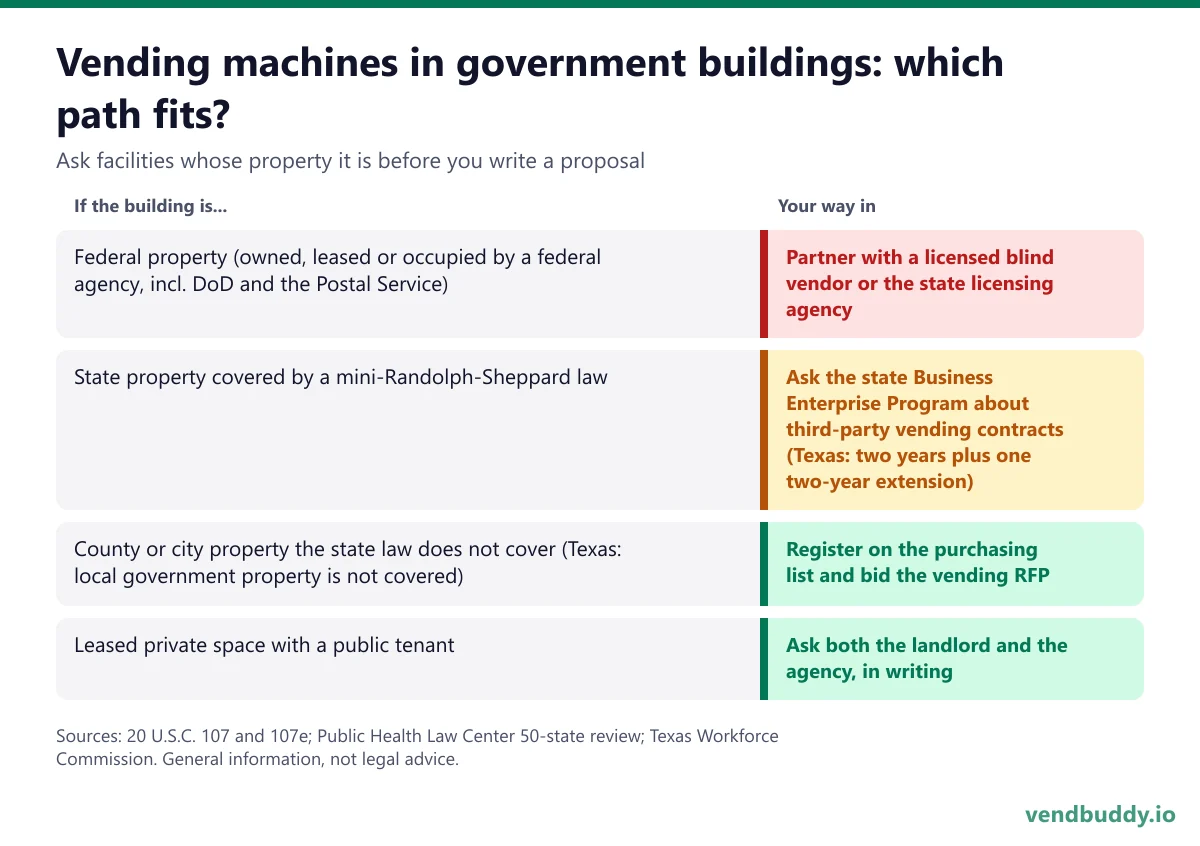
- Federal property. Federal law defines it as any building or land owned, leased or occupied by a federal department or agency, including the Department of Defense and the Postal Service (20 U.S.C. 107e). Licensed blind vendors get priority here. Your route in is through them.
- State property. Nearly every state has passed its own version of the federal law, often called a mini-Randolph-Sheppard Act (Public Health Law Center, 50-state review). In Texas, for example, the state law covers land and buildings owned, leased or otherwise controlled by the state, and does not extend to local government property (Public Health Law Center, Texas). State buildings usually run through the state program, which may contract vending out to private companies.
- County and city property. Depends on the state. Where the state law stops at state property, as in Texas, counties and cities buy vending like any other service: a request for proposals, a quote or a facilities decision.
- Leased private space with a public tenant. A county office on the third floor of a private building. The landlord may control the break room, the agency may control its own suite. Ask both.
Picture the machines paying you while you sleep
That’s the real promise of vending — income that doesn’t cost you your time, and a life on your own terms. VendBuddy turns this guide into a step-by-step plan so you actually build it instead of just reading about it. Start free today.
Start building free →What the Randolph-Sheppard Act means for vending
The Randolph-Sheppard Act of 1936 says blind persons licensed by a state agency are authorized to operate vending facilities on any federal property, and that priority goes to them (20 U.S.C. 107). A "vending facility" in the regulations covers automatic vending machines as well as cafeterias, snack bars and carts (34 CFR Part 395). On buildings the General Services Administration manages, the property manager signs a permit with the state licensing agency, which then licenses the blind vendor who runs the site (41 CFR 102-74.55).
The money part matters to you even if you never set foot on a base. On federal property, 100% of the income from machines in direct competition with a blind vendor's facility goes to that vendor, or to the state agency if there is no vendor on site. For machines that are not in direct competition, the share is 50%, or 30% at sites where at least half the hours are worked outside normal working hours (20 U.S.C. 107d-3). In plain terms: a private company running machines in a federal building is usually sharing a big slice of its net with the program, by law, so the deal is shaped by the program from day one.
The program is not small. In fiscal year 2023, 1,428 blind vendors operated 1,780 vending facilities on federal and other property, generating $747,455,376 in sales, with average vendor earnings of $103,085.50 (Rehabilitation Services Administration). For the full legal picture, including who qualifies and how the income rules work, read our Randolph-Sheppard Act explainer for vending operators.
Three ways a private operator gets in
1. Partner with a licensed blind vendor or the state program. Many blind vendors run a snack bar or cafeteria and want help with outlying machines, restocking or a micro market. Some state programs go further and hire private companies directly. Business Enterprises of Texas manages third-party contracts for vending services, splits the state into contract areas, and keeps a list of service sites for each area. Its contracts run an initial two years and can be extended once for another two, and new bids are posted on the Texas Workforce Commission's Bonfire portal and the Texas Comptroller's purchasing site (Texas Workforce Commission, BET vending services contracts). Search your own state's Business Enterprise Program page for "vending services contract" or call the program office and ask whether they use third-party vendors.
If you would rather not draft the contract from scratch, we keep a plain-English walkthrough at get vending machine contracts. It covers term, commission, exclusivity and how either side gets out.
Read the reporting rules before you bid. Texas wants a monthly online sales and commission report with beginning and ending meter readings for every machine, and charges a late penalty of 3% of that month's gross sales if the report or the payment arrives late. Unpaid commissions can end the contract and trigger the performance bond. If you subcontract part of the work, the prime contractor still owns the report.
2. Bid on city and county requests for proposals. This is where most small operators win their first government placement. A city or county posts a solicitation, you answer it, a committee scores it. These bids are often small enough that big national vendors skip them.
3. Ask about spaces the program does not cover. Federal law exempts some locations, such as exchange retail outlets and machines run by the Veterans Canteen Service, and machines not in direct competition with a blind vendor at a site whose total vending income does not exceed $3,000 a year (20 U.S.C. 107d-3). Do not guess at any of this. Ask the property manager and the state licensing agency, and get the answer in writing. An operator who works with the program gets referrals; one who tries to sneak around it gets removed.
Where government vending bids are posted
- SAM.gov for federal opportunities. You need a SAM registration to be paid on a federal contract. Search "vending" and "concession", and read whether the notice mentions the state licensing agency.
- State procurement portals, such as the Texas Comptroller purchasing site, and your state Business Enterprise Program page.
- City and county purchasing pages. Most post bids on their own site or a portal like Bonfire or a bid aggregator. Search "[county name] vending RFP" every quarter.
- School districts, transit agencies and park districts. Separate buyers with separate bid lists. Register as a vendor with each one you want.
Registering takes an afternoon, and it means the next solicitation lands in your inbox instead of being found two days before it closes.
What a government vending RFP asks for
Two 2026 solicitations show what a small operator is up against.
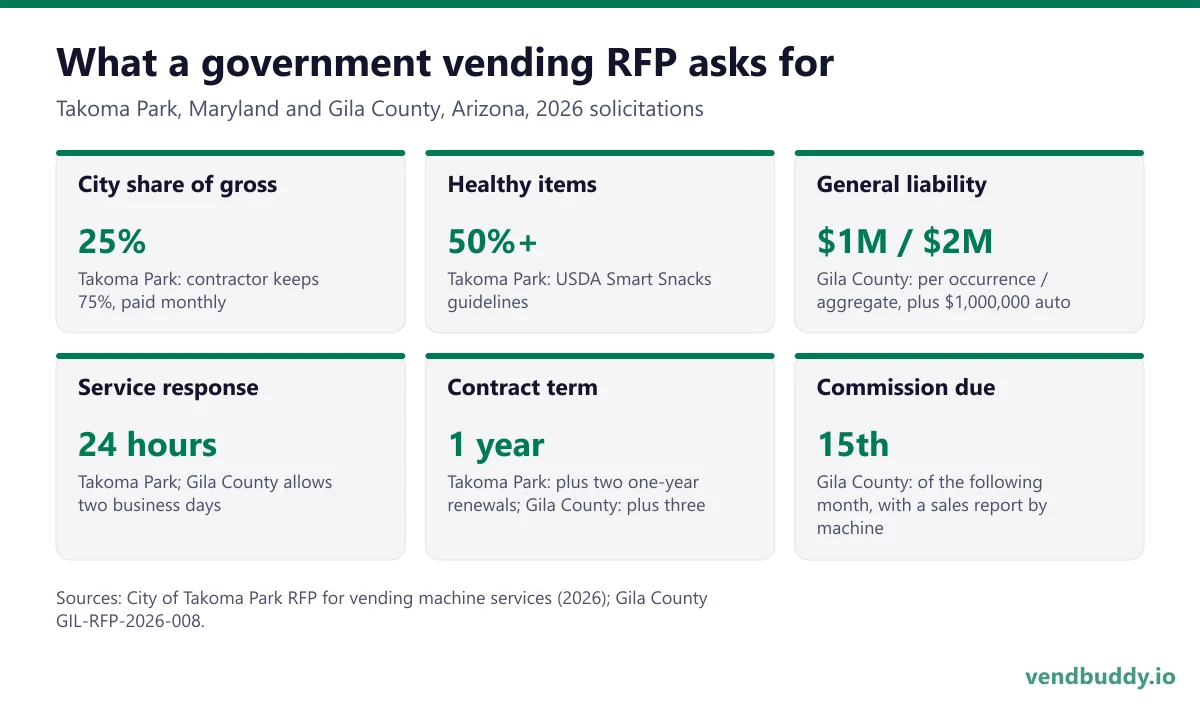
Takoma Park, Maryland. The contractor keeps 75% of gross vending revenue and the city receives 25%, paid monthly. At least 50% of stocked food and drinks must be healthy choices that follow the USDA Smart Snacks guidelines. Machines must take cash plus card and mobile payments where available, and every machine must accept $1 bills. Service requests get a response within 24 hours. Insurance includes $1,000,000 in automobile liability for bodily injury per occurrence and workers' compensation, and the contractor files a monthly sales report with supporting documentation (City of Takoma Park RFP).
Gila County, Arizona. Commercial general liability of $1,000,000 per occurrence and $2,000,000 in the aggregate, automobile liability of $1,000,000, and workers' compensation. Machines must accept cash, credit, debit, tap-to-pay and mobile wallets. Malfunctions get a response within two business days, inoperable machines are repaired or swapped for a temporary unit within five business days, and commission is paid by the 15th of the following month with a sales report by machine. The county also says the list of sites does not guarantee any minimum number of machines or sales (Gila County RFP).
Notice what is common: a certificate of insurance before install, cashless readers, a written service promise, and a monthly report that ties sales to each machine. If you cannot produce a clean per-machine sales report today, fix that before you bid. Our vending machine insurance guide and commission rates guide cover the numbers to plan around.
Healthy vending rules show up often. The federal Food Service Guidelines for Federal Facilities are voluntary best business practices for snack bars, concession stands, micro markets and vending machines, with standards that support options such as lower sodium items and freely available drinking water (CDC, Food Service Guidelines for Federal Facilities). Many cities and counties borrow from them. Build a planogram with a healthy row ready to show, and you answer the question before it is asked. Our healthy vending guide has product ideas.
Expect access rules too. Courthouses, jails and secure federal sites often require a background check, a badge, an escort or fixed service windows. Ask about access during the pre-bid questions, because a route you can only service on Tuesday mornings changes your restock plan.
How to get vending machines in government buildings, step by step
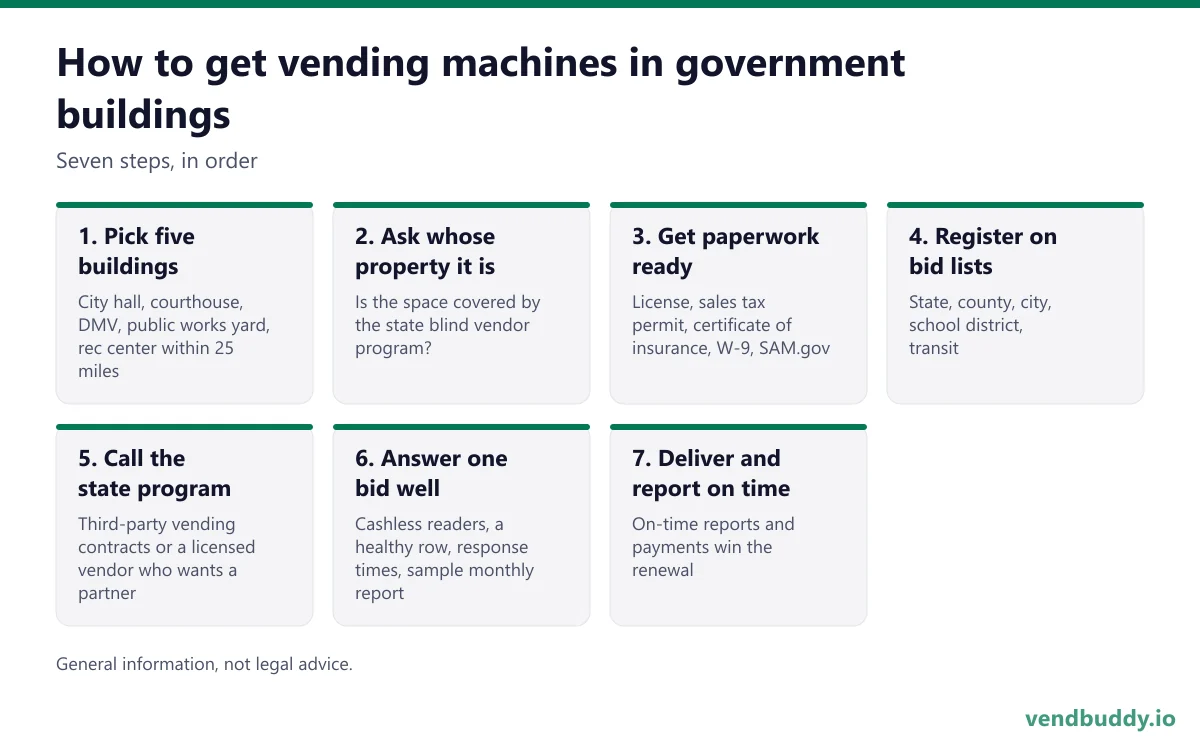
- Pick five buildings. City hall, the county courthouse, a DMV or license office, a public works yard and a recreation center within 25 miles of you.
- Find out whose property each one is. Call facilities and ask: is this space covered by the state's blind vendor program, and who handles vending today?
- Get your paperwork ready. Business license, sales tax permit, a certificate of insurance at the limits above, W-9, and a SAM.gov registration if you want federal work.
- Register on every bid list. State portal, county purchasing, city purchasing, school district, transit.
- Call the state Business Enterprise Program. Ask whether they contract vending to third parties or whether any licensed vendor near you wants a service partner.
- Answer one bid well. Machine list, cashless readers, a healthy-choice row, service response times, sample monthly report, commission offer, references.
- Deliver and report on time. Monthly reports and payments, on time, every month. That record wins the renewal and the next agency.
An illustrative example
Here is how this can play out. This is an illustrative example, not a real operator. A two-person route in a mid-sized county searches the county purchasing page and finds a vending RFP for six sites: two office buildings, a courthouse, a road yard and two parks buildings. They are not in the state program's coverage because the state law stops at state property. They send questions before the deadline, learn that the courthouse needs a background check for anyone servicing the machines, and price that in. Their proposal offers combo machines with card readers, one healthy row per machine, a two-business-day service promise and a sample monthly report by machine. They do not win the whole bid, but the county awards them the road yard and the parks buildings, which have early shifts and no cafeteria. Two years later they bid the renewal with a clean reporting record. Nothing here is guaranteed; the point is the order of the steps.
Find government buildings near you
The fastest start is a list. Find government offices near you in Lead Finder: it lists city halls, county offices and similar buildings around a ZIP with a score and the right contact title, so you know who to call about the vendor process. For what to stock and how a single office runs day to day, read our government office vending machines guide, and before you sign, read vending machine contracts 101.
One good government placement can turn into five, because the second agency calls the first for a reference. Pick your five buildings this week and make the first call.
Frequently Asked Questions
Can a private company put vending machines in a federal building?
Usually only through the Randolph-Sheppard program. Licensed blind vendors have priority on federal property, so a private operator works as a partner or subcontractor to the vendor or the state licensing agency, and a share of machine income goes to the program by law. Ask the property manager and the state agency before you place anything.
Do city halls and county offices fall under the Randolph-Sheppard Act?
The federal act covers federal property. Many states have their own mini-Randolph-Sheppard laws, and their reach varies. In Texas the state law covers state property and does not extend to local government property, so county and city buildings there buy vending through their own procurement.
What insurance do I need for a government vending contract?
Expect commercial general liability, automobile liability and workers compensation at minimum. Gila County, Arizona asked for $1,000,000 per occurrence and $2,000,000 aggregate general liability plus $1,000,000 auto liability in its 2026 RFP. Get a certificate of insurance naming the agency before install.
Where do I find government vending bids?
SAM.gov for federal notices, your state procurement portal and Business Enterprise Program page, and the purchasing pages of your city, county, school district and transit agency. Register as a vendor with each so solicitations come to you.
What commission do governments ask for on vending?
It varies by solicitation. Takoma Park, Maryland set the city share at 25% of gross vending revenue in its 2026 RFP, while Gila County, Arizona asked bidders to state their rate on a price sheet. Price your offer from your own per-machine numbers, not a rule of thumb.
Every figure here is an average, and averages hide the building. The revenue calculator lets you plug in the property you are actually looking at and see the range for that type.
What is selling, which buildings say yes, and the numbers before you buy a machine. Free, confirm from your inbox, unsubscribe in one click. Refer one friend and get 25 VendBuddy credits.
Walk-ins and cold emails find locations. A small site with your own machine photos and a request-a-machine form lets the next one find you. Around machine three to five, an AI builder drafts it in an evening. Wix is the mature site builder; Base44 also builds working tools like a quote form. Start with the AI website walkthrough or Wix vs Base44.
If you run an office, apartment community, gym or school, a local operator can put in a machine and keep it stocked at no cost to you. Check whether your place fits in about a minute, then decide if you want to send it.
Not the one who decides? You can still pass the place on, and the operator will ask who to talk to.
Check my placeSuggest a location →Original research: we read 28 public vending RFPs, agreements and awards and recorded the commission, term, insurance, card-reader and healthy-vending terms each one states. See Vending Commission Rates and Contract Terms 2026: what public contracts show.
General information, not legal, tax or financial advice. Rules change, so check the official source. Revenue and income figures are examples, not promises. See our terms.