- The Randolph-Sheppard Act (20 U.S.C. 107) gives blind persons licensed by a state agency priority to operate vending facilities, including vending machines, on federal property.
- A blind person under the act has central visual acuity of 20/200 or worse in the better eye with correction, or a visual field of 20 degrees or less.
- Income from machines in direct competition with a blind vendor goes 100% to the vendor or state agency; 50% for other machines, or 30% where most hours are off-hours; sites under $3,000 a year are exempt.
- In FY 2023, 1,428 blind vendors ran 1,780 facilities generating $747,455,376 (RSA); nearly every state has its own mini-Randolph-Sheppard law.
The Randolph-Sheppard Act is the 1936 federal law that gives licensed blind vendors first claim on vending facilities in federal buildings, and it is the reason a vending company cannot simply roll a machine into a post office or a federal courthouse. If you run vending machines, or plan to, it helps to know exactly what the law says, who it protects, and how it splits the money from machines on federal property. This explainer sticks to the statute and the regulations, with links to each, so you can check every line yourself. It is general information, not legal advice.
Part of our complete guide: how to find vending machine locations.
What the Randolph-Sheppard Act says
The core is one sentence. To give blind people paid work and more economic opportunity, blind persons licensed under the act "shall be authorized to operate vending facilities on any Federal property," and in authorizing those facilities, "priority shall be given" to blind persons licensed by a state agency (20 U.S.C. 107).
The law has been rewritten twice. The 1954 amendments said preference should be given "so far as feasible." The 1974 amendments replaced that softer wording with a firm priority and told the Department of Education to write rules so that, wherever feasible, one or more vending facilities are set up on all federal property unless that would hurt the interests of the United States. Any agency that wants to limit a vending facility on those grounds has to justify it in writing to the Secretary of Education, and the decision is published in the Federal Register.
Today the U.S. Department of Education's Rehabilitation Services Administration runs the program. Its rules sit in 34 CFR Part 395 (eCFR, 34 CFR Part 395).
What counts as a vending facility
Broader than most operators expect. The regulations define a vending facility as automatic vending machines, cafeterias, snack bars, cart service, shelters, counters and related equipment used to sell newspapers, confections, food, drinks and other items, plus state lottery sales where a state allows them (34 CFR 395.1).
For income purposes, a vending machine is a coin or currency operated machine that dispenses articles or services. Postal Service stamp machines, recreational machines and telephones are not counted. So a snack machine, a drink machine and a micro market kiosk on federal property are all in scope.
Picture the machines paying you while you sleep
That’s the real promise of vending — income that doesn’t cost you your time, and a life on your own terms. VendBuddy turns this guide into a step-by-step plan so you actually build it instead of just reading about it. Start free today.
Start building free →Who qualifies as a blind vendor
The act defines a blind person as someone whose central visual acuity does not exceed 20/200 in the better eye with correcting lenses, or whose field of vision in the better eye is limited to an angle of no more than 20 degrees (20 U.S.C. 107e). Licenses go only to applicants who meet that definition (20 U.S.C. 107a).
Each state designates a licensing agency, usually called the Business Enterprise Program or something close to it. The agency recruits, trains, licenses and places vendors, and supports them once they are running (RSA program page). Texas is a good example of what licensing involves: candidates must be legally blind by federal standards, U.S. citizens, at least 18, high school graduates or GED holders, referred by state vocational rehabilitation staff, and must finish the state's training, which covers food service and vending management, cost control and merchandising (Business Enterprises of Texas). North Carolina's program describes facilities in federal and state buildings, rest areas and welcome centers, and other private locations (NC DHHS Business Enterprise Program).
How the priority works on federal property
Federal property means any building or land owned, leased or occupied by a federal department or agency, and the definition names the Department of Defense and the Postal Service (20 U.S.C. 107e). On buildings managed under the Federal Management Regulation, vending facilities are authorized by permit: the federal property manager approves and signs the state licensing agency's permit, and the state then licenses a blind vendor to run the site (41 CFR 102-74.55).
The rules also allow Randolph-Sheppard facilities in leased space and in Cooperative Use Space in GSA buildings (RSA). Cafeterias are covered too: the Secretary of Education sets a priority for blind licensees to run cafeterias on federal property when that can be done at reasonable cost with comparable food quality.
How vending machine income is shared
This is the part that touches every vending company with a machine on federal ground. Under 20 U.S.C. 107d-3:
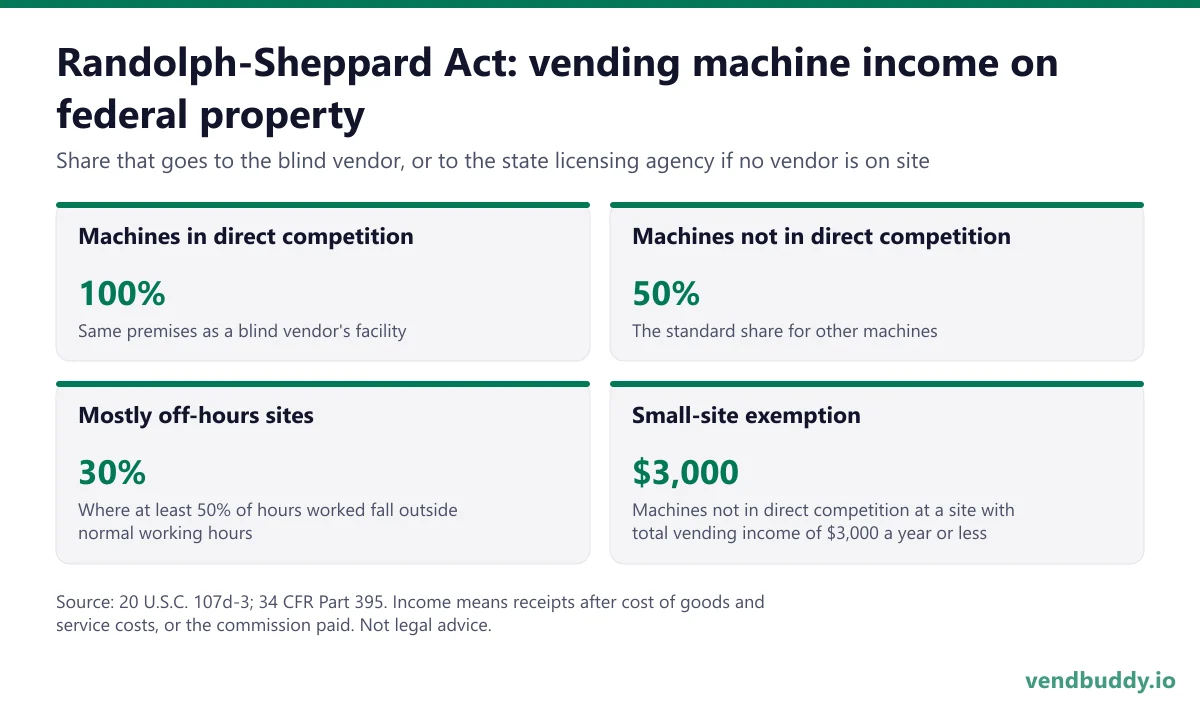
- Machines in direct competition with a blind vendor's facility: 100% of vending machine income goes to the blind vendor, or to the state agency if no blind vendor runs a facility on that property.
- Machines not in direct competition: 50% goes the same way.
- Sites where at least 50% of total hours worked fall outside normal working hours: the share for machines not in direct competition is 30%.
"Direct competition" means any machine or facility on the same premises as a blind vendor's facility, except machines serving employees most of whom do not normally have direct access to that facility. "Vending machine income" is not gross sales: it is receipts after the cost of goods sold and reasonable service and maintenance costs, or the commission paid by a commercial vending company that runs the machines (34 CFR 395.1).
There are exceptions. The income rules do not apply to machines inside exchange or ships' store retail outlets, to machines run by the Veterans Canteen Service, or to machines not in direct competition at a single location whose total vending income does not exceed $3,000 a year.
Where the money goes once a state agency receives it is set by law as well: retirement or pension plans, health insurance contributions, and paid sick leave and vacation for blind licensees, subject to a vote of the licensees, with any remainder reducing the fees the agency charges vendors.
State mini-Randolph-Sheppard laws
The federal act stops at federal property, but the idea did not. Nearly every state has adopted a similar law, often called a mini-Randolph-Sheppard Act (Public Health Law Center), and the RSA notes that in most states the priority now reaches state, county, municipal and some private locations as well.
The reach differs a lot from state to state. Texas law covers land and buildings owned, leased or otherwise controlled by the state, and does not extend to local government property (Public Health Law Center, Texas). Check your own state's entry before assuming a county courthouse or a city recreation center is covered or open.
The program by the numbers
In fiscal year 2023, 1,428 blind vendors operated 1,780 vending facilities on federal and other property. The program generated $747,455,376, and average vendor earnings were $103,085.50 (Rehabilitation Services Administration). Business Enterprises of Texas describes itself as one of the largest such programs in the country, with cafeterias, convenience stores, snack bars, micro markets and machines on state and federal property, highway rest areas, post offices and state prisons.
What it means if you run vending machines
Three practical points. First, on federal property you are not competing with the program, you are working inside it: partner with a licensed vendor who wants help, or answer a state agency's third-party vending contract. Texas, for one, posts third-party vending contracts for its contract areas (TWC vending services contracts). Second, price any federal deal knowing the income-sharing rules above. Third, the act opens as many doors as it closes: a blind vendor who runs a busy snack bar may need someone to service outlying machines.
If you would rather not draft the contract from scratch, we keep a plain-English walkthrough at get vending machine contracts. It covers term, commission, exclusivity and how either side gets out.
For the step-by-step on city halls, county offices, RFPs, insurance and bid portals, read our guide to getting vending machines into government buildings, then the government office vending machines guide for what to stock. When you are ready to build a list, find government offices near you in Lead Finder and ask each one, in writing, whether its space is covered by the state program.
Frequently Asked Questions
What is the Randolph-Sheppard Act in simple terms?
A 1936 federal law, amended in 1954 and 1974, that gives blind people licensed by a state agency priority to run vending facilities, including vending machines, cafeterias and snack bars, on federal property.
Does the Randolph-Sheppard Act apply to vending machines?
Yes. The regulations define a vending facility to include automatic vending machines, and the act sets how income from vending machines on federal property is shared with blind vendors or the state licensing agency.
How much vending machine income goes to blind vendors?
On federal property, 100% of vending machine income from machines in direct competition with a blind vendor facility, 50% from machines not in direct competition, or 30% at sites where at least half the hours worked are outside normal working hours. Income here means receipts after cost of goods and service costs, or the commission a vending company pays.
Does the Randolph-Sheppard Act cover state and city buildings?
The federal act covers federal property. Most states have their own versions that can reach state, county or city property, but the reach varies. Texas, for example, covers state property and not local government property.
Who runs the Randolph-Sheppard program in my state?
A state licensing agency, usually called the Business Enterprise Program, often inside the vocational rehabilitation or services-for-the-blind agency. It licenses and places vendors and may contract some vending to third parties.
What is selling, which buildings say yes, and the numbers before you buy a machine. Free, confirm from your inbox, unsubscribe in one click. Refer one friend and get 25 VendBuddy credits.
Original research: we read 28 public vending RFPs, agreements and awards and recorded the commission, term, insurance, card-reader and healthy-vending terms each one states. See Vending Commission Rates and Contract Terms 2026: what public contracts show.
General information, not legal, tax or financial advice. Rules change, so check the official source. Revenue and income figures are examples, not promises. See our terms.