- $5,000 is enough for one machine, properly placed, with a cushion — not for two unless you buy at the bottom of the used market and move them yourself.
- Allocate from the bottom up. Insurance, LLC, permits, first fill and the move are fixed and total $950–$2,000. The machine is the flexible line, not the other way round.
- Hold $500 back and do not touch it. The first unexpected repair or lift-gate delivery fee is what turns a tight budget into a stalled one.
- Card reader is not optional. $300–$600 plus a monthly fee, and it is the line item where buying cheap reliably costs more than it saves.
- Location first, machine second. A machine with no placement resells at 40–60 cents on the dollar. Size the cabinet to the building you actually got.
This page is not an argument about whether to start. It is the spreadsheet. You have $5,000, you have decided, and the question is where each of those dollars goes and in what order — which is a genuinely different question from how much you will make, and the one most guides skip straight past.
- The $5,000 allocation, line by line
- Spend in this order, not the obvious one
- The machine: $1,500–$3,500, and what each band buys
- The card reader: $300–$600, and the one line not to cheap out on
- The two lines everybody under-budgets
- If $5,000 does not quite stretch
- What the $5,000 actually bought you
- Frequently Asked Questions
Part of our complete guide: how to start a vending machine business.
What follows is a line-item allocation with real 2026 numbers, the order to spend in, the two lines people reliably under-budget, and what to do if the total comes up short. If you are still deciding between businesses rather than allocating inside one, the best business to start with $5,000 ranks eight of them honestly first.
The $5,000 allocation, line by line
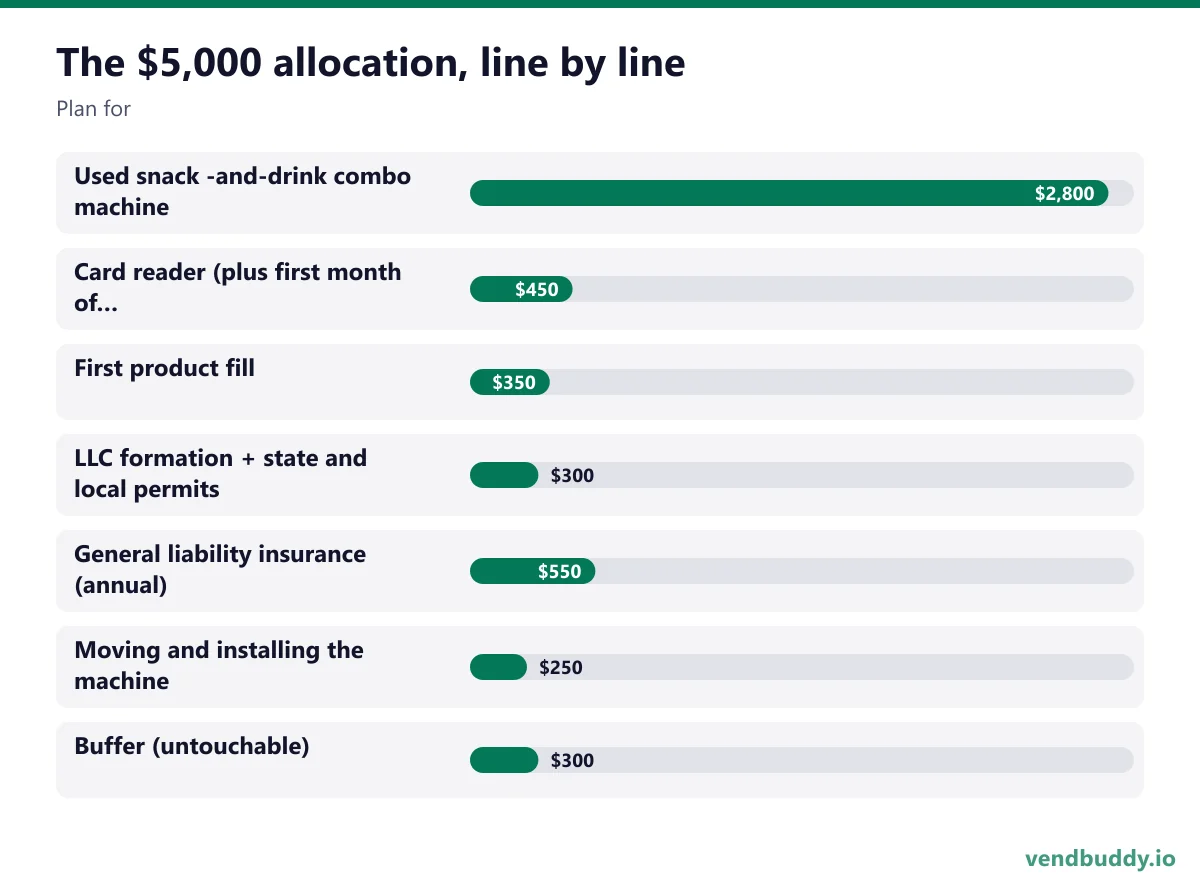
Here is the whole budget in one table. The middle column is the realistic range; the right column is what I would actually put in a first-machine plan, which sits deliberately below the top of each range because the sum of everyone’s best case is how budgets break.
| Line item | Realistic range | Plan for |
|---|---|---|
| Used snack-and-drink combo machine | $1,500–$3,500 | $2,800 |
| Card reader (plus first month of connectivity) | $300–$600 | $450 |
| First product fill | $250–$400 | $350 |
| LLC formation + state and local permits | $150–$500 | $300 |
| General liability insurance (annual) | $400–$700 | $550 |
| Moving and installing the machine | $150–$400 | $250 |
| Buffer (untouchable) | — | $300 |
| Total | — | $5,000 |
That is one machine, insured, legal, filled, installed and running, with $300 left that you have promised yourself you will not spend. It is a tight but genuinely workable plan, and the tightness is the point: $5,000 is a one-shot budget, which forces sharper decisions than $10,000 does.
Spend in this order, not the obvious one
The instinct is to buy the machine first because it is the exciting part. That is exactly backwards, and it is the single most common way a $5,000 start becomes a $5,000 loss.
The machine is the flexible line in a $5,000 vending budget. Insurance, permits, the fill and the move are fixed - and the people who blow the budget spend on the machine first.
Picture the machines paying you while you sleep
That’s the real promise of vending — income that doesn’t cost you your time, and a life on your own terms. VendBuddy turns this guide into a step-by-step plan so you actually build it instead of just reading about it. Start free today.
Start building free →The machine: $1,500–$3,500, and what each band buys
This is the biggest line and the one with the most room in it, which is why it should be decided last. What the money actually buys:
- Under $1,200. Usually somebody else’s compressor problem. There are exceptions — an estate sale, an operator retiring, a business closing — and they are worth chasing, but assume a fault until an inspection says otherwise.
- $1,500–$2,500. The working end of the used market. A ten-to-fifteen-year-old combo with a sound cabinet, a functioning board and, ideally, an existing card-reader harness. This is where most first machines come from and it is a perfectly good place to buy.
- $2,500–$3,500. Newer used, or a refurbished unit from a dealer with a short warranty. On a $5,000 budget this is the sensible top, and the warranty is worth real money when your buffer is $300.
- $3,500–$4,000+. A new combo. Lovely, and it does not fit this budget without cutting something that should not be cut.
Match the machine type to the building rather than to the price. A gym wants drinks and protein; a manufacturing site wants a combo with real snack capacity; an office lobby may want something that looks like an amenity rather than a vending machine. The free Machine Finder compares machine types and real price ranges against 15-plus property types, including the used and traditional options nobody earns a commission selling you:
The card reader: $300–$600, and the one line not to cheap out on
A cash-only machine in 2026 is turning away everyone who does not carry notes, which is most people under 40. Card acceptance is consistently reported to lift machine sales by 15 to 35 percent, which on a $1,200-a-month machine is $180 to $420 of revenue a month against a one-time $450 and a small monthly fee. There is no version of that arithmetic where skipping it wins.
Two things to get right at this budget. First, buy a reader with telemetry rather than a bare payment terminal — knowing what sold without driving to the machine is what makes one machine feel manageable and ten machines possible. Second, confirm the harness fits your specific machine before it ships, because a reader that needs an adapter kit is a $90 surprise on a $300 buffer.
Nayax card readers are the reader we see most often on profitable routes and the one we point new operators at — card acceptance plus telemetry in one unit. The honest comparison against the alternatives, including what each one charges monthly, is in the full card reader comparison, and the fee breakdown shows what processing actually costs per machine per month.
The two lines everybody under-budgets
Moving the machine. A full-size combo weighs 600 to 800 pounds. Options run from a friend with a truck and a rented appliance dolly (about $80, and genuinely doable — here is how) to a proper moving service at $300 to $400. What catches people is the lift gate: a delivery quote without one, to a site with no loading dock, is not a delivery quote. Get it in writing.
The first fill. $250 to $400 for a full combo, and it is not optional to do it properly — a half-stocked machine in week one teaches the building that the machine is unreliable, which is a lesson that takes months to unteach. Buy at a warehouse club at this volume rather than from a distributor; the distributor math only starts working around machine five. The starter planogram is 12 to 16 SKUs, not 40, which also keeps this line honest.
Everything above is free to read and free to do. The operator packs are the same material in fill-in-the-blank form — the 50-state distributor list, the LLC and permit checklist in unblocking order, the word-for-word walk-in script, and the placement agreement you hand a property manager. One-time purchase from $27, nothing renews.
See what is inside →If $5,000 does not quite stretch
Three honest options, in the order I would take them.
1. Cut the machine line and do the labour yourself. Buying at $1,800 instead of $2,800 and moving the machine yourself instead of paying for it saves roughly $1,200 combined. Nothing else on the list is safely cuttable — skipping insurance loses you the placement, skipping the reader loses you a fifth of the revenue, and skipping the buffer just moves the problem to month two. If even the trimmed number is out of reach, the tighter plan for how to start a vending machine business with $1,000 shows what one machine looks like on a fifth of this budget.
2. Wait two months and start with $6,000. Unglamorous and frequently correct, especially if the $5,000 is your entire cushion. The disqualifier is worth reading: if this money is your emergency fund, no allocation on this page makes it safe, because a forced sale of a used machine fetches 40 to 60 cents on the dollar.
3. Bridge the gap with 0% intro business credit. This works, with conditions, and it is how a large share of first machines actually get bought. The machine has to have a signed location already, and the payback has to sit comfortably inside the intro window rather than right at the edge of it. A $2,800 machine at a confirmed site netting $300 a month clears in about ten months, which fits a 12 to 18 month window with margin. A speculative placement does not, and financing a guess is how a cheap lesson becomes an expensive one.
7 Figures Funding works the qualification side of 0% intro business credit for new business owners — they look at your profile first and sequence the applications, rather than you applying cold one card at a time and collecting hard pulls. Worth a look only if the placement is confirmed and the payback fits inside the intro window.
What the $5,000 actually bought you
One machine at a real location, insured and legal, with a reader on it and a small cushion behind it. At a site with 100 to 200 daily visitors that machine grosses $1,200 to $3,000 a month and nets 25 to 30 percent of it — call it $330 on a $1,200 machine — and pays back its own cost in roughly 12 to 14 months.
Machine two comes out of machine one’s profit, which takes about a year at that rate, or sooner if you are also saving from a job. That is the boring, reliable version of this business and it is the one that works. What the first $100 actually feels like is the honest month-one account, and the income reality calculator shows what a route of any given size actually pays before you build a plan around it.
The location decides whether any of the numbers above happen. VendBuddy scores real buildings near you by traffic, headcount and category, hands you the best contact on file for each, and models net profit and payback before you commit a dollar of the $5,000. Free to start, no card.
Related reading: what it costs to start a vending machine business, how to inspect and buy a used machine, what vending machines really cost, how to finance vending machines, the full cost and profit breakdown, and how long a machine takes to pay for itself.
Frequently Asked Questions
Can you start a vending machine business with $5,000?
Yes, and it is close to the natural entry point. A workable allocation is roughly $2,500 to $3,500 on a properly inspected used snack-and-drink combo, $300 to $600 on a card reader, $250 to $400 on the first product fill, $150 to $500 on LLC formation and any permits your state requires, $400 to $700 on general liability insurance, $150 to $400 on moving the machine, and whatever is left held as a buffer. That lands one machine placed and running with a few hundred dollars of cushion. It does not stretch to two machines unless you buy at the bottom of the used market and move them yourself.
How should I allocate a $5,000 vending machine budget?
Work from the bottom up, not the top down. Reserve the non-negotiables first - insurance, LLC and permits, the first fill and the move, which together run roughly $950 to $2,000 - then hold $500 as an untouchable buffer, and only then see what is left for the machine. Most people do this backwards, spend $4,000 on equipment, and discover they cannot afford to fill it or insure it. The machine is the flexible line, not the fixed one, because the used market has options at almost every price.
What is the biggest mistake when starting vending with $5,000?
Spending the whole budget on the machine before the location is signed. A machine with no placement is a depreciating appliance in your garage, and the used market resells at 40 to 60 cents on the dollar under time pressure. The correct sequence is: secure the location first for free, then size the machine to the building you actually got. The second biggest mistake is leaving no buffer, because the first unexpected $400 - a failed bill validator, a delivery that needs a lift gate - then comes out of the product budget.
Worth noting on product spend: the route spend is the smaller half of this. The bigger line is the rent or mortgage payment, which normally earns nothing. Per its card page the Bilt card earns up to 1.25X on that payment with no transaction fee, and the no-fee Blue tier earns 1X on everything else. Referral link, and it only works if you clear the balance every month. Affiliate link, so we may earn a commission at no extra cost to you.
How much should I spend on a used vending machine?
A properly inspected used snack-and-drink combo runs $1,500 to $3,000, and a new combo $2,500 to $4,000. On a $5,000 total budget the sensible band is $2,500 to $3,500, which buys a machine recent enough to have a working board and a card-reader-ready harness without eating the money you need for everything else. Below about $1,200 you are usually buying somebody else compressor problem. Get a 15-point inspection done before money moves rather than after.
Do I need a card reader on my first vending machine?
Yes. Card acceptance lifts machine sales meaningfully - operators consistently report a 15 to 35 percent increase - and a cash-only machine in 2026 loses the entire population that does not carry notes. Budget $300 to $600 for the reader itself plus a monthly connectivity fee, and treat it as part of the machine cost rather than an upgrade. It is the one line item on this list where buying the cheapest option reliably costs you more than it saves.
What if $5,000 is not quite enough?
Three honest options. Buy further down the used market and move the machine yourself, which can save $600 to $1,000 combined. Wait two months and start with $6,000, which is genuinely the better answer if the $5,000 is your entire cushion. Or bridge the gap with 0% intro business credit, which works only if the machine payback is comfortably inside the intro window and you already have the location signed. What does not work is starting with no buffer and hoping nothing goes wrong in month two.
Is $5,000 enough for two vending machines?
Only at the very bottom of the used market, and it is a real trade-off rather than a free upgrade. Two machines at $1,500 each plus two readers, two fills and two moves lands at roughly $5,000 with nothing left over - no buffer, more maintenance exposure, and two locations to service from day one. What you buy for that is diversification: if one site underperforms you have a working machine and a data point instead of a verdict. Experienced operators often take that trade. First-timers usually should not, because the buffer is what keeps a bad month from ending the business.
What is selling, which buildings say yes, and the numbers before you buy a machine. Free, confirm from your inbox, unsubscribe in one click. Refer one friend and get 25 VendBuddy credits.
Walk-ins and cold emails find locations. A small site with your own machine photos and a request-a-machine form lets the next one find you. Around machine three to five, an AI builder drafts it in an evening. Wix is the mature site builder; Base44 also builds working tools like a quote form. Start with the AI website walkthrough or Wix vs Base44.
General information, not legal, tax or financial advice. Rules change, so check the official source. Revenue and income figures are examples, not promises. See our terms.