- You already own the startup cost everyone else pays. Van, dolly, straps, and the knowledge of how to move 700 pounds. That is $150 to $400 per machine and the entire reason most people are afraid of this business.
- Every job site is a warm lead. You are already inside commercial buildings between 9am and 4pm, which is the exact window everyone else cannot reach.
- Most service calls are yours to fix. Coil jams, validators, MDB harnesses, door switches, start relays. The sealed refrigeration system is the one you hand to a certified tech.
- Your closing advantage is a sentence nobody else can say: “the break room needs a dedicated circuit and I will run it.”
- Your specific failure mode: the van makes buying machines easy, so trades end up with three machines and zero locations. Location first, every time.
Most side-business advice aimed at trades is a list of other trades. Add gutter cleaning. Add Christmas lights. Add pressure washing. All of which have the same structural problem as the work you already do: the income stops the moment your body does, and your body is on a clock nobody talks about.
A vending route is a different category of thing. It is the only common small business where the assets a tradesperson already owns — the vehicle, the dolly, the tools, the commercial relationships and the willingness to fix things — erase most of the barriers that stop everybody else. This page is about those advantages specifically, and about the one way trades reliably lose money at this, which is not the one you would expect.
The four things you already own
1. The van, and everything in it. Ask any first-time vending operator what surprised them and a large share will say freight. A full-size machine weighs 600 to 800 pounds, and getting it from a seller to a break room costs $150 to $400 in liftgate freight and inside delivery, assuming the site has a suitable door. That is a real line item and it recurs with every machine. For you it is a Saturday morning, a full tank and equipment you already carry. You also know how to strap a load, how to walk an appliance dolly down a ramp, and — more importantly — when not to. The move guide is here and you will find most of it already obvious.
2. Commercial buildings, during business hours, as a matter of routine. This is the big one and it is worth being explicit about why. The single scarcest input in vending is being physically inside a business between 9am and 4pm on a weekday, because that is when the person who decides about the break room is there. A person with an office job cannot do that without burning vacation days, which is precisely why most aspiring operators never place a machine. You are inside three commercial buildings a week and you are talking to the facilities person in each of them. You are not cold-calling. You are already in the room.
3. Comfort with the physical and the mechanical. Vending has a repair layer that intimidates people who have never opened anything. The common faults are a jammed coil or a tired spiral motor, a bill validator that needs cleaning, an MDB harness that has worked loose, a door switch, a failed start relay or capacitor on the refrigeration deck, and lighting. For a first-time operator each of those is a $150 to $250 service call and a day of anxiety. For you it is a multimeter, a service manual and twenty minutes. What the calls cost when you have to pay for them is here, and the reason it matters is margin: repairs are one of the three things that quietly turn a $350-a-month machine into a $200-a-month machine.
The honest exception: the sealed refrigeration system. Work involving refrigerant is regulated and requires the appropriate certification, and a compressor or leak is not a general-competence job. Plenty of electricians and plumbers already hold the relevant certification; if you do not, that specific fault goes to a certified technician and everything else stays with you.
4. A supply chain and a parts mentality. You already keep a stock of fasteners, connectors and consumables, already have accounts at suppliers, already think in terms of spares on the truck. A spare spiral motor, a spare door switch and a cleaning kit in a bin costs about $60 and eliminates most downtime. Nobody teaches new operators this and almost none of them do it.
The closing line nobody else can use
This deserves its own section because it converts, and no other reader profile on this site can do it.
A full-size machine wants a dedicated 120V circuit of appropriate capacity, not an extension cord daisy-chained off the microwave outlet. A meaningful number of otherwise good break rooms fail on exactly this: the manager likes the idea, the maintenance guy points out that the circuit is already loaded, and the placement dies quietly on a technicality that nobody wants to spend money resolving.
You can say: “If the panel has capacity I will run the circuit as part of the install, at no cost to you.”
That sentence does three things at once. It removes the objection that kills the deal. It demonstrates competence in the first ninety seconds, which is the entire content of the trust judgement the manager is making. And it costs you an hour and $40 of materials against a machine that will net you $200 to $600 a month for years. For a plumber the equivalent is a water line for an ice or bottle-filler unit; for an HVAC contractor it is the airflow and clearance assessment that a facilities person will not have thought about.
Say it out loud in the walk-in. It is the strongest thing in your script. The rest of the script, and the twelve objections that come back, is here.
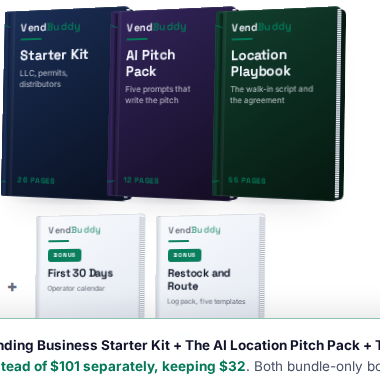
If you get to the end of this and the answer is yes, the kits are the shortcut past the blank page: a 26-page starter kit for the paperwork, a 55-page Location Playbook for the walk-in script and the agreement, and a 12-page AI Pitch Pack. Bought once, from $27, and you keep the files.
Look inside the kits →Picture the machines paying you while you sleep
That’s the real promise of vending — income that doesn’t cost you your time, and a life on your own terms. VendBuddy turns this guide into a step-by-step plan so you actually build it instead of just reading about it. Start free today.
Start building free →Your prospect list, which already exists
Write these down tonight. You will find you have thirty names without doing any research.
| Source you already have | Why it converts | The opening |
|---|---|---|
| Commercial customers you have worked for | They already trusted you with a key and a panel. Trust is the whole decision. | Asked in person, on site, while you are there for something else |
| Property managers who call you for repairs | They manage multiple buildings. One yes can be three placements. | A short email after a job, not during it |
| General contractors and their job sites | Active sites have crews with no food within a mile, and temporary sites become permanent buildings | The site super, at the trailer, at 7am |
| Supply house counters | Everybody in that queue owns or manages a building. This is the most under-used room in the trades. | The conversation you are already having while you wait |
| Your own shop or yard | Zero commission, zero landlord risk — a training machine | N/A. Useful for learning, not for revenue. |
The last row needs the honest caveat, because it is the first thing every trade does. Your own shop is a good first machine and a bad first location. It is genuinely useful for learning the software, practising a fill, finding out what breaks and testing product mix with no commission and no risk of losing a site. What it does not do is generate revenue, because a ten-person shop does not have the headcount. Treat it as a training machine and go find a building with three hundred people in it. How many people a machine actually needs is here, and the number is higher than people assume.
Electrician, plumber, HVAC, GC: the differences that matter
Electricians
The best fit of the four. The circuit offer above is yours specifically, the common repair set is almost entirely within your competence, and you are routinely in panel rooms and back-of-house areas where you see the actual condition of a building rather than the lobby version of it. You also know, as almost nobody does, which buildings have capacity and which are already at their limit, which is genuinely useful when choosing between two similar sites.
Plumbers
Very strong, with a different closing line. Water is the hook: ice machines, bottle-filler stations and any unit needing a supply line all die on the plumbing question, and you remove it. Plumbers also have an unusual density of commercial service relationships — restaurants, gyms, apartment complexes, care homes — and apartment complexes and gyms are two of the highest-performing vending categories there are. The gym vending economics are here, and the average ticket is materially higher than an office.
HVAC
Strong, and you have the one certification advantage in this whole business. If you hold the certification for refrigerant work, the single fault that sends every other operator to a paid technician is one you handle yourself, which changes the calculus on buying older refrigerated equipment. Cheap used coolers with sealed-system faults are a category most operators correctly avoid and you can correctly consider. The counterweight is seasonality: your busy months are the ones where you will not want to be doing anything else, so size the route for August and February rather than for October.
General contractors and handymen
Good, with the widest network and the most variable schedule. You know more building owners than anyone else on this list and your calendar is the least predictable. That combination argues for a small tight route built deliberately slowly — two machines, one cluster, added one at a time — rather than for capitalising on the network quickly.
The objection only you have
“I already work fifty hours a week with my hands. Why would I add more physical work?”
The honest answer is that this is precisely the argument for it, and it is worth being blunt about the underlying arithmetic.
A trade is income that stops when your body stops. Not eventually, in the abstract — on the specific Tuesday when a shoulder goes, or a knee, or a back, and there is nothing coming in until it is fixed. Every tradesperson knows somebody this happened to, and most of them have had the private thought about what their own version of that would look like.
A vending machine does not care about your back. It runs on a Tuesday you spend at a physio appointment. Four machines netting $250 each is $1,000 a month that arrives whether you can lift or not, and unlike your trade it is sellable — routes change hands, commonly somewhere around 12 to 24 times monthly net, which is a thing a one-person contracting business mostly cannot do. What a route sells for is here.
So the framing is not side hustle. It is the exit ramp built while the trade is still paying for it. The physical work involved is a loaded cart across a car park once a week, which is the lightest hour of your entire week.
Before you decide how many machines that argument implies, run it: the Income Reality Calculator converts your capital, the hours you genuinely have and the income you want into a machine count and a timeline. For most trades the number that comes back is smaller and slower than expected, and the second half — the timeline — is the part worth planning around.
The worked weekly plan, sized to a bad month
The design rule for a trade route is not the average week. It is the worst week you had this year, because that is the week that costs you a location.
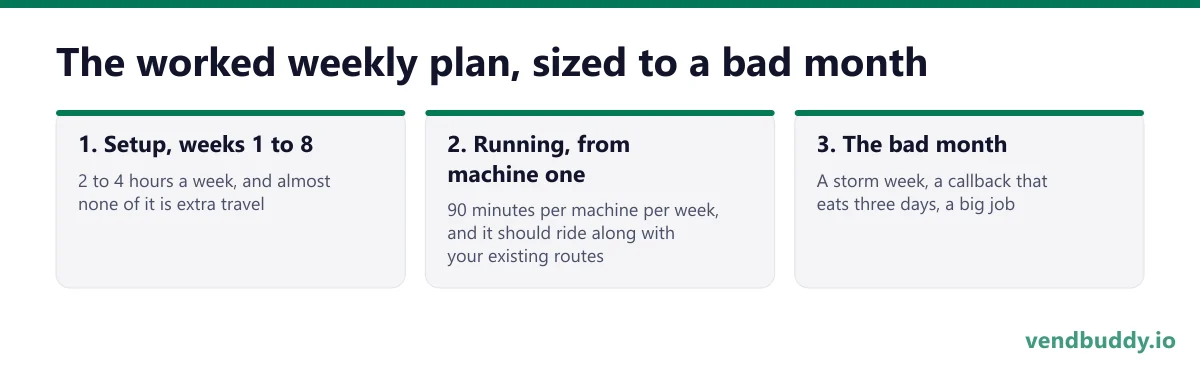
Setup, weeks 1 to 8
2 to 4 hours a week, and almost none of it is extra travel. The prospecting happens inside jobs you are already on: one question asked per commercial site, logged in a note, followed up properly on a Sunday evening. Add one deliberate Friday afternoon a fortnight for walk-ins — and use the work clothes rather than changing out of them, because arriving looking like someone who fixes things is an advantage with a facilities manager, not a liability.
Running, from machine one
90 minutes per machine per week, and it should ride along with your existing routes. The whole point of a trade route is that the service run is not a separate journey: a machine placed on a road you already drive twice a week costs you almost nothing in time. This is the reason to be genuinely ruthless about geography. Refuse a placement outside your normal working radius even when it looks good, at least until you have three inside it. Route density versus machine count is the whole argument.
The bad month
A storm week, a callback that eats three days, a big job. Two rules that make this survivable: keep par levels high enough that any machine can carry two weeks, and put a cashless reader with telemetry on from day one so you know which machine actually needs the trip. What readers cost and what the fees really are is here. The failure you are preventing is a two-week stockout at a site that concludes you are unreliable, which is how good locations get lost.
You are in commercial buildings every week and some of them are worth a machine and most are not. VendBuddy scores real venues near you by traffic, headcount and category, gives you the best contact on file for each, and models the monthly net before you ask - so the question you ask on site goes to the buildings that can actually carry a machine. Five free credits, no card.
When the honest answer is no
- If you are about to buy machines because you can move them. This is the trade failure mode and it is specific to you. Auction lots, marketplace listings, a distributor clearing old stock — everyone else is deterred by the logistics and you are not, which is exactly how a tradesperson ends up with three machines in the yard and zero signed locations. A machine without a building is an object with a storage cost that quietly pressures you into accepting a bad site. Location first, every single time.
- If your busy season is most of the year. A route sized for your good months will fail in your bad ones, and the failure costs a location rather than money. Size it for February.
- If you already have a second business. Many trades do. Two side businesses is usually one side business and a slow guilt, and the honest question is which one you want to still own in five years.
- If the plan is to replace the trade income quickly. Four machines is $600 to $1,400 a month net in a good case. Replacing a tradesperson income is ten to twenty machines and several years. The real replacement number is here, and it is about 28 percent higher than your take-home.
The bottom line
Everything that makes this business hard for a normal person — getting a 700-pound machine to a break room, being inside a commercial building on a Tuesday morning, knowing a facilities manager well enough to be trusted, and fixing the thing when it stops — is something you already do for a living. The startup cost for you is genuinely lower than the number on every other page of this site, and the conversion rate on your prospect list is genuinely higher, because your prospects already know you.
What you have to resist is the thing your advantages make easy: buying equipment before you have somewhere to put it. Sign a building, then buy the machine, then let one location prove the loop closes before you build anything on top of it. Do it in that order and this is the rare side business where the trade you already have is the reason it works.
Related reading: what vending repairs actually cost, moving a machine safely, route density versus machine count, starting a business while working full time, your first $100 in vending, and what a route sells for.
Frequently Asked Questions
Is vending a good side business for tradesmen?
It fits better than almost any other trade side business, for three reasons that are specific rather than flattering. You already own the thing everyone else has to rent: a vehicle with cargo space, an appliance dolly, straps and the knowledge of how to move six hundred pounds without hurting yourself, which removes $150 to $400 of delivery cost per machine and removes the fear entirely. You already have commercial relationships, because every job site, property manager and supply house counter is a building with a break room. And most vending service calls are simple mechanical or electrical faults you can already fix, which turns a $150 to $250 call-out into an eight-dollar part.
Can a contractor run a vending route?
Yes, and the scheduling shape is better than it looks. The binding constraint in vending is being inside a business between 9am and 4pm on a weekday to ask about the break room, and a tradesperson is already inside commercial buildings during exactly those hours. The honest complication is that trade weeks are wildly variable - storm work, a callback, a big job eating three weekends - so the route has to be sized to your worst month rather than your average one. Two or three machines in a tight cluster survives a bad month. Six scattered ones do not.
Can I service my own vending machines if I am an electrician?
Most of them, yes, and that is a genuine margin advantage. The common faults are a jammed coil or a worn spiral motor, a bill validator that needs cleaning or a firmware update, an MDB harness that has worked loose, a door switch, a failed start relay or capacitor on the refrigeration unit, and lighting. Those are all within reach of anyone comfortable with low-voltage wiring, a multimeter and a service manual. The exception is the sealed refrigeration system: work involving refrigerant is regulated and requires the appropriate certification, so a leak or a compressor failure goes to a certified technician rather than to you.
How much does it cost a tradesperson to start a vending business?
Less than the standard $2,000 to $5,000, because two of the line items are already covered. A used machine is $1,500 to $3,000, the first product fill is $200 to $400, and a card reader plus permits and insurance is a few hundred. The freight and install line, which is commonly $150 to $400 for everybody else, is a Saturday morning and a full tank for you. So the realistic all-in number is closer to $2,000 to $3,500 for a first placed machine, and the second machine costs less again because you already own the cart, the tools and the spare parts.
Prices move around more than any guide keeps up with. The machine finder is where we keep the current line-up, sorted by what a location that size can realistically support rather than by what looks impressive.
Where do tradespeople find vending locations?
In the buildings they are already working in, which is why this profile lands locations faster than almost any other. Every job site has a facility manager, every commercial customer has a break room, every supply house counter has a queue of contractors who all own buildings, and every property manager who has called you for a repair already trusts you with a key. That is a warm list rather than a cold one, and the difference in conversion is substantial. The opening line that works is not a pitch, it is a question asked while you are already there for something else, followed up properly afterwards.
Should I put a vending machine in my own shop or warehouse?
It is a reasonable first machine and a poor first location, and it is worth understanding why before you do it. Your own shop gives you a place to test the machine, learn the software, practise a fill and find out what breaks, all with no commission and no landlord risk, which is genuinely useful. What it does not do is teach you anything about whether you can land a location or whether a site produces revenue, because a ten-person shop does not have the headcount to generate meaningful sales. Treat it as a training machine, not as the business.
Can I run a vending business through my existing contracting LLC?
Often yes, and sometimes you should not, and it is a short conversation with your accountant and your insurance agent rather than a decision to make alone. The questions that decide it are whether your general liability policy covers vending activity or needs an endorsement, whether adding a retail activity to a contracting entity affects your classification or your workers compensation audit, and whether you want the two revenue streams separated for bookkeeping and eventual sale. A vending route is far easier to sell as its own clean entity than as a line inside a contracting company.
What is selling, which buildings say yes, and the numbers before you buy a machine. Free, confirm from your inbox, unsubscribe in one click. Refer one friend and get 25 VendBuddy credits.
Every operator we talk to wants fewer cold calls. The ones who get there have a Google Business Profile and a simple site a manager can check before replying. AI builders make that an evening job now. Wix is the mature site builder; Base44 also builds working tools like a quote form. Start with the AI website walkthrough or Wix vs Base44.
General information, not legal, tax or financial advice. Rules change, so check the official source. Revenue and income figures are examples, not promises. See our terms.