- Summer is the entire strategy. Scout in June, pitch in early July, install in August, and the route runs itself by September. Ten weeks of weekday daytime is more prospecting time than a nine-to-five worker gets in three years.
- There is a hard deadline inside it, around 20 July. Miss the signing window and you are trying to close a location at 4pm in October, which is how teachers decide this business does not work.
- Your own district is the one place you probably cannot sell to. Vending is usually a district contract, and being an employee makes it a conflict rather than an in. Point the pitch at daycares, tutoring centres, dance studios and youth sports complexes.
- The first machine is $2,000 to $5,000 all in, most of it a used snack and drink combo. Bought after a location is signed, never before.
- One machine nets $150 to $400 a month. It will not beat a summer of tutoring in year one. It beats it by year three, because it also pays in February.
The honest version first. One vending machine in an ordinary building nets $150 to $400 a month after product, commission and card fees, with $50 to $150 at a weak site and $300 to $800 at a genuinely good one. Getting that first machine placed costs about six weekday daytime hours, which is the resource teaching hands you in one enormous block and then takes away completely for nine months. So this is not really a plan for a business. It is a plan for a summer. Start here if you already know you want to.

What follows is the calendar arithmetic that decides whether a teacher ever gets a machine placed, where to point the pitch once you accept that your own building is off the table, what the machine really costs against a teacher salary, and the school-year rhythm that survives report-card week.
Ten weeks, and one deadline inside them
Start with why term time defeats people, because the usual explanation is wrong. It isn’t that teachers are busy. It’s that your free hours and the hours the decision exists in barely touch.
A 3:30 finish is not a 3:30 start. By the time you have actually left the building and driven to an office park it is 4:15, and the person who decides about the break room is thinking about their commute. What you need is not free time, it is a window where the decision-maker is both present and unhurried, and that window is roughly 9:30 to 11:30 and 1:30 to 3:30, Tuesday through Thursday. Between September and June you have that window on approximately zero days. In summer you have it on fifty consecutive weekdays.
Now the deadline, which is the part most summer plans miss. Twenty walk-ins produce about one yes, and at five or six buildings a morning that is four mornings of walking. Except it doesn’t compress into four mornings, because half of your targets will tell you the owner is in on Thursdays, or that they need to ask the district manager, or to come back next week. Realistically it is four weeks from your first walk-in to a signed agreement. Then you have to actually buy the thing: a used machine from a regional dealer takes one to three weeks to arrive, plus install and a first fill. Another three weeks.
Most first agreements are two pages, not twenty. The contracts walkthrough lays out the clauses that actually matter for the contract, including the termination language operators forget about until they need it.
Count backwards from the first day of term and the arithmetic is unforgiving. You want an agreement signed by about 20 July. Which means the first walk-in happens in the middle of June, not in the middle of July, and certainly not in August when half the businesses you want are running on skeleton staff and nobody is making decisions. The teachers who conclude vending does not work are almost always teachers who started the hunt in October. The general timeline, without the school calendar on top of it, is here.
You are the only person in this business who is already vouched for
A cold walk-in from a stranger converts at roughly one in twenty. That number is the reason most people quit in week three. It’s also not your number, and this is the part of the advantage nobody writes about.
Teaching is one of a very small set of jobs where local strangers already have a prior on you. You have taught the children of the people who own the businesses in your zip code. You have sat across a table from them at conferences. The owner of the tutoring centre hires your colleagues in the summer, the woman who runs the dance studio has your former students in her Tuesday class, and the coach at the travel-ball complex knows your name. Walking into a building where the person behind the desk recognises you is a completely different conversation than walking in as the vending guy.
So the first move is not a cold list. It is fifteen names. Before you knock on anything, write down fifteen people in your town who own or manage a business and already know who you are. Parents, former students now running something, the martial arts studio owner, the daycare director who used to teach. Those fifteen come first, in the first week of the sprint, and they are not a networking exercise. They are a shorter queue.
The sentence that works is short and you should say it out loud until it stops feeling strange: you are not the vending guy, you are the person who teaches at the middle school and is building a small route. That sentence gets you the meeting. The rest of the walk-in script, and the twelve objections it runs into, is here.
Now the building you cannot have. School vending is normally a district-level or board-approved contract, frequently bundled with the cafeteria agreement and constrained by nutrition standards that dictate what may be sold and during which hours. Being an employee of the district does not shorten that process, it complicates it, because an employee bidding for a district contract is a conflict-of-interest question. Read your district outside-employment and conflict-of-interest policy in writing before you approach anybody, and if a placement would touch district property in any way, ask first rather than after. The rules for school vending as a category are here, and they are worth reading precisely so you stop thinking about your own building.
Where to point it instead, ranked roughly by how well a teacher does in the room:
- Daycares and preschools. Staff who genuinely cannot leave the building, plus parents standing in a lobby at 5:15pm with a toddler and no snack. Directors say yes more often than almost anyone because the machine reads as a staff perk that costs them nothing.
- Tutoring and test-prep centres. The kids are inside for ninety minutes and half the parents wait in the car park rather than drive home twice.
- Dance, gymnastics and martial arts studios. Their entire business is 4pm to 8pm, and the waiting area is full of parents with an hour to kill and nowhere to get a coffee.
- Youth sports complexes and travel-ball fields. Enormous on a Saturday and dead in January, so treat them as a bonus placement rather than the foundation of a route.
- Teacher-heavy apartment complexes and any 150-unit building near the district. Residential vending has its own economics and long dwell time.
- Community colleges and trade schools. Sometimes contracted centrally, often not at the satellite trade programmes on the edge of campus. Worth one phone call to find out.
- Church youth wings, scout halls and summer camp offices. Small volume individually, and nobody else is pitching them.
Picture the machines paying you while you sleep
That’s the real promise of vending — income that doesn’t cost you your time, and a life on your own terms. VendBuddy turns this guide into a step-by-step plan so you actually build it instead of just reading about it. Start free today.
Start building free →What the machine actually costs, and why the order matters more than the price
Teachers get this number wrong in both directions. The videos show a $10,000 smart cooler. The marketplace listings show a $400 machine that needs $900 of parts and a bill validator that has not worked since 2019. Neither is the thing to buy.
The honest budget for one placed machine is $2,000 to $5,000 all in: $1,000 to $3,000 for a five-to-ten-year-old snack and drink combo from a regional refurbisher with a warranty, $150 to $500 freight, $200 to $400 for the first fill, and a few hundred for permit, insurance and a card reader. Freight and the first fill are the two line items beginners forget, and together they are commonly $700. The full line-item version of the $5,000 build is here, and what to check before you buy anything used is here.
The rule that protects a teacher salary is about sequence, not price: sign the location first, buy the machine second. A machine sitting in your garage costs nothing per month and quietly costs you your judgement, because you will accept a worse site just to stop looking at it. The difference between a good building and a bad one is the difference between $400 a month and $90. The location-first argument in full is here.
And the honest comparison, since summer income is usually the real motive. If your district pays you over ten months, or you stretch a twelve-month cheque thinly, summer is a gap you normally fill with summer school, camp work or tutoring at $20 to $30 an hour. A summer of tutoring pays more cash this summer than a first machine will. That’s just true, and any page telling you otherwise is selling you something. The trade you are actually making is one summer of immediate income for something that pays in February, and in the following July, and the July after that. Tutoring stops the day you stop. A machine in a dance studio lobby does not.
Before you commit to any of it, put your own numbers in rather than mine. The Income Reality Calculator takes your capital, the hours you genuinely have and the income you want, and returns the machine count and the timeline that implies. For most teachers it makes the plan smaller and more achievable in the same motion.
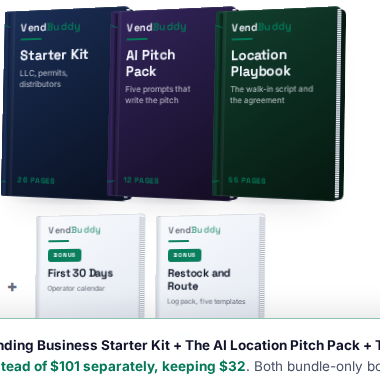
If you get to the end of this and the answer is yes, the kits are the shortcut past the blank page: a 26-page starter kit for the paperwork, a 55-page Location Playbook for the walk-in script and the agreement, and a 12-page AI Pitch Pack. Bought once, from $27, and you keep the files.
Look inside the kits →The ten-week summer sprint, week by week
Ten weeks from the last day of term. The first two are free, the middle six are the work, and the last two exist so you are not installing a machine during the week you are setting up a classroom.
| Week | What happens | What it costs |
|---|---|---|
| 1–2 (early June) | Sleep for a few days first. Then build the list: 40 target buildings inside a 20-minute radius, and the 15 warm names. Read the economics. Rehearse a 40-second opener out loud until it sounds like you. | $0 |
| 3–4 (mid to late June) | Walk in. Five or six buildings a morning, three mornings a week, Tuesday through Thursday. Warm names first. Record every no and the reason it was given. | Fuel |
| 5 (the 4 July week) | Dead week for decisions. Use it for follow-ups by phone, permit and insurance research, and opening a distributor account. | Permit fees |
| 6–7 (mid July) | Second wave of walk-ins plus the follow-ups. Target a signed placement agreement by about 20 July. What that agreement needs to say is here. | Fuel |
| 8 (late July) | Now buy. Machine, freight booked, card reader ordered, insurance bound. Not one day earlier. | $2,000–$5,000 |
| 9 (early August) | Install and first fill. Then leave it alone for a week and let it tell you what sells, rather than what you guessed would sell. | First fill |
| 10 (mid to late August) | Second fill, first real numbers, planogram rewritten from data. Set the school-year routine now, on the calendar, because you will not design one in September. | Product |
Two notes on the table. The first two weeks are genuinely free, which matters if the summer budget is tight: nothing about scouting, list-building or script practice costs money, so you can find out whether you can stand this work before you spend anything. And week 8 is where most people go wrong by going early. Buying in June because a good deal appeared is how you end up placing a machine in a laundromat with 40 people a day because you needed it to go somewhere.
The school-year rhythm, and the four windows inside it
Once the machine is placed, the term-time job is a single restock on a fixed day. Sixty to ninety minutes for one machine including the drive, closer to two hours for a cluster of three. The two slots that work are Friday from about 4pm, when you are leaving the building anyway and the weekend is the busiest stretch at a studio or a sports complex, and Saturday at 8am, when nothing else in your life is competing.
Here is a distinction worth keeping straight, because it catches people out. 3:30pm is a good hour for restocking and a bad hour for pitching. Restocking a daycare at 3:30 gets you in and out before the 4:30 pickup rush. Pitching an office at 3:30 gets you a manager with one eye on the door. Same hour, opposite verdicts, and the mistake is assuming that because the afternoon works for one it works for the other.
The four expansion windows are the school calendar breaks: fall break, the Thanksgiving week, the winter holidays and spring break. Each is worth one three-morning walk-in campaign, and that is how machine two and machine three happen without waiting for June. One caveat on the winter one: the fortnight around the holidays is the worst stretch in the year to ask a business for a decision, so use it for maintenance, bookkeeping and building next term list rather than for pitching.
The risk to name is drift, and for teachers it has specific dates on it. Report-card weeks, conference weeks and state testing are when a fill gets skipped, then skipped again, and then a location decides you are unreliable and starts taking calls from the operator who is not. The fix is unglamorous. Shrink the route to what your worst week can service, and put the restock on your calendar as a recurring appointment rather than an intention. Year-one failure has a pattern, and it is almost never the machine.
The compounding, if you keep going, sits in the summers. Every subsequent June is a fresh block of prospecting time and you now arrive with a reference, a photo of a clean machine and a property manager who will vouch for you. Two machines a summer is a realistic and unheroic pace, which puts you at six to eight machines by year four without ever working a school night.
The summer is ten weeks and the signing deadline is mid-July, so the expensive mistake is walking into forty buildings that were never going to work. VendBuddy scores real venues near you by traffic, headcount and category, names the decision-maker on each, and models what a machine would net there before you drive over - so your June mornings go to the daycares, studios and clinics that can actually say yes. Five free credits, no card.
When the honest answer is no
Four reasons to skip this, or at least to skip it this year.
- If you teach summer school every year and the money is already spoken for. The sprint needs the block, and trading one summer of guaranteed pay for a build is the actual cost of entry. If that money covers something real, wait for a summer where it does not.
- If the plan depends on your own school or district. That is the least available building on your list, not the most, and a plan that starts there usually ends there. Rebuild the target list around businesses with no procurement process before you go any further.
- If the goal is to stop teaching. At $150 to $400 net per machine, a teaching salary is 15 to 30 machines and a four-to-six-year build, and by that point it is a logistics business with a van and probably an employee. Some people want exactly that. A lot of teachers who think they want it actually want a different school.
- If the $3,000 has to go on a card you cannot clear. Borrowing for an asset whose payback is eight to sixteen months is defensible only if the terms give you that long. If they do not, the honest move is one more summer of saving. The genuinely low-capital routes into this business are here, and they are slower rather than free.
The bottom line
The teacher version of this business isn’t harder than anyone else’s. It’s just on a different clock. Everything that needs a stranger to make a decision has to happen between mid-June and mid-July, and everything after that bends comfortably around a school week.
So the decision is not about time. It is about whether you will give up one June for this, and whether you can take being told no by people whose children you may well have taught. The second one catches teachers off guard more than the first.
Still deciding? The by-schedule breakdown for people with full-time jobs covers the other calendars and it’s honest about which ones do not work. If the answer is already yes, the start page is the shortest path to a first location.
Related reading: starting a business while working full time, the $5,000 build in line items, school vending contracts, buying a used machine, your first $100 in vending, and the honest side-hustle assessment.
Frequently Asked Questions
Can a teacher start a vending machine business?
Yes, and the summer is what makes it work. The scarce input in vending is weekday daytime: a placement gets signed because you were standing inside a business between roughly 9am and 4pm on a weekday, and about 20 walk-ins produce one yes. During term a 3:30pm finish gives you almost none of that. June through August gives you fifty consecutive weekdays of it, which is more usable prospecting time than a nine-to-five worker accumulates in three years. Scout in June, pitch in early July, install in August, and the route runs on a weekly loop once term starts.
Can I put a vending machine in my own school?
It is the least available building on your list rather than the most. School vending is normally a district-level or board-approved contract, often bundled with the cafeteria agreement and wrapped in nutrition standards that dictate what may be sold and when. On top of that, an employee bidding for a district contract is a conflict-of-interest question rather than an advantage. Read your district outside-employment and conflict-of-interest policy in writing before you approach anyone, and if a placement would touch district property, ask first. Daycares, tutoring centres, dance and gymnastics studios and youth sports complexes have none of that machinery and decide in one conversation.
What can a teacher do over the summer to make money?
Be honest about the comparison. A summer of tutoring or summer school pays more cash this summer than a first vending machine will, because tutoring pays immediately and a machine takes about a month to produce meaningful revenue and eight to sixteen months to repay itself. The difference is what happens afterwards: tutoring stops the day you stop, and a machine in a dance studio lobby keeps selling in February while you are grading. If you need the money this summer, take the tutoring. If you are trying to build something that pays during the school year, spend one summer on the route instead.
How much does it cost to start a vending machine business?
For one machine, $2,000 to $5,000 all in. A used snack and drink combo runs $1,000 to $3,000 from a regional refurbisher, freight is $150 to $500, the first product fill is $200 to $400, and permit, insurance and a card reader add a few hundred more. Freight and the first fill are the two costs beginners forget and they commonly total $700 together. The cheaper listings on marketplace sites are often $400 machines that need $900 of parts, so the middle of the range is the honest place to buy.
How much time does a vending route take during the school year?
About 60 to 90 minutes per machine per week including the drive, once the par levels have settled. Two or three machines clustered within 20 minutes of each other share one trip and land at roughly two hours a week total, which is one Friday afternoon or one Saturday morning. The first month or two runs higher, two to four hours per machine, while you are still learning the product mix and the distributor. The failure mode during term is not the hours, it is drift during report-card and testing weeks.
Is vending a good side hustle for teachers?
It is a good fit structurally and a bad fit if the timing is wrong. It works because once a machine is placed nobody needs anything from you inside the week, so the work bends around a school calendar instead of competing with it. It fails when someone starts in October, cannot get inside a business before 4pm, stalls for eight months and concludes the business does not work, when what actually happened was a calendar mismatch. Start in June or wait until June.