- Airport vending machines are awarded by the airport authority through a concession solicitation. You respond to an RFP; you do not walk in with a machine.
- The condition that decides it is size and scope: small regional airports and landside spaces are open to small operators, while the large hubs use master concessionaires.
- Federal rules (49 CFR Part 23) set Airport Concession Disadvantaged Business Enterprise (ACDBE) goals at larger airports, so teaming with a certified firm can open doors.
- Dwell time is high but sales come in waves around flights. Stock water, quick snacks, travel items and phone chargers.
- Start by finding regional airports in your area, then ask the airport manager for the concession plan and any open opportunities.
Airport vending machines are one of the best-paying spots in the business, and one of the hardest to get. A traveler with a two-hour layover will pay for a bottle of water, a charger and a snack without blinking. But you will not get in with a walk-up pitch, and you should not try. If you want this placement, the way in is small: the regional airport, the landside lobby, the concession bid nobody else bothered to read.
Part of our complete guide: how to find vending machine locations.
Are airports good vending machine locations?
Yes for traffic, no for access. An airport has people with time, a limited number of shops and prices that travelers expect to be high. That is good for any retail format that runs 24 hours and needs no staff.
The condition that decides it is who controls the space. At a large hub, a master concessionaire holds the terminal and subleases pieces of it. At a small commercial or general aviation airport, the airport manager often handles requests directly, and a vending machine is a small decision. Start at the second kind.
Why airport vending machines work: dwell time at scale
The traffic is enormous. U.S. airlines carried 1,098,346,029 passengers in 2025, 841,400,740 of them on domestic flights, according to the Bureau of Transportation Statistics (BTS, TranStats passenger data). The busiest month was July 2025 with 104,666,931 passengers; the slowest was February 2025 with 75,571,621. December 2025 came in at 91,737,403.
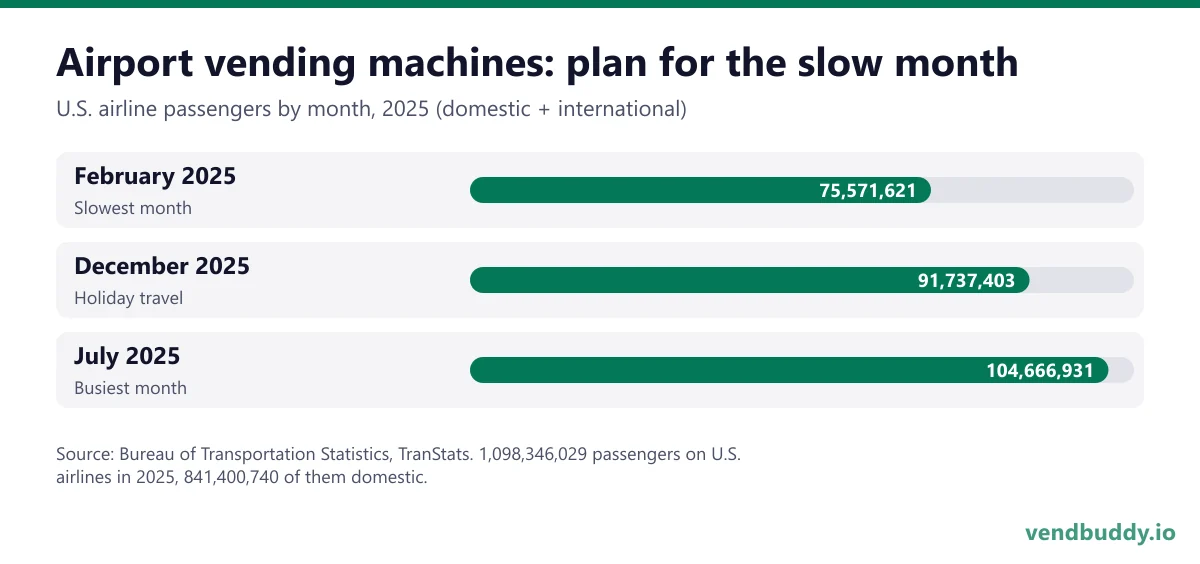
What turns that traffic into sales is dwell time. Travelers arrive early, wait at the gate, sit through delays and connect between flights. Water bought before security gets thrown out at the checkpoint, so the first bottle after security is a near-certain sale. Ground crews, TSA officers, airline staff and rental car workers add a second crowd that is there every day, not just on travel days.
The seasonal swing matters for planning. A gap of nearly 30 million passengers between February and July means a machine that sells out in summer can sit half full in late winter. Plan your restock schedule and your minimum guarantee around the slow month, not the busy one.
Picture the machines paying you while you sleep
That’s the real promise of vending — income that doesn’t cost you your time, and a life on your own terms. VendBuddy turns this guide into a step-by-step plan so you actually build it instead of just reading about it. Start free today.
Start building free →What VendBuddy's Lead Finder shows for airports
From VendBuddy's own Lead Finder data as of October 4, 2026: operators ran two airport searches, from two operators, in two ZIP codes since April 2026. That is almost nothing, which tells you the segment is open. Lead Finder has scored 15 airports across 14 cities, with a median of 40 Google reviews and a 4.13 average rating. A low review count at an airport usually means a small field.
Airports belong to the transit family in Lead Finder, which starts at a base location score of 76, the second highest of any family we track. The contacts Lead Finder looks for in transit are an Operations Manager, a Facilities Manager and a General Manager. At an airport, the person who really signs may sit in the authority's commercial or property office.
The rule that applies: ACDBE goals and who can bid
Federal rules shape airport concessions. Under 49 CFR Part 23, a primary airport that receives FAA funds must run an ACDBE program, with goals for participation by disadvantaged business enterprises. An ACDBE is a for-profit small business at least 51 percent owned by individuals who are socially and economically disadvantaged, and the firm has to be certified.
The rule that matters most for a small operator is in section 23.21: a non-primary airport, a general aviation airport or a reliever airport is not required to have an ACDBE program, but it must still take outreach steps to encourage ACDBEs whenever there is a concession opportunity (eCFR, 49 CFR Part 23). Smaller airports run lighter processes, and the airport manager may answer an email.
If you are not a certified firm, you can still team with one. Larger airports often look for sub-concessionaires with a small, defined scope. A vending contract is a good example of a piece that fits.
What to look out for in an airport concession agreement
An airport is usually run by a city, a county or a public airport authority, so it buys like a government. The public purchasing rules in our guide to vending machines in government buildings apply here too: published solicitations, scoring sheets and deadlines that do not move. On top of that, read the agreement for these points:
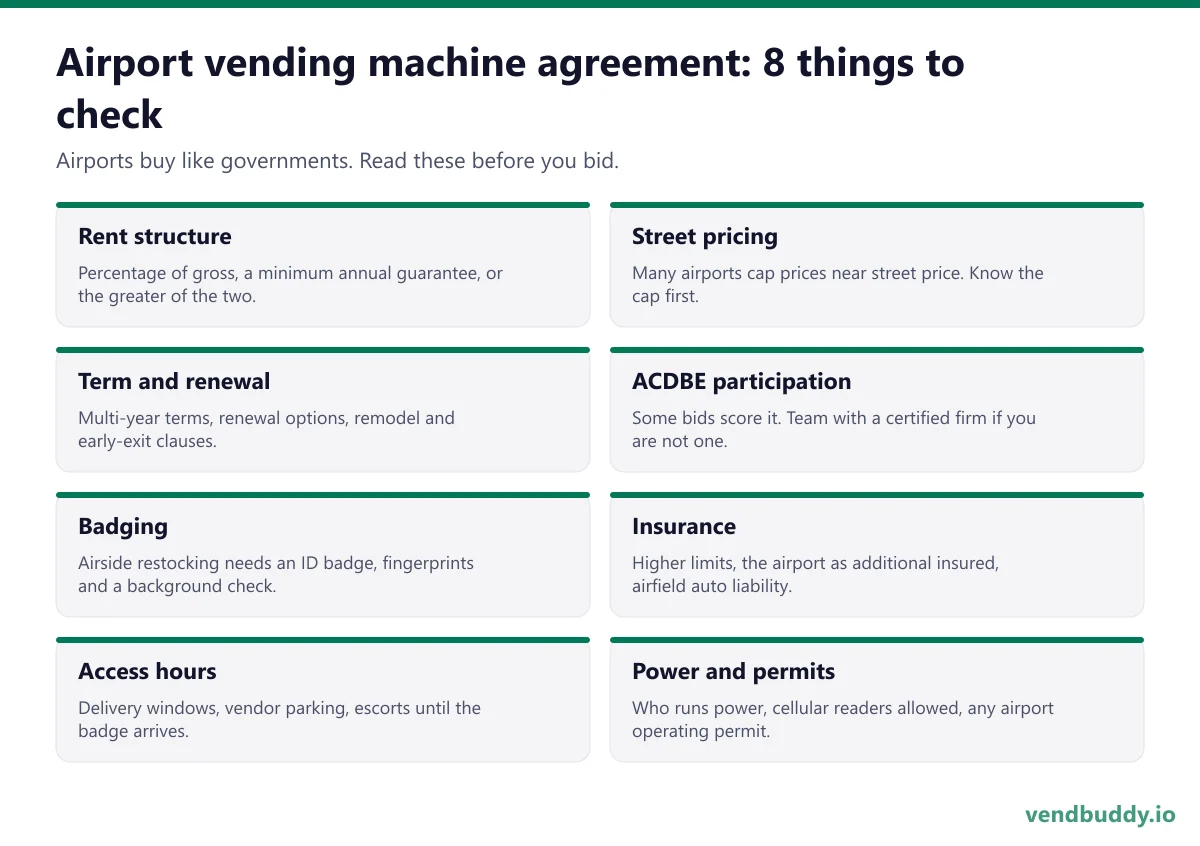
- Rent structure. A percentage of gross, a minimum annual guarantee, or the greater of the two. The guarantee is the risky part: you owe it in February too.
- Street pricing. Many airports cap prices at street price plus a small margin. Know the cap before you build the planogram.
- Term and renewal. Airport terms run for years. Check for renewal options, early termination and what happens if the terminal is remodeled.
- ACDBE participation. Some solicitations score ACDBE participation or set a goal for it. If you are not certified, a teaming arrangement with a certified firm can be part of the bid.
- Badging and background checks. Restocking past security usually needs an airport ID badge, which means fingerprints, a background check and security training for each driver. Budget the time; badges are not issued overnight.
- Insurance. Expect higher limits than a street location, the airport named as additional insured, and auto liability if your vehicle goes on the airfield side.
- Access hours and escorts. Ask when deliveries are allowed, where you park, and whether you need an escort until your badge comes through.
- Power, data and permits. Confirm who runs power to the spot, whether you may use cellular readers, and whether the airport requires its own operating permit on top of your business license.
How an airport runs
- Hours. The first flights leave before 6 a.m., the last arrive near midnight. Small airports have far fewer flights, and a regional field can be empty for hours.
- Who is inside. Travelers on layovers, people dropping off and picking up, airline and ground crews, TSA and airport staff, and rental car and shuttle workers.
- Peaks. Sales come in waves, 60 to 90 minutes before a departure bank and after a delay. A weather day can double a normal day.
- What competes. Terminal shops and cafes, plus automated retail kiosks. Past security, space is leased. Landside, there is more room.
- The rules to ask about. Airport security badging for staff who restock airside, the airport's pricing policy (some require prices close to street prices), and insurance requirements for tenants.
Which machine fits a airport, and what goes in it
Pick a unit with a card reader, a lit display and a clean look. Travelers do not carry coins. Automated retail units, which hold electronics and travel goods as well as snacks, sell well here.
- Bottled water. Travelers cannot bring it through security, and they buy it right after.
- Phone chargers and earbuds. The highest-margin row in a terminal.
- Protein bars and nut packs. A meal replacement for a long layover.
- Chips, candy and gum. Quick impulse items for a short wait.
- Travel items. Neck pillows, sanitizer, tissues, and small toiletries.
- Cold drinks and iced coffee. Early flights and late arrivals both buy.
- Sandwiches and fruit in a smart fridge. Where the airport allows fresh food.
The airport pitch: who decides and how it goes
Start with the airport manager or the director of operations and ask for the concession plan. For a larger field, the commercial or property manager of the airport authority runs the process. Look for the words “request for proposals” and “concession opportunity” on the authority's procurement page.
Opener: “I operate vending and automated retail locally. I am looking for small-scope concession opportunities, like a landside lobby or a rental car area. Can you tell me what space is open and how the solicitation works?”
The objection: “We have a master concessionaire.” The answer is to ask whether they sublease small spaces or machines and who to speak with. Also ask about the airport's small business element, which the rule requires them to keep.
On money, airports normally charge a percentage of gross sales, a minimum annual guarantee, or both, and the number is set in the solicitation. Operators commonly report commission of 5 to 15 percent in smaller venues; airports can run higher, so read the draft agreement closely. See vending machine commission rates, and use the vending ROI calculator to test what rate you can carry.
On the walk-in, check where the foot traffic really is, what the electric and network setup looks like, and how long the term is. Get the card-processing details right too; vending machine card reader fees shows what you will pay on each sale.
Common objections from airport staff, and what to say
- “All concessions go through an RFP.” Good. Ask to be added to the vendor notification list and ask when the next concession or vending solicitation is expected. Then read the last one so you know how it was scored.
- “We have a master concessionaire.” Ask whether the concessionaire subleases small spaces or machines, and who handles that. Your bid can be a small, clean piece of their ACDBE plan.
- “Travelers complain about prices.” Offer to follow the street-pricing policy and post prices on the machine.
- “We tried vending before and it was empty.” Offer telemetry, a card reader that reports sales, and a service schedule written into the agreement.
Illustrative example: a regional airport landside lobby
Illustrative example, not a real operator or airport. A small regional airport with a handful of daily departures has one cafe that closes after the afternoon bank. The landside lobby, where people wait for arrivals, has no machine at all.
An operator emails the airport manager, asks for the concession plan and learns there is no master concessionaire. The manager asks for a short written proposal: one combo machine with a card reader in the lobby, street pricing, a percentage of gross with no minimum guarantee, proof of insurance and a one-year term with a renewal option. Because the machine sits landside, no badge is needed to restock.
Most operators end up on Nayax for card readers because it is what the distributors already support. Their reader handles tap, chip and the telemetry feed in one box, and the monthly fee is the part to check against your per-machine volume before you commit the route to it. Affiliate link, so we may earn a commission at no extra cost to you.
The example shows the order to work in: start landside at a small field, keep the guarantee off the table, and use the first year’s sales reports as your reference for the next airport’s solicitation.
How to find airports near you
Use Lead Finder with the type pre-selected: Find airports near you in Lead Finder. It lists the airports in your radius with a score and the contact it can find.
Two free routes work too. In Google Maps, search “regional airport near me” and “municipal airport”, and check each website for an airport authority procurement page. Then do a drive-by test: walk the terminal on a weekday morning, note which snacks and drinks are sold, and count the vending machines. If there are none, there is your opening.
What Lead Finder adds is the airport's contact, a score and a radius, so you can list every field within 50 miles. For a general method, see how to find vending locations.
Before you pick airports over everything else, compare them with the other options in our best vending machine locations ranking, and check the warning signs in the worst vending locations. A big hub with a guarantee you cannot carry can sit on both lists.
You will not start at a major hub. You will start at a small field with no machine, and a manager who wishes someone would put one in. Find airports near you in Lead Finder and write down every airport on the list.
Frequently Asked Questions
Are airports good vending machine locations?
Yes for traffic and dwell time, but access is controlled. Airport space is awarded through concession solicitations, and large hubs use master concessionaires. Small regional airports and landside spaces are the realistic way in for a small operator.
What sells best in an airport vending machine?
Bottled water, phone chargers and earbuds, protein bars, chips and candy, cold drinks and travel items like sanitizer and neck pillows. Travelers buy water right after security, and electronics have the best margin.
How much commission does an airport expect?
Airports usually charge a percentage of gross sales, a minimum annual guarantee, or both, set in the solicitation. Operators commonly report 5 to 15 percent in smaller venues, but airports can run higher. Read the draft agreement before you bid.
What is an ACDBE and does it matter for vending?
An Airport Concession Disadvantaged Business Enterprise is a certified small business at least 51 percent owned by disadvantaged individuals. Larger airports set ACDBE goals under 49 CFR Part 23, so teaming with a certified firm can help you win a small-scope concession.
How many people pass through U.S. airports?
U.S. airlines carried 1,098,346,029 passengers in 2025, according to the Bureau of Transportation Statistics, with 841,400,740 on domestic flights. July 2025 was the busiest month and February 2025 the slowest.
Do I need a security badge to restock an airport vending machine?
Only if the machine is past security. Airside restocking usually needs an airport ID badge with fingerprints, a background check and security training for each driver. Landside machines in lobbies and rental car areas usually do not.
Is an airport a government building for vending purposes?
Most airports are run by a city, county or public airport authority, so they buy through public solicitations. Expect published RFPs, scoring sheets and insurance and bonding requirements similar to other public buildings.
What is selling, which buildings say yes, and the numbers before you buy a machine. Free, confirm from your inbox, unsubscribe in one click. Refer one friend and get 25 VendBuddy credits.
Walk-ins and cold emails find locations. A small site with your own machine photos and a request-a-machine form lets the next one find you. Around machine three to five, an AI builder drafts it in an evening. Wix is the mature site builder; Base44 also builds working tools like a quote form. Start with the AI website walkthrough or Wix vs Base44.
General information, not legal, tax or financial advice. Rules change, so check the official source. Revenue and income figures are examples, not promises. See our terms.