- Two different questions, two different authorities. Owning a US business and working in one are governed by different bodies of law and have different answers.
- Ownership, generally: most states do not impose citizenship or residency requirements on LLC members, and ITIN and EIN paths exist for people without a Social Security number.
- Working in the business: depends entirely on your individual immigration status. Nobody on the internet can answer that, including this page.
- State rules genuinely vary — registered agent, in-state address, publication and reporting requirements are not uniform.
- On language: vending is one of the most language-flexible businesses that exists — a forty-second scripted pitch, a written agreement, and customers who never speak to you.
This page is general information, not legal advice. VendBuddy is not a law firm, an immigration adviser, or a tax adviser, and nothing here creates a professional relationship of any kind.
Immigration status determines what you personally may do, and it is individual to you. It is not something a blog post, a forum, a video or an AI assistant can determine. Rules also change, and state requirements differ from each other.
Verify your specific situation with an immigration attorney before you form an entity, sign anything, or perform any work in a business you own. A cross-border accountant is worth talking to in the same week. This page will point at the questions worth asking them; it cannot answer them.
There is a specific kind of frustration in this question that deserves naming. You have found ten articles, and every one of them either says “anyone can start a business in America!” without qualification, or refuses to say anything at all. Neither is honest, and neither helps you decide whether to spend the next six months on this.
The reason the answers are so bad is that the question contains two questions wearing one coat, and they are governed by completely different bodies of law. Separating them is the single most useful thing this page can do.
The two questions, separated
| Can I own it? | Can I work in it? | |
|---|---|---|
| Governed by | State business law, plus federal tax administration | Federal immigration law |
| General position | US business ownership is generally not restricted to citizens; most state LLC statutes impose no citizenship or residency requirement on members | Depends entirely on your individual status — there is no general rule |
| Who can answer it for you | A business attorney or a cross-border accountant, plus the Secretary of State for your state | An immigration attorney, and nobody else |
| What varies | By state — registered agent, in-state address, publication, annual reports, fees | By individual status, and the rules change |
Almost every confusing article you have read is confusing because it answers the left column and then quietly implies the right column follows. It does not. A person can be a perfectly lawful owner of a US entity and separately have no authorisation to perform work for it. Those two facts coexist all the time, and the distinction is the thing to hold on to.
What that means practically: the ownership half of this is researchable, and the paragraphs below will help you research it. The working half is not researchable — it is a conversation with an attorney about your specific status, and there is no substitute for it. Anyone who tells you otherwise, in a comment section or a course or a chat window, is guessing with your immigration status.
The ownership side: what is generally true
These are the things worth understanding before you pay anyone for an hour of their time, so that the hour is spent well.
Entities and members. State LLC statutes typically define who may be a member without reference to citizenship or residency, which is why non-resident ownership of US entities is common and unremarkable. That is a statement about state business law in general, not a guarantee about your state or your situation — the point is that the default answer to “is this even possible” is usually yes, and the work is in the details rather than in the premise.
Tax identification numbers. A business generally needs an Employer Identification Number to open accounts, file returns and hire. The IRS publishes a process for applicants who do not have a Social Security number, and it commonly runs alongside an Individual Taxpayer Identification Number for the individual. These are tax-administration mechanisms; obtaining them is not a statement about immigration status and does not confer any. Processing routes and timelines change, so confirm the current procedure rather than relying on an article of any age, including this one.
Which state. The usual general guidance for a small operating business is to form where the business physically operates, because operating in a state typically creates a registration obligation there regardless of where you formed, and forming elsewhere often means two sets of fees and two sets of annual filings. The advice you see about forming in a specific state for tax advantages is mostly written for a different kind of company than a vending route with machines in one metro area.
Banking. This is where foreign owners most often get stuck, and it is not a legal barrier so much as an institutional one. Bank onboarding policies are set by each bank, vary widely, frequently require identification for beneficial owners, and sometimes require an in-person visit. Some institutions specifically serve foreign-owned US entities. The practical sequencing advice: talk to the bank before you form the entity, so the structure you file is one they can actually onboard, rather than discovering the mismatch afterwards.
Tax treatment. Federal tax treatment of a non-resident owner of a US entity is genuinely different from the resident case, involves filings that do not exist for domestic owners, and is one of the few areas where doing it yourself is a false economy. A cross-border accountant, once, before the first filing.
None of the above is a substitute for advice about your circumstances. It is a list of the right questions, so the meeting is productive.
Picture the machines paying you while you sleep
That’s the real promise of vending — income that doesn’t cost you your time, and a life on your own terms. VendBuddy turns this guide into a step-by-step plan so you actually build it instead of just reading about it. Start free today.
Start building free →If English is not your first language
This half has nothing to do with immigration status and applies just as much to a citizen who grew up speaking something else at home. It is also the part where the honest answer is genuinely encouraging rather than hedged, so it is worth spending time on.
Businesses are not equally language-demanding, and the difference is much larger than people assume. The variable is not vocabulary. It is how much unscripted, high-stakes, real-time spoken English the business requires you to perform, and by that measure the range across ordinary small businesses is enormous.
| Business | Language load | Why |
|---|---|---|
| Phone sales, insurance, real estate | Very high | Live persuasion, objection handling, tone, idiom, under time pressure |
| Agency, consulting, coaching | High | Nuanced written proposals plus live client management |
| E-commerce, content, marketing | Medium-high | Written copy carries the whole sale; idiom matters |
| Trades and service work | Medium | Scoping conversations, quotes, on-site problem-solving |
| Vending route | Low | One short repeatable pitch, a written agreement, self-serve customers |
The four structural reasons vending sits at the bottom of that table:
- The sales conversation is about forty seconds long, and it is the same forty seconds every time. You are asking a building manager whether they would like a machine, at no cost to them, serviced by you. That is a script. You can write it, rehearse it, and deliver essentially the same version at building nineteen as at building one. Almost no other sales job in America has that property.
- The agreement is written. Nothing binding happens in speech. A placement agreement is a document you can read at your own pace, translate, and have reviewed by anyone you trust before you sign. What belongs in one is here.
- Customers never speak to you. The person buying a drink interacts with a machine. There is no counter, no phone line, no support conversation. The revenue-generating interaction in this business contains zero language.
- A large share of prospecting can happen in writing. Email lets you compose carefully, use a translator, and revise before sending — which is a completely different task from performing live. The cold email scripts are here, and the version of this business that avoids cold calling entirely is a legitimate strategy rather than a workaround.
The thing that is not true, and that people worry about anyway: accent does not decide whether a property manager wants a machine in the break room. What decides it is whether the building has enough people, whether the food alternatives nearby are inconvenient, and whether the last vendor was unreliable. Those are facts about the building, and they are the same facts regardless of who is asking. The full walk-in script, with the twelve objections that actually come back, is here — and having it written down in advance is an advantage for everyone, not an accommodation.
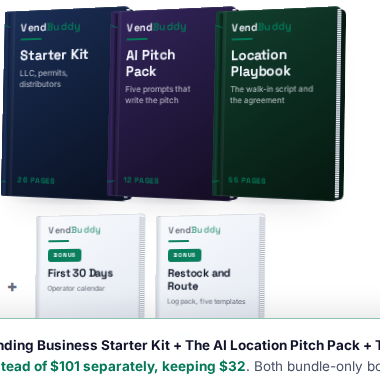
If you get to the end of this and the answer is yes, the kits are the shortcut past the blank page: a 26-page starter kit for the paperwork, a 55-page Location Playbook for the walk-in script and the agreement, and a 12-page AI Pitch Pack. Bought once, from $27, and you keep the files.
Look inside the kits →The parts of vending that are the same for everyone
Once the ownership question is settled with a professional, the business itself does not have a separate version for you. Same numbers, same sequence, same mistakes available.
Cost: $2,000 to $5,000 all in for a first used machine, including the freight and the first product fill that everybody forgets. The line-item budget is here.
The sequence: location first, machine second, always. A machine without a location is an expensive object with a storage cost that quietly pressures you into accepting a bad site. The 30-day first-dollar sequence is here.
The paperwork beyond the entity: vending has its own licence and permit layer, which is state and sometimes county specific, and is separate from anything discussed above. The requirements by state are here. Most locations will also ask for proof of liability insurance before a machine goes in — what that costs and what it covers.
Before you pay anyone for an hour of legal time, it is worth knowing whether the market around you supports a route at all. The Opportunity Map scores any US ZIP on population, employment and income with no account and no card. VendBuddy then scores individual venues by traffic and headcount and gives you the best contact on file for each — five free credits, no card required.
The bottom line
Hold the two questions apart and the fog clears. Can I own a US business is a researchable question with a generally encouraging default answer and a list of state-specific details to check. Can I work in it is a question about you specifically, answerable only by an immigration attorney who knows your status, and worth the fee precisely because the downside of guessing is not a business problem.
On the language question, the honest answer is better than most people expect: the amount of live English a business demands varies enormously, and choosing one that matches you is a strategy rather than a concession. A business whose sales pitch is forty scripted seconds and whose customers never speak to you is a reasonable place to start from.
And to say it once more, plainly, because it matters more than anything else on this page: this is general information, not legal advice. Verify your specific situation with an immigration attorney before you form an entity, sign anything, or do any work in a business you own.
Related reading: starting a vending business internationally, licence and permit requirements, vending contracts 101, cold email scripts that get replies, the complete startup guide, and starting a business while working full time.
Frequently Asked Questions
Can I start a business in the US as a non-citizen?
As a general matter, US business ownership is not restricted to citizens. Non-citizens, including people who do not live in the United States, can generally form and own an LLC or a corporation in most states, and there is no federal citizenship requirement to be an owner or member. What citizenship and immigration status do affect is a separate question: whether you are permitted to WORK in that business yourself, which is governed by immigration law rather than by business law. Those two questions have different answers and different authorities, and the second one is specific to your individual status. Treat this as general information and confirm your own situation with an immigration attorney.
Do I need a Social Security number to start a US business?
Not necessarily for the entity itself. A business generally needs an Employer Identification Number, and the IRS has a documented process for applicants who do not have a Social Security number, which commonly runs alongside an Individual Taxpayer Identification Number. That is a tax-administration question rather than an immigration question. Banks, payment processors and some states impose their own identification requirements on top, and those vary by institution. The practical path is to confirm the current IRS process and your bank requirements before filing anything.
Can a non-resident own an LLC in the United States?
In most states, yes as a general rule. State LLC statutes typically do not impose a citizenship or residency requirement on members, and non-resident ownership of US entities is common. The details that do vary by state include registered agent requirements, whether a physical in-state address is needed, publication requirements in a small number of states, and annual reporting. Federal tax treatment for a non-resident owner is its own subject and is genuinely different from the resident case, so a cross-border accountant is worth the fee before the first filing rather than after.
Can I work in my own business as a non-citizen?
This is the question that depends entirely on your immigration status, and it is the one nobody on the internet can answer for you. Owning an entity and performing labour for that entity are treated differently under US immigration law, and what counts as work is not always intuitive. There is no general rule that applies across statuses, and the consequences of getting it wrong are immigration consequences rather than business ones. Speak to an immigration attorney about your specific status before you perform any work in a business you own.
Can I start a business in the US if English is not my first language?
Yes, and some businesses are far more language-flexible than others. The variable is how much unscripted, high-stakes spoken English the business requires. Vending sits at the flexible end: the sales conversation is short, repeated and can be scripted; the agreement is written; the customer is a machine buyer who never speaks to you; and the daily work is physical and visual. Businesses that require live persuasion, phone sales, negotiation under pressure or nuanced written marketing are much harder. Choosing a business whose language demands match your comfort level is a strategy, not a compromise.
Is vending a good business for immigrants and non-native English speakers?
It suits people whose spoken English is functional but not fluent better than most alternatives, for four structural reasons. The pitch is roughly forty seconds long and is the same forty seconds every time, so it can be written out and rehearsed. The agreement is a written document that can be read slowly and reviewed by anyone you trust. Customers are self-serve and never interact with you. And a large share of prospecting can be done by email, where you can compose carefully rather than perform live. Accent is essentially irrelevant to whether a property manager wants a machine in the break room.
What do I need to open a US business bank account as a foreign owner?
Requirements are set by each bank rather than by law, and they vary widely. Banks commonly ask for formation documents, the entity tax identification number, identification for the beneficial owners, and often an in-person visit, and many have their own policies about non-resident owners. Some institutions and fintech platforms serve foreign-owned US entities specifically. Because policies change and differ by institution, confirm the current requirements with the bank before filing your entity, not after, so the entity is structured in a way the bank can actually onboard.
Which state should a non-citizen form a US business in?
The most common general guidance is to form in the state where the business physically operates, because operating in a state usually creates a registration obligation there regardless of where the entity was formed, and forming elsewhere often means paying two sets of fees. Guru advice about forming in a particular state for tax reasons is frequently wrong for small operating businesses. If your operations, machines and customers are in one state, that state is the default starting assumption, and a cross-border accountant can tell you whether your specific situation is an exception.
What is selling, which buildings say yes, and the numbers before you buy a machine. Free, confirm from your inbox, unsubscribe in one click. Refer one friend and get 25 VendBuddy credits.
Every operator we talk to wants fewer cold calls. The ones who get there have a Google Business Profile and a simple site a manager can check before replying. AI builders make that an evening job now. Wix is the mature site builder; Base44 also builds working tools like a quote form. Start with the AI website walkthrough or Wix vs Base44.
General information, not legal, tax or financial advice. Rules change, so check the official source. Revenue and income figures are examples, not promises. See our terms.