- Senior living vending machines work when you sell to staff and visitors. Residents are a small part of the sales, because most eat on a meal plan.
- The condition that decides it: around-the-clock staffing. A building with night and weekend shifts gives you a captive buyer when the cafeteria is closed.
- The CDC counts more than 30,600 residential care communities in the US. Most are small, so expect one machine in a break room, not a route stop with five.
- Stock coffee, water, protein, fruit and easy-to-open snacks. Keep sugar-free and low-sodium picks for visitors and residents who ask.
- The director or administrator decides. Offer a signed agreement, a free machine and a monthly report on what sells.
Senior living vending machines are a good fit if you pick the right buyer. The buyer is the aide on the night shift and the daughter visiting on Sunday, not the resident who eats three meals in the dining room. If you want a placement where people are in the building at 3 a.m. and the nearest store is a drive away, this is one of the few venues that offers it.
Part of our complete guide: how to find vending machine locations.
We already cover the walk-in in how to get vending machines into senior living. This guide is about the decision: is the venue worth your time, and how do you find the right ones.
Are senior living communities good vending locations?
Yes, for the right size and mix. A nursing home or assisted living community has staff on every shift, a steady stream of family, and a break room where people sit for fifteen to thirty minutes. That is dwell time, and dwell time sells.
The weak spot is the residents. Most communities serve meals on a schedule and have dietitians who watch what comes in. Some residents have swallowing or diet restrictions, and the community will not want a machine pushing candy at them. Plan on the staff and the visitors carrying the machine.
The CDC's National Center for Health Statistics counted more than 30,600 residential care communities in the US in its 2020 survey (NCHS National Post-acute and Long-term Care Study). That is a lot of buildings. The catch is that most are small. A 40-bed home has maybe 25 people on the clock across a full day, so expect one good machine, not a full route stop.
The numbers behind senior livings
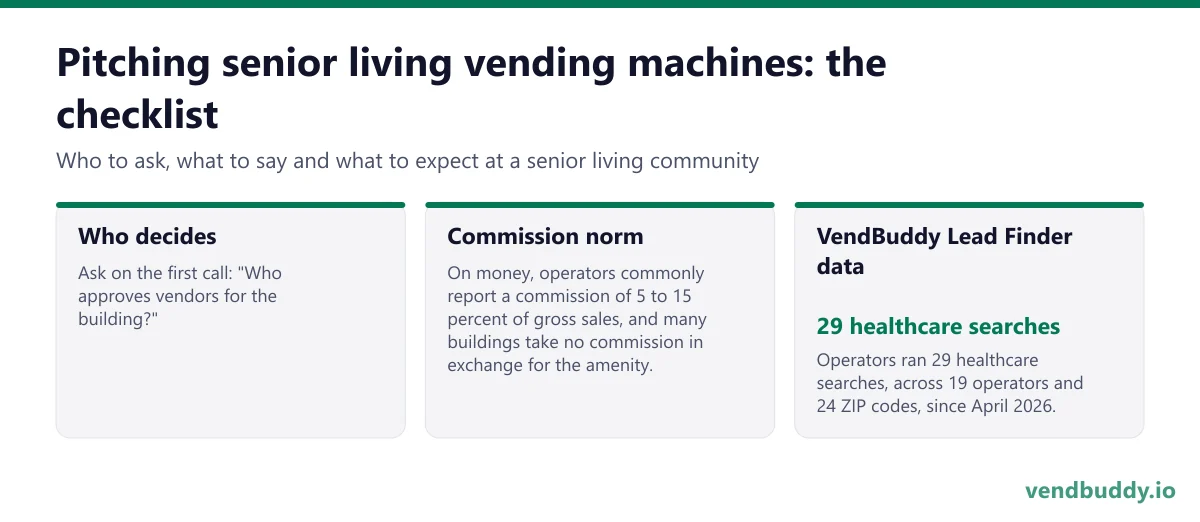
This is VendBuddy's own Lead Finder data as of October 4, 2026. Operators ran 29 healthcare searches, across 19 operators and 24 ZIP codes, since April 2026. Senior living and nursing homes were only one of those searches, so operators are not looking here yet. That is the gap. Few operators are walking into these buildings, and the people inside have few snack options.
Lead Finder starts a senior living community at its default location score of 55, then adjusts for the individual business. Treat that as honest: a typical facility is a decent lead, not an automatic yes. Score each one on staff count and shift coverage before you spend a day on it.
Picture the machines paying you while you sleep
That’s the real promise of vending — income that doesn’t cost you your time, and a life on your own terms. VendBuddy turns this guide into a step-by-step plan so you actually build it instead of just reading about it. Start free today.
Start building free →How a senior living community runs, and what it means for the machine
- Hours. Staff work three shifts, seven days. The dining room closes after dinner. The machine is the only food source at midnight.
- Who is inside. Aides, nurses, kitchen and cleaning staff, therapists, visiting family, and residents who are still mobile. Hospice and home health staff also come and go.
- What they already buy. Coffee from the break room, vending from a gas station on the way in, food from home. Staff often bring a bag lunch and want a drink or something sweet.
- What competes. A staff cafeteria, a free coffee station for visitors, and the building's own rules on outside food.
- The rule to ask about. Many communities, especially skilled nursing, are strict about what residents can access. Ask the administrator if the machine will sit in a staff-only area or a public lobby, and whether there are dietary guidelines for what you load.
Which machine fits a senior living, and what goes in it
Go small and quiet. A compact combo or a smart fridge in the staff break room does more than a big front-lobby unit. Put a card reader on it, because most staff do not carry cash.
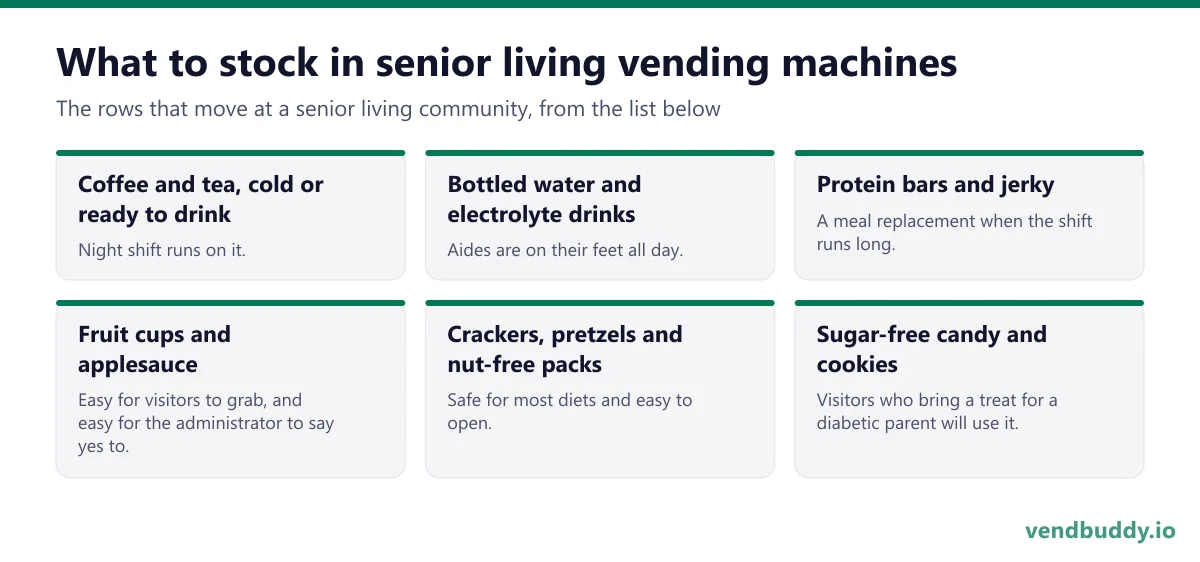
- Coffee and tea, cold or ready to drink. Night shift runs on it.
- Bottled water and electrolyte drinks. Aides are on their feet all day.
- Protein bars and jerky. A meal replacement when the shift runs long.
- Fruit cups and applesauce. Easy for visitors to grab, and easy for the administrator to say yes to.
- Crackers, pretzels and nut-free packs. Safe for most diets and easy to open.
- Sugar-free candy and cookies. Visitors who bring a treat for a diabetic parent will use it.
- A few real meals. A cold sandwich or a microwave soup if you have a smart fridge.
Skip anything hard to chew in the public areas and avoid large sugary drinks in any area residents can reach.
The senior living pitch: who decides and how it goes
The decision-maker is usually the administrator or executive director, with the dietary or food services manager and the facilities lead weighing in. In a chain, a regional or corporate procurement team may need to sign. Ask on the first call: “Who approves vendors for the building?”
Here is an opener you can say in two sentences: “I run a small vending service for local employers. I would like to put a free machine in your staff break room, stocked with what your night shift asks for, and send you a monthly report of what sells.”
You will hear: “We do not want unhealthy food around residents.” The answer is that the machine goes in a staff area, you load to their dietary guidelines, and they can approve every product. Offer to put a fruit and water row at eye level.
On money, operators commonly report a commission of 5 to 15 percent of gross sales, and many buildings take no commission in exchange for the amenity. See vending machine commission rates for how to set it. Run your own numbers in the vending ROI calculator before you quote.
On the walk-in, check three things: where the power outlet is, whether the break room door is locked or badge-only (you will need access for restocking), and how many people work the busiest shift. A written agreement helps; our vending machine contracts 101 guide covers the terms.
How to find senior living communities near you
The fastest way is the Lead Finder, which can pre-select the venue type: Find senior living communities near you in Lead Finder. It scores each building and lists a decision-maker contact when it can.
Two free ways work too. In Google Maps, search “assisted living facility near me” and “nursing home near me” and note every result in your route area. Then do a drive-by test: visit at shift change (about 3 p.m. or 11 p.m.) and count the cars in the staff lot. A full lot means a busy break room.
What Lead Finder adds is the owner or manager contact, a score for each building, and a search radius so you can sweep a whole county in one session. To see how we score, read how to find vending locations.
Most operators who got a good route started with one building and one signed agreement. A care home with a busy night shift can be that first one. Then you ask the administrator who else they know, because these managers talk to each other. Find senior living communities near you in Lead Finder and start with the three closest.
Frequently Asked Questions
Are senior living communities good vending machine locations?
Yes, when there is steady staff traffic. Nursing homes and assisted living communities run around the clock, so staff and visiting family buy snacks and drinks at all hours. Residents are a small part of sales, because most eat on a meal plan. Expect one well-placed machine per building.
What sells best in a senior living vending machine?
Coffee, bottled water, protein bars, fruit cups, crackers and easy-to-open snacks sell to staff and visitors. Add sugar-free candy and low-sodium picks for visitors who bring treats for residents. A smart fridge with sandwiches works on night shifts when the kitchen is closed.
How much commission does a senior living community expect?
Operators commonly report 5 to 15 percent of gross sales, and many communities take nothing in exchange for a free staff amenity. Offer a commission if they ask, and propose to skip it if they would rather have product approval and a monthly sales report.
Can residents use a vending machine in a nursing home?
It depends on the building. Many skilled nursing homes restrict resident access and follow dietary orders, so machines usually go in staff areas. Ask the administrator before you load anything, and offer to stock to their dietary guidelines.
What is selling, which buildings say yes, and the numbers before you buy a machine. Free, confirm from your inbox, unsubscribe in one click. Refer one friend and get 25 VendBuddy credits.
Every operator we talk to wants fewer cold calls. The ones who get there have a Google Business Profile and a simple site a manager can check before replying. AI builders make that an evening job now. Wix is the mature site builder; Base44 also builds working tools like a quote form. Start with the AI website walkthrough or Wix vs Base44.
General information, not legal, tax or financial advice. Rules change, so check the official source. Revenue and income figures are examples, not promises. See our terms.