- Ice demand follows heat, water and power outages. The FDA says the average American buys four bags of packaged ice a year, 80% of it between Memorial Day and Labor Day.
- The strongest sites sit on the way to recreation: roads to lakes and beaches, marinas, boat ramps, bait shops and campgrounds. 57.9 million Americans went fishing in 2024.
- Check competition before you sign. Twice the Ice alone lists more than 3,300 locations, and many of the 151,975 US convenience stores already sell bagged ice.
- The site needs a water line, dedicated power, drainage, drive-up access and lighting. Walk it with a plumber and an electrician first.
- Score every site on heat, traffic, recreation, bulk buyers, utilities, access, competition and owner cooperation before you make an offer.
Ice vending machine locations make or break the whole investment. An ice kiosk costs far more than a snack machine, and you can't roll it to a better spot next month, so the site you sign is the business you have. The good news is that ice demand is predictable. People buy it when it's hot, when they're heading to the water, and when the power goes out. Find those at one address with an owner who will work with you, and you've found a site.
Part of our complete guide: how to find vending machine locations.
This guide is about the site. For equipment prices and buildout costs, see what an ice vending machine costs; for revenue and payback, the ice vending machine business guide.
How ice demand actually works
Start with the calendar. The FDA notes that the average American buys four bags of packaged ice a year, and 80% of it is bought between Memorial Day and Labor Day (FDA). That one fact explains most of the business. Your machine earns most of its year in about four months, so a site has to be very good in summer, and you have to be able to live with it in winter.
Next, follow the coolers. Coolers go where people fish, boat, camp, tailgate and work outside. In 2024, 57.9 million Americans went fishing, a record 19% of the population age 6 and up (NMMA, citing the 2025 Special Report on Fishing). A road that carries those people on a Saturday morning is worth more than a busier road that doesn't.
Then remember that ice is food. The FDA regulates packaged ice in interstate commerce as a food, made under the same good manufacturing practice rules as other foods (FDA). A kiosk on a single lot is usually handled by your state or county health department instead, so call them before you sign anything. The site you pick has to pass their inspection, too.
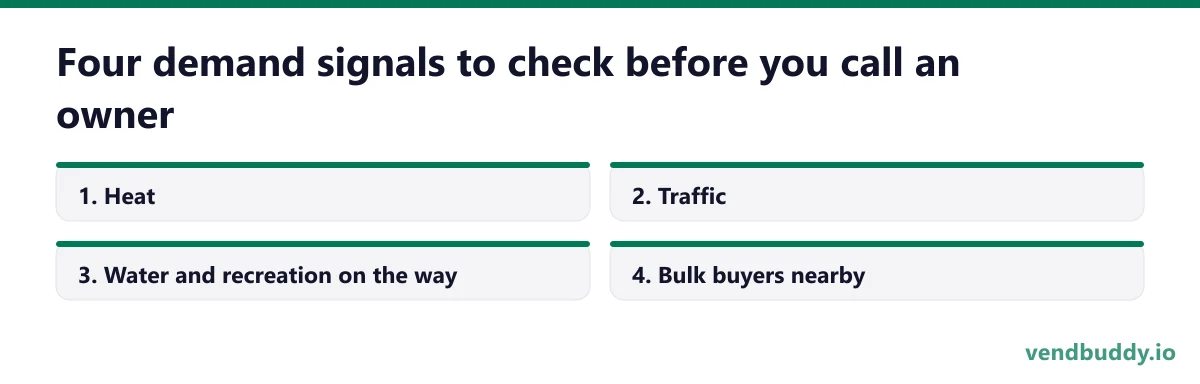
Four demand signals to check before you call an owner
- Heat. Compare candidate towns with the NOAA U.S. Climate Normals, which show typical temperatures by station. A town with a long, hot summer earns more machine-months than one with a short one.
- Traffic. State transportation departments publish annual average daily traffic counts for most roads; the Federal Highway Administration links to each state's data. Look for the road people take to the water, not just the busiest road in town.
- Water and recreation on the way. Lakes, rivers, beaches, boat ramps, campgrounds, ball fields and fairgrounds. The best site is on the route to them, on the side of the road people drive in the morning.
- Bulk buyers nearby. Food trucks, fish markets, restaurants, roofing and landscaping crews, event organizers. They buy every day in summer and keep buying on weekdays when families don't. Twice the Ice even runs a business account program, ICE2U for Business, so owners can track crew purchases (Twice the Ice).
Picture the machines paying you while you sleep
That’s the real promise of vending — income that doesn’t cost you your time, and a life on your own terms. VendBuddy turns this guide into a step-by-step plan so you actually build it instead of just reading about it. Start free today.
Ice vending machine locations, ranked by type
| Location type | Why it sells | Watch out for |
|---|---|---|
| Roadside lot on the way to a lake, beach or campground | Saturday-morning traffic that needs ice before it arrives | Turning room for boat trailers, access from both directions, zoning |
| Marinas, boat ramps and bait shops | Every trip needs ice, for drinks and for the catch | Short season up north; power and water near the dock |
| Campgrounds and RV parks | Guests stay for days and refill coolers daily | The camp store may already sell bagged ice |
| Gas stations and convenience stores | Drivers stop anyway; people expect ice there | Most sell bagged ice, so your pitch is rent or a revenue share plus 24/7 sales |
| Grocery and hardware store parking lots | Heavy daily traffic, shoppers already thinking about home | Corporate approval, longer sales cycle |
| Fairgrounds, sports complexes and event venues | Tournaments and festivals buy in bulk | Demand comes in spikes; check the event calendar |
| Industrial, agricultural and construction corridors | Crews fill coolers every morning, all week | Early hours, so the machine has to run unattended |
| Apartment complexes | Small, steady purchases close to home | Lower volume; often better as a water-and-ice combo |
On convenience stores: there are 151,975 of them in the US (NACS 2026 store count), and many sell bagged ice from a freezer by the door. Some owners will see your kiosk as competition. The ones who say yes usually want the rent, have no room for a bigger freezer, or close at night while your machine keeps selling.
Before you sign anywhere, look at who is already there. Twice the Ice alone lists more than 3,300 locations on its locator, and other brands run their own. Our ice vending machine near me guide shows how buyers find kiosks, which is also how you find your competitors.
What the site itself needs
- Water. A line close to the pad. The farther the plumber has to run it, the higher the bill.
- Power. A dedicated circuit sized for the machine. Ask the manufacturer for the spec and have an electrician confirm the panel can carry it.
- Drainage and a level pad. Ice machines move water. It has to go somewhere that won't flood a parking lot or freeze into a hazard.
- Drive-up access. Room to pull in, buy and pull out, including with a trailer.
- Light and visibility. Much of the money comes at night and early morning. A dark corner of a lot sells less and gets vandalized more.
- Permits. Zoning first, then the health department. Some cities treat a kiosk as a structure that needs a building permit. Read can you put a vending machine anywhere for how permission works.
Plan for water quality from day one. In April 2026, the International Packaged Ice Association pointed to a peer-reviewed University of Iowa study that found detectable lead in water bought from for-profit vending kiosks in several states, with at least one location near double the EPA's threshold (IPIA). Test the source water at your site, change filters on schedule, and keep a written log. Show that log to the property owner when you pitch. It answers the question they will be too polite to ask.
Score a site in 15 minutes
Rate each candidate from 1 (weak) to 5 (strong) on the same eight lines, and compare totals across sites.
| Factor | What a 5 looks like | What a 1 looks like |
|---|---|---|
| Heat | Long, hot summers | Short summer, long winter |
| Traffic | On the main route to recreation | Quiet side street |
| Recreation nearby | Lake, beach, ramp or campground down the road | Nothing outdoors for miles |
| Bulk buyers | Crews, food trucks and events close by | Households only |
| Utilities | Water and power at the pad | Long trench for both |
| Access and visibility | Easy in and out, lit, seen from the road | Hidden corner, tight turn |
| Competition | No kiosk nearby, store freezer only | Another kiosk within sight |
| Owner cooperation | Signs a long lease, helps with permits | Month-to-month, slow to answer |
One rule overrides the total: if heat or traffic scores a 1 or 2, walk away no matter how friendly the owner is. A great owner can't create demand.
Finding the owner and landing the lease
For a business, the decision-maker is usually the owner or the property manager, not whoever is at the register. For a bare lot, the county assessor's parcel records show who owns it. The VendBuddy Lead Finder lists gas stations, marinas, campgrounds and other businesses near a ZIP with the job title to ask for, and how to find vending machine locations explains how we score them.
When you pitch, lead with what the owner gets: monthly rent or a share of sales, a lit and maintained corner, a reason for people to stop, and a machine that keeps selling when the lights are off. Then get these terms in writing:
- Length. Long enough to pay back the buildout. If the payback math in the ice business guide says four years, a two-year lease is a bet you shouldn't make.
- Rent. Flat monthly, a percentage of sales, or a small flat amount plus a percentage. Flat is simpler; a percentage is easier to agree to.
- Utilities. Who pays for water and power, and how it's metered.
- Signage and lighting. What you can put up and who maintains it.
- Exclusivity. No second ice kiosk on the property.
- Removal. How either side ends the deal, and how much notice you get to move a machine that weighs thousands of pounds.
If the price of the machine is the hurdle, ice vending machine financing compares the options. And if you want a lower-cost add-on for the same pad, water vending often shares the plumbing.
Most people who run ice kiosks didn't start with a perfect map. They started with one corner of one lot that people drove past on the way to the lake. VendBuddy shows you which properties near you are worth the drive, so you spend your Saturday talking to owners, not guessing.
Frequently Asked Questions
Where is the best place to put an ice vending machine?
On the route people take to the water or outdoors in a hot region: roadside lots on the way to lakes, beaches and campgrounds, plus marinas, boat ramps and bait shops. Gas stations, grocery and hardware lots, event venues and work corridors with crews filling coolers can also work if the site has water, power and easy drive-up access.
Do ice vending machines do well at gas stations?
They can, but many of the 151,975 US convenience stores already sell bagged ice from a freezer, so some owners see a kiosk as competition. Owners who say yes usually want the rent or a share of sales, lack freezer space, or close at night while the kiosk keeps selling.
When do ice vending machines sell the most?
In summer. The FDA notes the average American buys four bags of packaged ice a year, with 80% bought between Memorial Day and Labor Day. Heat waves, holiday weekends, tournaments and power outages add spikes.
Do I need a permit for an ice vending machine location?
Usually yes. Expect zoning approval, a health department permit or registration because ice is a food, and sometimes a building permit for the kiosk itself. Requirements vary by state and county, so call both offices before you sign a lease.
How do I find the owner of a lot for an ice kiosk?
For a business, ask for the owner or property manager. For a bare lot, the county assessor's parcel records list the owner. The VendBuddy Lead Finder lists businesses near a ZIP with the decision-maker title to ask for.
What is selling, which buildings say yes, and the numbers before you buy a machine. Free, confirm from your inbox, unsubscribe in one click. Refer one friend and get 25 VendBuddy credits.
Walk-ins and cold emails find locations. A small site with your own machine photos and a request-a-machine form lets the next one find you. Around machine three to five, an AI builder drafts it in an evening. Wix is the mature site builder; Base44 also builds working tools like a quote form. Start with the AI website walkthrough or Wix vs Base44.
General information, not legal, tax or financial advice. Rules change, so check the official source. Revenue and income figures are examples, not promises. See our terms.