- Ice vending machine financing usually means an SBA 7(a) loan (up to $5 million, equipment and working capital eligible) or an equipment finance agreement through a lender the manufacturer works with.
- SBA 7(a) small loans run up to $350,000 with an SBA guarantee of up to 85% at $150,000 or less; the 504 program suits deals that include land or buildings and needs at least 10% down.
- Ice House America and Everest name Taycor Financial; Kooler Ice names LEAF and CapCity Finance and says five-year terms and rolled-in site prep are common.
- Test debt service coverage month by month: an ice machine can clear 1.5x on the year and still fall below 1.0x in the off-season, so budget a winter reserve.
- For 2026 tax years the Section 179 limit is $2,560,000 (phase-out above $4,090,000) per IRS Rev. Proc. 2025-32; check with a CPA whether a kiosk counts as equipment or a building.
Ice vending machine financing usually comes down to three doors: an SBA-guaranteed bank loan, an equipment finance agreement through a lender the manufacturer already works with, or a 504 loan when real estate is part of the deal. The SBA 7(a) program tops out at $5 million and explicitly covers buying and installing machinery, which is more than enough for a kiosk. What decides approval is not the machine. It is whether the site, the water hookup and a slow January still leave enough cash to make the payment.
Part of our complete guide: how much does a vending machine cost.
Still pricing equipment? The ice vending machine cost breakdown covers models and site work, and the ice vending business guide covers revenue. This page is about who funds the purchase and what they will ask for.
Why ice vending machine financing works differently from snack machine loans
A used snack machine costs a few thousand dollars and can be loaded onto a trailer if the location goes bad. An ice machine that makes its own ice is a different kind of asset, and underwriters treat it that way for four reasons.
Ticket size
Self-contained ice vendors and kiosk buildings run into the tens of thousands of dollars, and the biggest kiosks into six figures. That moves you out of credit-card and microloan territory and into full equipment underwriting, where the lender wants tax returns, a site plan and a real repayment story.
Site work that is hard to repossess
Ice-making units need a water line, a drain, a dedicated electrical circuit and, for kiosks, a concrete pad. The lender can repossess a machine. It cannot repossess a trench, a pad or a plumber's invoice. That is why some programs cap how much site work they will roll into the note, and why others only allow it when a licensed contractor does the work.
Utility hookups and permits
Ice sold for people to eat or drink is regulated as food in many states, and water and power have to be in place before the machine earns anything. Expect a lender to ask whether the utilities are confirmed, who pays for them, and whether the health or agriculture permit is in hand or at least applied for.
Seasonality in underwriting
This is the big one. A kiosk in a hot-climate parking lot can sell far more ice in July than in January. Most standard loans expect the same payment every month. A lender that knows ice will look at your slowest months, not your average, and may offer a deferred or seasonal payment schedule. A lender that does not know ice will average the year and approve a payment you struggle to make in February.
SBA 7(a) and 504 loans for an ice vending business
The Small Business Administration does not usually lend money itself. It guarantees part of a loan made by a bank, credit union or other approved lender, which makes that lender more willing to fund a newer business. Two SBA programs matter for ice.
SBA 7(a). The SBA lists a maximum 7(a) loan of $5 million, and its list of eligible uses includes working capital and the purchase and installation of machinery and equipment. For an ice operator that means one loan can cover the machine, the site work and a cash cushion for the first winter. According to the SBA's lender terms page, a 7(a) small loan runs up to $350,000, and the SBA guarantees up to 85% of loans of $150,000 or less and 75% above that. Almost every ice deal falls in that small-loan band.
A credit line is still a debt you personally guarantee, so the honest rule is to borrow only what a signed location can repay inside the intro window. 7 Figures Funding sequences the applications for you if you would rather not apply one card at a time. Affiliate link, so we may earn a commission at no extra cost to you.
SBA 504. The 504 program finances major fixed assets: land, buildings, and machinery with a remaining useful life of at least 10 years. The SBA lists 10-, 20- and 25-year maturities, and borrowers put in at least 10% of the project cost. A 504 makes sense when you are buying the lot the kiosk will sit on, or building a multi-kiosk site. For a single machine on a leased pad, it is usually more paperwork than the deal needs.
Some ice manufacturers are listed with the SBA so their buyers skip part of the eligibility review. Ice House America says on its financing page that its business opportunities are pre-approved by the SBA, which it describes as giving applicants an expedited loan process. That speeds up eligibility. It does not replace your own credit and cash-flow review.
If you need less than $50,000, the SBA Microloan is the other route, and it is covered in our SBA microloan guide. For most ice-making equipment plus site work, the 7(a) is the better fit.
Picture the machines paying you while you sleep
That’s the real promise of vending — income that doesn’t cost you your time, and a life on your own terms. VendBuddy turns this guide into a step-by-step plan so you actually build it instead of just reading about it. Start free today.
Start building free →Equipment financing and leasing for ice machines: how the paper works
Most ice vending machines are bought with an equipment finance agreement, not a bank loan. The difference matters when you compare offers.
Equipment finance agreement (EFA). You own the machine from day one, the lender holds a lien on it, and you make fixed payments over a set term. When the last payment clears, the lien comes off. Because you own the asset, you can usually claim depreciation or the Section 179 deduction yourself.
$1 buyout lease. This works like an EFA with different paperwork. You lease the machine and buy it for a dollar at the end. For tax purposes it is generally treated as a purchase.
Fair market value (FMV) lease. Lower payments, but at the end you return the machine, renew, or buy it at an appraised price. For a kiosk expected to run for decades, handing it back after five years rarely makes sense.
Three things to compare on every quote, beyond the monthly payment:
- What is financed. The machine only, or also freight, sales tax, installation and site work. Soft costs you have to pay in cash change how much you need saved.
- The payment schedule. Level payments, a deferred start, or a seasonal schedule with smaller payments in the off-season.
- Prepayment and default terms. Whether you can pay the loan off early without a penalty, and what counts as a default if a location closes.
A personal guarantee is standard on small-business equipment finance. Read it as your personal debt, because that is what it is.
Manufacturer financing programs from ice machine makers
Ice machine makers do not usually lend directly. They send buyers to finance companies that already understand the product. As of September 2026, here is what three makers say on their own sites.
| Manufacturer | Named financing partner | What the maker says about the program |
|---|---|---|
| Ice House America | Taycor Financial; SBA pre-approval | Says it receives no compensation for loans set up through Taycor; points buyers to payment estimators and to banks and credit unions |
| Everest Ice & Water Systems | Taycor Financial | Describes a 100% financing program that can include tax, shipping and other machine-related costs; also points to local banks and SBA loans |
| Kooler Ice | LEAF and CapCity Finance | Says owners with two years of established credit commonly get 100% financing, five-year terms are most common, deferred payments are often available, and licensed-contractor site prep can be rolled in |
Sources: Ice House America, Everest Ice & Water, Kooler Ice. None of them publish a rate. Rates depend on your credit, time in business and the deal, so treat any number a salesperson quotes before you apply as a guess.
Maker-linked lenders have two real advantages. They already know what the machine is worth on resale, and they are used to seasonal revenue, so a deferred-start or off-season schedule is a normal request rather than a strange one. The trade-off is that you are looking at one offer, so get a second quote from your own bank or credit union before you sign.
Debt service coverage for an ice machine: a seasonal example
Debt service coverage ratio (DSCR) is the number lenders use to decide whether you can afford the payment: monthly net operating income divided by the monthly loan payment. Many lenders commonly want about 1.25 or better on an annual basis. Ice needs one more test, because the annual number hides the winter.
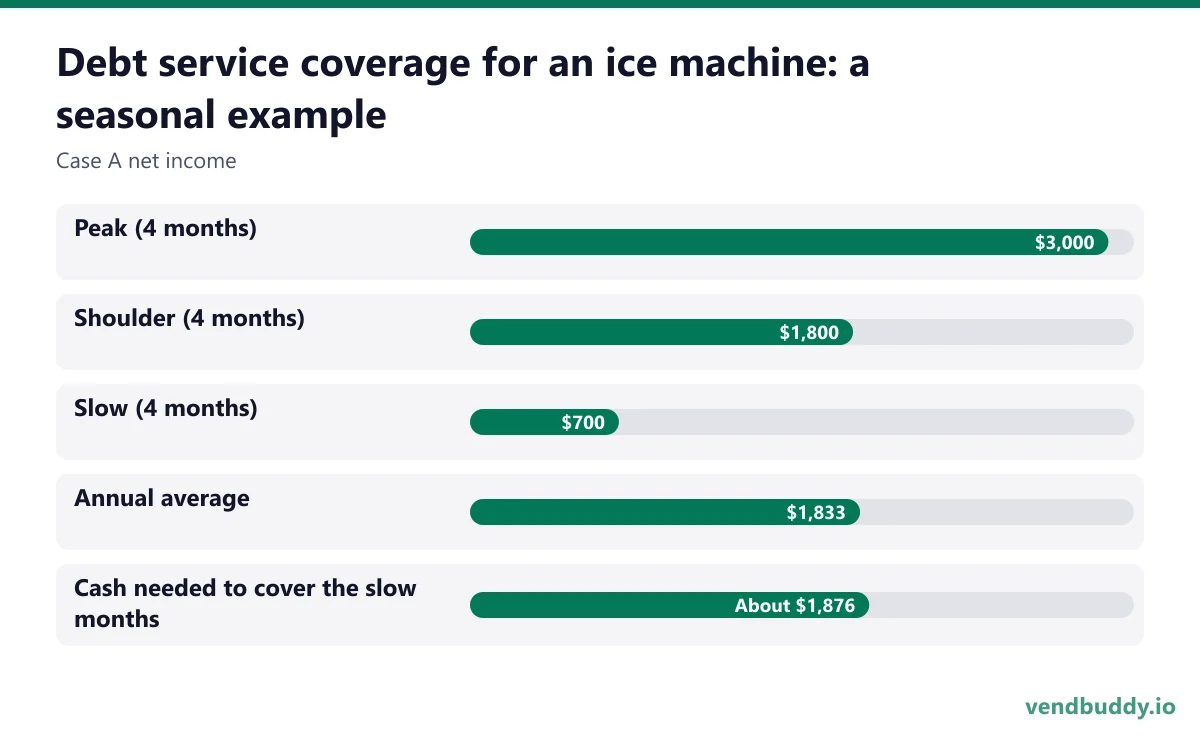
The table below is illustrative only. Every input is an assumption we chose to show the mechanics. None of it is a quote, a rate offer or a revenue forecast. Case A is a self-contained ice vendor with $55,000 financed at an assumed 10% APR over 60 months (payment about $1,169). Case B is a kiosk with $110,000 financed at an assumed 10% over 84 months (payment about $1,826). "Net operating income" means after electricity, water, bags, supplies, maintenance and the location's cut, but before the loan payment.
| Assumed month type | Case A net income | Case A DSCR | Case B net income | Case B DSCR |
|---|---|---|---|---|
| Peak (4 months) | $3,000 | 2.57 | $5,500 | 3.01 |
| Shoulder (4 months) | $1,800 | 1.54 | $3,000 | 1.64 |
| Slow (4 months) | $700 | 0.60 | $1,200 | 0.66 |
| Annual average | $1,833 | 1.57 | $3,233 | 1.77 |
| Cash needed to cover the slow months | About $1,876 | About $2,504 | ||
Both cases pass comfortably on the annual number and fail in the slow months. That is normal for ice, and it is not a reason to walk away. It does mean three things. First, put the winter reserve in your loan request or your own savings before closing, not after. Second, ask for a seasonal or deferred schedule if the lender offers one. Third, a longer term lowers the payment. In Case A, stretching the same $55,000 to 72 months drops the assumed payment to about $1,019, at the cost of more total interest. Run your own site's numbers through the vending ROI calculator before you apply, and our general vending machine loan guide explains how a lender reads DSCR on any deal.
Section 179 and bonus depreciation on ice vending equipment in 2026
Financing and taxes work together. When you finance equipment you own, the deduction is based on the full cost of the equipment in the year you place it in service, not on the payments you make. For tax years beginning in 2026, the IRS's Rev. Proc. 2025-32 sets the Section 179 expensing limit at $2,560,000, reduced dollar for dollar once total Section 179 property placed in service in the year goes over $4,090,000. No single-machine ice operator gets close to either number.
The IRS has also issued guidance on the permanent 100% bonus depreciation for qualified property acquired after January 19, 2025. Between the two, a financed ice vendor can often be written off in its first year.
Two cautions. Section 179 cannot create a loss. The deduction is limited to your business income for the year, so a brand-new operator with little income may get more from bonus depreciation or regular depreciation. And a kiosk on a permanent foundation raises a real question: is it equipment or a building? The answer changes which deductions apply, so ask a CPA who has seen kiosk deals before you count on a first-year write-off. IRS Publication 946 is the reference your accountant will use.
What lenders ask for on an ice vending loan
How can you get a loan to start an ice vending business? Show up with the file already built. Ice deals get stuck on the same few documents, and most of them are about the site, not you.
- A signed site lease or placement agreement. Its term should be at least as long as the loan. A five-year note on a site you can lose in twelve months is the most common reason an ice loan stalls. Lenders may also ask the landowner to sign a waiver so they can reach the machine if you default.
- Utility confirmation. Written confirmation that water, drain and a dedicated circuit are available, plus the contractor quote for connecting them.
- The manufacturer quote. Model, capacity, freight, installation and warranty, on the maker's or dealer's letterhead.
- Permit status. Your state or county health or agriculture permit, or proof you have applied.
- Personal and business financials. Usually two years of tax returns, a personal financial statement, bank statements, and your credit report. Down-payment money that has sat in your account for a few months reads better than a recent deposit.
- A month-by-month projection. Twelve columns, not one annual number, with your slow months visible and the reserve that covers them.
The site lease is the item you control most and the one that takes longest. Gas stations, campgrounds, marinas and grocery lots are the usual hosts, and the fastest way to reach the person who can sign is to know their name before you call. The VendBuddy location finder lists properties in any ZIP along with decision-maker contacts, so you can start those conversations while the lender reviews the rest of your file. For every other funding path, including credit lines and reinvesting cash flow, see how to finance vending machines.
Frequently Asked Questions
How can I get a loan to start an ice vending business?
Start with a signed site lease that runs at least as long as the loan, a manufacturer quote, and written confirmation that water, drain and power are available. Then apply to an SBA 7(a) lender or the finance company your ice machine maker works with, and get a second quote from your own bank or credit union. Bring two years of tax returns, a personal financial statement and a month-by-month cash-flow projection that shows your slow season. Most stalled ice loans stall on the site paperwork, not the borrower's credit.
You can build all of this yourself in a spreadsheet over a weekend. If you would rather not, the operator kits package the same checklists and templates as a one-time download starting at $27.
Can you use an SBA loan to buy an ice vending machine?
Yes. The SBA lists the purchase and installation of machinery and equipment as an eligible 7(a) use, along with working capital, and the program maximum is $5 million. Most ice deals fall under the 7(a) small loan limit of $350,000. If you are also buying the land, the SBA 504 program can finance fixed assets with a remaining useful life of at least 10 years.
Do ice vending machine manufacturers offer financing?
Most makers refer buyers to a partner lender rather than lending directly. Ice House America and Everest Ice and Water both name Taycor Financial, and Kooler Ice names LEAF and CapCity Finance. None of them publish interest rates, because the rate depends on your credit, time in business and the deal. Compare the maker's lender against at least one outside quote.
Can site work be included in ice machine financing?
Sometimes. Kooler Ice says site prep done by licensed contractors can be rolled into notes from its partner lenders, and Everest describes a 100% program that can include tax, shipping and other machine-related costs. Other lenders finance only the machine and expect you to pay for the pad, plumbing and electrical in cash. Ask exactly which line items are financed before you compare monthly payments.
How does seasonality affect an ice vending machine loan?
Level loan payments do not change with the weather, but ice sales do. A machine can show a healthy debt service coverage ratio across the year and still earn less than the payment in its slowest months. Ask about deferred-start or seasonal payment schedules, consider a longer term, and set aside a reserve that covers the gap in your off-season months.
What is the Section 179 limit for ice vending equipment in 2026?
For tax years beginning in 2026, IRS Rev. Proc. 2025-32 sets the Section 179 limit at $2,560,000, reduced once total qualifying purchases in the year exceed $4,090,000. The deduction cannot exceed your business income for the year. A kiosk on a permanent foundation may be treated differently from movable equipment, so confirm the treatment with a CPA.
What is selling, which buildings say yes, and the numbers before you buy a machine. Free, confirm from your inbox, unsubscribe in one click. Refer one friend and get 25 VendBuddy credits.
General information, not legal, tax or financial advice. Rules change, so check the official source. Revenue and income figures are examples, not promises. See our terms.