- Lenders underwrite you, not the route. Machines are collateral; signed locations are goodwill, and goodwill secures nothing. That single fact shapes every option below.
- Under $50k: SBA Microloan (8–13% APR, to 6 years). Above it: SBA 7(a), the standard business-acquisition loan. Machines only: vendor equipment financing at 6–12%, often $0 down.
- Seller financing is the quiet default in vending because so many sellers are retiring operators — 20–50% down, the rest paid out of the route’s own cash flow.
- Run the DSCR before you apply. Monthly net divided by the proposed payment. Under 1.25 and the bank says no; under 1.5 and you should probably say no yourself.
- Most declines are document declines. The seller who cannot produce a clean P&L kills more vending loans than any buyer credit score does.
There is a specific moment where a vending deal stops being exciting. You have found a route, the seller wants $58,000, the numbers look decent — and you have $12,000. What happens next is not really a financing question, it is an underwriting question, and the reason so many of these applications die is that almost nobody explains what the person on the other side of the desk is actually looking at.
- How to get a loan to buy a vending machine business
- What a lender is actually underwriting
- The four doors that actually fund a vending purchase
- The arithmetic that decides it: debt service coverage
- The document pack, and why most declines are document declines
- The alternative most first-machine buyers actually use
- What kills applications
- The bottom line
This page is about that: how to get a loan to buy a vending machine business or the machines to start one, which door fits which deal size, and the four or five things that decide the answer before anyone reads your business plan. If you want the wider comparison of every funding path including cards, credit lines and reinvestment, the full vending machine financing guide covers all six side by side. This page assumes you already know you want a loan.
How to get a loan to buy a vending machine business
Buying a route rather than machines changes which loan you are eligible for. The short answer: under $50,000 you want an SBA Microloan, above it an SBA 7(a) acquisition loan with roughly 10% down, and in both cases you should expect the seller to carry part of the price, because the part you are paying for that a bank will not secure is the locations. Work it in this order:
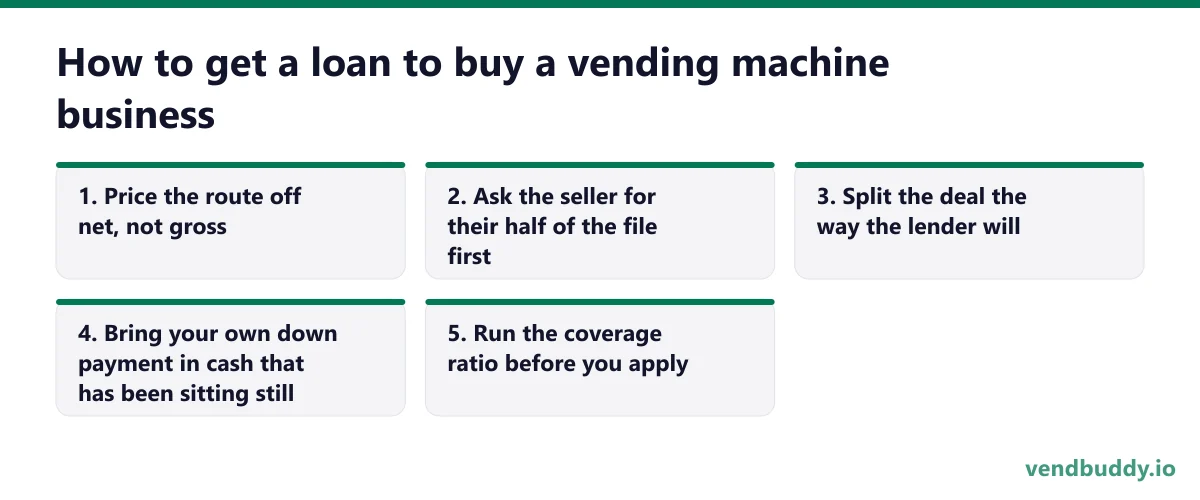
- Price the route off net, not gross. Small routes commonly change hands at one to two times annual net profit. Get to that number before you talk to a lender, because the appraisal a bank runs will not flatter an offer built on gross revenue. The negotiating positions are laid out in route acquisition price negotiation.
- Ask the seller for their half of the file first. Two years of profit-and-loss statements, business tax returns, a machine list with make, model, age and serial numbers, every location agreement, and the commission schedule per site. A seller who cannot produce that is telling you something about the route, not just about their bookkeeping.
- Split the deal the way the lender will. The machines get financed against the machines. The goodwill gets covered by your down payment and a seller note. Deals structured that way close; deals presented as one lump sum for a business usually come back asking for exactly this.
- Bring your own down payment in cash that has been sitting still. Plan on 10% for a 7(a) and 20–50% when the seller is the lender. Underwriters look at where the money came from, so a balance that appeared last month raises a question a balance that has been there six months does not.
- Run the coverage ratio before you apply. Route net divided by the proposed monthly payment, with commission modeled in. The DSCR section below has the arithmetic and the number to beat.
One practical note on where these deals come from: most listed routes are priced by the seller with nothing to compare against, which is why the same route can be $38,000 in one listing and $60,000 in another. Browsing what is actually on offer in your area is worth an hour before you make any offer — the route and machine marketplace is a starting point, and the route valuation tool will tell you what the numbers support.
What a lender is actually underwriting
Start with the uncomfortable structural fact, because every option below is shaped by it. A vending route is mostly made of things a lender cannot repossess.
| What you are buying | How a lender sees it | What it will finance |
|---|---|---|
| The machines | Appraisable hardware with a resale market | Readily — this is textbook equipment lending |
| The signed locations | Goodwill. Contracts that a property manager can cancel | Almost nothing on its own |
| The route’s cash flow | Repayment capacity, not collateral | It decides the size, not the security |
| You | The actual security, via a personal guarantee | This is the file they are really reading |
That is why route purchases so often end up as a blend rather than one clean loan: hardware financed against the hardware, goodwill covered by cash or by the seller carrying paper. And it is why the strength of your personal credit file matters more in this business than in one where the asset is a building.
Picture the machines paying you while you sleep
That’s the real promise of vending — income that doesn’t cost you your time, and a life on your own terms. VendBuddy turns this guide into a step-by-step plan so you actually build it instead of just reading about it. Start free today.
Start building free →The four doors that actually fund a vending purchase
A lender will finance your machines all day. It will not finance your locations — those are goodwill, and goodwill secures nothing. That gap is why seller financing quietly runs vending.
The arithmetic that decides it: debt service coverage
Before you fill in a single form, run the test the lender is going to run. Debt service coverage ratio is the route’s monthly net divided by the proposed monthly payment. Most commercial lenders want at least 1.25 and prefer 1.5.
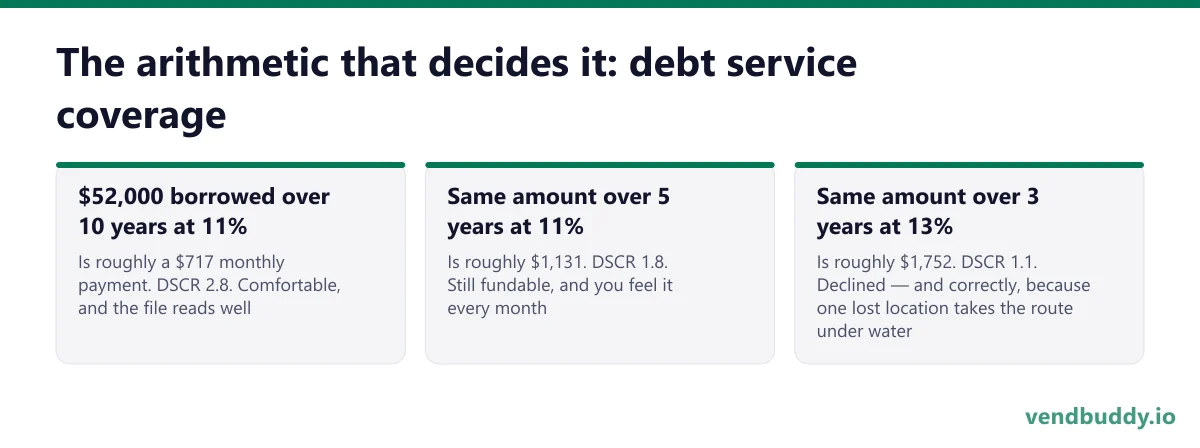
A worked example on a $58,000 route netting $2,000 a month after product cost, commission, fuel and card fees:
- $52,000 borrowed over 10 years at 11% is roughly a $717 monthly payment. DSCR 2.8. Comfortable, and the file reads well.
- Same amount over 5 years at 11% is roughly $1,131. DSCR 1.8. Still fundable, and you feel it every month.
- Same amount over 3 years at 13% is roughly $1,752. DSCR 1.1. Declined — and correctly, because one lost location takes the route under water.
Two things follow from that. The term is a risk decision, not a cosmetic one: a longer term costs more interest and buys you the ability to survive losing a building. And the net has to be the real net. Sellers quote gross with impressive frequency, and commission is the line most often left out. Verify it against the actual numbers before you borrow against them — the route due-diligence checklist is the version of this with the receipts, and the margin explainer shows where the gross actually goes.
The document pack, and why most declines are document declines
The single most common reason a vending acquisition loan dies is not the buyer. It is a seller who cannot produce paperwork, because a large share of small routes are run out of a notebook and a cash box.
Have these ready before you apply, and ask the seller for their half before you make an offer:
- From the seller: two to three years of profit-and-loss statements, business tax returns, a machine list with make, model, age and condition, the location agreements, and a commission schedule per site.
- From you: personal tax returns, a personal financial statement, credit report, proof of the down payment, and a one-page plan for the route that names the buildings rather than the ambition.
- For the deal: the purchase agreement or letter of intent, an equipment valuation, and evidence of the insurance a property manager will require anyway.
If the seller cannot produce their half, that is not only a financing problem. It is information about the deal, and the correct response is usually a lower offer with more seller carry in it, not a different lender.
The alternative most first-machine buyers actually use
If you are buying one machine rather than a business, a loan is often the wrong instrument. The amount is small, the application is disproportionate, and the payback window on a machine at a confirmed location is typically 12 to 14 months — which is inside the intro window on a 0% business card. That route needs no collateral, funds in days rather than weeks, and costs nothing if you clear the balance before the promotional period ends.
0% intro business credit is how a large share of first machines actually get bought — no collateral, no appraisal, and funded in days. 7 Figures Funding specializes in helping new business owners qualify for 0% intro business credit lines.
One warning that belongs next to any promotional-rate product: an intro-APR purchase offer simply starts charging interest on the remaining balance when the window closes. A deferred-interest promotion, which some equipment sellers use, retroactively charges every avoided month if any balance remains. Similar marketing, very different products. Confirm in writing which one you signed.
What kills applications
- Borrowing before the location exists. A financed machine with nowhere to go is the worst position in this business: a payment, no revenue, and storage. Location first, equipment second — the order-of-operations argument is here.
- Modelling zero commission. Roughly a third of buildings ask for a cut of gross, usually 10 to 20 percent. A DSCR built without it is a DSCR that will not survive contact with the route.
- A term chosen to make the payment look good. Three-year money on a ten-year asset is how a workable route becomes a stressful one.
- Applying everywhere at once. Multiple hard inquiries in a short window reads as distress. Pick the door that matches your deal size, apply there, and wait.
- A seller price built on gross. Routes are commonly priced at one to two times annual net. If the asking price only makes sense against gross revenue, the financing was never the problem.
Everything above is free to read and free to do. The operator packs are the same material in fill-in-the-blank form — the 50-state distributor list, the LLC and permit checklist in unblocking order, the word-for-word walk-in script, and the placement agreement you hand a property manager. One-time purchase from $27, nothing renews.
See what is inside →The bottom line
Match the door to the deal. Under $50,000 and buying a route, SBA Microloan. Above it, SBA 7(a), with the seller’s paperwork lined up before you apply. Machines only, no business attached, equipment financing from the vendor. And in a market full of retiring operators, always ask about seller carry — it is frequently the cheapest, fastest and best-aligned money on the table, and the only lender who is also a reference for the route.
Then run the coverage ratio yourself before anyone else does. If the route does not cover its own payment by 1.5, the honest answer is a lower offer or a longer term, not a more agreeable lender.
A loan application is only as good as the buildings behind it. VendBuddy scores real venues near you by traffic, headcount and category, gives you the best contact on file for each, and models what a machine would net there - which is exactly the evidence that turns a plan into a fundable one. Five free credits, no card required.
Related reading: how seller financing is structured, the route due-diligence checklist, leasing versus buying machines, equipment financing versus a business card, and what machines actually cost.
Frequently Asked Questions
How do you get a loan to buy a vending machine business?
Through one of four doors, and which one depends almost entirely on the size of the deal. Under about $50,000, an SBA Microloan is the usual fit at roughly 8 to 13 percent APR with terms up to six years. Above that, an SBA 7(a) loan is the standard vehicle for buying an existing business, and the lender will want the seller financials to support it. If you are buying machines rather than a business, equipment financing from the vendor runs roughly 6 to 12 percent and often needs nothing down because the machine itself is the collateral. And seller financing - the seller carrying 50 to 80 percent of the price and being paid out of the route cash flow - is extremely common in vending because so many sellers are retiring operators.
Can you get an SBA loan to buy a vending route?
Yes, and it is the most common formal route above about $50,000. Under that figure the SBA Microloan program is simpler and faster; above it the 7(a) program is the standard business-acquisition vehicle. The practical barrier is not the program, it is the paperwork on the other side of the table: an SBA lender underwrites the business being bought as well as the buyer, so a seller who cannot produce two or three years of clean profit-and-loss statements, a machine list and location contracts will sink the application no matter how strong your own credit is.
Worth reading before you sign anything: the contract walkthrough covers which terms get pushed back on and which ones you can safely give away. Commission is rarely the clause that hurts you later.
What credit score do you need to finance a vending machine?
For vendor equipment financing, commonly around 600 to 650, because the machine is collateral the lender can repossess. For an SBA loan, most lenders want 680 or better plus a personal guarantee and often some collateral outside the business. For seller financing there is no formal threshold at all - the seller is the underwriter, and what they care about is the down payment and whether they believe you will keep the route running well enough to pay them.
Do lenders count vending machines as collateral?
The machines yes, the business mostly no, and that gap is what surprises first-time buyers. A vending machine is appraisable hardware with a resale market, so an equipment lender will finance it happily. The valuable part of a route - the signed locations and the relationships - is goodwill, and goodwill secures nothing. That is why route purchases usually end up as a blend: equipment financing or an SBA loan against the hardware, and seller carry or cash against the goodwill portion.
How much do lenders want you to put down on a vending route?
Plan on 10 to 30 percent depending on the door. SBA 7(a) acquisitions commonly require around 10 percent from the buyer, credit-union equipment loans 10 to 20 percent, vendor equipment financing sometimes nothing at all, and seller-financed deals typically 20 to 50 percent because the seller is carrying the risk you are not paying a bank to carry. The down payment is also the number that most often decides the deal: buyers who cannot cover it tend to overpay elsewhere, usually by accepting a shorter term and a payment the route cannot service.
What debt service coverage ratio do vending lenders want?
Most commercial lenders want the business to produce at least 1.25 times its own loan payment, and prefer 1.5. Run it before you apply: take the route monthly net after product cost, commission, fuel and card fees, and divide it by the proposed monthly payment. A route netting $2,000 a month against an $830 payment covers at 2.4 times and is a comfortable file. The same route against a $1,700 payment covers at 1.2 and is a decline - and, more importantly, is a deal that would have kept you awake even if it had funded.
How long does vending machine financing take to fund?
Vendor equipment financing is the fastest, often two to five business days on a single machine because the underwriting is largely automated. Credit-union equipment loans run one to three weeks. SBA Microloans typically take three to six weeks through an intermediary lender, and SBA 7(a) acquisitions routinely take 45 to 90 days from application to funding. Sellers rarely wait 90 days quietly, so if you are bidding on a route with an SBA loan, say so in the offer and put the timeline in writing rather than discovering the mismatch at week six.
What is selling, which buildings say yes, and the numbers before you buy a machine. Free, confirm from your inbox, unsubscribe in one click. Refer one friend and get 25 VendBuddy credits.
General information, not legal, tax or financial advice. Rules change, so check the official source. Revenue and income figures are examples, not promises. See our terms.