- A lease is a loan wearing a monthly payment as a disguise. $60–$120/month over 24–36 months totals 20–40% above the cash price — roughly 18–30% APR once you actually solve for it.
- Buying used usually wins. $1,500–$3,000 for a solid machine that pays for itself in 3–5 months at a decent location, after which your monthly equipment cost is zero.
- Ask which of three products you are being offered: rental (own nothing), lease-to-own (nominal buyout), or fair-market-value lease (the buyout is a surprise). The marketing language is identical.
- Four cases where leasing genuinely wins: unproven locations, seasonal placements, fast-obsoleting smart coolers, and when locations rather than machines are your binding constraint.
- The clause that matters most is the buyout schedule. A fair lease shows the payoff at every month. A bad one shows it only at the end.
Leasing a vending machine feels like the responsible choice. No big cheque, no drained savings, a predictable payment that the machine itself can cover. Then you do the arithmetic on what the payment plan actually costs and discover you agreed to a rate somewhere around 25 percent APR — a number that would have ended the conversation instantly if anyone had said it out loud.
- First, three different things all called "leasing"
- The number nobody quotes: what the lease actually charges
- Three years, side by side
- The four cases where leasing is the right call
- Tax treatment, briefly, and why it rarely flips the decision
- The five clauses that decide whether a lease is fair
- The bottom line
- Frequently Asked Questions
That is the whole of this page. Not "leasing is bad" — there are four situations where it is clearly right, and they are named below — but that a lease is a credit product, and credit products should be compared on their rate rather than on their payment.
First, three different things all called "leasing"
Almost every confusing vending equipment quote comes down to a seller using one word for three products.
| Typical cost | What you own at the end | What it is really for | |
|---|---|---|---|
| Straight rental | $75–$150/month, service usually included | Nothing, however long you pay | Reversibility. You are buying an exit, not a machine. |
| Lease-to-own ($1 or nominal buyout) | $60–$120/month over 24–36 months | The machine | A purchase on instalments. Compare it to a loan, not to a rental. |
| Fair-market-value lease | Often the lowest monthly of the three | Nothing, unless you pay the FMV buyout | Keeping the payment low. The cost moves to the end where it is harder to see. |
The FMV lease is the one that catches people. It quotes like a lease-to-own and finishes like a rental, and the buyout is "fair market value" rather than a number you were shown at signing. Ask which of the three you are being offered, get it in writing, and if the answer is FMV, ask what the estimated buyout is in dollars. If the question is deflected, that is your answer. For the beginner-level version of the rent question — whether you can simply rent a machine at all, and the one case where renting beats owning — the rent-versus-buy page covers it properly.
The number nobody quotes: what the lease actually charges
Take an ordinary deal. A solid used combo machine you could buy outright for $2,200, offered instead at $100 a month for 30 months with nothing down and a nominal buyout at the end.
- Total paid: $3,000 against a $2,200 cash price — about 36% more, squarely inside the 20–40% premium these deals normally carry.
- Solve that for a rate and it is roughly 2.1% per month, or about 25% APR.
- For comparison, the same machine on vendor equipment financing runs 6–12%, a credit-union equipment loan 6–9%, and an SBA Microloan 8–13%.
Nothing about that is a scandal — it is unsecured-ish credit to a business with no history, and it prices accordingly. The problem is purely that it is never presented as a rate, so it never gets compared against the products it should lose to. Every one of those alternatives is laid out in every financing route compared, which is the page to read if the real question is how to fund the machine at all rather than whether to lease it.
A vending machine lease is a loan wearing a monthly payment as a disguise. Solve a typical one for its rate and it is about 25% APR — a number you would refuse if a bank said it out loud.
Picture the machines paying you while you sleep
That’s the real promise of vending — income that doesn’t cost you your time, and a life on your own terms. VendBuddy turns this guide into a step-by-step plan so you actually build it instead of just reading about it. Start free today.
Start building free →Three years, side by side
Same machine, same location, 36 months, using the machine values our buyer’s guide publishes.
| Lease-to-own | Buy used outright | |
|---|---|---|
| Cash needed on day one | $0–$300 | $1,500–$3,000 |
| Monthly equipment cost | $60–$120 for 24–36 months | $0 after purchase |
| Total paid over 36 months | About $3,000 on a $2,200 machine | $2,200, once |
| Implied rate | ~25% APR | None — it is your money |
| What you own at month 37 | The machine (nominal buyout) | The machine |
| If the location fails in month 4 | Payments continue, or you negotiate an exit | Move the machine, or sell it for 40–60% of cash price |
| Effect on other credit | Payment consumes debt capacity; UCC-1 likely filed | None |
| Cash preserved for locations | Yes — this is the real argument for it | No |
The four cases where leasing is the right call
Tax treatment, briefly, and why it rarely flips the decision
The tax argument for leasing is real and usually smaller than the salesperson implies. Broadly: ordinary operating-lease payments are deductible as an expense in the year you pay them, while a purchase is handled through depreciation — except that Section 179 and bonus depreciation often let you deduct a large share of the equipment cost in year one anyway. And a lease-to-own with a nominal buyout is typically treated as a purchase rather than a lease, which surprises people who leased specifically for the deduction.
The practical read: a deduction returns your marginal tax rate on the expense, not the expense. A 25% implied borrowing rate is not rescued by a deduction, and the decision is nearly always settled before tax enters it. Our deductions overview covers the wider picture, and this is a genuine ask-your-CPA question rather than a blog-post question — the answer depends on your entity and on the exact contract language.
If you would rather not draft the contract from scratch, we keep a plain-English walkthrough at get vending machine contracts. It covers term, commission, exclusivity and how either side gets out.
The five clauses that decide whether a lease is fair
- A buyout schedule at every month. A fair lease shows what it costs to end the agreement in month nine. A bad one shows only the number at the end, which means you cannot exit early without a negotiation you will lose.
- Fixed buyout or fair market value. Get the dollar figure, in writing, at signing.
- Auto-renewal. Evergreen clauses are how a 24-month term quietly becomes a 36-month one. Note the notice window and put the date in a calendar the day you sign.
- Repair responsibility and response time. A machine down for two weeks costs more in lost sales than two months of payments. Ask for a 48 to 72 hour commitment and get it in the document.
- UCC-1 scope. Most equipment lessors file one. A filing against the specific machine is normal; a blanket filing against all business assets is not, and it will complicate the next loan you apply for — including a route acquisition loan.
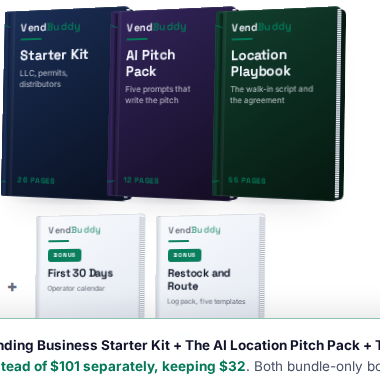
If you get to the end of this and the answer is yes, the kits are the shortcut past the blank page: a 26-page starter kit for the paperwork, a 55-page Location Playbook for the walk-in script and the agreement, and a 12-page AI Pitch Pack. Bought once, from $27, and you keep the files.
Look inside the kits →The bottom line
For most operators buying most machines, buying used is the cheaper, simpler and more flexible answer, and the lease loses primarily because nobody makes you look at its rate.
But run the comparison the right way round. The question is not "lease or buy" in the abstract — it is which constraint are you actually under. Short of cash with buildings waiting: the premium may be worth it. Short of proven locations: neither, yet, because the most expensive machine in this business is the one that is financed and sitting in a garage.
Lease or buy only matters once a building has said yes. VendBuddy scores real venues near you by traffic, headcount and category, gives you the best contact on file for each, and models what a machine would net there - so you find out whether locations or capital is your real bottleneck before you sign anything. Five free credits, no card required.
Related reading: renting versus buying, for beginners, what vending machines actually cost, how to buy a used machine without getting burned, how long a machine takes to pay for itself, and how to get a loan to buy a route.
Frequently Asked Questions
Is it better to lease or buy a vending machine?
Buy, for most small operators, and the reason is the implied interest rate rather than any principle about ownership. A lease-to-own at $60 to $120 a month over 24 to 36 months typically totals 20 to 40 percent more than the cash price, which works out to somewhere around 18 to 30 percent APR once you do the arithmetic - a rate you would refuse instantly if a bank quoted it out loud. A used machine at $1,500 to $3,000 pays for itself in three to five months at a decent location, after which your monthly equipment cost is effectively zero while the lease payment continues. Leasing wins in four specific situations, and outside them it is the most expensive ordinary way to end up owning a machine.
What is the difference between leasing and renting a vending machine?
A rental is pure usage: $75 to $150 a month, maintenance usually included, and you own nothing at the end no matter how long you pay. A lease-to-own is a purchase disguised as a payment plan: $60 to $120 a month over 24 to 36 months, after which the machine is yours, often for a nominal buyout. The confusing middle case is a fair-market-value lease, which looks like a lease-to-own until the end, when the buyout is whatever the machine is then worth rather than a dollar. Always ask which of the three you are being offered, in writing, because the marketing language for all three is nearly identical.
How much does it cost to lease a vending machine?
Lease-to-own terms commonly run $60 to $120 a month over 24 to 36 months on a standard snack or combo machine, sometimes with nothing down. Straight rental is higher at $75 to $150 a month because it includes service and carries no equity. Specialty equipment - coffee, frozen, smart coolers with cameras and card readers - runs well above both. Delivery is usually extra either way, commonly $100 to $300 each direction, and it is the line most often left out of a quoted monthly figure.
On card readers specifically, Nayax is the default for a dull reason: it is the one most machine suppliers pre-wire for. Price the monthly against your slowest machine, not your best one.
When does leasing a vending machine actually make sense?
Four situations. Testing a location nobody has data on, where a reversible commitment is worth paying for. Short-term or seasonal placements that will not run long enough to justify buying. Fast-obsoleting equipment such as camera-and-sensor smart coolers, where the technology risk is real and you may genuinely not want to own a five-year-old unit. And the case where your binding constraint is locations rather than machines - if the same cash can secure two more buildings, paying a premium to spread the equipment cost can be the right trade. Outside those four, the math favours buying used.
Can you write off vending machine lease payments?
Ordinary operating-lease payments are generally deductible as a business expense in the year they are paid, while a purchase is normally handled through depreciation - though Section 179 and bonus depreciation frequently allow a large deduction in the first year instead. A lease-to-own with a nominal buyout is usually treated as a purchase rather than a lease for tax purposes, which surprises people. The tax difference is real but it is rarely large enough to flip a decision that a 25 percent implied rate has already decided, and the treatment depends on your entity and the exact contract, so confirm it with a CPA rather than with a salesperson.
What should you check before signing a vending machine lease?
Five things. A buyout schedule showing the payoff figure at every month rather than only at the end. Whether the end-of-term buyout is a fixed nominal amount or fair market value. Whether the term auto-renews, because evergreen renewal clauses are how a 24-month lease quietly becomes a 36-month one. Who is responsible for repairs and what the response-time commitment is, because a machine down for two weeks costs more than the payment. And whether the lender files a UCC-1 against your business, which can affect other credit you apply for while the lease runs.
Does leasing hurt your ability to get other business credit?
It can, in two ways worth knowing about. Equipment lessors commonly file a UCC-1 financing statement, which is a public lien notice against the financed equipment and sometimes against business assets more broadly, and a later lender will see it. And the payment itself consumes debt-service capacity: a $100 monthly lease is $100 a month of coverage that a future loan application no longer has. Neither is a reason to avoid leasing, but both are reasons to read the filing scope before signing, particularly if a route acquisition loan is anywhere in your plans.
What is selling, which buildings say yes, and the numbers before you buy a machine. Free, confirm from your inbox, unsubscribe in one click. Refer one friend and get 25 VendBuddy credits.
General information, not legal, tax or financial advice. Rules change, so check the official source. Revenue and income figures are examples, not promises. See our terms.