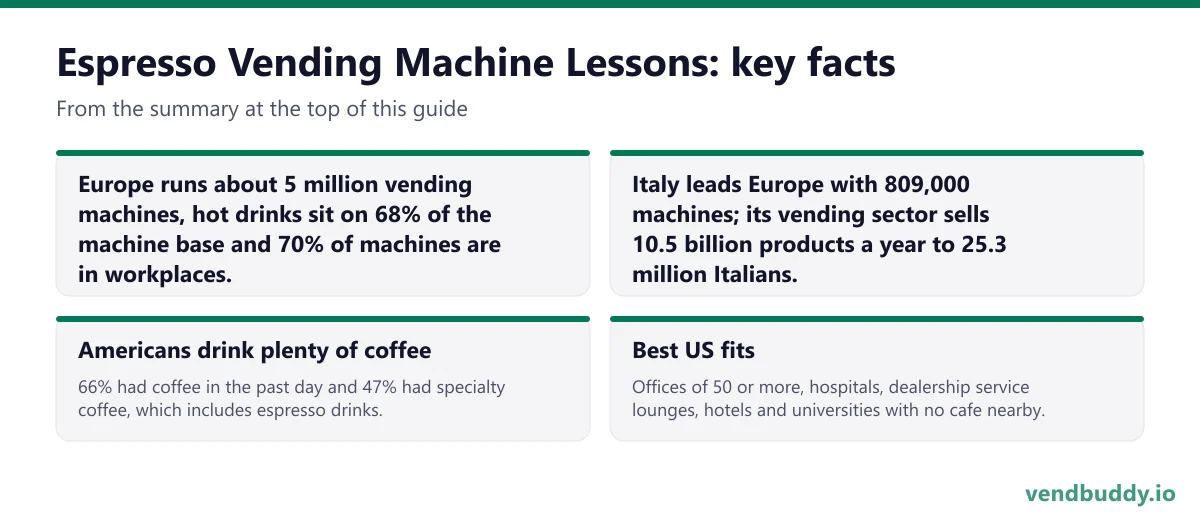
- Europe runs about 5 million vending machines, hot drinks sit on 68% of the machine base and 70% of machines are in workplaces.
- Italy leads Europe with 809,000 machines; its vending sector sells 10.5 billion products a year to 25.3 million Italians.
- Americans drink plenty of coffee: 66% had coffee in the past day and 47% had specialty coffee, which includes espresso drinks.
- The US gap is not demand but habit: US workplaces rely on drip pots and pods, so a good espresso vending machine fills a hole.
- Best US fits: offices of 50 or more, hospitals, dealership service lounges, hotels and universities with no cafe nearby.
An espresso vending machine is ordinary in a European office and rare in an American one. That is odd, because Americans drink a lot of coffee. The gap is a habit, not a lack of demand, and habits are where a vending operator can make money: put a good cup of coffee where people are stuck for eight hours and you earn from it every working day.
- Why does Europe buy coffee from vending machines?
- Why US offices went with drip pots and pods instead
- Where an espresso vending machine works in the US
- How to pitch an espresso machine to an office manager
- Vending machine or office coffee service?
- Bean-to-cup, instant or pod: what to place
- What to copy from Europe, and what to skip
- A simple test plan
Part of our complete guide: how much does a vending machine cost.
The numbers make the case. Across Europe, hot drinks sit on 68% of the vending machine base, and the European Vending and Coffee Service Association reports that 70% of the roughly 5 million machines are in workplaces. Italy alone has 809,000 machines, the most in Europe. In the US, the National Coffee Association found that 66% of American adults had coffee in the past day, more than any other drink, and 47% had specialty coffee, a category that includes espresso drinks like lattes and cappuccinos. Americans want the cup. They are just not buying it from a machine at work.
This piece covers why Europe built coffee vending, why the US did not, and where an espresso machine makes sense on a US route. For broader European lessons such as micro markets and healthy-vending rules, see our earlier piece on Europe vs US vending culture.
Why does Europe buy coffee from vending machines?
Three habits stack up.
The coffee break is built into the workday. In Italy, France and much of Europe, a short espresso break is normal, and the machine down the hall is where it happens. Italy's vending association, Confida, says the sector has 3,000 operating companies and 33,000 employees and distributes 10.5 billion products a year to 25.3 million Italians. That is a coffee machine habit, not a snack habit.
Espresso suits a machine. A shot takes seconds, uses a small dose of beans and gives a consistent cup. That makes it easier to automate well than a large brewed coffee.
Workplaces are the core market. European operators sell mostly to offices, factories, hospitals and schools. EVA also notes that the growth in machine numbers has come from table-top semi-automatic machines, the kind that sit on a counter in a small office. In other words, the European model reaches down to small workplaces too.
Why US offices went with drip pots and pods instead
American workplace coffee grew up around the drip pot and later the single-serve pod brewer, usually supplied free by the employer. Free coffee is hard to compete with, and a vending machine selling a mediocre cup next to a free pot loses.
The other half of the US story is the drive-through. With 69.2% of US workers driving alone to work, the morning coffee is often bought on the way in. That is why NCA found that 36% of past-day specialty coffee drinkers had it prepared outside the home. The demand for a better cup is there; it just gets spent at a cafe or a drive-through window.
That points to the US opening: places where people cannot easily leave to buy that better cup, and where the free office coffee is weak or missing.
Picture the machines paying you while you sleep
That’s the real promise of vending — income that doesn’t cost you your time, and a life on your own terms. VendBuddy turns this guide into a step-by-step plan so you actually build it instead of just reading about it. Start free today.
Start building free →Where an espresso vending machine works in the US
Look for three things together: people on site for hours, no cafe within a short walk, and no good free coffee already in place.
- Offices of 50 or more people. Especially ones that cut the free coffee service. Pitch it as a better cup the company does not have to pay for.
- Hospitals. Night shifts, family members waiting for hours and cafeterias that close early.
- Dealership service lounges and tire shops. People waiting an hour or two with nothing to do.
- Hotels without a lobby cafe. Guests want something better than the in-room pod. Our guide on getting vending machines into hotels covers the pitch.
- Universities and libraries. Long study hours and late nights.
A manufacturing plant can work too, though plant crews often prefer a big cheap cup over an espresso drink. Ask before you buy the machine.
How to pitch an espresso machine to an office manager
Most office managers have heard a vending pitch before. A coffee pitch lands differently because it solves a complaint they already get: the coffee is bad, the pod machine is always empty, or people leave for twenty minutes to get a latte.
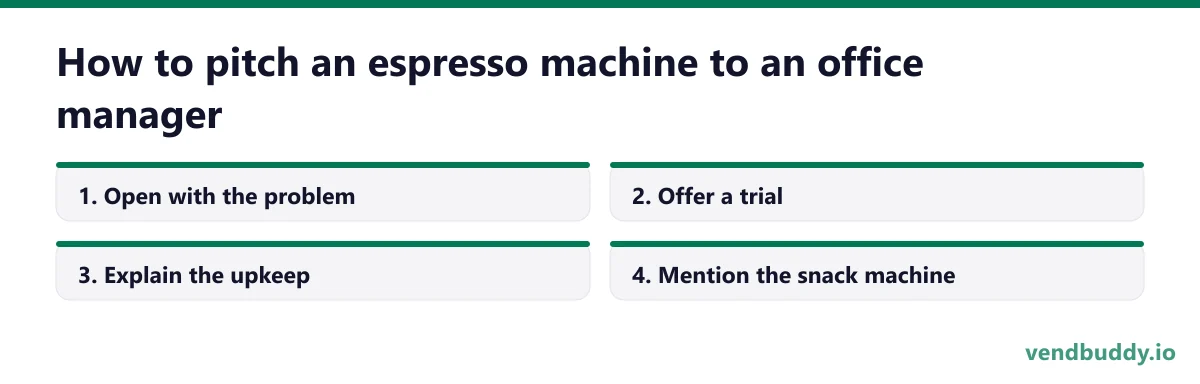
Keep the pitch short and about their people:
- Open with the problem. Ask what staff say about the current coffee and how often people leave the building to buy it.
- Offer a trial. Thirty to sixty days, no cost to the company, removed if it does not work. That lowers the risk of saying yes.
- Explain the upkeep. Who cleans it, how often you restock beans and milk, and who to call if it jams. Managers worry about being stuck with a broken machine.
- Mention the snack machine. If you place both, the coffee brings people to the machine area every morning, which helps the whole setup.
If the company would rather pay for free coffee as a perk, switch to an office coffee service quote instead of walking away.
Vending machine or office coffee service?
There are two ways to sell coffee into a US office. You can place a coin- or card-operated machine and keep the sales, or you can run an office coffee service where the employer pays you to keep a free machine stocked. Europe does both; EVA's report covers vending and office coffee service together, and in the Netherlands office coffee is so big that it recorded 5.66 billion vends on its own.
For a US operator, the paid machine fits large or public-facing sites like hospitals and lounges. Office coffee service fits companies that want free coffee as a perk. Our guide to the office coffee service model walks through how that contract works.
Most first agreements are two pages, not twenty. The contracts walkthrough lays out the clauses that actually matter for the contract, including the termination language operators forget about until they need it.
Bean-to-cup, instant or pod: what to place
Bean-to-cup machines grind fresh beans for each cup. They make the best espresso drinks and justify the highest price per cup, but they cost the most up front and need regular cleaning and milk handling if they offer milk drinks.
Instant or soluble machines mix powders with hot water. They are cheaper and simpler but the cup is weaker, and in a market where specialty coffee drinkers now outnumber traditional ones, a weak cup is a hard sell.
Table-top units are the European small-office answer: a compact bean-to-cup machine on a counter, paired with a card reader.
Prices, refurbished options and cost per cup are covered in our coffee vending machine cost guide, so we will not repeat them here.
What to copy from Europe, and what to skip
- Copy: coffee as the anchor product in workplaces. A good cup brings people to the machine area every day, and they often buy a snack too.
- Copy: card readers on every coffee machine. Cantaloupe found US cashless vending tickets averaged $2.45 against $1.57 for cash, and coffee prices sit above the average vending sale.
- Copy: the small-office table-top model for workplaces under 50 people.
- Skip: the tiny espresso shot as your main product. US buyers want larger cups, iced drinks and milk drinks. Thailand's Tao Bin, which offers about 200 drink options, shows how far menus have moved from the classic espresso.
- Skip: placing coffee next to a strong free coffee service. You will lose.
A simple test plan
- Find one building with 75 or more people, no cafe nearby and weak free coffee.
- Place a bean-to-cup machine with a card reader and a short menu: espresso, americano, latte, an iced option.
- Track cups per day and the effect on your snack machine sales in the same room for 60 days.
- If it carries its cost, add the same pitch to every similar building on your list.
Europe shows that coffee at work is a daily habit a machine can own. The US has the coffee drinkers; it is short on good machines in the right buildings. VendBuddy finds offices, hospitals and service businesses in any ZIP code with the best contact on file, so you can line up a coffee test site this week. For the wider view across countries, see vending machines around the world.
Frequently Asked Questions
Why are espresso vending machines so common in Europe?
Europe built vending around the workplace coffee break. Hot drinks sit on 68% of European vending machines and about 70% of machines are in workplaces. Italy alone has 809,000 machines, and its vending sector sells 10.5 billion products a year.
Is an espresso vending machine a good business in the US?
It can be at the right site: 75 or more people on site for hours, no cafe nearby and no strong free coffee. Hospitals, larger offices, dealership service lounges and hotels without a cafe are the usual fits. Placed next to a good free coffee service, it usually struggles.
What is the difference between bean-to-cup and instant coffee vending machines?
Bean-to-cup machines grind fresh beans for every cup and make real espresso drinks, so they cost more and need more cleaning but command higher prices. Instant machines mix powders with hot water, cost less and are simpler, but the cup is weaker.
How much does an espresso vending machine cost?
It depends on new versus refurbished, bean-to-cup versus instant, and whether it handles fresh milk. Our coffee vending machine cost guide breaks down current prices and cost per cup.
What is selling, which buildings say yes, and the numbers before you buy a machine. Free, confirm from your inbox, unsubscribe in one click. Refer one friend and get 25 VendBuddy credits.
General information, not legal, tax or financial advice. Rules change, so check the official source. Revenue and income figures are examples, not promises. See our terms.