- Under about 20 machines: no. Property managers do not search the web for vending vendors. The ones who do already have a vendor and are not looking.
- Locations come from three channels — walking in, a filtered list of decision-makers, and referrals from managers you already serve. A website is not one of them.
- The instinct is right; the tool is wrong. What you actually want is to look credible in a lobby. That is an insurance certificate, a signable agreement, and a one-page PDF.
- The one piece of online presence worth 20 minutes: a free Google Business Profile, which puts you in the map results a facilities manager with a dead machine actually searches.
- Build the site at machine three to five, when you have photos of your own installs and a service list. Before that you are making a brochure for an audience of nobody.
You have decided to do this. Somewhere in the first week, usually late at night, the thought arrives fully formed: I should probably get a website. It feels like the responsible next step. It feels like the thing that turns a person with a machine into a business.
Part of our complete guide: how to start a vending machine business.
That instinct is completely reasonable and I want to defend it for a second before taking it apart. You are about to walk into a building and ask a stranger to let you install a large appliance in their lobby, and you are aware that you have nothing behind you — no logo, no reviews, no proof. Wanting something to point at is not vanity. It is a sensible response to feeling like the least established person in the room.
Here is the problem: the website does not solve that. It solves a different problem, one you do not have yet, and it costs you the weekend you were going to spend doing the thing that actually lands locations. This page is about what actually lands them.
The honest answer: no, not yet
For a route under roughly 20 machines, a website will land approximately zero placements in your first year. Not few. Zero, in the majority of cases.
The reason is structural rather than a matter of how good the site is. Vending placements are decided by a person inside a building — an office manager, a facilities lead, a gym owner, a plant supervisor — and that person is not searching for a vending vendor. Buildings that already have a machine are not shopping. Buildings that do not have one are not aware they want one until somebody stands in front of them and points out that the nearest snack is a ten-minute drive. The demand is latent, and latent demand does not type things into Google.
Compare that to a business where a website earns its keep. A plumber gets found at the moment of need, because a burst pipe generates a search. Nobody has ever had a vending emergency.
The exception, which is real and worth naming: a facilities manager staring at a dead machine sometimes does search — something like “vending machine services near me”. That is a genuine, if thin, stream of inbound, and it is exactly the stream a free Google Business Profile captures. Twenty minutes, no hosting bill, no weekend. We will come back to it.
Nobody has ever had a vending emergency. That is the whole reason a website does not land you locations - the demand is latent, and latent demand does not search.
What actually lands locations, in order of what works
Three channels do essentially all of the work at this size. None involves a homepage.
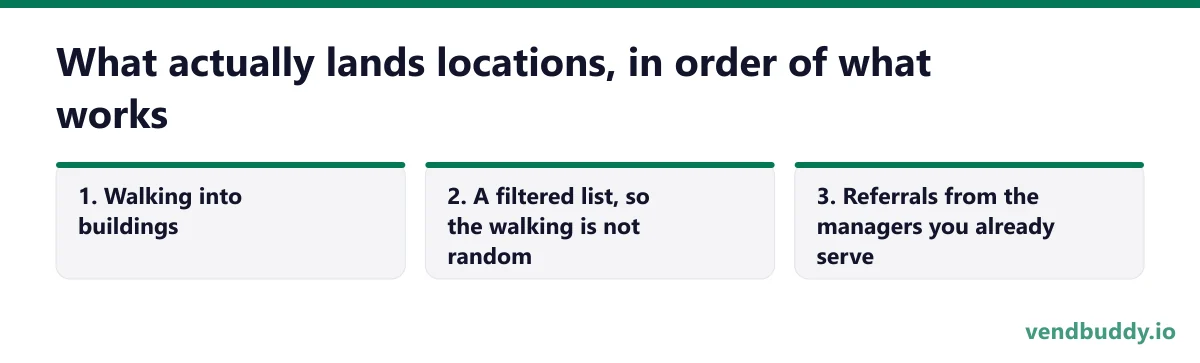
1. Walking into buildings
Highest close rate, worst hourly rate, and non-negotiable for your first two or three machines. You are converting a stranger’s mild indifference into a yes, and there is no digital substitute for standing in a lobby being obviously a normal, reliable human being. The exact words to use are in the cold pitch script that works, including the twelve objections that come back.
What makes this land is not credentials. It is specificity: you noticed the break room, you counted the cars, you know the nearest alternative is a drive. That is a level of attention a website cannot express and a stranger cannot fake.
2. A filtered list, so the walking is not random
The difference between an operator who lands a location in three weeks and one who is still looking in month four is almost never charisma. It is that one of them walked into 40 buildings sorted by headcount, category and whether anyone already serves them, and the other one drove around.
Filtering by employee count, business type and location before you leave the house turns a demoralising day into a productive one. The full location playbook covers the qualification criteria, and the headcount thresholds tell you which buildings to skip entirely.
3. Referrals from the managers you already serve
This is the one nobody plans for and it becomes the dominant channel around machine five. Property managers frequently manage more than one building, and they talk to other property managers. Being conspicuously reliable at your first location — showing up, restocking before it is empty, answering the phone — is worth more than any marketing spend available to you.
It is also the reason the dark-machine play compounds: fixing a visible annoyance in somebody’s lobby is the strongest possible opening for “what else do you manage?”
The supporting cast
Cold email and phone work, at a lower close rate but a much better hourly rate than driving — the scripts are here. Local Facebook groups and community boards occasionally produce a lead. And the free Google Business Profile catches the thin inbound stream mentioned above. That is the whole list, and a website is not on it.
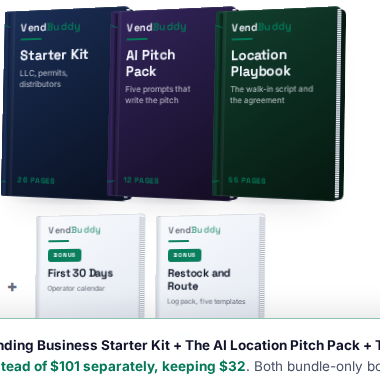
If you get to the end of this and the answer is yes, the kits are the shortcut past the blank page: a 26-page starter kit for the paperwork, a 55-page Location Playbook for the walk-in script and the agreement, and a 12-page AI Pitch Pack. Bought once, from $27, and you keep the files.
Look inside the kits →Picture the machines paying you while you sleep
That’s the real promise of vending — income that doesn’t cost you your time, and a life on your own terms. VendBuddy turns this guide into a step-by-step plan so you actually build it instead of just reading about it. Start free today.
Start building free →What you actually wanted when you wanted a website
Go back to the instinct. You wanted to look like a real business to a person who is about to decide whether to trust you. Correct goal. Here is what actually moves that needle, in the order a property manager checks it:
- A certificate of insurance. General liability at $1M per occurrence and $2M aggregate, with a free additional-insured endorsement naming their property. This is the single document that separates you from a hobbyist in a facilities manager’s mind, and most commercial properties will not sign without it. Roughly $400–$700 a year for a solo operator. What it covers and who writes it.
- A placement agreement they can actually read. Two pages, plain English, with the commission structure, the service commitment, the term and the exit. Handing one over unprompted signals competence more loudly than any homepage. What belongs in it.
- A one-page PDF you can send the same afternoon. Who you are, a phone number, what the machine looks like, the insurance line, the commission offer, agreement attached. This is the document that closes deals, because nobody who met you in a lobby is going home to browse your website.
- An LLC and a business bank account. Cheap, fast, and it means the cheque has a business name on it. The setup and the deductions.
- A phone number you answer. Genuinely. The most common complaint property managers have about vending vendors is that they stopped answering, which is why the bar here is lower than you think and clearing it is worth more than anything you could build.
Total cost of that list: an afternoon and a few hundred dollars, most of it the insurance you needed anyway. Total cost of the website: a weekend, a monthly bill, and the opportunity cost of the forty buildings you did not walk into.
When you should build one
Around machine three to five. The trigger is not a revenue number, it is having something a site can actually do:
- Photographs of your own installed machines in real buildings, which is the only content on a vending website that does any persuading.
- A list of the kinds of buildings you serve, so a manager can see themselves in it.
- Enough volume that a few inbound enquiries a month are worth catching.
At that point it takes an evening, it costs almost nothing, and it does a real job: it is where you send a manager who asked for something after the conversation, and it is what a referral clicks before they call you.
When you get there, let AI do the building. An AI site builder drafts the whole thing from a description of your route, and you spend the evening swapping in your own photos. Wix is the mature option with bookings, forms and SEO settings built in. Base44 builds working tools as well as pages, like a request-a-machine form. The walkthrough is in how to build a vending business website with an AI builder, the trade-offs are in Wix vs Base44, and once it is live, our vending website SEO guide covers what we learned about getting a small site found. Affiliate links: VendBuddy may earn a commission at no extra cost to you.
The one case that flips entirely: if you are running a specialty route rather than snacks and drinks — PPE, electronics, farm produce, collectible cards, anything a consumer might search for by name — then real search demand exists and a page should exist early. That is a different business with a different customer, and the alternative machine businesses page covers which ones behave that way.
The thing a website cannot do is tell you which forty buildings to walk into. VendBuddy scores real venues near you by traffic, headcount and category, and hands you the best contact on file for each one. Start free with 5 credits — no card required.
The bottom line
The website instinct is a symptom of a real and correct worry: that you have nothing behind you when you walk into that lobby. The fix is not a homepage. It is an insurance certificate, a signable agreement, a PDF you can send that afternoon, and a phone you answer — and then forty pre-qualified buildings and a free morning.
Build the site at machine three, when it takes an evening and you have real photos to put on it. Until then, every hour spent on it is an hour not spent on the only thing that decides your first year, which is how many buildings have met you.
If you are still upstream of all this — working out whether to start at all rather than how to market it — the income reality calculator shows what a route of a given size actually pays, and is the vending machine business right for you is the honest version of the question.
Related reading: how to find vending machine locations, the cold pitch script that works, vending machine contracts 101, the insurance coverage property managers check, how long it takes to get a first location, and the goldmine hiding in broken vending machines.
Frequently Asked Questions
Do vending machine businesses need a website?
For a route under about 20 machines, no. Locations are won by walking into buildings and by working a list of decision-makers, and property managers essentially never search the web for a vending vendor - the ones who do already have one. A website costs you a weekend and $15 a month and lands roughly zero placements in year one. What it does do is give you somewhere to send a manager who asked for something after the conversation, which is a real but small job that a one-page site or even a PDF can do. Build it after machine three, when it is a five-minute task and you have photos of your own machines to put on it.
How do vending operators actually find locations?
Three channels do almost all of it. Walking into buildings in person, which has the highest close rate and the worst hourly rate. Working a filtered list of local businesses by headcount and category so the walk-ins are pre-qualified instead of random. And referrals from property managers you already serve, which becomes the dominant channel around machine five and is the reason over-servicing your first location matters more than any marketing. Cold email and phone work as a supporting channel. A website is not on the list at this size.
Will a website make my vending business look more legitimate to property managers?
Less than you think, and not in the way you are imagining. What a property manager actually checks is a certificate of insurance naming their property as additional insured, a placement agreement they can read, and whether you answer the phone. A tidy one-page site helps at the margin, and an obviously thin one built from a template can hurt - it reads as a hobbyist. If legitimacy is the goal, spend the money on the insurance certificate and a clean agreement, not on a homepage.
When should a vending business build a website?
Around machine three to five, or earlier if you are selling something other than snacks. The trigger is having something a site can actually do: real photos of your own installed machines, a list of buildings you serve, and enough volume that inbound enquiries are worth catching. Before that you are building a brochure for an audience of nobody. A route selling specialty product - PPE, electronics, farm goods, anything a consumer might search for by name - flips this and should have a page early, because there the search demand genuinely exists.
Does a Google Business Profile help a vending machine business?
More than a website does, and it is free. A Google Business Profile puts you in the map results for "vending machine services near me" - the search a facilities manager with an existing dead machine actually makes - and it takes about twenty minutes to set up. If you want exactly one piece of online presence in your first year, this is the one worth having, followed by a single page listing your service area and a phone number. That is the entire honest version of a vending website in year one.
What do I send a property manager who asks for more information?
A one-page PDF, not a URL. Your name and phone number, what you place and what it looks like, that you carry general liability at $1M per occurrence and will name them as additional insured, the commission or flat-fee structure you are offering, and the placement agreement attached. That document closes deals. A homepage does not, because nobody who just met you in a lobby is going to go home and browse your website. Attach it to the follow-up email you send the same afternoon.
If you would rather not draft the placement agreement from scratch, we keep a plain-English walkthrough at get vending machine contracts. It covers term, commission, exclusivity and how either side gets out.
What is selling, which buildings say yes, and the numbers before you buy a machine. Free, confirm from your inbox, unsubscribe in one click. Refer one friend and get 25 VendBuddy credits.
General information, not legal, tax or financial advice. Rules change, so check the official source. Revenue and income figures are examples, not promises. See our terms.