- A wall mounted vending machine is a slim, cashless touchscreen unit that hangs on or sits in a wall, so it fits places with no floor space to spare.
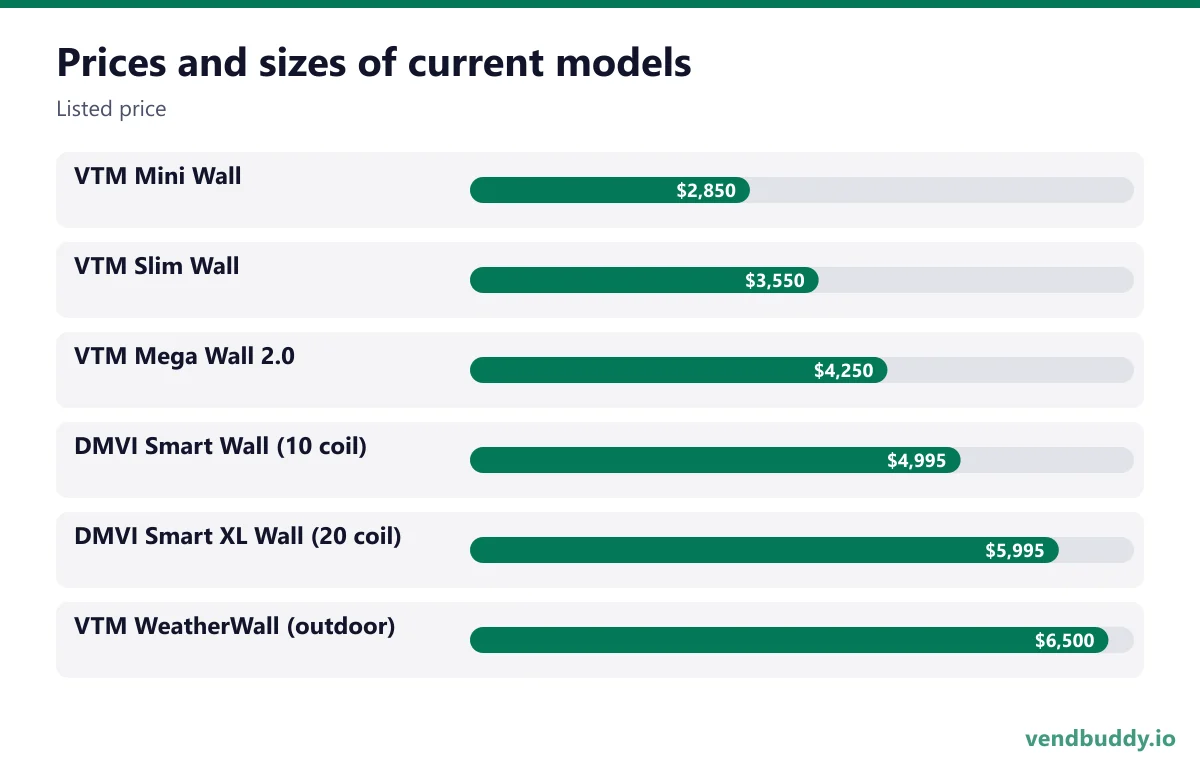
- Listed prices for current models run from about $2,850 for a small 72-item unit to $6,500 for an outdoor-rated one; a 20-selection in-wall model lists at $5,995.
- Depth is the selling point: 9 to 17 inches, against 30 to 39 inches for a full-size machine. Weight is 80 to 100 pounds, not 600 to 900.
- They suit small, high-value products: phone accessories, trading cards, beauty and travel items, and age-verified products where legal. They're the wrong tool for high-volume snacks and cold drinks.
- Mounting needs a solid wall, power and the property's sign-off, so get approval in writing before you order.
A wall mounted vending machine solves one problem: the location wants a machine but has no floor to give you. It hangs on the wall or sits recessed into it, takes card and phone payments on a touchscreen, and sells small items that don't need a three-foot-deep cabinet. If you've walked into a gym, bar or hotel and heard "we just don't have the space," this is the machine that turns that no into a yes.
Part of our complete guide: how to find vending machine locations.
Below: what current models cost, how big they are, what they hold, which products actually make money in them, and the mounting questions to settle before you buy one.
What a wall mount machine is, and isn't
Think of it as a smart vending machine squeezed into a shallow box. The ones on the market now share a few traits: a large touchscreen instead of buttons, cashless payment only, coil trays for small packaged goods, and a cellular or Wi-Fi connection so you can see sales from your phone. Some can be recessed so the front sits nearly flush with the wall, and some can also sit on a pedestal stand if the wall won't take the load.
What they aren't is a replacement for a snack or soda machine. One maker says it plainly on its product page: wall units are strongest when products are compact and the purchase is quick, and a floor-standing machine is usually better for high-volume snack, drink or refrigerated programs (DMVI).
Prices and sizes of current models
| Model | Listed price | Size (W x H x D) | Capacity |
|---|---|---|---|
| VTM Mini Wall | $2,850 | 21.6 x 33.3 x 8.7 in | 8 aisles, 72 units |
| VTM Slim Wall | $3,550 | 23.6 x 40.5 x 10.2 in | 10 aisles, 100 units |
| VTM Mega Wall 2.0 | $4,250 | 23.6 x 40.5 x 14 in | 15 aisles, 105 units |
| DMVI Smart Wall (10 coil) | $4,995 | 25.6 x 45 x 9 in | 10 selections, up to 200 items |
| DMVI Smart XL Wall (20 coil) | $5,995 | 25.6 x 45 x 12 in | 20 selections, up to 400 items |
| VTM WeatherWall (outdoor) | $6,500 | 24.4 x 49.2 x 16.9 in | 12 aisles, 120 units |
Sources: VTM Vending and DMVI product pages, prices as listed in 2026. Capacity depends on coil setup and package size, so treat it as a ceiling.
Compare that with a full-size machine. A standard snack machine is around 35 inches deep and 600 to 900 pounds (see our vending machine dimensions guide). DMVI lists its wall units at 80 and 100 pounds, drawing about 80 watts. That difference is why a manager who refused a floor machine will often say yes to one of these.
Picture the machines paying you while you sleep
That’s the real promise of vending — income that doesn’t cost you your time, and a life on your own terms. VendBuddy turns this guide into a step-by-step plan so you actually build it instead of just reading about it. Start free today.
Start building free →What sells in a wall machine
The math of a wall unit is simple: you have 72 to 400 slots, so each slot has to earn. A 75-cent bag of chips in a slot that holds 15 of them doesn't move the needle. Products that work share three traits: small, standard packaging, and a price high enough that a full refill is worth real money.
- Trading cards. Booster packs in top-loader cases fit coil trays, and card units ship with coils sized for them. Our Pokémon card vending guide covers sourcing and margins.
- Phone accessories. Chargers, cables and earbuds in hotels, airports-adjacent spots and bars.
- Beauty, wellness and travel items. Salons, gyms, hotel corridors.
- Age-restricted products where legal. Vape and nicotine units add ID scanning. Rules vary by state and city, so read our nicotine and vape vending guide before you consider it.
DMVI's own revenue calculator illustrates the point with a 200-item refill at a $10 average price, which comes to $2,000 of gross sales per full machine. That's a gross figure before product cost, commission and fees, and it only matters if the machine actually sells through, but it shows why wall units lean toward higher-priced items.
Where wall units win
The best spots have steady traffic and a reason floor space is precious:
- Bars and nightlife, behind or beside the bar
- Gym locker rooms and lobbies
- Hotel corridors and small lobbies
- Apartment mailrooms and amenity spaces
- Salons, barbershops and card or hobby shops
- Office break rooms that already have a full snack machine but want more variety
Outdoor placements need an outdoor-rated cabinet. VTM's WeatherWall is the example above, at $6,500, nearly double the indoor version.
Mounting: settle this before you order
A wall machine is easier to place than a floor machine, but it's also more permanent. Before ordering:
- Get written approval to drill. Landlords and franchise brands often have rules about wall penetrations.
- Check what's behind the drywall. The maker's bracket needs studs, block or a backing plate. DMVI notes its units need appropriate wall structure and contractor or facility approval.
- Find the outlet. A cord running down a wall looks bad and gets yanked. Ask whether an outlet can sit behind the unit.
- Check the signal. These are cashless only. Corridors and basements can kill Wi-Fi; cellular units help.
- Leave room to open the door. You'll restock from the front, so plan for the door swing and your own body in a narrow hallway.
Pricing products in a wall unit
Because a wall unit holds far fewer items than a floor machine, each sale has to carry more of the machine's cost. A practical way to set prices: look up what the same item costs in the nearest store, then charge a fair convenience premium for having it right there at 11 p.m. A phone charger that's $15 at a pharmacy can sell for a bit more in a hotel corridor where the pharmacy is closed. Keep prices in round numbers so the touchscreen reads cleanly, and check sales weekly for the first month. Slots that don't move should be swapped quickly, since in a 72-slot machine every dead row is a real share of your capacity.
Restocking is quicker than on a floor machine, which is part of the appeal. With fewer slots and lighter products, a full refill often fits in one bag, so a wall unit slots easily into a route you already run.
Is a wall machine a good first machine?
It can be, if you already have the right location: a busy spot with no floor space and an audience for a higher-priced product. It's a weaker choice if you're starting from nothing and want broad snack and drink sales, where a used combo or soda machine usually earns more per dollar spent. Our smart vs traditional vending machines comparison walks through that trade-off.
Most operators who start small start with one yes from one manager. If you're still looking for that first location, VendBuddy shows you which businesses near you are worth the walk-in.
Frequently Asked Questions
How much does a wall mounted vending machine cost?
Listed prices for current models run from about $2,850 (VTM Mini Wall, 72 items) to $6,500 (an outdoor-rated unit). DMVI lists a 10-selection in-wall model at $4,995 and a 20-selection XL at $5,995.
How deep is a wall vending machine?
About 9 to 17 inches, depending on the model, compared with 30 to 39 inches for a full-size floor machine. They weigh roughly 80 to 100 pounds.
What should I sell in a wall mounted vending machine?
Small, standard-size products with a higher price: trading cards, phone accessories, beauty and travel items, and age-verified products where legal. Low-priced snacks and cold drinks are usually better in a floor machine.
Can a wall mounted vending machine go outside?
Only an outdoor-rated model. Indoor units aren't sealed against rain and heat. VTM's WeatherWall is one outdoor example, listed at $6,500.
Do wall vending machines take cash?
Most current models are cashless only: cards, tap-to-pay and phone wallets. That keeps the cabinet slim and means you need a reliable cellular or Wi-Fi signal at the spot.
What is selling, which buildings say yes, and the numbers before you buy a machine. Free, confirm from your inbox, unsubscribe in one click. Refer one friend and get 25 VendBuddy credits.
General information, not legal, tax or financial advice. Rules change, so check the official source. Revenue and income figures are examples, not promises. See our terms.