- Virginia vending machine dealers pay sales tax on the cost price of merchandise, not on sales: 7% in Hampton Roads, Northern Virginia and Central Virginia, 6.3% elsewhere (Va. Code 58.1-614, Virginia Tax).
- A machine selling $1,000 a month with $450 of product cost owes about $28.35 (6.3%) or $31.50 (7%); vending food does not get the reduced 1% grocery rate, and localities may not charge meals tax on vending sales.
- You need a certificate of registration for every county or city with machines, plus a local BPOL license where you base the business; BPOL gross-receipts tax is barred under $100,000 in localities over 50,000 people.
- Only machines holding TCS (perishable) food need a VDH food permit; prepackaged shelf-stable snacks are exempt, but TCS machines must have an automatic shutoff.
- Virginia bans tobacco, vapes and nicotine products from vending machines entirely, and the 2026 minimum wage is $12.77 an hour, rising to $13.75 on January 1, 2027.
Virginia vending machine laws come down to five things: a sales tax paid on what you buy rather than what you sell, a local BPOL license in the county or city where you base the business, a VDH food permit only if a machine holds perishable food, a flat ban on tobacco and nicotine vending, and a $12.77 minimum wage for anyone you hire in 2026. This guide works through each one with the statute or agency page behind it, plus a worked tax example for a machine doing $1,000 a month.
- How does Virginia sales tax work for vending machines?
- What does Virginia vending tax cost on a $1,000-a-month machine?
- What registration and local license does a Virginia vending business need?
- When does a Virginia vending machine need a health permit?
- Can you sell tobacco, vapes or nicotine pouches from a vending machine in Virginia?
- What must a Virginia vending operator pay a route driver in 2026?
- First 30 days in Virginia: a state-specific checklist
- Frequently Asked Questions
Part of our complete guide: how to start a vending machine business.
How does Virginia sales tax work for vending machines?
Virginia is one of the few states that taxes vending on the input side. Under Va. Code § 58.1-614, a dealer selling through vending machines reports his wholesale purchases of the goods that go into the machines and remits tax on that figure. The state portion is 5.3 percent of purchases (6.0 percent in localities that levy the regional transportation taxes), and subsection B adds the 1 percent local tax computed on the same base.
Virginia Tax states the combined result plainly: 7 percent of cost price in the Hampton Roads, Northern Virginia and Central Virginia regions, and 6.3 percent everywhere else. “Cost price” is what you paid for the merchandise you load; if you make the product yourself, it is your manufacturing cost (raw materials, labor, overhead). The same page says the Vending Machine Dealers Return must be filed electronically, monthly or quarterly depending on your liability.
Three consequences operators often miss:
- Your shelf price does not change the tax. Raising a soda from $2.00 to $2.50 raises revenue, not tax, because the base is the case cost.
- Shrink is still taxed. Product that expires, gets stolen or jams was still a wholesale purchase for the machines, so it stays in the base.
- Buy inventory tax-free for resale. The Virginia Tax regulation on vending dealers (23VAC10-210-6041) lets you give suppliers a resale exemption certificate (Form ST-10) for merchandise, while the machines themselves and repair parts are taxable purchases. Skip the certificate and you pay sales tax at the warehouse club and again on the VM-2. The same regulation requires records of every machine location and your purchases and inventories, kept for three years.
What does Virginia vending tax cost on a $1,000-a-month machine?
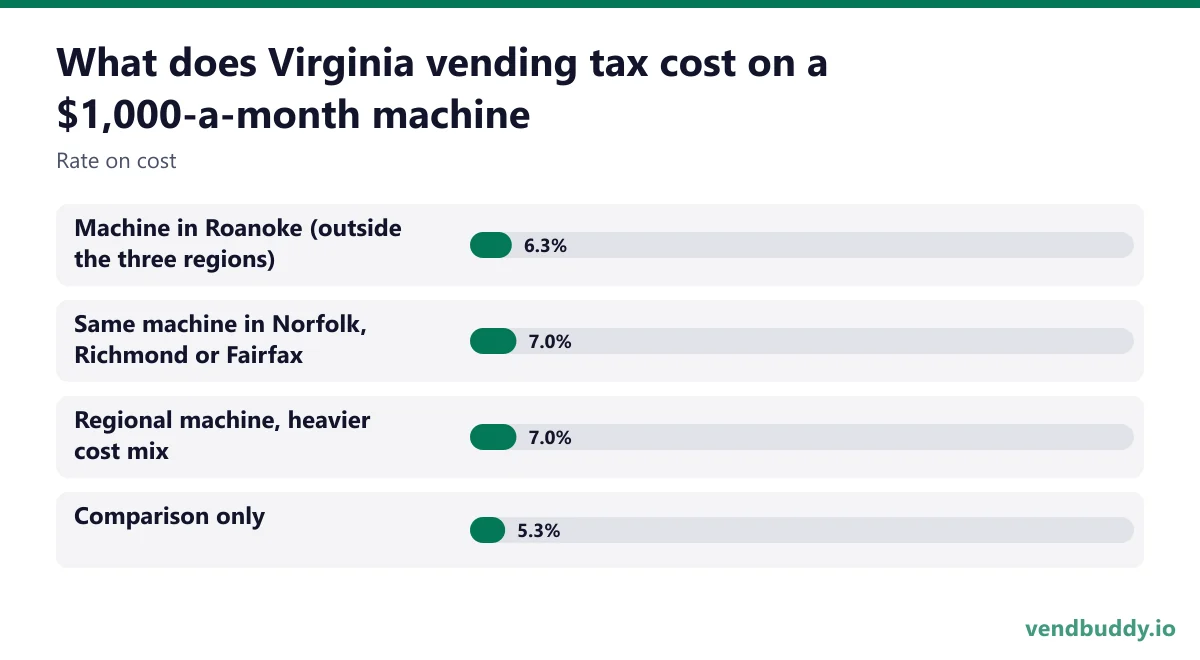
Here is the Virginia cost-price method applied to one machine. The product cost is illustrative (a 45 percent cost of goods on $1,000 of sales); plug in your own invoices. The last row shows, for comparison only, what the ordinary 5.3 percent retail rate would take out of tax-included gross sales, which is not how Virginia taxes vending dealers.
| Scenario (illustrative) | Monthly sales | Product cost | Rate on cost | Tax due |
|---|---|---|---|---|
| Machine in Roanoke (outside the three regions) | $1,000 | $450 | 6.3% | $28.35 |
| Same machine in Norfolk, Richmond or Fairfax | $1,000 | $450 | 7.0% | $31.50 |
| Regional machine, heavier cost mix (55% cost of goods) | $1,000 | $550 | 7.0% | $38.50 |
| Comparison only: 5.3% backed out of $1,000 tax-included sales | $1,000 | n/a | 5.3% of sales | $50.33 |
The practical read: in Virginia, the tax on a snack machine usually lands around 3 percent of gross, and the lever that moves it is your buying, not your pricing. Food does not get a discount here. Virginia’s reduced 1 percent rate on groceries does not apply to vending, because Virginia Tax lists vending machine vendors among sellers presumed to sell food for immediate consumption. Local meals taxes are the other way around: Va. Code § 58.1-3840 bars localities from imposing a meals tax on food and beverages sold through vending machines. If a city official asks you to collect meals tax on machine sales, point to that clause. One caution: some localities add other local sales taxes to ordinary retail, and the Virginia Tax vending page lists only the 6.3 and 7 percent figures. If a machine sits in a locality with an extra levy, confirm the vending rate with Virginia Tax before you file.
Picture the machines paying you while you sleep
That’s the real promise of vending — income that doesn’t cost you your time, and a life on your own terms. VendBuddy turns this guide into a step-by-step plan so you actually build it instead of just reading about it. Start free today.
Start building free →What registration and local license does a Virginia vending business need?
At the state level you register with Virginia Tax as a vending machine dealer, not as an ordinary retailer. Subsection E of § 58.1-614 requires a certificate of registration for each county or city where you have machines, so a route that crosses from Henrico into Richmond city needs both on file, and the VM-2 return breaks your purchases out by locality. Add a locality to your account before the first machine goes in there, not when the return is due.
Locally, Virginia’s version of a business license is the BPOL (Business, Professional and Occupational License) tax, levied by counties, cities and towns. The state caps it. Under Va. Code § 58.1-3706, no gross-receipts license tax may be charged on businesses under $100,000 in receipts in a locality over 50,000 people (or under $50,000 in a locality of 25,000 to 50,000), and the retail rate may not exceed 20 cents per $100 of receipts; smaller businesses can still owe the flat license fee allowed by § 58.1-3703. Fairfax County is a good example of how that looks in practice: no fee at $10,000 or less, $30 from $10,001 to $50,000, $50 from $50,001 to $100,000, a retail rate of $0.17 per $100 above that, filing due March 1, and new businesses expected to register within 75 days.
Where you owe BPOL depends on where you have a definite place of business, which for most small operators is the home office or storage unit. Machines placed in a neighboring city do not automatically create a second BPOL account, but localities read this differently, so call the commissioner of the revenue in each place you operate and get the answer in writing. Entity formation (an LLC through the State Corporation Commission) is optional; our guide on whether a vending business needs an LLC covers that decision.
When does a Virginia vending machine need a health permit?
The Virginia Department of Health regulates food service under 12VAC5-421, and its definitions count a “vending location” as a food establishment and define a vending machine as any self-service device paid by coin, bill, card, key or electronic transaction. The line that matters for most operators is on VDH’s own food safety exemptions page: an operation offering only prepackaged foods that do not need time/temperature control for safety (TCS) is exempt from the VDH food permit. Chips, candy, pastries in sealed wrappers and canned or bottled drinks generally fall there.
Load sandwiches, salads, yogurt, milk or anything else that must be held cold or hot and you are in permit territory. Contact the environmental health office of the local VDH health district before you stock. The equipment rules become concrete at that point:
- Automatic shutoff. 12VAC5-421-1310 requires a machine vending TCS food to stop vending after a power or mechanical failure until it is serviced and restocked. After a fill, a refrigerated machine may not sit above 41°F for more than 30 minutes, and a hot machine may not drop below 135°F for more than 120 minutes.
- Self-closing doors. Even a plain snack machine needs a self-closing door or cover on the dispensing compartment if it sits outdoors without shelter or runs unsupervised, under 12VAC5-421-1240. Most modern cabinets already have one; older used machines are worth checking.
A micro market or smart cooler carrying fresh food is the case where Virginia operators most often need to ask first. If the host site is a grocery or convenience store under the Virginia Department of Agriculture and Consumer Services, the food authority may be VDACS instead of VDH. For the operating trade-offs of those formats, see micro markets vs vending machines.
Can you sell tobacco, vapes or nicotine pouches from a vending machine in Virginia?
No. Virginia bans the product category from machines outright. Va. Code § 18.2-371.2 says no person shall sell retail tobacco products or hemp products intended for smoking from a vending machine, and its definition of retail tobacco product reaches anything containing nicotine, electronic smoking devices and their liquids, and accessories such as rolling papers and wraps. A revised version of the section taking effect October 1, 2026 keeps the vending ban. The civil penalty is $500 for a first violation and $2,500 for a repeat within three years.
Federal law would allow a narrow exception: 21 CFR 1140.16(c) permits cigarette and smokeless machines only in facilities where no one under 21 is present or allowed to enter at any time. That exception does not help in Virginia, because the state ban is stricter and applies even inside a 21-plus bar. Nicotine pouches and disposable vapes in a Virginia machine are a violation regardless of location.
What must a Virginia vending operator pay a route driver in 2026?
The Virginia Department of Labor and Industry set the state minimum wage at $12.77 an hour effective January 1, 2026, an inflation adjustment from $12.41. In April 2026 the governor signed HB 1 and SB 1, which raise the rate to $13.75 on January 1, 2027 and $15.00 on January 1, 2028. Build those steps into any route you plan to staff.
For a part-time restocker working 15 hours a week, $12.77 an hour is about $192 a week in base wages before payroll taxes, and the same schedule at $15.00 is $225. Drive time between stops counts as hours worked, which is why a spread-out route is a labor problem as much as a fuel problem. Workers’ comp is the other threshold: the Virginia Workers’ Compensation Commission requires coverage once you regularly employ more than two people, part-time included, and it has no waivers. A sole proprietor with no employees is not required to carry it. Timing the first hire is its own question, covered in when to hire your first vending route driver.
First 30 days in Virginia: a state-specific checklist
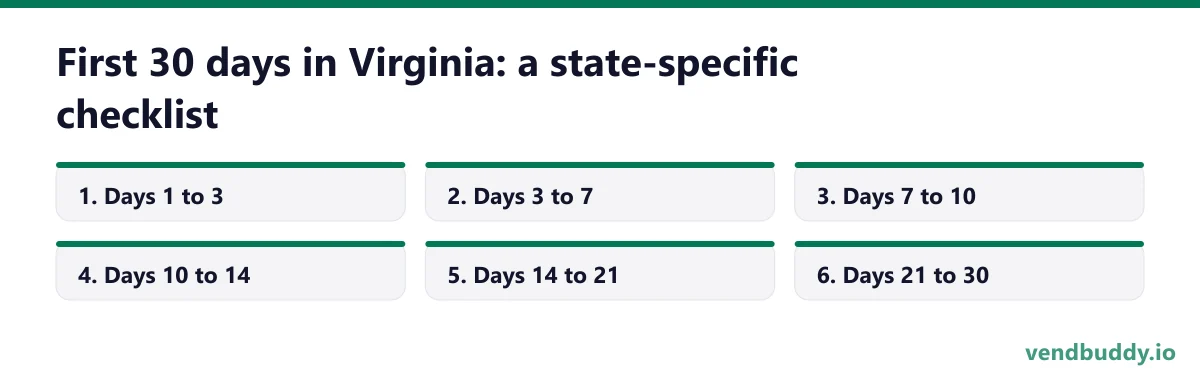
- Days 1 to 3: Register with Virginia Tax as a vending machine dealer (the VM-2 tax type, not a regular retail account) and list every county or city where a machine will go.
- Days 3 to 7: Send Form ST-10 resale certificates to each supplier, and set up a purchase log that tags every case to a locality, because that is how the VM-2 and its locality schedule are built.
- Days 7 to 10: Call the commissioner of the revenue where you keep inventory about BPOL; note the receipts threshold and the March 1 renewal date.
- Days 10 to 14: Decide your planogram. Sealed, shelf-stable only means no VDH permit; any cold fresh food means a call to the local health district first.
- Days 14 to 21: Pull every nicotine product off any used machine you bought, and check that outdoor or unattended machines have a self-closing dispensing door.
- Days 21 to 30: Price placements knowing tax follows cost, not price. If you plan a helper, budget $12.77 an hour now and $13.75 from January 2027. Use VendBuddy to pull properties and the best contact on file in the ZIPs you registered.
For city-by-city location guides across the state, start at our Virginia vending hub. For how Virginia compares with other states, see vending machine permits by state and the broader license and permit requirements guide.
Frequently Asked Questions
Do I need a license to put a vending machine in Virginia?
Virginia has no state vending operator license, but you do need two registrations. Virginia Tax must register you as a vending machine dealer, with a certificate for each county or city where machines are placed. Your home locality will also expect a BPOL license, although the gross-receipts tax does not apply below $100,000 of receipts in localities over 50,000 people. A food permit is only needed if a machine holds perishable food.
How much sales tax do vending machines pay in Virginia?
Vending machine dealers pay 7% of the cost price of their merchandise in the Hampton Roads, Northern Virginia and Central Virginia regions and 6.3% everywhere else. The tax is based on what you paid for the product, not on the price customers pay. On $450 of product cost, that is $28.35 or $31.50. Confirm the rate with Virginia Tax if a machine sits in a locality with an additional local levy.
If the spend is going on plastic anyway, the card choice is worth ten minutes. Most operators we talk to land on the Bilt card, not for what it pays on pallets but because the rent payment earns too. Referral link, and the honest caveat is that a carried balance beats what any of these points are worth. Affiliate link, so we may earn a commission at no extra cost to you.
Is food from a vending machine taxed at Virginia's reduced grocery rate?
No. Virginia Tax lists vending machine vendors among sellers presumed to sell food for immediate consumption, so the reduced 1% grocery rate does not apply. Vending dealers use the cost-price rates instead. On the other hand, Va. Code 58.1-3840 prevents localities from charging their meals tax on food and beverages sold through vending machines.
When is the Virginia VM-2 vending machine return due?
Virginia Tax assigns monthly or quarterly filing based on your liability, and the return is due on the 20th of the month after the period ends. It must be filed electronically, and a return is required even if you had no sales. The VM-2B schedule allocates your taxable cost price by locality, so keep purchase records tagged to each machine's county or city.
Can I sell vapes or nicotine pouches in a vending machine in Virginia?
No. Va. Code 18.2-371.2 prohibits selling retail tobacco products or smokable hemp products from a vending machine, and the definition covers anything containing nicotine, e-cigarettes and their liquids, and accessories like rolling papers. The ban applies even in adults-only venues, which makes it stricter than the federal rule. Penalties are $500 for a first violation and $2,500 for a repeat within three years.
What is selling, which buildings say yes, and the numbers before you buy a machine. Free, confirm from your inbox, unsubscribe in one click. Refer one friend and get 25 VendBuddy credits.
General information, not legal, tax or financial advice. Rules change, so check the official source. Revenue and income figures are examples, not promises. See our terms.