- Under 17 NCAC 07B .2901, items sold through a coin-operated vending machine in North Carolina are taxed on 50% of the sales price; tobacco, newspapers and sales from non-coin-operated machines are taxed on 100%.
- A machine grossing $1,000 a month in tax-included sales owes about $31.62 in Guilford, $33.80 in Wake and $38.11 in Mecklenburg, where the combined rate rose to 8.25% on July 1, 2026.
- Vending food is non-qualifying food, so it pays the general 4.75% state rate plus local tax, not the 2% grocery rate; Wake County exempts vending from its 1% prepared food tax.
- NCDOR registration is free, municipal privilege license taxes were repealed effective July 1, 2015, and state food-establishment rules do not cover vending machines.
- North Carolina's minimum wage is $7.25 an hour in 2026, and workers' comp is required once a business regularly employs three or more people.
North Carolina vending machine laws have one rule that changes your numbers more than any other: items sold through a coin-operated vending machine are taxed on only 50 percent of their sales price, except tobacco and newspapers. Around that sit a free state sales tax registration, no municipal privilege license since 2015, state health rules that do not cover vending machines themselves, a tobacco vending restriction, and a $7.25 minimum wage. Below is each rule with its source and a worked tax example.
Part of our complete guide: how to start a vending machine business.
How is vending machine sales tax calculated in North Carolina?
The controlling text is the Department of Revenue’s rule 17 NCAC 07B .2901. A person selling tangible personal property through a vending machine is a retailer and must register and remit tax. Tobacco products and newspapers sold that way are taxed on 100 percent of the sales price; other property sold through a coin-operated vending machine is taxed on 50 percent; and all items sold through a machine that is not coin-operated are taxed on 100 percent. The exemption itself sits in G.S. 105-164.13, and NCDOR’s 2026 Sales and Use Tax Bulletins (SUTB 83-2, reflecting law as of January 1, 2026) restate it as a 50 percent exemption for coin-operated vending.
Two details decide how much of that break you actually keep:
- Your prices already include tax. North Carolina does not require vending sales to show tax separately, so NCDOR lets operators back it out: take the taxable amount (50 or 100 percent of receipts), then divide by 100 percent plus the combined rate to get taxable sales for the return. SUTB 83-2 gives the example of dividing by 106.75 percent in a 6.75 percent county.
- Records protect the 50 percent. The rule says a retailer who cannot show which sales qualified for the 50 percent basis owes tax on 100 percent. Keep machine-level sales reports and separate any tobacco or non-coin-operated receipts.
An open question worth a written answer: the rule distinguishes coin-operated machines from machines that are “not coin-operated,” and neither the rule nor the bulletin says how a machine that takes both coins and cards is treated. With most sales now on card readers, ask NCDOR in writing how your specific machines are classified before your first return, and keep the reply.
On card readers specifically, Nayax is the default for a dull reason: it is the one most machine suppliers pre-wire for. Price the monthly against your slowest machine, not your best one. Affiliate link, so we may earn a commission at no extra cost to you.
What does North Carolina vending tax look like on $1,000 a month?
This table runs one machine grossing $1,000 a month in tax-included sales through the NCDOR method, using the county rates in effect from July 1, 2026. Note Mecklenburg: voters approved a 1 percent transit tax, and NCDOR confirmed the county rate rose from 7.25 to 8.25 percent on July 1, 2026. Older guides still show the lower figure.
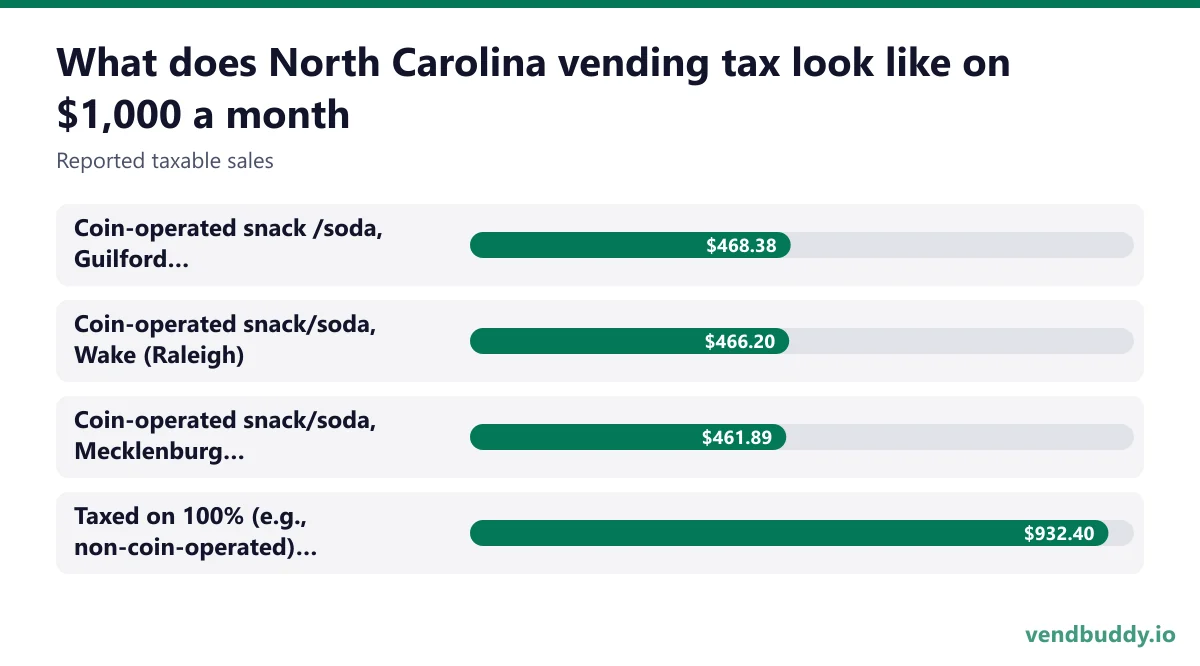
| Machine and county | Combined rate | Taxable amount | Reported taxable sales | Tax due |
|---|---|---|---|---|
| Coin-operated snack/soda, Guilford (Greensboro) | 6.75% | $500 (50%) | $468.38 | $31.62 |
| Coin-operated snack/soda, Wake (Raleigh) | 7.25% | $500 (50%) | $466.20 | $33.80 |
| Coin-operated snack/soda, Mecklenburg (Charlotte) | 8.25% | $500 (50%) | $461.89 | $38.11 |
| Taxed on 100% (e.g., non-coin-operated), Wake | 7.25% | $1,000 (100%) | $932.40 | $67.60 |
The spread between the rows is the whole story. On the 50 percent basis a $1,000 machine owes roughly $32 to $38 a month depending on county; lose the basis and the same machine owes about $68 in Wake. That is why the card-reader question above deserves a letter from NCDOR rather than a guess.
Picture the machines paying you while you sleep
That’s the real promise of vending — income that doesn’t cost you your time, and a life on your own terms. VendBuddy turns this guide into a step-by-step plan so you actually build it instead of just reading about it. Start free today.
Start building free →Do snacks and drinks get North Carolina’s 2 percent food rate in a vending machine?
No. North Carolina taxes most grocery food at a reduced 2 percent state rate with no local tax, but NCDOR classifies food sold through a vending machine as non-qualifying food, defined as food dispensed from a machine or other mechanical device that accepts payment. Non-qualifying food pays the general state rate of 4.75 percent plus local and transit rates. The same bag of pretzels is taxed differently on a grocery shelf than in your machine, but the 50 percent coin-operated basis offsets much of the difference.
County prepared food and beverage taxes are a separate layer that several North Carolina counties levy on restaurants. Wake County’s 1 percent tax is the clearest example for operators, because Wake County states that sales from vending machines are specifically exempt. Other counties write their own ordinances, so check the county tax office wherever you place machines rather than assuming the Wake answer carries over. Bags of ice sold through a coin-operated machine follow the same 50 percent rule, according to the 2026 bulletins.
Does a North Carolina vending business need a state or city license?
The only statewide requirement is the Certificate of Registration from NCDOR, and the 2026 bulletins state there is no fee to apply. NCDOR assigns your filing frequency from your tax: quarterly when liability is consistently under $100 a month (due the last day of the month after the quarter), monthly from $100 up to $20,000 (due the 20th). One machine from the table above owes well under $100 and would file quarterly; three of them together sit right at the monthly line. Inventory you buy for resale is exempt when you give the supplier Form E-595E, while vending machines you buy for your own use are taxable purchases under SUTB 83-1.
Cities and towns no longer sell general business licenses. The General Assembly repealed municipal privilege license taxes effective July 1, 2015, in Session Law 2014-3, as the UNC School of Government explained at the time. What remains local is zoning (relevant only if you store inventory somewhere a town regulates) and county property tax: North Carolina counties tax business personal property, and under G.S. 105-307 the listing period runs from the first business day of January through January 31, so your machines go on that listing. Forming an LLC through the Secretary of State is optional; see do you need an LLC for a vending machine business.
Who regulates food in North Carolina vending machines?
This is where North Carolina differs from most states. County environmental health departments enforce the state Food Code rules in 15A NCAC 18A .2600, but those rules were amended to delete the definitions of “vending machine” and “vending machine location” because, according to the state’s own fiscal note on the rule change, the Food Protection and Facilities Branch and the Commission for Public Health do not have statutory authority to regulate vending machines. A sealed snack and soda machine therefore does not need a county food permit.
That does not make fresh food a free-for-all. The NCDA&CS Food and Drug Protection Division inspects food manufacturers, wholesale food operations and retail food outlets, so it is the state agency to ask about packaged food you source or produce. Micro markets and fresh-food coolers are the gray zone, because an open-shelf market is not obviously a “vending machine” and a county may treat it as a food establishment. Before you stock anything that needs refrigeration, call the county environmental health office and NCDA&CS, ask which one has jurisdiction over your exact setup, and get the answer in writing. For the format decision itself, read micro markets vs vending machines.
What are North Carolina’s tobacco vending machine rules?
State law and federal law point different ways here, and the federal rule is the one that binds. G.S. 14-313(b1) says tobacco products shall not be distributed in vending machines, except in an establishment open only to people 18 and older, or where the machine is under the continuous control of the owner or an employee, must be activated before each purchase, and is not reachable when the business is closed. Violations are a Class 2 misdemeanor.
The federal floor is higher. 21 CFR 1140.16(c) allows cigarette and smokeless tobacco machines only in facilities where the retailer ensures no one under 21 is present or permitted to enter at any time, and the federal sale age is 21. An 18-plus venue that satisfies G.S. 14-313 can still fail the federal test. Remember too that tobacco sold through any machine is taxed on 100 percent of the price, so the 50 percent basis never applies to it. For a new operator the plain answer is to leave nicotine out of the planogram.
What is the North Carolina minimum wage for a vending route helper in 2026?
The North Carolina Department of Labor sets the state minimum at $7.25 an hour, the same as the federal rate, and no increase is scheduled for 2026. The legal floor is rarely the market rate for a reliable driver with a clean record, though, so budget from local job postings, not the statute. At $15 an hour, a 15-hour-a-week restocker costs $225 a week before payroll taxes; at the legal minimum it would be about $109. Time spent driving between machines during the shift is paid time.
Workers’ comp starts earlier than many owners expect. The North Carolina Industrial Commission says businesses regularly employing three or more employees must carry coverage, and corporate officers count toward the three. Two part-time helpers plus you as an officer of your own corporation can cross that line. When a first hire makes sense at all is covered in when to hire your first vending route driver.
First 30 days in North Carolina: a state-specific checklist
- Week 1: File the free NCDOR registration and email NCDOR asking how coin-and-card machines are classified under 17 NCAC 07B .2901. Save the reply with your tax records.
- Week 1: Look up the county rate for every planned placement on the NCDOR chart, and use 8.25 percent for Mecklenburg.
- Week 2: Give suppliers Form E-595E so inventory is bought tax-free, and set up machine-level sales reporting that splits 50 percent and 100 percent receipts.
- Week 2: Ask the county tax office whether a prepared food tax exists there and whether it exempts vending, as Wake’s does.
- Week 3: Keep the first planogram sealed and shelf-stable. If a host wants fresh food, get county environmental health and NCDA&CS answers first.
- Week 4: Drop tobacco and nicotine from any used machine you bought, add the machines to your January county property listing, and use VendBuddy to find properties and decision-maker contacts for your first placements.
City guides and local prospecting notes live on our North Carolina vending hub. For how the state compares nationally, see vending machine permits by state and the license and permit requirements overview.
Frequently Asked Questions
Do I need a license to operate vending machines in North Carolina?
North Carolina has no vending operator license. You need a Certificate of Registration from the Department of Revenue, which is free, and cities have not been able to levy privilege license taxes since July 1, 2015. Counties still tax business personal property, so list your machines during the January listing period. Fresh-food setups may need a local answer on health permits.
How is sales tax calculated on vending machine sales in North Carolina?
For coin-operated machines, only 50% of the sales price is taxable, except tobacco and newspapers, which are taxed on 100%. Because vending prices include tax, NCDOR lets you divide the taxable amount by 100% plus your combined rate to get reported taxable sales. On $1,000 of monthly sales in Wake County at 7.25%, that works out to $466.20 of taxable sales and $33.80 of tax. Keep records that prove which sales qualified, or the full 100% applies.
Does the 50% vending tax rule apply to machines with card readers?
The rule taxes coin-operated machine sales on 50% and sales from machines that are not coin-operated on 100%, but it does not spell out how a machine taking both coins and cards is classified. Because the difference roughly doubles your tax, ask the North Carolina Department of Revenue in writing how your machines are treated. Keep the response with your records in case of audit.
Can you sell cigarettes or vapes from a vending machine in North Carolina?
G.S. 14-313 allows tobacco vending machines only in 18-plus establishments or where an employee controls and activates the machine for each sale. Federal rule 21 CFR 1140.16 is stricter: cigarette and smokeless machines are allowed only where no one under 21 is ever present or permitted to enter. Tobacco sold through a machine is also taxed on 100% of the price. Most new operators leave nicotine out entirely.
What is the sales tax rate for vending machines in Charlotte in 2026?
Mecklenburg County's combined sales tax rate became 8.25% on July 1, 2026, after voters approved a 1% transit tax, according to the North Carolina Department of Revenue. Coin-operated vending sales there are still taxed on 50% of the sales price. On a machine doing $1,000 a month, that is about $38.11 in tax. Older guides listing 7.25% for Charlotte are out of date.
What is selling, which buildings say yes, and the numbers before you buy a machine. Free, confirm from your inbox, unsubscribe in one click. Refer one friend and get 25 VendBuddy credits.
General information, not legal, tax or financial advice. Rules change, so check the official source. Revenue and income figures are examples, not promises. See our terms.