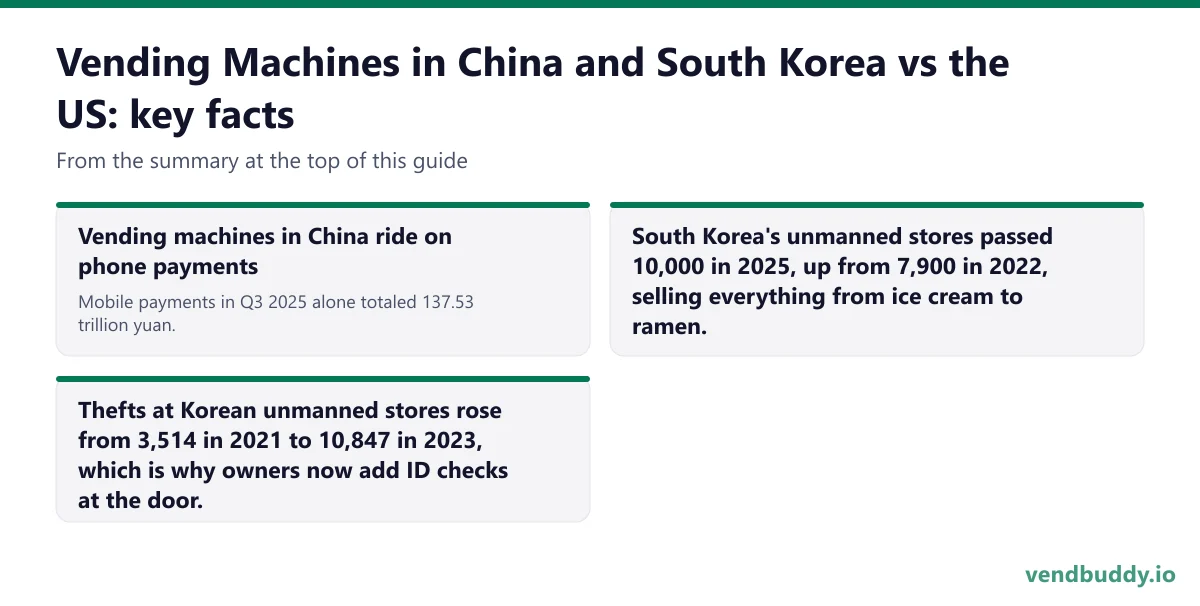
- Vending machines in China ride on phone payments: mobile payments in Q3 2025 alone totaled 137.53 trillion yuan.
- China's retail vending market was about USD 4.8 billion in 2024, yet machine density is low: one estimate put China at 0.7 machines per 1,000 people in 2021, against about 20 in Japan.
- South Korea's unmanned stores passed 10,000 in 2025, up from 7,900 in 2022, selling everything from ice cream to ramen.
- Thefts at Korean unmanned stores rose from 3,514 in 2021 to 10,847 in 2023, which is why owners now add ID checks at the door.
- US lesson: smart stores and micro markets pay best where access is controlled, such as staff-only break rooms and resident-only lobbies.
Vending machines in China and unmanned stores in South Korea are where a lot of the "future of retail" talk comes from. Phone payments, smart coolers, shops with no staff at all. Some of it works. Some of it has already failed in public. For a US operator deciding whether to buy a smart cooler or open a micro market, those results are more useful than any sales brochure.
- How do vending machines in China work?
- China's unmanned store boom, and what went wrong
- South Korea's unmanned stores: ice cream, ramen and night-time shopping
- Why thefts at Korean unmanned stores tripled
- Should you open an unmanned store or smart cooler in the US?
- What US operators can take from China and Korea
- What does not transfer
- Your next step
Part of our complete guide: how to start a vending machine business.
First, the scale. China's mobile payments in the third quarter of 2025 alone came to 137.53 trillion yuan, according to central bank data reported by China's government news service. Grand View Research puts China's retail vending revenue at USD 4,822.6 million in 2024, 6.7% of the global market. In South Korea, the number of unmanned stores passed 10,000 in 2025, up from 7,900 in 2022, according to the Maeil Business Newspaper. And the catch: Korea's National Police Agency counted thefts at unmanned stores rising from 3,514 in 2021 to 10,847 in 2023.
How do vending machines in China work?
Most purchases in Chinese cities happen on a phone, through WeChat Pay or Alipay. Vending machines follow that habit: scan a code or tap a phone, and the machine releases the item. Smart coolers that unlock with a scan and charge for what you take are common in offices and transit stations.
What surprises people is that China is not especially dense with machines. A Research and Markets summary estimated China had about 900,000 vending machines in 2021, or 0.7 per 1,000 people, against roughly 20 per 1,000 in Japan. China's cities already have convenience stores, delivery apps that bring snacks in minutes and street food everywhere. Machines have to fight for a narrow slot.
For more on how AI vision checkout and smart coolers are spreading in China, see the China section of our AI vending by region piece. This guide focuses on the business lessons.
China's unmanned store boom, and what went wrong
Around 2017, Chinese startups raced to open staff-free convenience stores. One early sign of trouble came that July, when Sixth Tone reported that a BingoBox store in Shanghai closed for "technical adjustments" after summer heat made its glass box too hot for customers. The company said it would improve cooling and look for better locations.
It sounds small, but it captures the problem. A shop with no staff still needs someone to restock it, clean it, fix it and deal with problems, and a glass box in the sun is a bad building. Removing the cashier does not remove the work. By 2019 Nikkei Asia was reporting that China's unmanned store boom had ended as quickly as it began. The formats that lasted were smaller and placed inside buildings: smart coolers in offices, kiosks in malls and transit stations.
Picture the machines paying you while you sleep
That’s the real promise of vending — income that doesn’t cost you your time, and a life on your own terms. VendBuddy turns this guide into a step-by-step plan so you actually build it instead of just reading about it. Start free today.
Start building free →South Korea's unmanned stores: ice cream, ramen and night-time shopping
Korea took a different path. Instead of tech-company flagship stores, small owners opened unmanned shops in apartment neighborhoods and near subway stations: ice cream freezers, snack shops, coin laundries, print shops, even a 24-hour ramen shop in Seoul's Jongno district where customers cook their own noodles for 3,300 to 5,000 won. Shinhan Card's research arm found the number of unmanned stores had grown nearly five times over five years by the end of 2023.
The appeal was low labor cost and a cheap way to start a side business, the same pitch that brings people to vending in the US. Korean shoppers liked the 24-hour access and the convenience.
Why thefts at Korean unmanned stores tripled
Korea is a low-crime country by most measures, and unmanned stores still saw thefts nearly triple in two years. The Chosun Daily reported that many suspects were around 10 years old, and that owners turned to posting CCTV images or calling police, which led to its own disputes and lawsuits. The Maeil Business Newspaper notes that the model worked when stores sold cheap items like ice cream, because the labor saved outweighed small losses, but became harder as stores added meat, game consoles and other pricey goods.
Owners responded by controlling the door. Some now use entry systems that verify visitors with a Naver or Kakao QR code or a phone number before the door opens, so the owner can identify who was inside if something goes missing.
That is the most useful lesson in this whole piece. Unmanned retail works when you know who can walk in. It struggles when anyone can.
Should you open an unmanned store or smart cooler in the US?
Before you spend on smart retail, run through the questions Korean and Chinese owners learned the hard way:
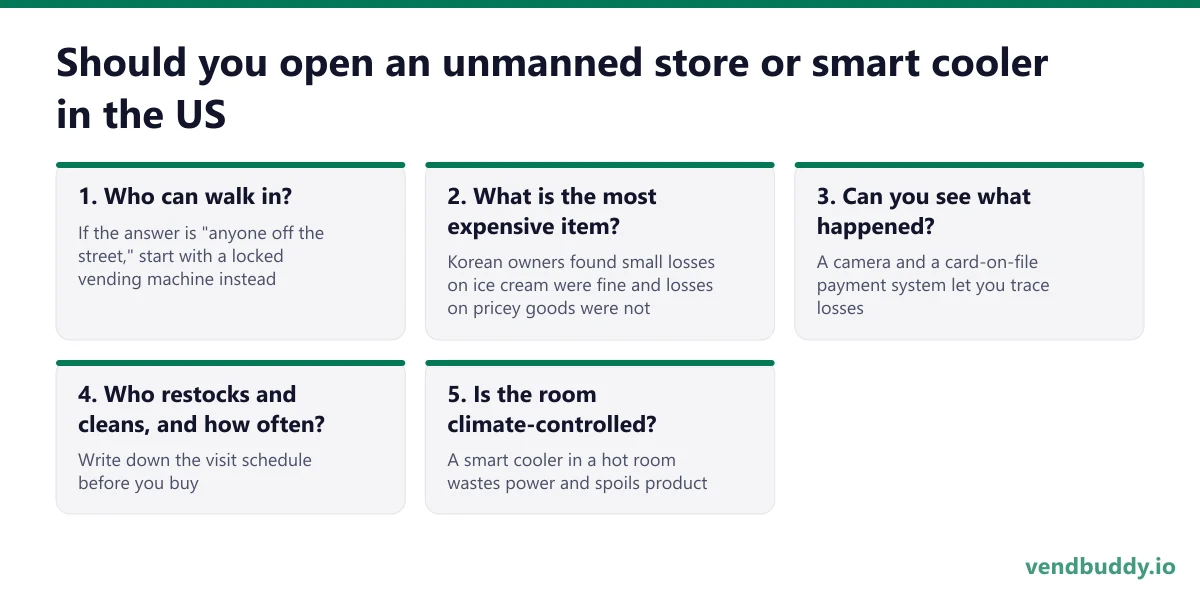
- Who can walk in? If the answer is "anyone off the street," start with a locked vending machine instead. If it is "badge holders" or "residents with a fob," a smart cooler or micro market is worth pricing.
- What is the most expensive item? Korean owners found small losses on ice cream were fine and losses on pricey goods were not. Start with lower-value products and add premium items once you see the shrink rate.
- Can you see what happened? A camera and a card-on-file payment system let you trace losses. Without them, every missing item is a guess.
- Who restocks and cleans, and how often? Write down the visit schedule before you buy. If the numbers only work with no visits, they do not work.
- Is the room climate-controlled? A smart cooler in a hot room wastes power and spoils product.
If you can answer all five with confidence, the format is worth a test. If not, a standard machine with a card reader is the safer first step. Our honest take on whether a smart cooler is worth it as a first machine goes deeper.
What US operators can take from China and Korea
- Controlled access first. Put smart coolers and micro markets in staff-only break rooms, badge-access offices and resident-only apartment lobbies. Our guide to micro markets vs vending machines explains when each format wins.
- Bigger tickets come with open-shelf formats. Cantaloupe found US smart stores averaged $4.49 per transaction in 2025, against $2.01 for vending, and smart stores grew more than 700% in a single year. Our smart markets guide covers the setup.
- Keep labor in the plan. Unstaffed is not unmanaged. Budget visits for restocking, cleaning and fixing, just as BingoBox learned.
- Match the local payment habit. China built around phone QR codes. In the US, that means tap-to-pay cards and phones, not QR.
What does not transfer
Street-front unmanned shops. If Korea, with its low crime rate, saw thefts triple, a US storefront with no staff and an open door is a gamble. If you want that model, add access control and cameras and sell low-value items first. Our theft and vandalism prevention guide covers the basics.
QR-first payment. US buyers do not scan codes to pay. A machine that asks them to open an app loses the sale.
Glass boxes in the sun. BingoBox learned this in one Shanghai summer. Indoor, climate-controlled sites are safer for any unstaffed format.
Your next step
The China and Korea story comes down to one rule: smart, unstaffed retail earns the most where the door is controlled and the crowd is known. In the US, that is a break room at a 150-person plant, a badge-access office floor or an apartment building's resident lounge. VendBuddy shows you those buildings in any ZIP code with the best contact on file, so you can test one smart cooler where it has the best odds. For the full set of country comparisons, start with vending machines around the world.
Frequently Asked Questions
How many vending machines are there in China?
There is no official count. One market research summary estimated about 900,000 machines in 2021, or 0.7 per 1,000 people, far below Japan's roughly 20 per 1,000. Grand View Research put China's retail vending revenue at about USD 4.8 billion in 2024.
How do people pay at vending machines in China?
Mostly by phone, through WeChat Pay or Alipay, usually by scanning a QR code. China's mobile payments in Q3 2025 alone totaled 137.53 trillion yuan according to central bank data.
How many unmanned stores are there in South Korea?
More than 10,000 in 2025, up from 7,900 in 2022, according to the Maeil Business Newspaper. They sell ice cream, snacks, ramen, laundry and printing services, often open 24 hours.
Do unmanned stores have a theft problem?
Yes. Korea's National Police Agency counted thefts at unmanned stores rising from 3,514 in 2021 to 10,847 in 2023. Owners have responded with entry systems that verify visitors before the door opens. In the US, unstaffed formats work best in staff-only or resident-only spaces.
What is selling, which buildings say yes, and the numbers before you buy a machine. Free, confirm from your inbox, unsubscribe in one click. Refer one friend and get 25 VendBuddy credits.
General information, not legal, tax or financial advice. Rules change, so check the official source. Revenue and income figures are examples, not promises. See our terms.