- China is furthest along on AI checkout — vision-based smart coolers are mainstream in tier-1 cities.
- Europe mastered coffee vending and telemetry, but camera-based AI vending is still early.
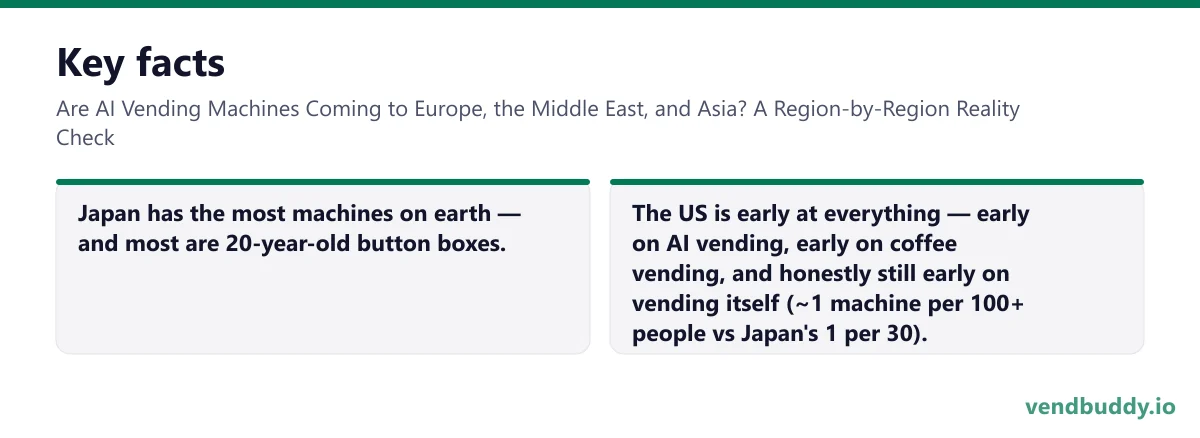
- Japan has the most machines on earth — and most are 20-year-old button boxes. Density leader, AI laggard.
- The Middle East (Gulf states) is the fastest new adopter: cashless-native malls importing smart machines from both the US and Asia.
- The US is early at everything — early on AI vending, early on coffee vending, and honestly still early on vending itself (~1 machine per 100+ people vs Japan’s 1 per 30). That’s not a weakness. It’s the window.
“AI vending machine” gets used loosely, so let’s define it: a machine where software does work a human used to do — camera-based checkout (grab items, walk away, get charged), dynamic product mixes driven by sales data, predictive restocking, remote diagnostics. The hardware exists on every continent in 2026. What differs wildly by region is how much of it is actually deployed — and that gap is where the opportunity lives.
Part of our complete guide: how much does a vending machine cost.
China: the preview of where this goes
China skipped the coil-machine era almost entirely. Cashless payment is universal, and vision-based smart coolers — tap your phone, door unlocks, cameras bill whatever you remove — moved from pilot to normal in tier-1 city offices, apartment towers, and transit hubs years ago. Chinese manufacturers now export those same smart coolers globally at prices that keep falling. For US operators the lesson isn’t “China is ahead” — it’s that the hardware is proven and getting cheaper every year. The technology risk of a smart cooler in 2026 is low; the placement risk is the same as it ever was.
Europe: coffee first, AI second
Here’s the contrast that matters. Europe built one of the most sophisticated unattended-retail industries on earth — around coffee, not AI. Bean-to-cup espresso machines are standard office equipment from Italy to the Nordics, hot drinks are the continent’s #1 vending revenue category, and telemetry-driven routes are table stakes (full Europe vs US breakdown here). But camera-based AI checkout? Still early — pilots in offices and train stations, not the default. Europe proves an important point: a region can build a billion-euro vending culture on a single product category with zero AI involved. The margin was in the coffee, not the cameras.
And the US mirror image: coffee vending is still early in the States — office coffee service exists, but the espresso-quality machine in every 50-person office that Europe takes for granted simply is not deployed here yet. US operators keep waiting for AI to create an edge while the proven European edge (a 75–85% margin cup sold daily to the same building) sits mostly unclaimed.
Picture the machines paying you while you sleep
That’s the real promise of vending — income that doesn’t cost you your time, and a life on your own terms. VendBuddy turns this guide into a step-by-step plan so you actually build it instead of just reading about it. Start free today.
Start building free →Japan: the density king is an AI laggard
The country with 4 million machines runs mostly legacy hardware — superb mechanical reliability, immaculate service, but button-and-coil designs that predate the smartphone. Upgrades are coming (multi-payment terminals, digital-screen machines in Tokyo hubs), yet Japan’s vending dominance was never about intelligence in the machine. It was restock discipline, placement psychology, and product-location fit. If AI vanished tomorrow, Japan’s vending economy wouldn’t notice. That should recalibrate how much any operator anywhere thinks the machine’s brain matters versus the operator’s.

The Middle East: the fastest new adopter
The Gulf states are becoming the most interesting new vending market on the map: cashless-native consumers, extreme mall and tower density, hot climates that make 24/7 refrigerated access genuinely valuable, and governments actively courting retail automation. Dubai has had a gold-bar vending machine since 2010 — the region has never lacked appetite for novel unattended retail. Smart machines from US and Asian manufacturers are landing in Riyadh and Dubai malls now, often skipping the legacy-machine generation entirely, the same way the region skipped landlines. It’s early — but it’s early with capital behind it.

So where does that leave US operators?
Holding the best hand at the table, honestly:
- It’s early for AI vending in the US — smart coolers are maybe a low-single-digit share of ~3 million machines. Early adopters at the right locations (offices, gyms, medical) are seeing the 3–4x revenue lift that open-shelf fresh food enables.
- It’s early for coffee vending in the US — the single most proven playbook in global vending (Europe’s) is barely deployed here.
- It’s early for vending, period. One machine per 100+ Americans versus one per 30 Japanese. Even matching half of Japan’s density is decades of headroom.
Being early everywhere means a US operator in 2026 can import Europe’s coffee margins TODAY, adopt China-proven smart-cooler hardware at falling prices, and apply Japan’s service standards — while most local competitors are still running cash-only snack machines on calendar routes.
The practical version (not the hype version)
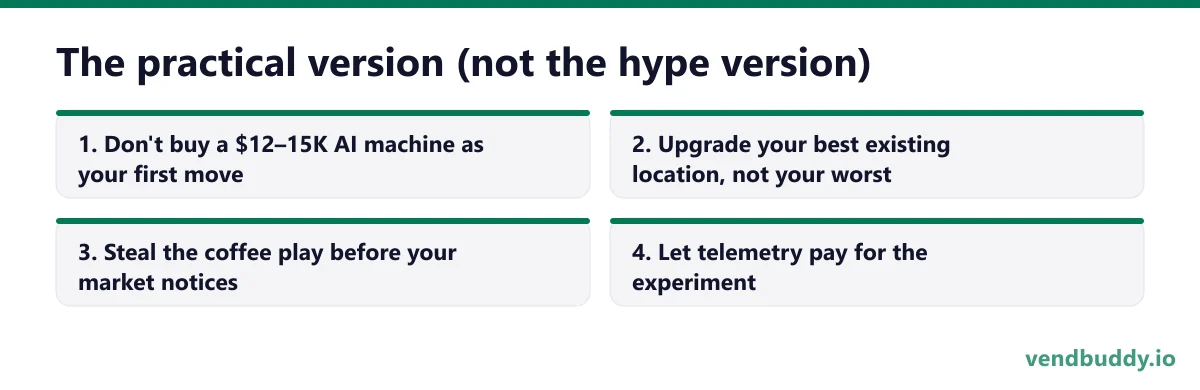
- Don’t buy a $12–15K AI machine as your first move. The math only works at proven 100+ daily-traffic locations. Model it in the ROI Calculator first.
- Upgrade your best existing location, not your worst. A smart cooler rescues nothing at a dead placement — fix or pull those first.
- Steal the coffee play before your market notices. Any 50+ employee building with no cafeteria is a bean-to-cup candidate — that’s Europe’s entire industry in one sentence.
- Let telemetry pay for the experiment. Dynamic restocking cuts 20–30% of route stops — that saved labor funds the smart-machine trial.
Smart coolers and coffee bundles only pencil at the right buildings — 50+ employees, long shifts, no cafeteria. VendBuddy finds and scores those buildings in your ZIP, with the best contact on file.
Frequently Asked Questions
Are AI vending machines actually profitable?
At the right location, yes — smart coolers and micro-market formats typically do 3–4x the revenue of a traditional machine because open-shelf formats sell fresh food and premium items coil machines can’t. At a weak location they lose money faster than a cheap machine, because the capital at risk is 3–5x higher. Location quality still decides everything.
Which country is most advanced in vending machine technology?
Split decision: China leads AI checkout and computer-vision smart coolers; Japan leads density and operational excellence with mostly legacy hardware; Europe leads coffee vending and telemetry-driven routes. No single market has all three — which is why operators everywhere can borrow from the others.
On telemetry specifically, Nayax is the default for a dull reason: it is the one most machine suppliers pre-wire for. Price the monthly against your slowest machine, not your best one. Affiliate link, so we may earn a commission at no extra cost to you.
Are AI vending machines coming to Europe and the Middle East?
They’re arriving now — European offices and stations are piloting vision-based checkout on top of an already-mature coffee and telemetry industry, and Gulf-state malls are importing smart machines directly, often skipping legacy machines entirely. Deployment is early in both regions, roughly comparable to the US.
Related: what Japan’s 4 million machines teach US operators, Europe vs US vending culture, 2026 vending trends, and high-ticket vending products. Compare smart machines and prices in the Machine Finder.
What is selling, which buildings say yes, and the numbers before you buy a machine. Free, confirm from your inbox, unsubscribe in one click. Refer one friend and get 25 VendBuddy credits.
General information, not legal, tax or financial advice. Rules change, so check the official source. Revenue and income figures are examples, not promises. See our terms.