- Payback period decides this, not the interest rate. Clear it inside the intro window and the card wins outright. Miss the window and financing was always cheaper.
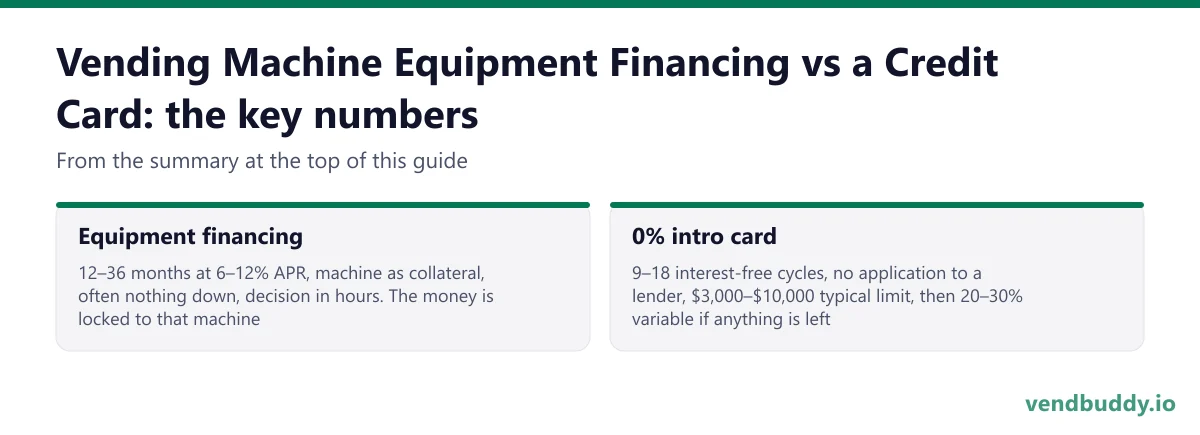
- Equipment financing: 12–36 months at 6–12% APR, machine as collateral, often nothing down, decision in hours. The money is locked to that machine.
- 0% intro card: 9–18 interest-free cycles, no application to a lender, $3,000–$10,000 typical limit, then 20–30% variable if anything is left.
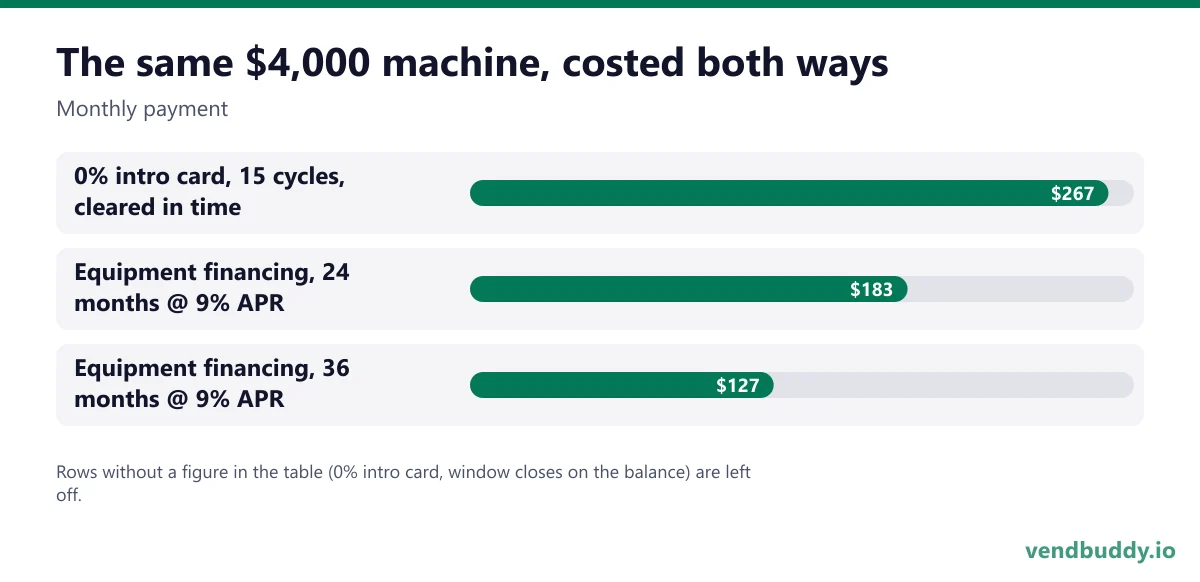
- On a $4,000 machine: $183/mo and ~$383 total interest over 24 months financed, versus $267/mo and $0 on a 15-cycle card — or ~$600–$1,000 if the window closes on a balance.
- Neither is right without a signed location. Both instruments charge you on a schedule the building has never heard of.
Two instruments, one $4,000 machine, and a decision most people make on the headline rate when the number that actually settles it is how fast the placement can retire the balance. This page compares exactly those two options head to head. Lines of credit, SBA microloans, credit-union equipment loans and leasing are real routes and they are deliberately not here — the complete vending machine financing guide compares all six, and the generic three-way version adds a line of credit for non-vending equipment.
Part of our complete guide: business credit vs personal savings.
The two instruments, honestly described
Vending machine equipment financing
A term loan secured by the machine, arranged through the dealer or a specialist equipment lender. 12 to 36 months at roughly 6 to 12 percent APR, with the machine itself as collateral.
What that buys you: a decision in hours rather than weeks, no business plan required, frequently nothing down, and on smaller deals sometimes no personal guarantee because the lender can repossess the collateral. What it costs you: the interest runs for the full term, the funds are locked to that specific machine so there is no working capital component, and the total cost is higher than an SBA or credit-union loan if you carry it to maturity.
The 0% intro APR business credit card
9 to 18 billing cycles of interest-free float on purchases, then a go-to rate commonly in the 20 to 30 percent variable range. Underwritten on your personal credit with a personal guarantee, typical first approval $3,000 to $10,000.
What that buys you: genuinely zero financing cost if you clear it in time, no lender application at all, and instant flexibility — the same card covers the reader, the first fill and the freight, which equipment financing will not. What it costs you: a hard clock, a limit that may not cover a larger machine, and a rate that is worse than any loan on this page if the clock beats you. The vending-specific version of that play is here.
The same $4,000 machine, costed both ways
One machine, one price, four scenarios. Interest figures are standard amortisation at the stated rate, rounded.
| How you pay for it | Monthly payment | Total interest | Total cost | What has to be true |
|---|---|---|---|---|
| 0% intro card, 15 cycles, cleared in time | $267 | $0 | $4,000 | Signed placement netting $267+ a month, and the discipline to actually pay it. |
| Equipment financing, 24 months @ 9% APR | $183 | ~$383 | ~$4,383 | Nothing. This is the version that works without heroics. |
| Equipment financing, 36 months @ 9% APR | $127 | ~$580 | ~$4,580 | You want the lowest monthly and accept paying $200 more for it. |
| 0% intro card, window closes on the balance | varies | ~$600–$1,000 | ~$4,600–$5,000 | The failure case. Worse than every financed option above. |
Read the first and last rows together, because they are the same instrument. The card is the cheapest option available to you and the most expensive one, separated only by whether the machine cleared the balance in time. Equipment financing does not have that variance — it costs $383 whether you are disciplined or not, which is what you are buying.
The 0% card is both the cheapest way to buy a vending machine and the most expensive one. The only variable is whether the placement retired the balance before the clock did.
Picture the machines paying you while you sleep
That’s the real promise of vending — income that doesn’t cost you your time, and a life on your own terms. VendBuddy turns this guide into a step-by-step plan so you actually build it instead of just reading about it. Start free today.
Start building free →The rule that decides it
Work out the machine’s payback period at your actual site, then compare it to the intro window you could realistically get.
A machine grossing $1,200 a month nets roughly $330 after 40–50% cost of goods, commission and card processing. That is the payoff capacity. Divide the purchase into it:
- Payback comfortably inside the window — say 10 months against a 15-cycle offer. Take the card. Zero beats nine percent, and the margin absorbs a bad month.
- Payback roughly equal to the window — 14 months against 15 cycles. Take the financing. A photo finish on a 26% cliff is not a plan, and $383 is a cheap price for removing the deadline.
- Payback past 18 months, which is most smart and AI coolers at $5,000–$10,000. Financing, or do not buy it yet. No intro window is long enough. What those machines actually earn per month is worth checking before you decide the site justifies one.
- Purchase larger than your card limit. Financing, obviously — and do not solve it by splitting the purchase across two cards, which is how people end up at 90% utilisation on both.
- You want a payment you cannot overspend against. Financing. This is a legitimate reason on its own. A fixed instalment is a commitment device, and a revolving card is not.
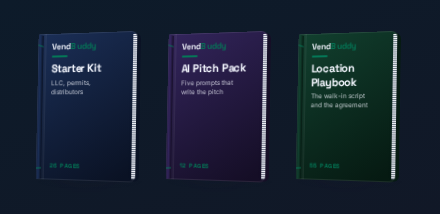
Everything above is free to read and free to do. The operator packs are the same material in fill-in-the-blank form — the 50-state distributor list, the LLC and permit checklist in unblocking order, the word-for-word walk-in script, and the placement agreement you hand a property manager. One-time purchase from $27, nothing renews.
See what is inside →What each one will and will not pay for
An underrated practical difference, and the one that catches first-time operators after the decision is already made.
| Cost | Equipment financing | 0% card |
|---|---|---|
| The machine itself | Yes | Yes |
| Freight and lift-gate delivery | Sometimes, if bundled by the dealer | Yes |
| Card reader | Rarely | Yes |
| First product fill | No | Yes |
| LLC, permits, insurance | No | Yes |
| The cushion for month two | No | Yes, and this is the risk as much as the benefit |
Equipment financing funds a machine. A card funds a launch. That flexibility is genuinely useful — the $700 to $1,400 of reader, fill and freight is exactly what people forget to budget — and it is also how a $2,800 machine quietly becomes a $4,200 balance on the same 15-cycle clock. Decide what goes on the card before the card exists.
Three things to check in the paperwork
A 0% approval large enough to cover the machine, the reader and the fill is the whole ballgame on that path. 7 Figures Funding reviews your credit profile first and sequences the applications, rather than you applying cold one card at a time and collecting hard pulls for a $2,000 limit.
The bottom line
Take the card when a signed placement clears the balance with months to spare. Take the equipment financing when the purchase is large, the payback is long, or you want a fixed payment and no deadline. Roughly $383 is what certainty costs on a $4,000 machine over two years, and on plenty of first placements that is money well spent.
What neither instrument fixes is a building without traffic. Both charge you on a schedule that has never heard of your location, which is why the location comes first in every version of this plan.
The payback period decides this, and the payback period is decided by the building. VendBuddy scores real venues near you by traffic, headcount and category, hands you the best contact on file for each, and models net profit and payback before you sign anything. Free to start, no card.
Related reading: how to finance vending machines, the 0% intro credit runway play for vending, lease to own a vending machine, how to get a loan to buy a vending business, what vending machines really cost, and how long a machine takes to pay for itself.
Frequently Asked Questions
What is vending machine equipment financing?
A term loan secured by the machine itself, usually arranged through the machine dealer or a specialist equipment lender. Terms run 12 to 36 months at roughly 6 to 12 percent APR, with the machine as collateral, which is why approval is faster and easier than an unsecured loan and why a personal guarantee is sometimes waived on smaller deals. The money can only be used for that specific machine - there is no working capital component - and you carry the interest for the whole term unless the contract allows early payoff without penalty.
If you would rather not draft the contract from scratch, we keep a plain-English walkthrough at get vending machine contracts. It covers term, commission, exclusivity and how either side gets out.
Is equipment financing or a credit card better for a vending machine?
It comes down to one number: how fast you can retire the balance. If a signed placement can clear the machine cost inside a 0% intro window - typically 12 to 18 billing cycles - the card is cheaper, because zero percent beats six percent every time. If the purchase is larger than your card limit, or the payback runs past 18 months, or you want a fixed payment schedule you cannot overspend against, equipment financing is the better instrument. Payback period decides it, not the headline rate.
What does equipment financing cost on a $4,000 vending machine?
At 9 percent APR over 24 months, a $4,000 machine costs roughly $183 a month and about $383 in total interest. Over 36 months at the same rate the payment drops to about $127 and the interest rises to roughly $580. The same $4,000 on a 15-cycle 0% intro card costs $267 a month and $0 in interest if you clear it in time - and roughly $600 to $1,000 in interest over the following year if you do not. The card is cheaper when it works and more expensive when it does not, which is the whole trade.
Can you get vending machine equipment financing with bad credit?
Easier than an unsecured card, because the machine secures the loan, but the rate moves sharply against you and the offers get worse fast. Below roughly a 640 FICO you will mostly see no-credit-check equipment deals structured as lease-to-own, where effective rates above 50 percent are common. That is a different product wearing similar language. If that is the only offer on the table, compute the total of payments and compare it to the cash price of the same machine before you sign anything.
Does equipment financing require a down payment on a vending machine?
Dealer and specialist equipment financing frequently requires nothing down on smaller deals, which is a genuine advantage over a credit union equipment loan where 10 to 20 percent down is typical. Watch for the first-and-last-payment structure instead - some lenders take two payments up front, which is effectively a down payment described differently. Get the amount due at signing as a single number in writing before you compare offers.
Should I finance a smart or AI vending machine as my first machine?
Only against a confirmed location, and only if the payback still clears 12 to 14 months at conservative revenue. A smart cooler runs $5,000 to $10,000 against $1,500 to $3,500 for a used combo, so the financed payment is two to four times larger while the location risk is identical. At a $330 monthly net a $7,000 machine takes roughly 21 months to pay back before interest - outside the rule and well outside any 0% intro window, which is why this purchase belongs on equipment financing rather than a card if it belongs anywhere.
What is selling, which buildings say yes, and the numbers before you buy a machine. Free, confirm from your inbox, unsubscribe in one click. Refer one friend and get 25 VendBuddy credits.
General information, not legal, tax or financial advice. Rules change, so check the official source. Revenue and income figures are examples, not promises. See our terms.