- A lease-to-own is a loan wearing a monthly payment as a disguise. $60–$120 a month over 24–36 months totals 20–40% above the cash price — near 25% APR once you solve for it.
- Three buyout structures, and they are not close to equivalent: $1 buyout, 10% PUT, and fair market value. Which one you signed is the most important line in the contract.
- A low monthly on an FMV lease is not a better deal. It is a deferred one — the ownership question is unresolved and the lessor resolves it.
- The evergreen clause is the trap that costs the most, because it costs you money after you thought you were finished.
- You usually still owe repairs, insurance and taxes on a machine you do not own. Confirm that line before you sign, not after a compressor fails.
This page assumes you have already decided to lease and are now looking at a contract. It is about the mechanics of a lease-to-own agreement and the clauses that cost operators money — not a survey of your other options. If you have not made that decision yet, leasing versus buying vending machines solves a typical lease for its implied rate and is the page to read first, and how to finance vending machines compares every route side by side.
Part of our complete guide: business credit vs personal savings.
How a lease-to-own actually works
An equipment finance company buys the machine from the dealer. You do not. They then rent it to you over a fixed term, and at the end of that term ownership transfers according to whatever the contract says — which is where the whole thing lives or dies.
Most first agreements are two pages, not twenty. The contracts walkthrough lays out the clauses that actually matter for the contract, including the termination language operators forget about until they need it.
The typical shape for a snack-and-drink combo: $60 to $120 a month over 24 to 36 months, frequently with $0 down, sometimes with the first and last payment taken up front. Total of payments lands 20 to 40 percent above the cash price of the identical machine.
That premium is the price of the money, and it is worth converting into a rate so you can compare it to anything else. A $2,500 machine leased at $100 a month for 36 months is $3,600 of payments — $1,100 of finance cost on $2,500 borrowed, over three years. Solve that properly and it lands near 25 percent APR. Nobody quotes it that way, because the monthly payment is the thing being sold.
What the same class of machine costs in cash
Compare a lease quote against the cash sticker, not against somebody else’s monthly payment. These are the AI machines at the price you would pay outright on Amazon, which ships them on Prime with a return window. Affiliate links, and we earn a commission when you buy through one.
HAHA AI Open-Front US-360View on Amazon →The cheapest way into AI vending, for indoor placements where an open front is not a theft problem.
HAHA Smart Combo US-360View on Amazon →Drinks and snacks in one cabinet. The default first AI machine for a 50–100 person site.
The three buyout structures
This is the single most important fact in your agreement, and it is frequently not on the first page.
| Structure | What you pay at the end | Monthly payment | Verdict |
|---|---|---|---|
| $1 buyout | One dollar. You own it. | Highest | The one to ask for if you intend to keep the machine. It is a purchase with the total spelled out. |
| 10% PUT | 10% of the original cost, and it is mandatory, not optional. | Middle | Workable, but budget the balloon from day one. The word PUT means you are obliged to buy. |
| Fair market value (FMV) | Whatever the lessor says the machine is worth. | Lowest | The one that surprises people. The lowest monthly in the category, and the ownership question is unresolved until month 36. |
Read that table in the direction people usually do not: the lowest monthly payment belongs to the structure with the least certain ending. On a used combo, an FMV buyout might come in at $600 or it might come in at $1,200, and you find out about it at the end of a three-year term when the machine has already been earning for you and handing it back is not a real option.
The lowest monthly payment on a vending lease belongs to the structure with the least certain ending. That is not a bargain, it is a deferred bill.
The clauses that cost operators money
Six things to find in the document before you sign it.
One more, which is less a clause than a pattern: if a lease is being offered to you specifically because your credit will not support a loan, that is the moment to compute the total of payments rather than to feel lucky. No-credit-check equipment deals routinely carry effective rates above 50 percent, and they are the reason the main financing guide lists them under predatory lending rather than under options.
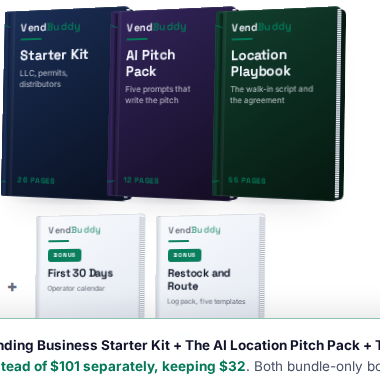
If you get to the end of this and the answer is yes, the kits are the shortcut past the blank page: a 26-page starter kit for the paperwork, a 55-page Location Playbook for the walk-in script and the agreement, and a 12-page AI Pitch Pack. Bought once, from $27, and you keep the files.
Look inside the kits →Picture the machines paying you while you sleep
That’s the real promise of vending — income that doesn’t cost you your time, and a life on your own terms. VendBuddy turns this guide into a step-by-step plan so you actually build it instead of just reading about it. Start free today.
Start building free →When leasing genuinely is the right call
Four situations, and they are narrower than the industry would like:
- The cash would otherwise come out of product and buffer. A machine you own but cannot afford to fill or repair is worse than a machine you are paying monthly for.
- The location is confirmed and the machine services its own payment from month one. A $100 monthly payment against a placement netting $330 is a manageable structure. The same payment against a placement you have not signed yet is a monthly bill attached to a hope.
- The tax treatment favours it in your situation. Operating leases and capital leases are treated differently, and Section 179 and bonus depreciation change the arithmetic on an owned machine. This is genuinely a question for whoever does your return — the deduction landscape is here as background, not as advice.
- You need equipment faster than a lender will move. Lease approvals are frequently same-day. An SBA microloan is two to four weeks, and a location does not always wait.
Outside those four, buying used with cash is cheaper, and the difference is not small — on a $2,500 machine it is roughly $1,100 over three years, which is three months of net profit from a decent placement.
A lease is one of six ways to pay for a machine, and it is rarely the cheapest. Our complete guide compares SBA microloans at 8-13% APR, credit union equipment loans at 6-9%, vendor financing, the 0% intro card play, and reinvested cash flow, with real lender names attached.
The bottom line
A lease-to-own is a legitimate instrument with an expensive default configuration. Ask for the $1 buyout, ask for the total of payments as one number, find the renewal notice window and diary it, and confirm who pays for repairs. Four questions, ten minutes, and they are the difference between a financing decision and a surprise.
A credit line is still a debt you personally guarantee, so the honest rule is to borrow only what a signed location can repay inside the intro window. 7 Figures Funding sequences the applications for you if you would rather not apply one card at a time. Affiliate link, so we may earn a commission at no extra cost to you.
And before any of it: have the location signed. Get the free half done first.
VendBuddy scores real buildings near you by traffic, headcount and category, hands you the best contact on file for each, and models net profit and payback so you know whether a monthly payment is safe before you commit to one. Free to start, no card.
Related reading: leasing versus buying vending machines, renting versus buying a machine, how to finance vending machines, how to get a loan to buy a vending business, how to inspect and buy a used machine, and how long a machine takes to pay for itself.
Frequently Asked Questions
How does lease to own work for a vending machine?
An equipment finance company buys the machine and rents it to you over a fixed term - typically 24 to 36 months at $60 to $120 a month - and at the end you take ownership through whatever buyout the contract specifies. The three structures are a $1 buyout (you own it outright for a token payment), a 10% PUT (you owe 10% of the original cost at the end, and it is mandatory), and a fair market value buyout (you pay whatever the lessor says the machine is worth, which is the one that surprises people). Which of the three you signed is the single most important fact in the agreement, and it is often not on the first page.
How much does it cost to lease to own a vending machine?
Expect $60 to $120 a month over 24 to 36 months for a snack-and-drink combo, which totals 20 to 40 percent above the cash price of the same machine. Solve a typical vending lease for its implied rate and it lands near 25 percent APR, which is why the rate is almost never the number being quoted to you. Add the buyout on top if the contract is not a $1 structure, plus any documentation fee and any end-of-term return or restocking charge buried in the schedule.
What is a fair market value buyout on a vending machine lease?
It means that at the end of the term you pay the lessor whatever they determine the machine is currently worth in order to keep it - and in most vending FMV leases the lessor determines it. On a used combo that might be $600, or it might be $1,200, and you find out at month 36. FMV leases carry lower monthly payments than $1 buyout leases precisely because the ownership question is unresolved, so a low monthly on an FMV structure is not a better deal, it is a deferred one. If you intend to own the machine, insist on a $1 buyout and accept the higher payment.
What should I look for in a vending machine lease agreement?
Six things, in this order. The buyout structure ($1, 10% PUT, or FMV). The total of payments, written as one number, not a monthly. Whether early payoff is allowed and at what discount - many leases have no discount at all, so paying early saves you nothing. The automatic renewal or evergreen clause, which can silently add 6 to 12 months if you miss a written notice window. Who is responsible for repairs, insurance and taxes, which in most equipment leases is you despite not owning the machine. And any end-of-term return condition, because returning a machine in unacceptable condition can cost more than the buyout would have.
Can you lease a vending machine with bad credit?
Sometimes, and that is exactly when to read the contract hardest. Lease-to-own is the most common financing route offered to people who cannot get a loan, which means the worst terms in the category concentrate there - effective rates above 50 percent are not rare on no-credit-check equipment deals. If a lease is being offered to you specifically because your credit is thin, treat that as a reason to compute the total of payments and compare it to the cash price of the same machine, not as a lucky break.
Is lease to own ever the right choice for a vending machine?
Yes, in four fairly narrow situations: when the cash would otherwise come out of your product and buffer budget and leave you unable to actually run the machine, when the location is confirmed and the machine will service its own payment from month one, when the tax treatment genuinely favours it for your situation, and when you need equipment faster than any lender will move. Outside those, buying used with cash is cheaper and the difference is not small. The full comparison, with the rate solved out, is worth reading before you sign anything.
What is selling, which buildings say yes, and the numbers before you buy a machine. Free, confirm from your inbox, unsubscribe in one click. Refer one friend and get 25 VendBuddy credits.
General information, not legal, tax or financial advice. Rules change, so check the official source. Revenue and income figures are examples, not promises. See our terms.