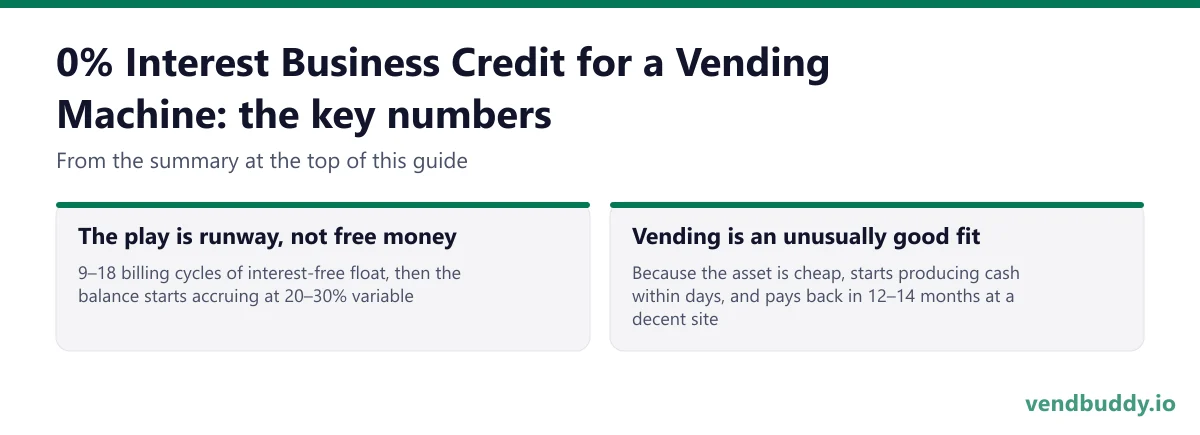
- The play is runway, not free money. 9–18 billing cycles of interest-free float, then the balance starts accruing at 20–30% variable.
- Vending is an unusually good fit because the asset is cheap, starts producing cash within days, and pays back in 12–14 months at a decent site.
- Typical first approval is $3,000–$10,000, underwritten on your personal credit. Enough for a used combo, a reader and a fill. Usually not enough for a smart cooler.
- The only math that matters: balance divided by cycles remaining, checked against the machine’s monthly net. If the machine cannot service it, you are the one servicing it.
- It fails in exactly one way — the machine had no signed location, so there was no cash flow to retire the balance and the clock ran out anyway.
This page is about one instrument used for one purchase: a 0% intro APR business credit card, used to buy a vending machine, paid off before the intro window closes. It is not a comparison of financing routes — how to finance vending machines compares all your vending machine financing options side by side, and if you want the instrument explained without the vending context, funding a first business with 0% intro business credit covers the general mechanics.
Part of our complete guide: business credit vs personal savings.
What follows is the vending-specific version: whether you qualify, what limit to expect, and the arithmetic that tells you whether this machine will retire this balance before the rate resets.
Why the runway play fits vending in particular
Most businesses that get funded on 0% intro credit should not be. The instrument gives you a fixed window of interest-free money, so it only works when what you buy produces cash inside that window — and most of what people buy with it (ad spend, inventory for an unproven product, runway) does not.
Vending has an unusually favourable shape against that constraint:
- The asset is cheap. A used snack-and-drink combo is $1,500 to $3,500, which sits comfortably inside a first business-card limit rather than requiring one.
- It produces cash within days. Not months. A machine installed on Monday is collecting on Tuesday, which means the payoff can start in cycle one rather than cycle six.
- Payback is 12 to 14 months at a normal placement, and 6 to 9 at a high-traffic one — against intro windows that commonly run 12 to 18 cycles. That is the whole argument, and it is a real one.
- The asset is resellable. Not at a good price under pressure — 40 to 60 cents on the dollar — but it is a physical thing with a market, which is more than most funded startups can say.
Hold onto the third point, because everything else on this page is a test of it.
Who actually qualifies, and for how much
The uncomfortable part first: a business card for a new business is underwritten on your personal credit. There is no version where the business qualifies on its own, because a business with no operating history has no credit file. That means a hard pull on your personal report and a personal guarantee, which makes this a personal debt with a business name on it.
What that implies in practice:
- FICO in the high 600s is the practical floor. The better offers and larger limits realistically start around 720. Below roughly 660 you will mostly collect declines, and the right move is three to six months of fixing utilisation and payment history first — not applying anyway and adding hard pulls to the problem.
- You do not need an LLC. A sole proprietorship is a business for application purposes: your legal name as the business name, your SSN as the tax ID, and a realistic expected annual revenue figure. Form the LLC anyway for liability and bookkeeping reasons, just do not expect it to change the approval.
- Expect $3,000 to $10,000 on a first approval. That covers a used combo, a card reader and a first fill with room. It generally does not cover a smart or AI cooler at $5,000 to $10,000 without running the card near its limit, which is its own problem.
- Treat 60 to 70 percent of the limit as your usable capacity. A card run to 90 percent looks worse to the next issuer, and some issuers report business card utilisation to your personal file every month. Confirm your issuer’s reporting policy if you have a mortgage or car loan coming.
0% intro credit is a timing tool, not capital. It works when the asset pays for itself before the clock runs out - and vending machines are one of the few things that reliably do.
Picture the machines paying you while you sleep
That’s the real promise of vending — income that doesn’t cost you your time, and a life on your own terms. VendBuddy turns this guide into a step-by-step plan so you actually build it instead of just reading about it. Start free today.
Start building free →The payoff-before-the-cliff math
One calculation decides this, and it takes thirty seconds.
Balance ÷ billing cycles remaining = your required monthly payment. Compare that to what the machine actually nets each month. If the machine covers it, this is a financing decision. If it does not, the gap comes out of your job or your savings, which is fine if you planned it and a crisis if you did not.
A machine grossing $1,200 a month nets roughly $330 after 40–50% cost of goods, location commission and card processing. That $330 is the number to test everything against — not the gross, which is the mistake that makes every one of these deals look easy.
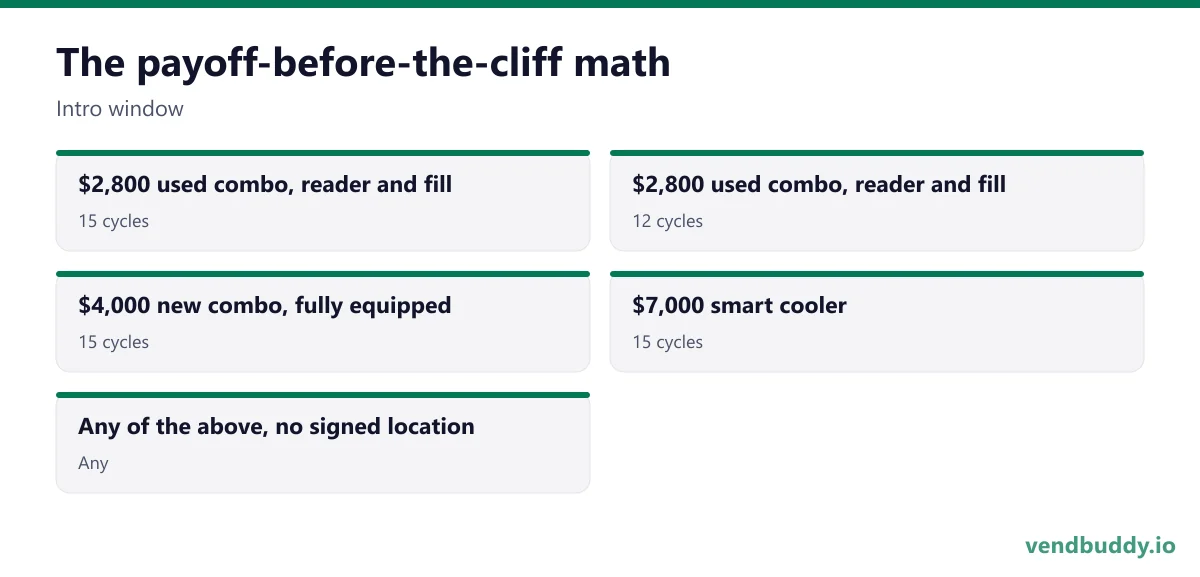
| What you put on the card | Intro window | Required monthly | Machine net covers it? |
|---|---|---|---|
| $2,800 used combo, reader and fill | 15 cycles | $187 | Yes — $330 net leaves $143 of margin a month. |
| $2,800 used combo, reader and fill | 12 cycles | $233 | Yes, tighter. Roughly $97 of margin. One bad month is survivable, three are not. |
| $4,000 new combo, fully equipped | 15 cycles | $267 | Just. $63 of margin. Only do this at a genuinely proven site. |
| $7,000 smart cooler | 15 cycles | $467 | No. The machine has to net $467 before you see a dollar, which needs a captive Class A placement, not a hope. |
| Any of the above, no signed location | Any | Any | No. There is no cash flow to test against. This is the failure mode. |
The bottom two rows are where this play actually goes wrong, and note that neither of them is about the credit card. They are about the machine and the building. The instrument is fine; it just does not create demand that was not there.
The one thing to confirm in writing
There are two products marketed almost identically and they behave completely differently at the end of the window:
- A standard 0% intro APR purchase offer. When the window closes, whatever is left starts accruing at the go-to rate — commonly 20 to 30 percent variable. You are not charged for the interest-free months. This is what a mainstream business card gives you.
- A deferred-interest promotion. Common on store cards and some equipment-seller financing. If any balance remains at the end, it retroactively charges every month of interest you thought you had avoided. On a $3,000 balance that is a four-figure surprise.
Ask which one you are signing, and get the answer in writing. It is the single highest-value question on this page.
Five free guides cover the ground below in more detail than a blog post can — a 90-day launch plan, the location scouting checklist, the B2B pitch script with the twelve objections answered, tax deductions, and pricing. No card, delivered to your inbox in a couple of minutes.
Get the free guides →The order that makes this safe
Applying one card at a time is how first-timers end up with three hard pulls and one $2,000 limit. 7 Figures Funding looks at your credit profile first, tells you what you would realistically qualify for, and sequences the applications so approvals land together instead of fighting each other.
When not to do this
- No signed location. Said three times on this page because it is the only failure mode that matters.
- The payback and the window are the same length. You need margin, not a photo finish. If payback is 14 months and the window is 12, this is not funding, it is a bet with a deadline.
- The balance also has to cover living expenses. A card doing double duty as business capital and personal runway will not clear either.
- Your FICO is under about 660. Fix that first. Three to six months of work now is cheaper than three hard pulls and a $2,000 limit.
- You are buying a smart or AI cooler as machine one. The payback maths does not fit a normal intro window at $5,000 to $10,000 unless the placement is genuinely captive. The real per-month numbers on those machines are worth reading before you decide the site qualifies.
The bottom line
0% intro business credit turns a $2,800 machine you cannot afford today into a $187 monthly payment a signed location can cover, with $143 a month left over. That is a genuinely good trade, and it is the reason a large share of first machines get bought this way.
It is also a clock. The instrument does not care whether your building has traffic; it only cares what month it is. Sign the location, size the machine to the net, automate the payoff, diary the cliff — and the clock never becomes your problem.
VendBuddy scores real buildings near you by traffic, headcount and category, hands you the best contact on file for each, and models net profit and payback — so you know what the machine can service before you put anything on a card. Free to start, no card required.
Related reading: how to finance vending machines, 0% intro business credit for a first business, the best business credit card for a vending business, equipment financing versus a business credit card, how long a machine takes to pay for itself, and starting with no money.
Frequently Asked Questions
Can you buy a vending machine with 0% interest business credit?
Yes, and it is one of the more common ways a first machine actually gets bought. A 0% intro APR business card gives you 9 to 18 billing cycles of interest-free float on purchases, and most machine dealers, smart-cooler vendors and Amazon accept cards. The instrument works well for vending specifically because a placed machine starts producing cash within days and a used combo at $1,500 to $3,500 pays itself back in roughly 12 to 14 months, which fits inside a long intro window with room to spare. It stops working the moment the machine has no signed location, because then you are financing a guess on a clock.
What credit limit can you expect on a 0% business card for a vending machine?
Typical first approvals for a new business land in the $3,000 to $10,000 range, underwritten on your personal credit rather than the business. That is enough for a used combo plus a card reader plus the first fill, and usually not enough for a smart cooler at $5,000 to $10,000 without running the card near its limit. Treat your usable capacity as roughly 60 to 70 percent of the approved limit rather than all of it, because running a card at 90 percent utilisation makes the next issuer you apply to less generous and can affect your score depending on how the issuer reports.
How do you pay off a vending machine before the 0% intro period ends?
Divide the balance by the number of billing cycles remaining and treat that as a fixed monthly bill, then check it against the machine net profit. A $3,000 machine on a 15-cycle window needs $200 a month. A single decent placement nets roughly $330 a month after cost of goods, commission and card fees, so the machine services its own payoff with margin left. If the required monthly exceeds the machine net, the gap has to come from your job or your savings - which is fine if you planned it and a problem if you did not.
If the spend is going on plastic anyway, the card choice is worth ten minutes. Most operators we talk to land on the Bilt card, not for what it pays on pallets but because the rent payment earns too. Referral link, and the honest caveat is that a carried balance beats what any of these points are worth. Affiliate link, so we may earn a commission at no extra cost to you.
What happens if you do not pay off the machine before the 0% window closes?
On a standard 0% intro APR purchase offer, the remaining balance simply starts accruing interest at the go-to rate - commonly 20 to 30 percent variable in 2026 - from that point forward. You are not back-charged for the interest-free months. That is different from a deferred-interest promotion, which some equipment sellers and store cards use and which does retroactively charge every month of avoided interest if any balance remains. They market almost identically. Confirm in writing which one you signed before you buy anything on it.
Do you need an LLC to get a 0% business credit card for vending?
No. A sole proprietorship counts as a business for card-application purposes - you apply using your own legal name as the business name, your SSN as the tax ID, and your realistic expected annual revenue. Forming an LLC is worth doing for liability and bookkeeping reasons and it is cheap, but a brand-new entity has no credit file of its own, so it does not improve your approval odds. Expect a hard pull on your personal credit and a personal guarantee either way.
Is using 0% business credit to buy a vending machine a good idea?
It is a good idea when the money buys an income-producing asset at a placement you have already signed, and the payback period is comfortably shorter than the intro window. A $2,800 used combo at a confirmed 100-to-200-visitor site clears in about ten months against a 15-cycle window, which has margin. It is a bad idea when the machine has no location, when the payback and the window are the same length, or when the balance also has to cover living expenses. The instrument is a timing tool, not capital.
What is selling, which buildings say yes, and the numbers before you buy a machine. Free, confirm from your inbox, unsubscribe in one click. Refer one friend and get 25 VendBuddy credits.
General information, not legal, tax or financial advice. Rules change, so check the official source. Revenue and income figures are examples, not promises. See our terms.