- Sports complexes can be strong locations because tournament weekends bring thousands of players and spectators to one site.
- The condition that decides it is the concession contract. Many complexes lease their snack stand, and the lease may block you.
- VendBuddy Lead Finder has scored 13 stadium-type venues, with a median of 1,629 Google reviews and an average rating of 4.55, as of 2026-10-04.
- Entertainment venues start at a base score of 72 in Lead Finder, and complexes often have several machine sites on one property.
- Many complexes are city-run, so expect a facilities manager, a park board or a procurement process.
Sports complex vending machines can sell thousands of bottles on a good tournament weekend, which makes them one of the biggest single-site wins in the business. The one thing that decides it is the concession contract. If a company already holds the rights to sell food on the property, ask what it covers before you spend a day on the pitch.
Part of our complete guide: how to find vending machine locations.
If you want an exit from the weekday grind, one complex with ten fields and a full tournament calendar can fill a serious share of your year. It is also the hardest kind of site to land, so go in prepared.
Are sports complexes good vending machine locations?
Yes, for the right complex. A multi-field park with baseball, softball, soccer and turf fields draws families for entire weekends. A parent might arrive at 8 am and leave at 6 pm. They buy drinks, snacks and sometimes a meal. The traffic is huge on tournament weekends and thin on weekday afternoons.
VendBuddy's own Lead Finder data, as of 2026-10-04, shows what the biggest venues look like. We have scored 13 stadium-type venues across 13 regions. They carry a median of 1,629 Google reviews and an average rating of 4.55. That is heavy, positive traffic, and the same pattern shows up at the best complexes. Sports complexes themselves are a young search in Lead Finder, with 1 search by 1 operator in 1 ZIP code since April 2026, so few operators have worked this space.
The other side is access. Complexes are large, they have layers of managers, and many are run by cities or leagues. A deal can take months. Treat a complex as a long project, and keep your smaller sites running while you work it.
How a sports complex runs
Most complexes have two kinds of days. League days are steady: games from late afternoon, with moderate crowds. Tournament days are spikes: multiple fields all day, with traffic ten times a normal evening. Spring and fall are the busiest seasons. Some complexes run year-round with indoor fields.
The standard setup is a central building with a snack bar, restrooms and a pavilion. Fields spread out from it. Players and parents walk between the fields and the central building. Distance matters. A machine at the far end of the property can outsell the one by the snack bar because there is nothing else nearby.
The rules are the main wrinkle. Many complexes are run by a parks and recreation department, and a city or county purchasing office may require a bid. A private complex may hold a beverage contract with a large bottler. The rule is: ask who runs the concession and whether it is exclusive before you walk the fields.
If you would rather not draft the contract from scratch, we keep a plain-English walkthrough at get vending machine contracts. It covers term, commission, exclusivity and how either side gets out.
Many city parks also limit sugary drinks or require healthy options for youth sports. Ask for the policy in writing.
The biggest mistake new operators make at a complex is pitching one machine. A property with eight fields needs a plan: where the walking paths run, which field clusters are busiest and where the shade and power are. A map and a simple count of machines by cluster shows the owner you have thought about their property, not just your sales.
Staffing is the second issue. A tournament weekend can empty a machine by noon on Saturday. You need to be able to restock on the spot, or have a second unit ready, because a sold-out machine on the busiest day is a lost sale and a bad first impression.
Picture the machines paying you while you sleep
That’s the real promise of vending — income that doesn’t cost you your time, and a life on your own terms. VendBuddy turns this guide into a step-by-step plan so you actually build it instead of just reading about it. Start free today.
Start building free →The rows that sell at a sports complex
Outdoor-rated machines with a roof or a shaded pad work best. Place them near field clusters, not just the main building. Stock for hot, long days:
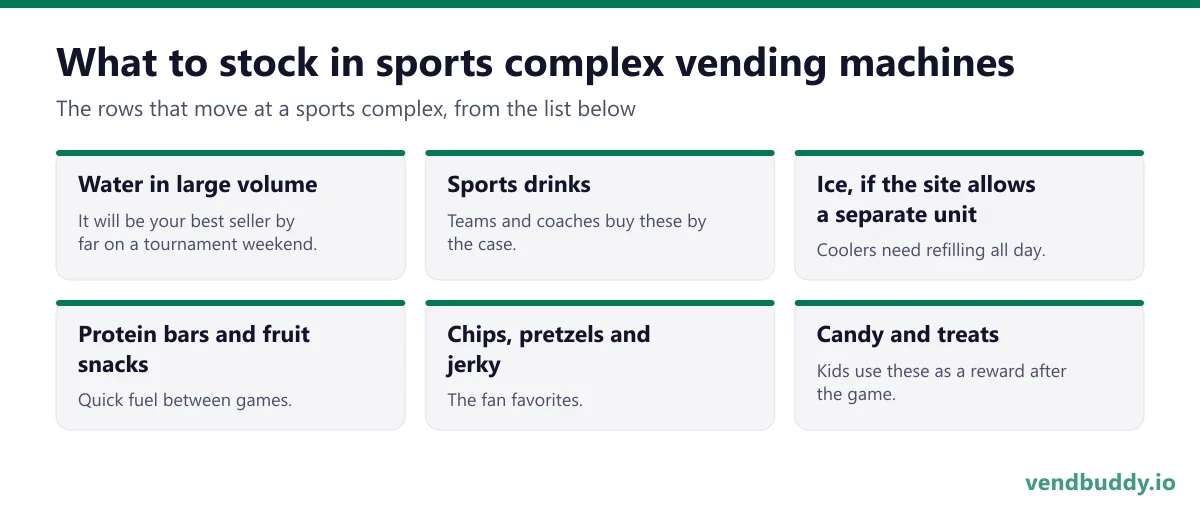
- Water in large volume. It will be your best seller by far on a tournament weekend.
- Sports drinks. Teams and coaches buy these by the case.
- Ice, if the site allows a separate unit. Coolers need refilling all day. See ice vending machine locations.
- Protein bars and fruit snacks. Quick fuel between games.
- Chips, pretzels and jerky. The fan favorites.
- Candy and treats. Kids use these as a reward after the game.
- Electrolyte packets and sunscreen wipes, if the machine allows. Small items that sell on hot days.
If the contract requires healthy options, put water and bars at eye level and move candy to the lower rows. Tournament venues with room for a second machine can also carry a sports card vending machine, since parents and kids wait between games.
If the complex is city-owned, read the rules before you reach out. Public sites often require insurance, a business license and sometimes a bid. Ask for the request for proposals if there is one, and read what the city says about revenue share. Some cities want a fixed fee, others a percentage, and a few award the contract to the highest bidder.
Pitching the sports complex: the opener and the objection
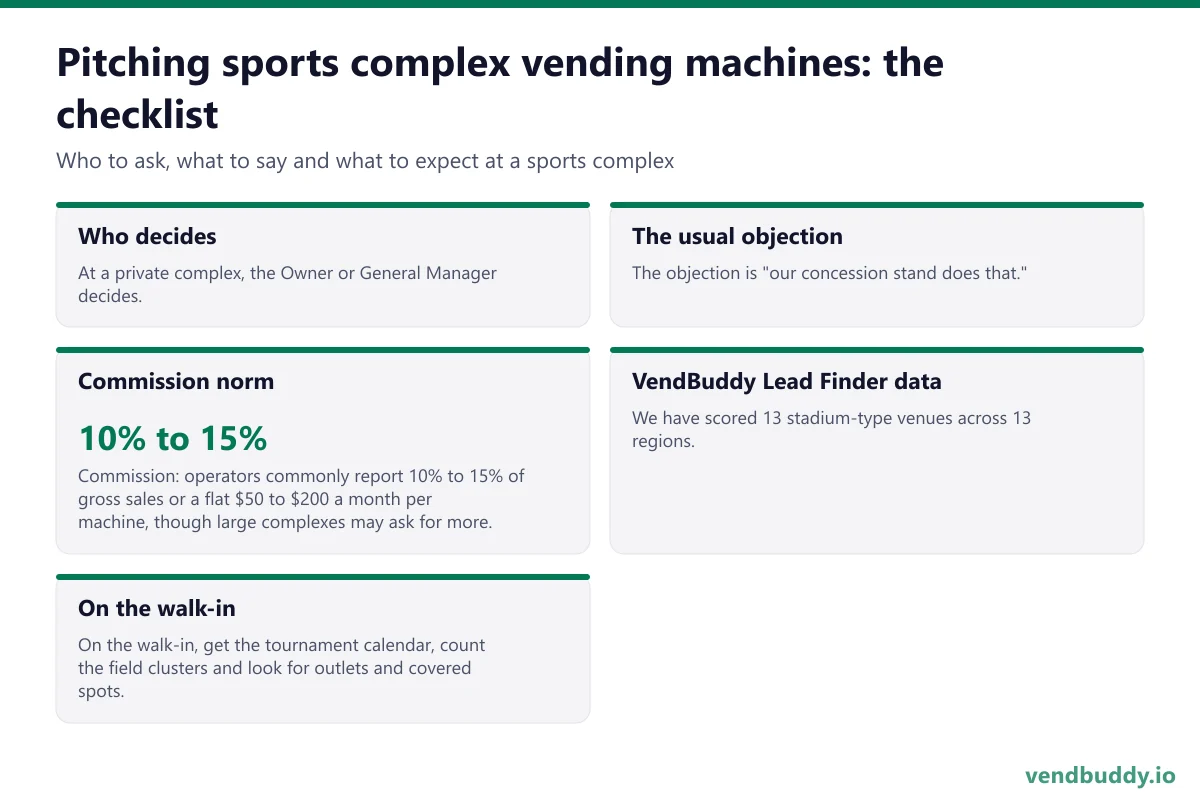
At a private complex, the Owner or General Manager decides. At a city complex, the decision may sit with a Parks and Recreation Director, a facilities manager or a purchasing office. Ask who handles concessions and vending, and ask whether the complex sends out requests for bids.
Opener: "I stock machines at sports facilities. I would place several around your fields so families do not have to walk to the snack bar, and share sales with you. Do you have a concession agreement I should know about?"
The objection is "our concession stand does that." The answer is to offer machines for the hours and spots the stand cannot cover: far fields, early mornings, late evenings, and quick-grab drinks that skip the line.
Commission: operators commonly report 10% to 15% of gross sales or a flat $50 to $200 a month per machine, though large complexes may ask for more. The vending machine commission rates post explains the options. Use the vending ROI calculator to size each machine, because a tournament weekend inflates the picture.
On the walk-in, get the tournament calendar, count the field clusters and look for outlets and covered spots. Ask who cleans up trash. A machine at a park gets blamed for litter.
If the answer is no, ask for a smaller yes. A single machine in the staff building, the concession storage area or the umpire room is a start. It builds trust, and a good record opens the door to field-side units next season.
How to find sports complexes near you
Use Lead Finder: Find sports complexes near you in Lead Finder. Choose Sports Complex, enter a ZIP and set the radius up to 50 miles. Results show a location score and, when available, the owner or manager contact.
The free route is Google Maps. Search "sports complex near me," "youth sports park" and "tournament fields." City recreation department websites list their complexes and tournament schedules. The drive-by test is a Saturday morning in May. If the parking lot spills onto the grass, you have found one. The wider method is in how to find vending locations.
Lead Finder adds the contact, a location score and a radius search, so you can see which complexes in your region are worth the call.
One complex can anchor a route, but only if you start with a clean question about the concession contract. Find sports complexes near you in Lead Finder and make that first call.
Frequently Asked Questions
Are sports complexes good vending machine locations?
Yes, especially on tournament weekends when thousands of players and parents spend the day on site. The catch is access: many complexes are city-run or have a concession contract, so the first step is to ask who holds the rights.
What sells best in a sports complex vending machine?
Water by a wide margin, then sports drinks, protein bars, fruit snacks, chips, pretzels and jerky. Candy sells as a reward for kids. If the park requires healthy options, put water and bars at eye level.
How much commission does a sports complex expect?
Operators commonly report 10% to 15% of gross sales or a flat $50 to $200 a month per machine. Large or city-run complexes may ask for more or require a bid. Read the commission rates post before you quote a number.
Do I need to bid for a vending contract at a city sports complex?
Often yes. Parks and recreation departments may require a purchasing process or a request for bids, especially for exclusive rights. Ask the facilities manager or the purchasing office how vending is awarded before you spend time on a pitch.
What is selling, which buildings say yes, and the numbers before you buy a machine. Free, confirm from your inbox, unsubscribe in one click. Refer one friend and get 25 VendBuddy credits.
Every operator we talk to wants fewer cold calls. The ones who get there have a Google Business Profile and a simple site a manager can check before replying. AI builders make that an evening job now. Wix is the mature site builder; Base44 also builds working tools like a quote form. Start with the AI website walkthrough or Wix vs Base44.
General information, not legal, tax or financial advice. Rules change, so check the official source. Revenue and income figures are examples, not promises. See our terms.