- Good coaches are worth it — conditionally. Their real product is real-time context and accountability, and both require that you are already executing.
- Most people overestimate what starting requires. The first-machine sequence is four steps, not a discipline that needs a guide.
- The economics: small-business coaching commonly runs roughly $6,000–$20,000+; the tactical layer for vending exists in software at $49–$79 a month.
- Which means the coaching budget is also two to four machines. One of those two things produces income while you learn.
- The honest sequence: start, get stuck on something specific, then buy the answer to that specific thing.
If you are asking this question, something reasonable is happening: you have read enough to know roughly what the business involves, and you have hit the point where reading stops helping and you are still not moving. Wanting somebody to just tell you what to do next is not weakness. It is the correct response to being stuck.
So this page is not going to tell you coaches are a scam. Plenty of them are excellent and some of them changed the trajectory of businesses that would otherwise have stalled. What it is going to do is separate what you are actually buying from what it costs, and then look honestly at what the same money buys if you spend it on the business instead. Two valid paths. One of them is roughly a hundred times cheaper, and it is worth knowing that before you sign a twelve-month agreement.
What a good coach is actually selling
Strip away the marketing and there are exactly two things a coach provides that no document, video or piece of software fully replaces.
Real-time context. This is the genuine one. General advice says target buildings with 50 or more people and an on-site decision-maker. Your situation is a 34-person machine shop where the owner seemed interested but wants a commission you think is too high, and you do not know whether to walk or take it. A document cannot answer that. Someone who has taken and walked away from forty of those deals can answer it in ninety seconds. That is a real product and it is not free.
Accountability. Also real, and undersold. A scheduled conversation with a person who will ask what you did this week creates a deadline, and for a large share of people deadlines are the actual mechanism that produces action. Nobody likes admitting this about themselves. It is still true.
Now the honest counterweight: everything else a coaching program contains is information, and information has a market price that is nowhere near a coaching fee. The scripts, the templates, the target criteria, the contract language, the machine buying checklist, the product mix, the pricing model — that layer is documented, it is documented well, and much of it is free. When a five-figure program spends its first six weeks delivering that material, you are paying coaching prices for a course.
If you want the checklist done for you instead, the starter kit has the checklist and the fill-in templates in one download. It is a one-time $27, not a subscription.
The thing almost everyone gets wrong about starting
Here is the observation that reframes this whole decision, and it comes from watching where people actually stall.
Starting is not the complicated part. It looks complicated from the outside because it is unfamiliar, and unfamiliarity feels exactly like difficulty. But the sequence for a first vending machine is four steps: pick a tight radius and list thirty buildings, walk into twenty of them, buy the machine the winning building needs, install it and leave it alone. That is genuinely the whole thing, and it fits on one page.
What makes people stall is not missing information. It is that step two involves walking into a building and asking a stranger for something, roughly twenty times, and being told no roughly nineteen of those times. No amount of coaching removes that. A coach can make you do it on a schedule, which is worth something. A coach cannot make it comfortable, and a coach who implies they can is selling the wrong thing.
The complicated parts of vending arrive later and they are real: route economics once you are past five machines, negotiating with multi-site property groups, hiring your first driver, deciding whether a struggling location is fixable or should be pulled. Those are the problems where somebody with scar tissue is worth paying. They are also problems you cannot even describe accurately until you own machines.
Picture the machines paying you while you sleep
That’s the real promise of vending — income that doesn’t cost you your time, and a life on your own terms. VendBuddy turns this guide into a step-by-step plan so you actually build it instead of just reading about it. Start free today.
Start building free →The economics, laid out plainly
Coaching prices are rarely published, which makes this section harder to write and more useful to read. The ranges below are order-of-magnitude, drawn from what programs in the small-business and vending space typically ask, and they move constantly.
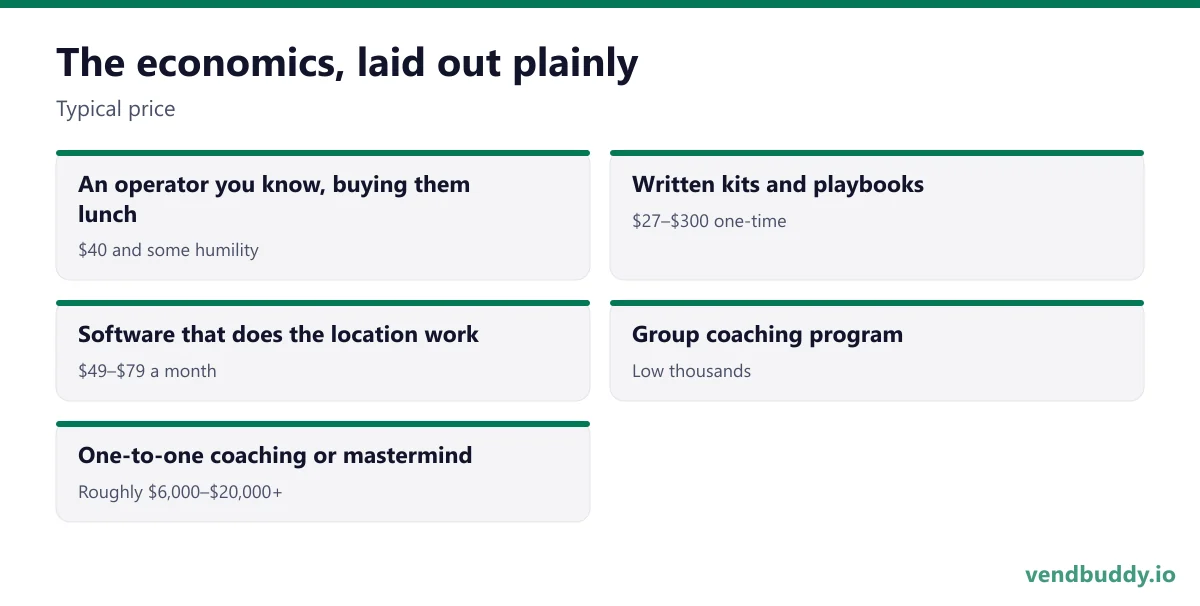
| What you buy | Typical price | What it gets you |
|---|---|---|
| An operator you know, buying them lunch | $40 and some humility | Local reality: who is servicing what, which buildings churn vendors, what commissions look like in your metro. Underrated. |
| Written kits and playbooks | $27–$300 one-time | The tactical layer in fill-in-the-blank form — scripts, checklists, agreements, distributor lists. |
| Software that does the location work | $49–$79 a month | Scored venues, the best contact on file, unit economics per site, pipeline. Cancellable. |
| Group coaching program | Low thousands | Course material plus a cohort and a weekly call. Quality varies enormously. |
| One-to-one coaching or mastermind | Roughly $6,000–$20,000+ | Real-time context on your situation, plus accountability. The two things worth paying for — at a price that assumes you will use them hard. |
Now put that next to what the same money buys in equipment. A used combination machine is $1,500 to $3,000, plus $150 to $500 freight and $200 to $400 for a first fill — call it $2,500 all in for a machine that is actually running. The full line-item budget is here.
So an $8,000 coaching engagement is three placed machines. A $15,000 program is five or six. At $150 to $400 net per machine per month, five machines is $750 to $2,000 a month in income, arriving whether or not you feel motivated that week.
That is the whole argument, and it is an argument about sequence rather than about coaches. The machines teach you the same lessons the coaching would have, more slowly and more expensively in emotional terms, while paying you. And after six months of owning them you can describe your actual problem in one sentence — at which point a coach becomes worth a great deal more to you, and you can afford one out of cash flow rather than out of savings.
The frame that makes this decision easy: what are you de-risking?
People buy coaching to reduce risk. That is the honest motive underneath, and it deserves respect rather than a lecture. So the useful question is: which risk, specifically?
- “I might pick a bad location.” This is the real risk in vending — the gap between a $180-a-month machine and a $900-a-month machine is the building, and nothing else comes close. It is also measurable in advance, with traffic, headcount, category and nearby alternatives. That is a data problem, and data problems are what software is for. Coaching is an expensive way to solve it.
- “I might overpay for a machine.” A fifteen-point inspection checklist solves this. It is here, free.
- “I might sign a bad agreement.” A template and knowing the four clauses that matter solves this. Here, free.
- “I might not do it at all.” This is the one coaching genuinely addresses, and if you know from experience that you do not act without external structure, that is worth real money. Be honest with yourself about which category you are in — but also notice that a cheaper form of the same medicine exists: a specific date in the calendar, told to somebody who will ask.
- “I do not know if this business is right for me at all.” Then do not buy coaching for it. The readiness quiz takes two minutes and is willing to tell you no, and the fit assessment is more useful than a discovery call with someone whose income depends on the answer being yes.
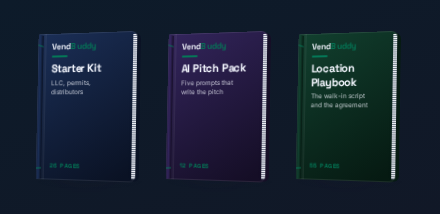
Everything above is free to read and free to do. The operator packs are the same material in fill-in-the-blank form — the 50-state distributor list, the LLC and permit checklist in unblocking order, the word-for-word walk-in script, and the placement agreement you hand a property manager. One-time purchase from $27, nothing renews.
See what is inside →When hiring a mentor is clearly the right call
To be fair to the good ones, here is when the answer is straightforwardly yes:
- You are past five machines and the route stopped scaling. Density, service time, driver economics and pricing all become genuinely non-obvious here, and the answers are situational. The written version is here, but this is the stage where a person who has done it earns their fee.
- You are buying an existing route. A five- or six-figure acquisition with information asymmetry against you is exactly where a few hours of experienced eyes pays for itself many times over. The due diligence checklist is here, and using it alongside somebody who has bought routes is better than either alone.
- You know, from evidence rather than self-criticism, that you do not act without accountability. If three previous projects died at the same stage, that is data. Buy the structure.
- The coach currently operates. Not “used to”, not “built a team”, not “teaches”. Operates now, in this market, with machines you could go and look at. The industry changed materially with cashless payments and telemetry, and advice from 2018 is a different business.
And the questions worth asking any program before you pay: how many machines do you personally run right now, may I speak to two clients who joined more than a year ago, is any part of this bundled with machine sales or a locating service, and what exactly are the refund terms in writing. A good coach answers all four without friction. The reaction to being asked tells you most of what you need to know.
The location work is the part people hire out, and it is a data problem rather than a wisdom problem. VendBuddy scores real venues near you by traffic, headcount and category, gives you the best contact on file for each, and models what a machine would net there before you commit — the same tactical layer a program charges five figures for, at $49 to $79 a month, cancellable. Start free with 5 credits, no card required.
The bottom line
Two valid paths, and this is not a trick where one of them is secretly bad.
Path one: hire someone excellent, use them hard, and pay for real-time context and accountability. Legitimate. Worth it if you are already executing, if they currently operate, and if you do the work between sessions. Expensive, and the expense is the point — it is what makes you show up.
Path two: spend the same money on machines and the tactical layer, get stuck on something real, and then buy a narrow answer to that specific thing from someone who has solved it. Slower to feel confident. Faster to have income. Roughly a hundredth of the price.
What would be a mistake is spending five figures to reduce the discomfort of step two, because step two is walking into buildings and being told no, and that discomfort is not for sale. It is just the entry fee, and it is the same entry fee for everyone including the person you would be paying.
Related reading: vending locator services reviewed, your first $100 in vending, is the vending business right for you, buying a vending route without getting burned, scaling past five machines, and franchise versus independent.
Frequently Asked Questions
Is it profitable to work with a business coach?
It can be, and the variable is almost entirely you rather than them. A coach produces a return when three things are true at once: you are already executing and stuck on a specific problem, the coach has done the actual thing recently, and you do the work between sessions. When any one of those is missing the fee buys clarity that evaporates. The honest way to test it is to price the outcome: if coaching costs $8,000 and a placed vending machine nets $200 to $400 a month, the coaching has to accelerate you by roughly two to three machines to break even, which is a real bar but not an absurd one.
You can run break-even on your own numbers in the revenue calculator instead of borrowing ours. It asks for property type and headcount, which is where nearly all of the difference comes from.
Should I hire a vending business mentor in 2026?
If you have already placed a machine and are stuck on something specific - a route that will not scale, a pricing problem, a negotiation with a national account - a mentor who operates now is genuinely valuable, because that is context no document contains. If you have not placed a machine yet, the honest answer is usually not yet. The starting sequence is not complicated enough to justify five figures, and the same tactical material exists in written and software form for a tiny fraction of the price. Start, get stuck on something real, then buy the answer to that.
How much does a vending machine business mentor cost?
The market spans an enormous range. Informal mentorship from a local operator is often free or costs a few hours of your labour. Structured group coaching programs commonly run in the low thousands. One-to-one business coaching and mastermind programs in the small-business space frequently run roughly $6,000 to $20,000 or more for a year, and high-ticket vending-specific programs sometimes sit at the top of that range or above it. Prices move constantly and are usually not published, so treat any figure you read as an order of magnitude rather than a quote.
What does a business coach actually do that a course does not?
Two things a document cannot do. First, real-time context: a coach can look at your specific building, your specific numbers and your specific stuck point and tell you what applies, which is different from reading general advice and guessing whether it fits. Second, accountability: a scheduled conversation with someone who will ask what you did creates a deadline, and deadlines are the actual reason many people move. Everything else a coach provides - scripts, templates, checklists, target lists, contract language - is information, and information has a market price far below a coaching fee.
Are vending machine mentorship programs a scam?
Most are not scams, and treating them that way is lazy. What is fair to say is that the pricing is often disconnected from the difficulty of what is being taught, and that the highest-priced programs frequently sell certainty rather than skill. The specific things to check: whether the person coaching currently operates machines or only teaches, whether any income claim is backed by something verifiable, whether the program bundles machine sales or locating services with the coaching, and whether the refund terms are written down. A locating service bundled into a mentorship is a separate transaction with its own well-documented failure modes.
Can I learn the vending business without paying for coaching?
Almost entirely, yes, and this is not a controversial claim within the industry. The tactical layer of vending - which buildings to target, what to say at the door, what belongs in a placement agreement, which machines to buy, what to stock, how to price - is documented publicly and comprehensively, and the parts that are not free cost tens of dollars rather than thousands. What you cannot get free is somebody looking at your specific situation and telling you what to do about it, which is exactly the narrow thing a good coach sells.
What should I spend my first $10,000 on in a vending business?
Two to four placed used machines, in almost every case. A used combination machine runs $1,500 to $3,000 plus freight and a first fill, so $10,000 realistically buys two comfortably or three lean, at locations you have measured. That produces $300 to $1,200 a month in net income and a set of real problems worth asking somebody about. The same $10,000 spent on coaching produces knowledge about machines you do not own, and the knowledge decays faster than the machines do.
What is selling, which buildings say yes, and the numbers before you buy a machine. Free, confirm from your inbox, unsubscribe in one click. Refer one friend and get 25 VendBuddy credits.
Every operator we talk to wants fewer cold calls. The ones who get there have a Google Business Profile and a simple site a manager can check before replying. AI builders make that an evening job now. Wix is the mature site builder; Base44 also builds working tools like a quote form. Start with the AI website walkthrough or Wix vs Base44.
General information, not legal, tax or financial advice. Rules change, so check the official source. Revenue and income figures are examples, not promises. See our terms.