- Mid-size museums, zoos and aquariums make steady vending locations. A nonprofit board or director has to approve, so pitch mission and guest comfort.
- Water, low-sugar drinks, fruit cups and granola bars lead. Match the machine to the lobby and keep it out of the galleries.
- VendBuddy data: 75 museums in our Places cache have a median of 2,793 Google reviews; 8 zoos have a median of 12,356.
- IMLS counted 35,144 US museums in 2014, including zoos, aquariums and gardens.
- Offer a flat fee or a share to an education program, and ask when the cafe closes.
Museum vending machines are a quiet, steady business if you can find the right building. Think of a school group of 90 kids arriving at ten, a gift shop with a short line, and a cafe that closes at three. A machine can pick up the water and snacks in the gaps. The one thing that decides it is the board: most museums are nonprofits, and a nonprofit board or director has to say yes, so your pitch needs to talk about mission and guest comfort, not just income.
Part of our complete guide: how to find vending machine locations.
That takes a little more patience than a gas station. It also gives you a location with long-term staying power. Museums rarely move, close seasonally or change owners, and a good relationship lasts for years.
Are museums good vending machine locations?
Yes, for the right size of building. Visits last one to four hours, families and school groups come in waves, and many visitors have traveled to get there. Zoos and aquariums, which we group with museums, are even better: they have walking, sun and long days.
The limits are the cafe and the rules. A museum with a full restaurant or a contracted caterer usually has an exclusive. Many also care about the look of their galleries and will not allow a machine anywhere visitors see it. And a nonprofit board often meets once a quarter, so decisions can take months.
Target the middle: a small or mid-size museum with a lobby, a basement break room or a school-group area, and no cafe, or a cafe with short hours. Those buildings need what you offer and have the least to lose.
Museums in VendBuddy's own data
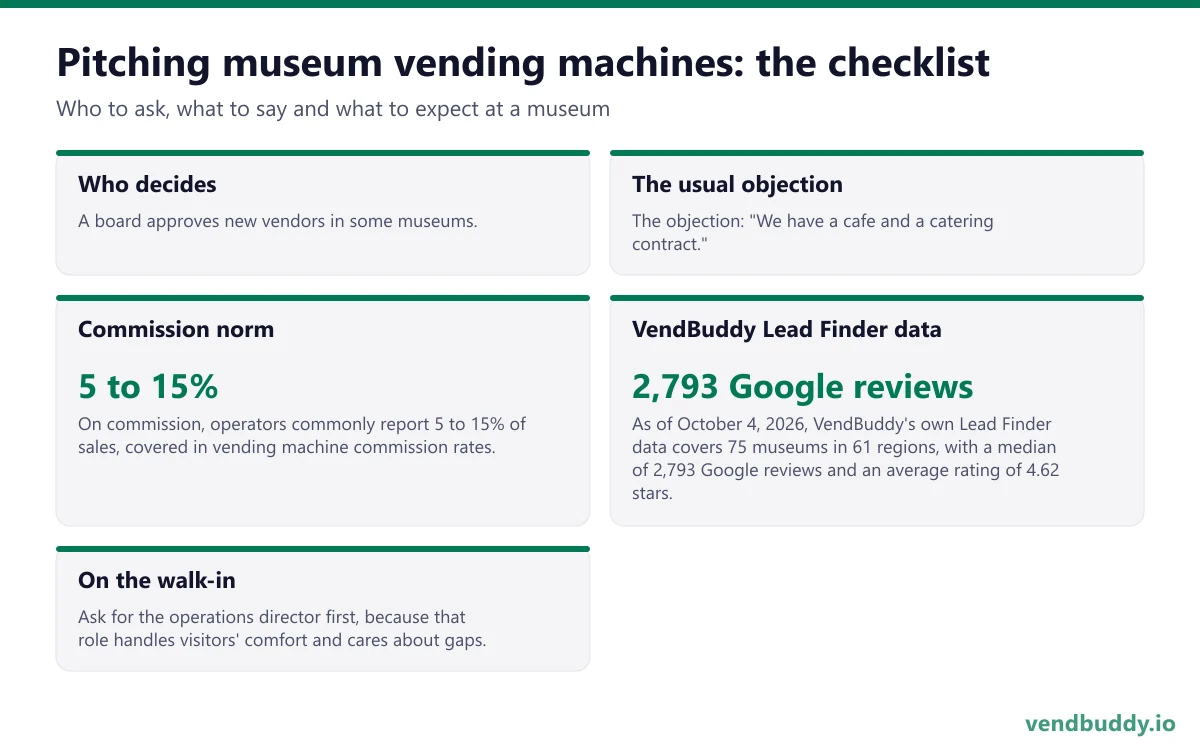
Museums did not show up as a filter in operator searches, so we have no search count to quote. What we have is the Places cache. As of October 4, 2026, VendBuddy's own Lead Finder data covers 75 museums in 61 regions, with a median of 2,793 Google reviews and an average rating of 4.62 stars. Zoos are fewer but busier: 8 zoos in 8 regions, with a median of 12,356 reviews and an average of 4.64 stars.
Those are big numbers. A median of 2,793 reviews means museums in our cache draw steady crowds. Lead Finder starts entertainment venues at a base location score of 72 out of 100 before it adjusts for each business's reviews, demographics and distance.
For scale, the federal Institute of Museum and Library Services counted 35,144 museums in the United States, a figure it published in 2014 that includes historical societies, zoos, aquariums, gardens and science centers (IMLS). It is the standing federal count, though it dates from 2014, and more than a third of those are small history organizations that have no crowd to speak of.
Picture the machines paying you while you sleep
That’s the real promise of vending — income that doesn’t cost you your time, and a life on your own terms. VendBuddy turns this guide into a step-by-step plan so you actually build it instead of just reading about it. Start free today.
Start building free →How a museum runs
Weekdays belong to school groups, tour buses and retirees. Weekends belong to families. Special exhibits, summer camps and holiday weeks bring spikes. Most museums close one day a week, often Monday.
What people already buy is a ticket, a gift shop item and maybe a coffee or a lunch. What competes is the cafe, the gift shop, and the free drinking fountain. Many museums also run vending themselves through a food-service contractor, so ask who holds the current contract before you pitch.
Nonprofit rules matter in two ways. Boards want to see community benefit and a signed agreement with insurance. And school groups mean health-conscious buyers: teachers and parents prefer water, fruit and low-sugar snacks. Some states also set nutrition rules for what students can buy, so check if your museum runs school programs. Read can you put a vending machine anywhere for how permission works.
The rows that sell at a museum
Choose a clean, quiet, modern unit that matches the lobby. A smart fridge or glass-front combo fits a museum better than a loud, bright older unit. Place it in a lobby, a cafeteria alcove or a school-group room, not in a gallery.
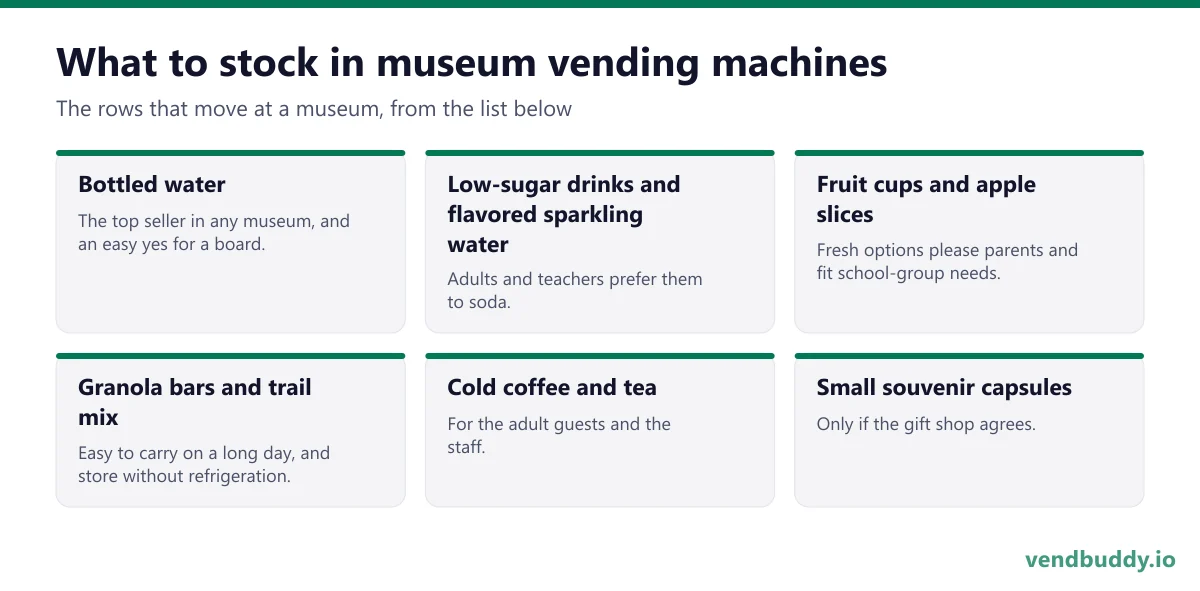
- Bottled water. The top seller in any museum, and an easy yes for a board.
- Low-sugar drinks and flavored sparkling water. Adults and teachers prefer them to soda.
- Fruit cups and apple slices. Fresh options please parents and fit school-group needs.
- Granola bars and trail mix. Easy to carry on a long day, and store without refrigeration. See vending machine snacks for brands that move.
- Cold coffee and tea. For the adult guests and the staff.
- Small souvenir capsules. Only if the gift shop agrees. Kids love them and the museum may like the extra stop.
Keep the packaging neat and the prices fair. A museum is a place people expect to be a little more expensive, but a $4 bottle of water will lose goodwill fast.
Pitching the museum: the opener and the objection
The decision-maker is usually the executive director, the operations director or the facilities manager. A board approves new vendors in some museums. Lead Finder lists contacts for museums when we can find them. Ask for the operations director first, because that role handles visitors' comfort and cares about gaps.
A two-sentence opener: "I supply healthy vending that I stock and service myself, and I share a percentage with the museum, so you get a new income line without any extra staff work. Your school groups and visitors have no way to buy water after the cafe closes, and I would like to fix that."
The objection: "We have a cafe and a catering contract." Answer by asking about the cafe's hours and by offering a machine for those hours only. You can also offer to give a portion of proceeds to an education program, which fits a nonprofit's mission and gives a board something to like.
On commission, operators commonly report 5 to 15% of sales, covered in vending machine commission rates. A nonprofit may prefer a flat monthly fee, which is easier to put in a budget. Test both in the vending ROI calculator.
On the walk-in, check three things: when the cafe closes, where school groups gather, and whether there is a power outlet in a spot out of the galleries. Ask for the date of the next board meeting.
How to find museums, zoos and aquariums near you
Use Find museums, zoos and aquariums near you in Lead Finder. It lists museums, zoos and aquariums by ZIP and radius, with contacts where we have them and a score.
The free route: search Google Maps for "museum near me", "children's museum", "science center" and "aquarium". Read the reviews for "school trip", "line" and "no food". Reviews that complain about not finding water are your best leads. Then do the drive-by test on a weekday morning. Look for school buses in the lot.
Lead Finder adds the owner or director contact, a location score and a radius filter. For the full method, see how to find vending locations.
Start with the mid-size museum
One museum with school groups and a short-hours cafe is a strong first location. Find museums, zoos and aquariums near you in Lead Finder, pick two in your area, and send a one-page proposal ahead of the next board meeting.
Frequently Asked Questions
Are museums good vending machine locations?
Yes, for mid-size museums, zoos and aquariums with school groups and a cafe that closes early. Visits last one to four hours and guests need water. A nonprofit board or director must approve, so decisions can take months.
What sells best in a museum vending machine?
Bottled water leads. Low-sugar drinks, fruit cups, granola bars and trail mix follow, since school groups and parents prefer healthier choices. Add cold coffee for adults. Keep the machine quiet and out of the galleries.
How much commission does a museum expect?
Operators commonly report 5 to 15% of sales. Many nonprofits prefer a flat monthly fee for budgeting, or a share that goes to an education program. Test both in the ROI calculator.
What if a museum already has a cafe or catering contract?
Ask about the contract terms and the cafe hours. Many contracts leave out after-hours or school-group areas. Offer a machine for those hours only, and keep it away from the cafe entrance.
What is selling, which buildings say yes, and the numbers before you buy a machine. Free, confirm from your inbox, unsubscribe in one click. Refer one friend and get 25 VendBuddy credits.
Every operator we talk to wants fewer cold calls. The ones who get there have a Google Business Profile and a simple site a manager can check before replying. AI builders make that an evening job now. Wix is the mature site builder; Base44 also builds working tools like a quote form. Start with the AI website walkthrough or Wix vs Base44.
General information, not legal, tax or financial advice. Rules change, so check the official source. Revenue and income figures are examples, not promises. See our terms.